Vitalik Buterin Outlines Ethereum’s AI Vision As Alternative To The Race For AGI

bitcoinistPublished on 2026-02-10Last updated on 2026-02-10

Abstract

Vitalik Buterin challenges the mainstream AI industry's focus on the race toward artificial general intelligence (AGI), proposing instead for Ethereum to serve as decentralized infrastructure for more private, verifiable, and economically coordinated AI systems. He emphasizes privacy through local AI tooling and zero-knowledge payments, client-side verification, and cryptographic proofs to allow secure and anonymous AI interactions. Buterin also envisions Ethereum as an economic layer for AI-to-AI transactions and smart contract-based coordination. Additionally, he suggests AI could assist in improving decentralized governance and market mechanisms, offering an alternative path focused on safety and practical integration rather than accelerated AGI development.

Vitalik Buterin is pushing back against the dominant narrative shaping today’s artificial intelligence industry. As major AI labs frame progress as a competitive sprint toward artificial general intelligence (AGI), the Ethereum co-founder argues that the premise itself is flawed.

In a series of recent posts and comments, Buterin outlined a different approach, one that prioritizes decentralization, privacy, and verification over scale and speed, with Ethereum positioned as a key piece of enabling infrastructure rather than a vehicle for AGI acceleration.

Buterin likens the phrase “working on AGI” to describing Ethereum as simply “working in finance” or “working on computing.” In his view, such framing obscures questions about direction, values, and risk.
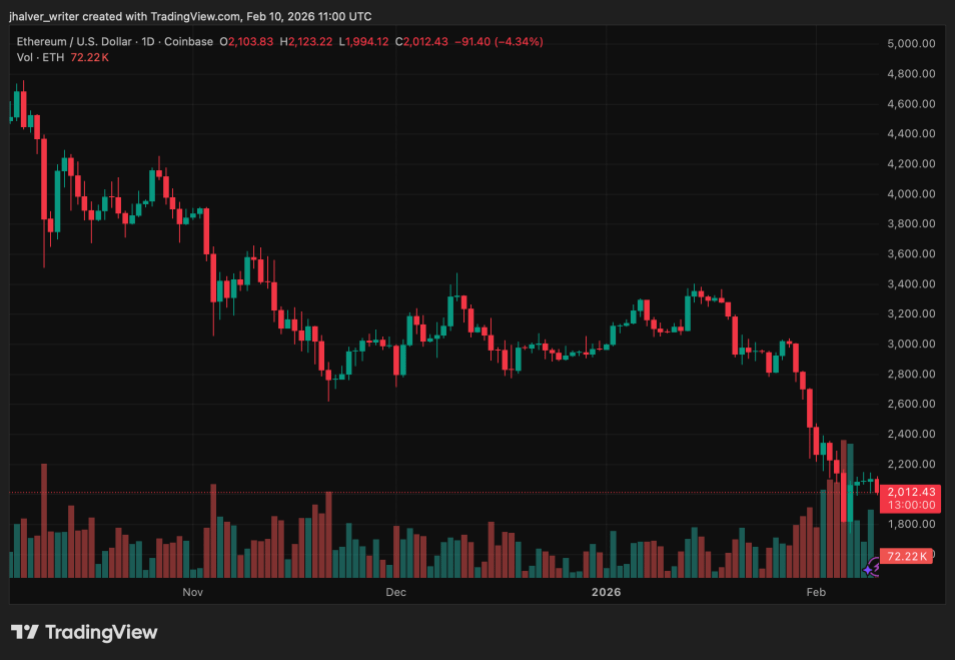
ETH's price trends to the downside on the daily chart. Source: ETHUSD on Tradingview

Ethereum as Infrastructure for Private and Verifiable AI

A central theme in Buterin’s vision is privacy-preserving interaction with AI systems. He points to growing concerns around data leakage and identity exposure from large language models, especially as AI tools become more embedded in daily decision-making.

To address this, Buterin proposes local LLM tooling that allows AI models to run on user devices, alongside zero-knowledge payment systems that enable anonymous API calls. These tools would make it possible to use remote AI services without linking requests to persistent identities.

He also highlights the importance of client-side verification, cryptographic proofs, and Trusted Execution Environment (TEE) attestations to ensure AI outputs can be checked rather than blindly trusted.

This approach reflects a broader “don’t trust, verify” ethos, with AI systems assisting users in auditing smart contracts, interpreting formal proofs, and validating onchain activity.

An Economic Layer for AI-to-AI Coordination

Beyond privacy, Buterin sees Ethereum playing a role as an economic coordination layer for autonomous AI agents. In this model, AI systems could pay each other for services, post security deposits, and resolve disputes using smart contracts rather than centralized platforms.

Use cases include bot-to-bot hiring, API payments, and reputation systems backed by proposed ERC standards such as ERC-8004. Supporters argue that these mechanisms could enable decentralized agent markets where coordination emerges from programmable incentives instead of institutional control.

Buterin has stressed that this economic layer would likely operate on rollups and application-specific layer-2 networks, rather than Ethereum’s base layer.

AI-Assisted Governance and Market Design

The final pillar of Buterin’s framework focuses on governance and market mechanisms that have historically struggled due to human attention limits.

Prediction markets, quadratic voting, and decentralized governance systems often falter at scale. Buterin believes LLMs could help process complexity, aggregate information, and support decision-making without removing human oversight.

Rather than racing toward AGI, Buterin’s vision frames Ethereum as a tool for shaping how AI integrates with society. The emphasis is on coordination, safeguards, and practical infrastructure, an alternative path that challenges the prevailing acceleration-first mindset.

Cover image from ChatGPT, ETHUSD chart on Tradingview

Related Questions

QWhat is Vitalik Buterin's main criticism of the current AI industry's direction?

AVitalik Buterin criticizes the dominant narrative of a competitive sprint toward artificial general intelligence (AGI), arguing that this premise is flawed as it obscures questions about direction, values, and risk.

QHow does Buterin propose to address privacy concerns in AI interactions?

AButerin proposes local LLM tooling for running AI models on user devices, zero-knowledge payment systems for anonymous API calls, and the use of client-side verification, cryptographic proofs, and TEE attestations to ensure privacy and verifiability.

QWhat role does Ethereum play in Buterin's vision for AI-to-AI coordination?

AEthereum serves as an economic coordination layer where AI agents can pay each other for services, post security deposits, and resolve disputes using smart contracts, enabling decentralized agent markets on rollups and layer-2 networks.

QHow does Buterin suggest AI could assist in governance and market design?

AButerin suggests that LLMs could help process complexity, aggregate information, and support decision-making in systems like prediction markets and quadratic voting, addressing human attention limits without removing oversight.

QWhat is the core alternative Buterin presents to the 'race for AGI'?

AButerin presents an alternative focused on decentralization, privacy, verification, and practical infrastructure, using Ethereum to shape AI integration with society through coordination and safeguards rather than acceleration toward AGI.

Related Reads

Apple's Desired On-Device AI Sees a Dark Horse Emerge: The First Cognitive Model is Born, 4B Matches GPT-5.4

A Chinese company, Tomorrow's Journey (Nextie), has introduced what it is calling the industry's first "cognitive model" for edge devices. Named New Journey Alpha, this 4-billion-parameter model reportedly matches the performance of trillion-parameter giants like GPT-5.4 in group intelligence tasks such as debate and collective decision-making. The development follows Andrej Karpathy's vision of stripping vast factual knowledge from large language models to retain only a smaller "cognitive core" capable of reasoning, planning, and knowing its own limits. This approach directly addresses the soaring computational costs and token expenses hindering AI's widespread deployment, as highlighted by incidents like Amazon shutting down an internal AI tool due to prohibitive costs. Trained via reinforcement learning on a corpus of academic papers from 1800-2020 to enhance generalization, the model enables three key advancements: 1) Improved decision quality in multi-agent systems, 2) Drastically reduced compute costs, allowing for cost-effective cloud or on-device (e.g., MacBook) deployment, and 3) The feasibility of "proactive" AI agents that act autonomously without user prompts, unlocking new commercial possibilities beyond today's reactive models. Built by the former Microsoft Xiaoice team—known for creating a 3.6B model that outperformed a 65B Llama model—the company is now focusing on the multi-agent systems sector, a field gaining significant investor interest. The model's economic impact is profound; by achieving high-level performance with minimal parameters, it fundamentally alters the cost structure of AI services, challenging the prevailing model of ever-larger parameter counts.

marsbit46m ago

Apple's Desired On-Device AI Sees a Dark Horse Emerge: The First Cognitive Model is Born, 4B Matches GPT-5.4

marsbit46m ago

OpenAI's 'Blueprint for the Future': Making AI Beneficial for Every Person on the Planet

A new transformative technology emerges every few generations. OpenAI draws a parallel with the advent of electricity in the 1920s, which initially brought convenience but ultimately enabled unprecedented progress in medicine, engineering, and living standards by empowering people to create new possibilities. AI is poised to recreate this phenomenon. Its true significance lies not in the technology itself, but in what people can achieve with it—from understanding a medical bill or starting a business to aiding scientific discovery. OpenAI believes AI should be universally accessible, allowing everyone to use it according to their own needs. This future, however, is not guaranteed. While transformative tech can centralize power, OpenAI's philosophy is that AI must serve humanity, augmenting human capabilities and broadly distributing its benefits. The company's first commitment is to build AI for human service, aiming to empower the many rather than concentrate power in a few. Safety, alignment with human intent, and oversight are paramount. OpenAI is optimistic about AI's potential to expand human welfare but remains clear-eyed about risks. The goal is to help people achieve more, not to replace them. Full automation is not the desired future; human judgment, values, and direction will become even more critical. OpenAI outlines three core goals: 1. Build automated AI researchers to accelerate and increasingly automate the research process itself, maintaining close human collaboration. The internal projection is that by March 2028, a significant portion of their research will be conducted by AI systems working alongside human researchers. 2. Accelerate economic development by advancing science, boosting productivity, and fostering growth, while ensuring the fruits are widely shared. 3. Provide a personal AGI for everyone on Earth, allowing individuals to benefit from this transformative technology in their own way. The company is entering its third phase, moving from foundational AGI research (Phase 1) to product deployment and learning from real-world use (Phase 2). The current challenge is making advanced AI abundant, affordable, safe, practical, and usable for all individuals and organizations. OpenAI concludes that a widely distributed power structure leads to a more resilient, adaptable, and free society. A positive AI future should not be controlled by a handful of entities but built, benefited from, and owned by many. If realized correctly, AI can become a cornerstone for enhancing global productivity, creativity, scientific advancement, and economic opportunity, fulfilling the mission to ensure AGI benefits all of humanity.

marsbit1h ago

OpenAI's 'Blueprint for the Future': Making AI Beneficial for Every Person on the Planet

marsbit1h ago

Arthur Hayes' New Article: AI Bubble Nears Bursting, Crypto Market Faces Short-Term Pressure

In a new essay, Arthur Hayes argues that the AI market bubble is approaching a rupture, which will place significant short-term pressure on crypto assets. He identifies rising oil prices, a trio of massive tech IPOs (SpaceX, Anthropic, OpenAI), and potential anti-AI political rhetoric from Trump as the three key catalysts for a correction. Hayes posits that the prolonged blockage of the Strait of Hormuz will drive energy prices higher, increasing operational costs for data centers and squeezing AI company profits. Simultaneously, the market may struggle to absorb the upcoming wave of multi-trillion dollar tech IPOs. Furthermore, with high inflation hurting his election chances, Trump could pivot to attacking the AI sector with proposals for heavy taxation and regulation to win over voters, spooking the market. Hayes notes that nearly all new dollar liquidity since 2022 has flowed into the AI sector, leaving little for Bitcoin, explaining its recent underperformance. He believes an AI stock crash would trigger a broad risk-off sentiment and credit contraction, dragging down crypto in the near term. Consequently, his fund, Maelstrom, has sold all AI-related stocks and non-core cryptocurrencies, retaining only Bitcoin and Ethereum while building positions in traditional energy stocks. He anticipates Bitcoin will bottom and resume its bull run only after the AI bubble pops and a new monetary easing cycle begins.

marsbit1h ago

Arthur Hayes' New Article: AI Bubble Nears Bursting, Crypto Market Faces Short-Term Pressure

marsbit1h ago

Trading

Spot
Futures

Hot Articles

Discussions

Welcome to the HTX Community. Here, you can stay informed about the latest platform developments and gain access to professional market insights. Users' opinions on the price of S (S) are presented below.

活动图片
















