VIRTUAL surges 12% as bulls align – But downside risk still lurks

ambcryptoPublished on 2026-03-17Last updated on 2026-03-17

Abstract

VIRTUAL surged 12% in 24 hours, driven by strong bullish sentiment across both spot and futures markets. Futures activity showed a positive funding rate of 0.0022%, with $12 million inflows boosting open interest to $102.42 million, indicating dominant long positioning. Spot market demand also accelerated sharply, with net purchases rising nearly tenfold from $72,000 to $697,140 within a day, reflecting growing investor confidence. However, liquidity clusters above and below the current price suggest potential downside risk, making near-term price direction dependent on sustained momentum.

VIRTUAL continues to gain strength as market sentiment shifts decisively in its favor. The asset recorded a 12% increase over the past 24 hours, reflecting growing bullish positioning.

AMBCrypto’s analysis highlights a rare alignment between Spot and Futures markets, with participants across both segments actively accumulating the asset.

Futures market drives capital inflow

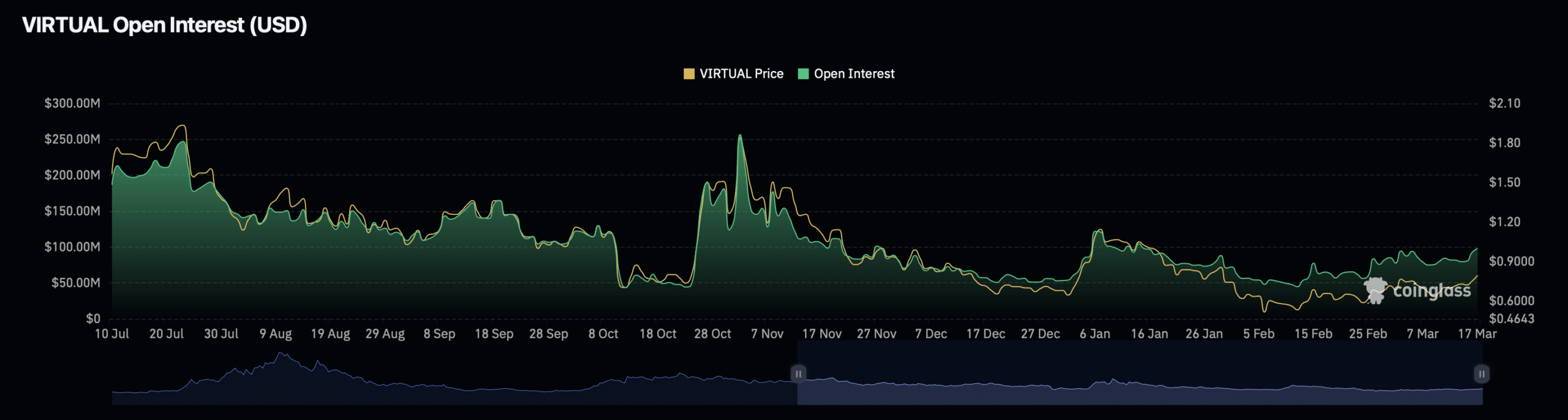
The recent surge in Virtual [VIRTUAL] has been largely fueled by bullish activity in the Futures market. This bias is reinforced by a positive Funding Rate of 0.0022%, indicating that long traders are paying a premium to maintain their positions.

In effect, long positions dominate capital flows into VIRTUAL contracts, signaling strong expectations of continued upside.
Source: CoinGlass

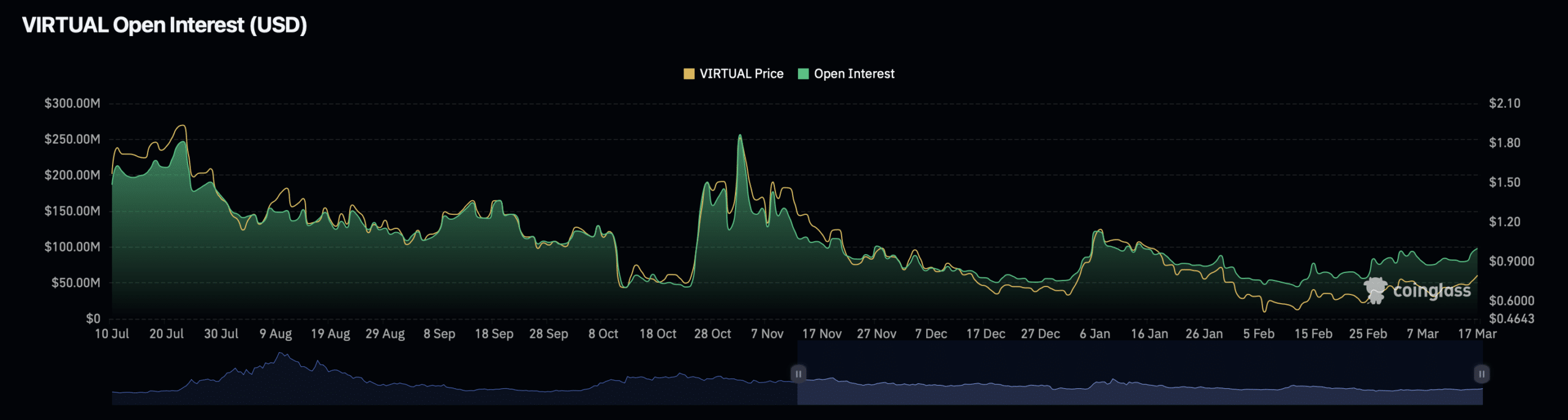
Within the last 24 hours, capital inflows totaled $12 million, pushing Open Interest to $102.42 million. This sharp increase reflects rising participation and conviction among derivatives traders.

With most of this capital concentrated in long positions, bullish momentum remains firmly intact—at least in the short term.

Spot demand strengthens conviction

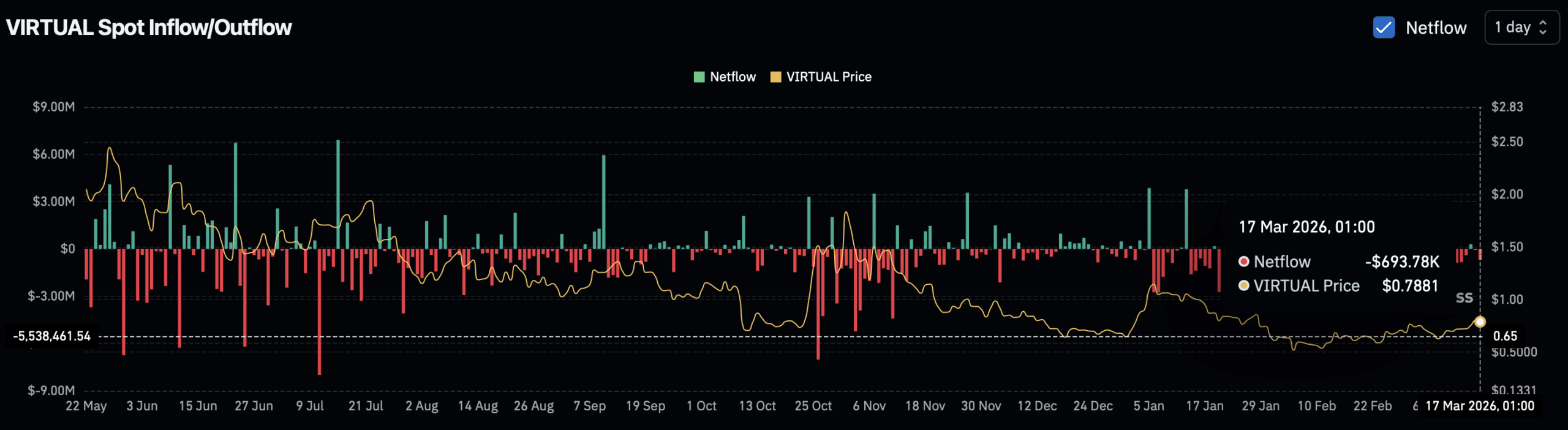
Spot market activity has also accelerated, reinforcing the broader bullish outlook. Accumulation began modestly on the 16th of March, with net inflows of just $72,000, according to CoinGlass data.

However, this quickly scaled. By the 17th of March, total purchases surged to $697,140—nearly ten times the previous day’s volume.
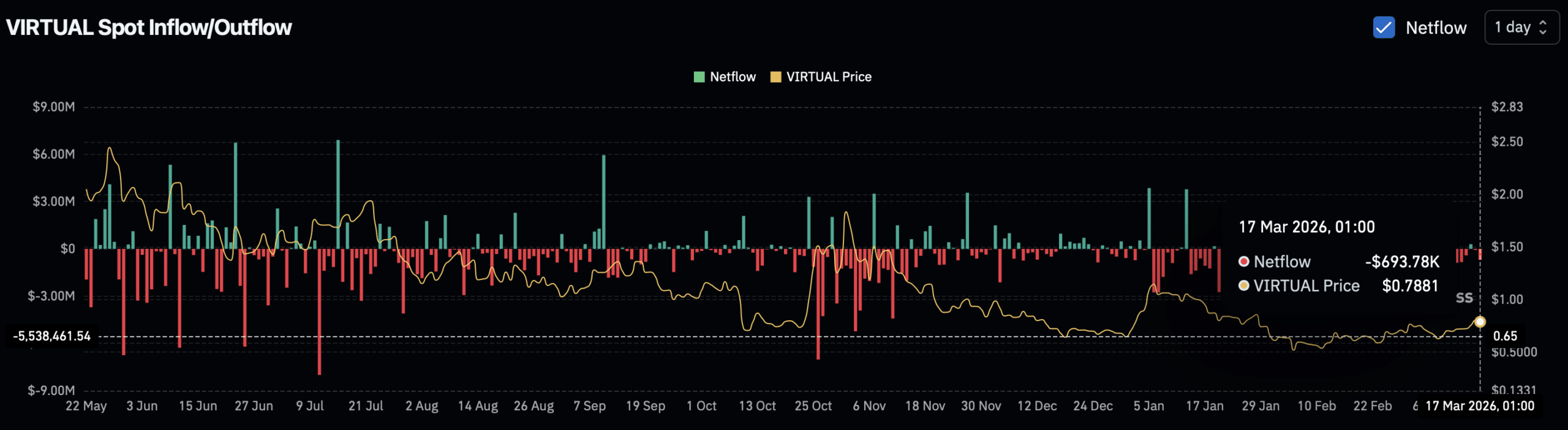
Source: CoinGlass

This sharp increase signals renewed investor confidence. When capital inflows expand at this pace, it typically reflects stronger conviction and a growing expectation of sustained price appreciation.

If this level of demand persists, it could provide the structural support needed to extend the rally. A slowdown, however, would weaken that foundation and expose the asset to downside pressure.

Liquidity clusters leave direction open

Despite the bullish buildup, liquidation data suggests the next move is not yet fully determined.

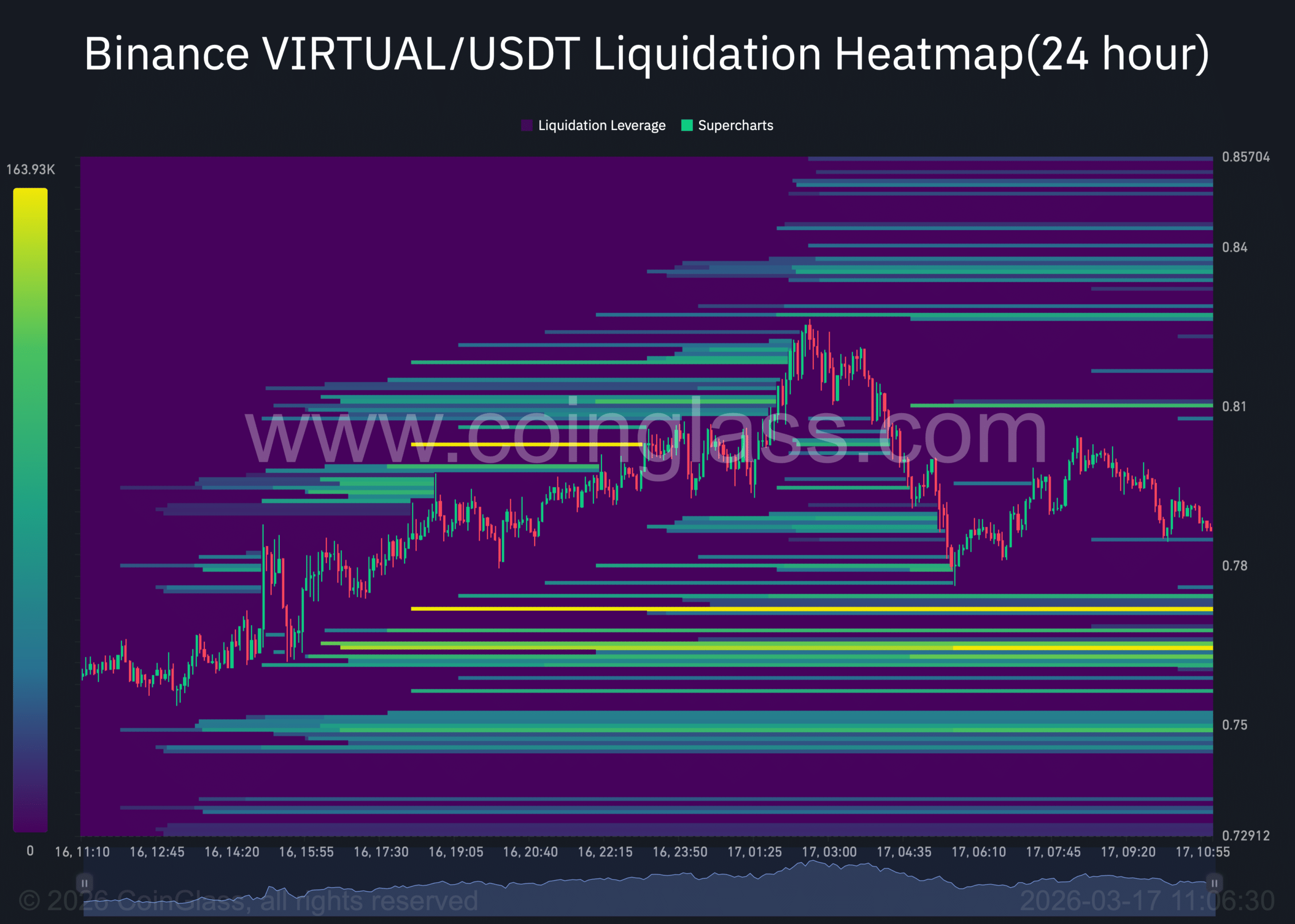
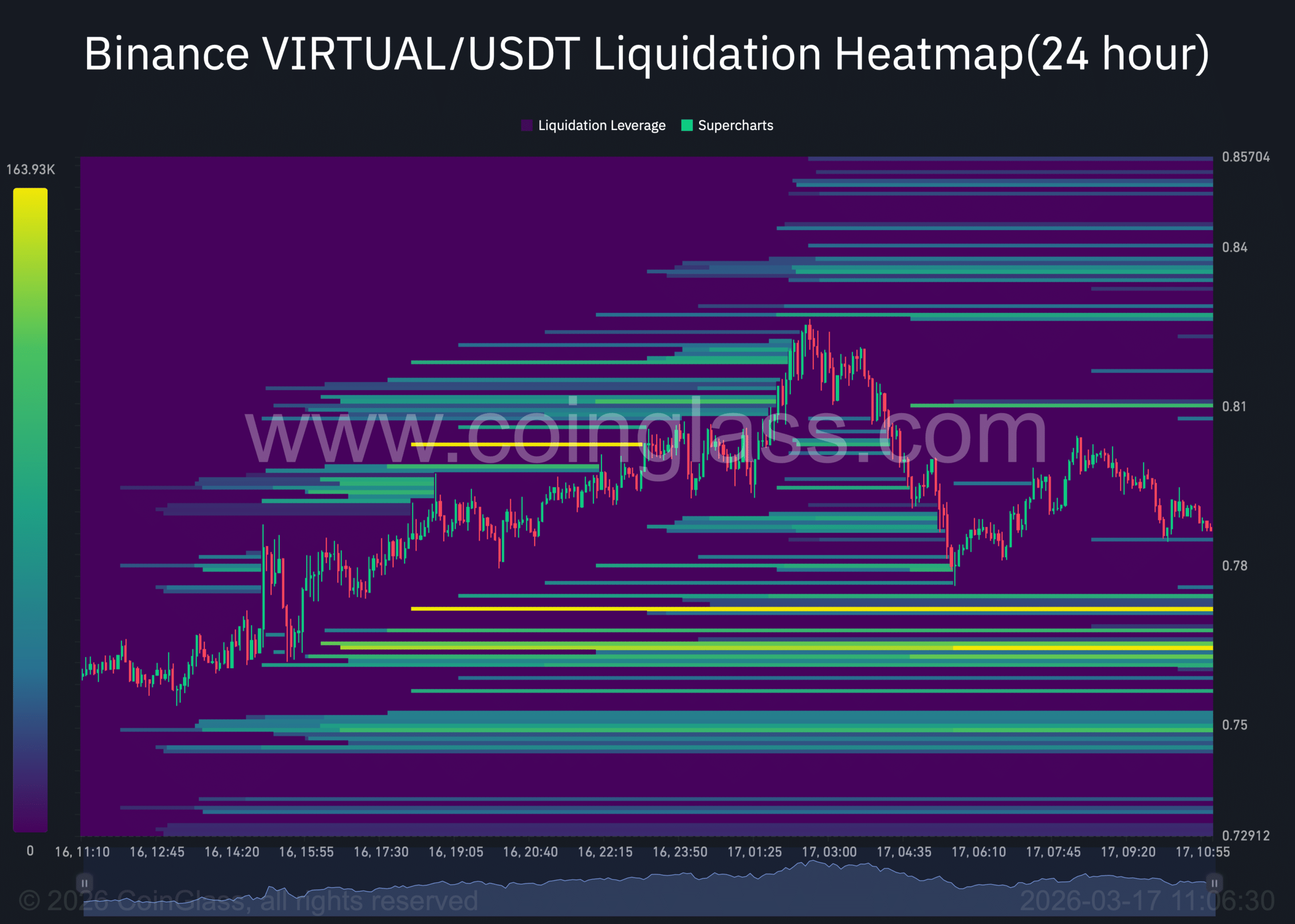
The heatmap shows liquidity clusters both above and below the current price. These clusters—visible as dense shaded zones—tend to attract price action.
Source: CoinGlass

While liquidity remains split, the clusters below price appear more concentrated, suggesting stronger downside pull.

This creates a balanced but fragile setup. As a result, the next phase of price action will depend heavily on momentum, with VIRTUAL likely to move toward the dominant liquidity zone in the near term.


Final Summary

  • VIRTUAL’s price rally and capital inflows were driven primarily by long traders in the perpetual market.
  • Spot investors intensified accumulation, with purchases rising nearly tenfold day-over-day.

Related Reads

No Sales Team, $20 Million in Revenue: How Did AI Employee Viktor Win Over 30,000 Companies?

The AI employee Viktor, developed by a team with DeepMind background, has achieved $20 million in annual revenue without a traditional sales team, serving over 30,000 companies. Its core innovation lies in positioning itself as a "Tier 3 AI Coworker" capable of "end-to-end execution and delivery of results," moving beyond the "draft and wait for human completion" model of typical AI assistants. Users can simply mention Viktor in Slack or Microsoft Teams using natural language commands, and it autonomously performs tasks like pulling sales data from a CRM, generating reports, or even cross-tool operations like creating board meeting PPTs by aggregating data from six different sources. Key to its growth is a pure Product-Led Growth (PLG) model, eliminating complex implementation cycles and per-seat licensing. Instead, it charges based on task credits or consumption, lowering the trial barrier with a $100 free credit offer and no credit card required. This enabled viral, bottom-up adoption within organizations. Viktor's interaction paradigm removes the barrier of prompt engineering, allowing non-technical employees to delegate complex workflows seamlessly. It also features proactive, automated task execution (e.g., overnight bookkeeping, scheduled reports) based on triggers, effectively embedding AI as an automated "process layer" within business operations. However, its expansion into Microsoft Teams—a platform with 320 million users—highlights challenges. Large enterprises require stringent IT compliance, security reviews (e.g., SOC 2), and governance, potentially hindering the frictionless, user-driven adoption that succeeded in Slack. Additionally, the "black box" nature of its autonomous decision-making raises concerns about operational risks, data integrity, and the need for robust audit logs and permission controls. Balancing efficiency gains with security and trust remains a critical hurdle for Viktor and similar AI agents aiming to become core enterprise infrastructure.

marsbit1h ago

No Sales Team, $20 Million in Revenue: How Did AI Employee Viktor Win Over 30,000 Companies?

marsbit1h ago

Trading

Spot
Futures
活动图片