VELVET slides 18% – But key data points to consolidation, not sell-off

ambcryptoPublished on 2026-07-16Last updated on 2026-07-16

Abstract

Velvet (VELVET) has dropped approximately 18% in the last day, though it retains its position as a top market performer with a 571% gain over the past 90 days. Analysis of its perpetual futures market shows a $24 million capital outflow over two weeks, indicating profit-taking and capital flight. However, despite this exodus, a positive funding rate suggests long positions remain in control, pointing to underlying bullish sentiment among traders. The price decline is thus interpreted more as a consolidation phase following massive gains rather than a bearish reversal. The token's immediate direction hinges on a key ascending support line; a hold could spark a rebound, while a break may see a test of the $0.45 demand zone.

Velvet [VELVET] has emerged as one of the market’s heaviest losers over the past day, sliding roughly 18% across the session as sellers took control.

Despite the recent pullback, Velvet has held its position as one of the strongest gainers across the market over the past couple of months.

Over the last 90 days alone, the token has outpaced every asset in the top 100 by market capitalization, posting a 571% gain that edged out the next-best performer, Audiera [BEAT], which surged 530% over the same stretch.

Leveraged capital exits Velvet’s Futures market

A leading concern now weighing on Velvet is the capital exodus spreading across its market. The token’s perpetual Futures market shows heavier outflows than inflows, a sign that money is leaving rather than entering.

Capital draining from a market typically signals that investors are pulling their funds out, a move that often reflects bearish sentiment. Roughly $24 million has flowed out of the perpetual market over the past two weeks, pointing to investors heading for the exits.
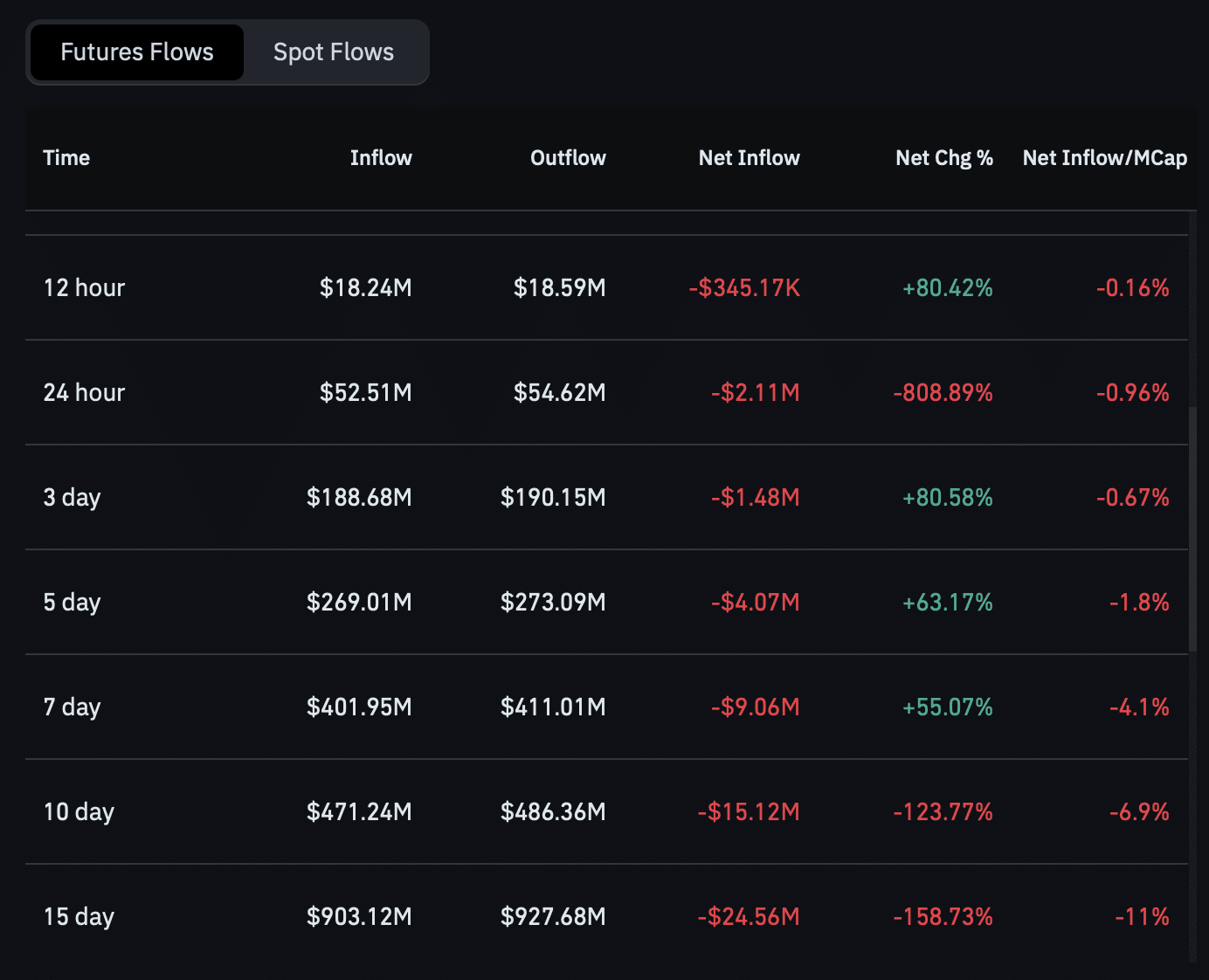
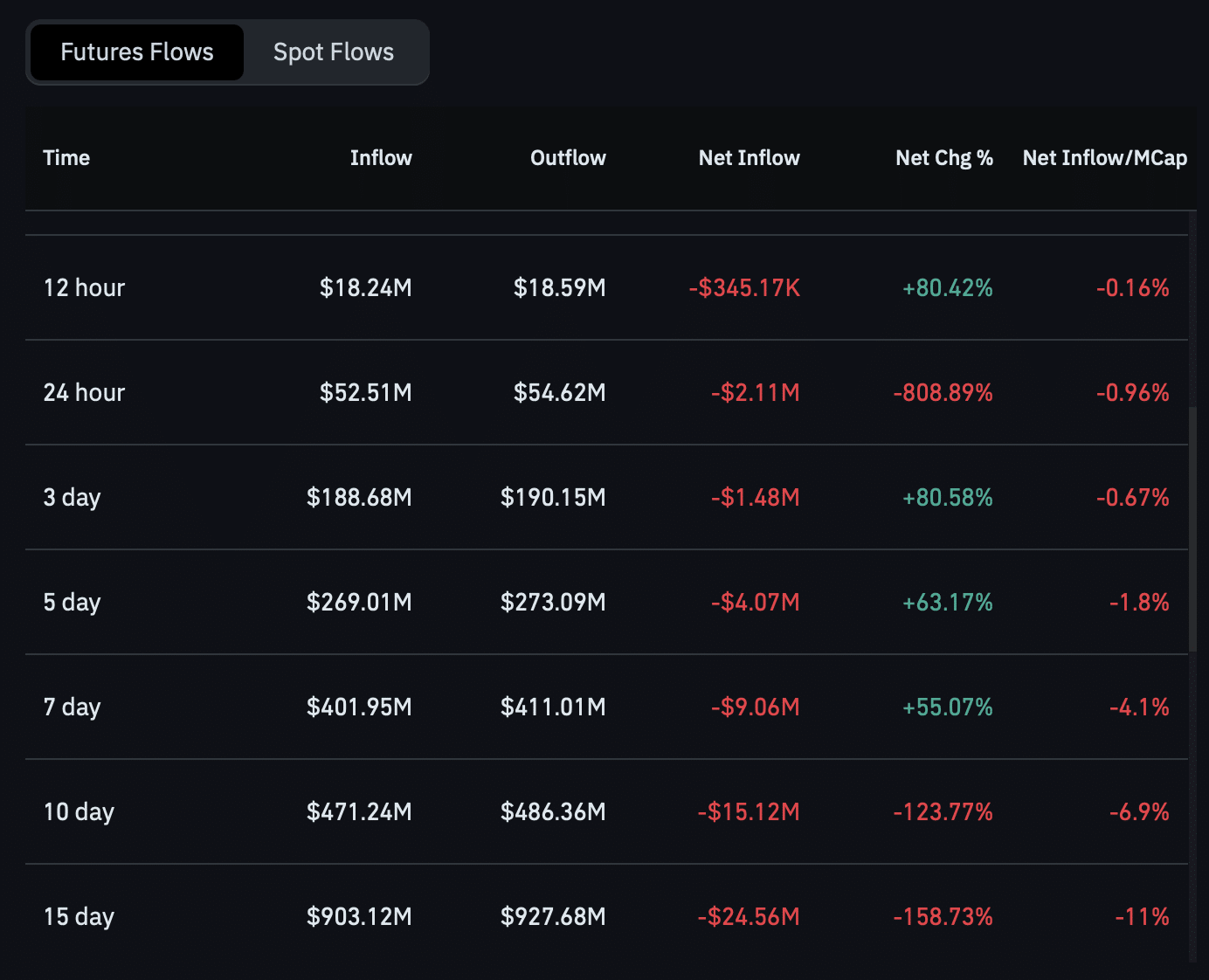
Source: Coinglass

Rising prices usually breed confidence and draw fresh capital into a market, yet Velvet has seen the opposite, with profit-taking and capital flight dominating the flows and underscoring the prevailing sentiment.

Spot market investors have failed to keep pace with the move, buying comparatively little VELVET over the same window. The chart shows a total Spot netflow of roughly $847,000.

Spot buying of that scale rarely fuels a rally on its own, leaving little chance that price mounts a meaningful move to the upside off the back of it.

Why Velvet’s decline isn’t bearish control

On the surface, Velvet’s slide and the capital retreat from its perpetual market look like bearish dominance, yet the data underneath tells a more nuanced story.

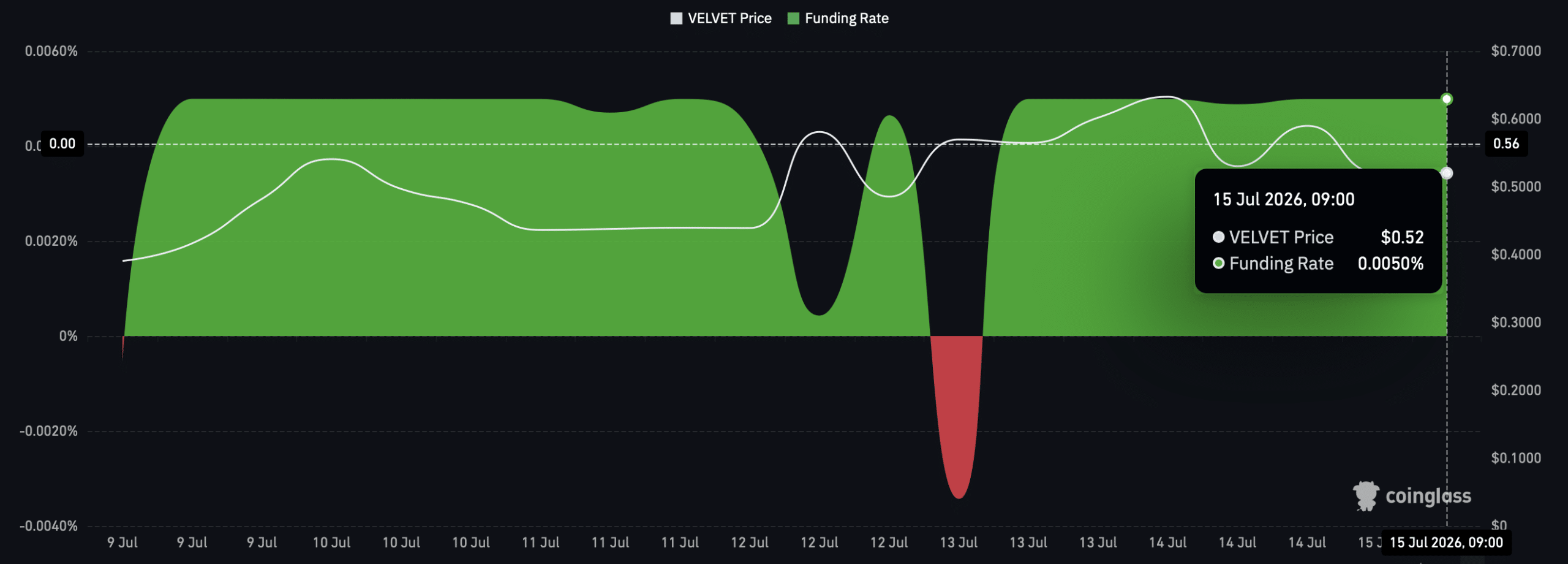
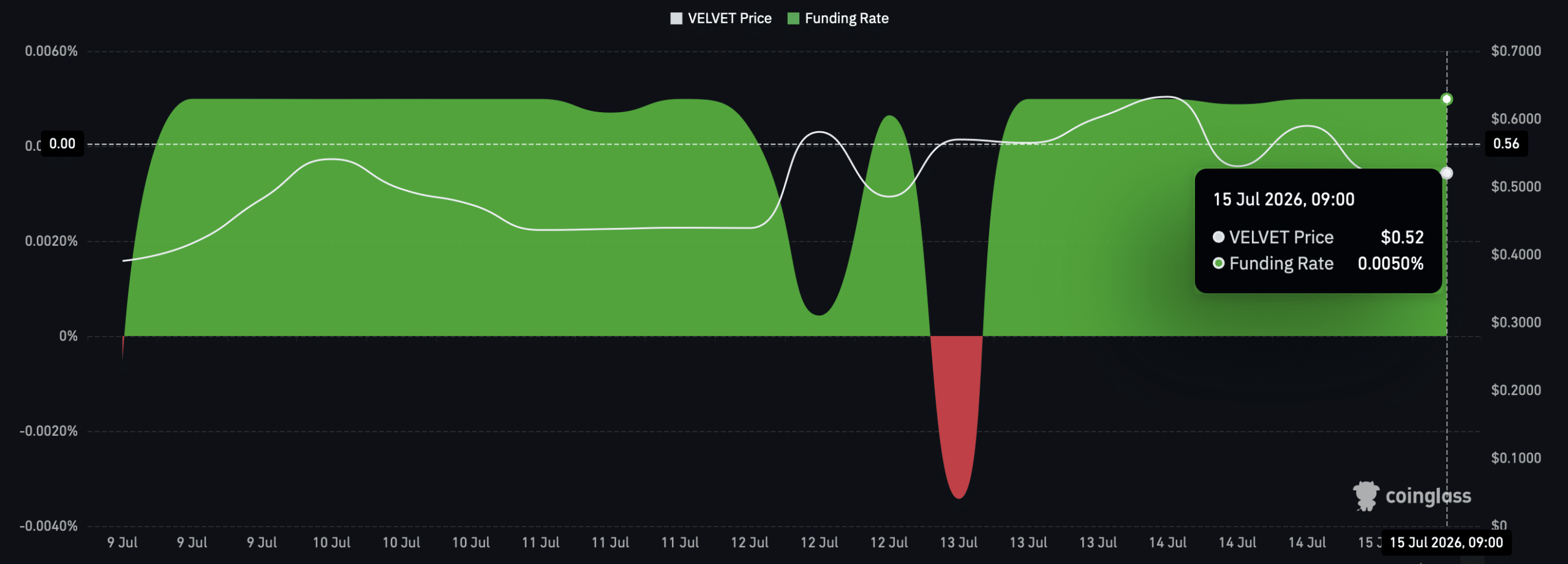
Chart data shows that even as capital exits mounted over the past two weeks, traders in Velvet’s perpetual market have clung to a bullish outlook.

Funding Rate data, which reveals which side of the market holds control based on who pays the funding fee, shows that longs have stayed in command.
Source: Coinglass

Despite the $2.17 million net outflow recorded over the past 24 hours, the Funding Rate reached 0.0044%, suggesting that the $27.87 million perpetual market balance still sits largely in long positions.

One side, long or short, typically takes command when strong conviction builds that price will swing higher over the short to near term.

In this case, the sentiment holds that Velvet’s decline looks more like consolidation and capital management from traders who have banked massive gains.

This hangs on one key support level

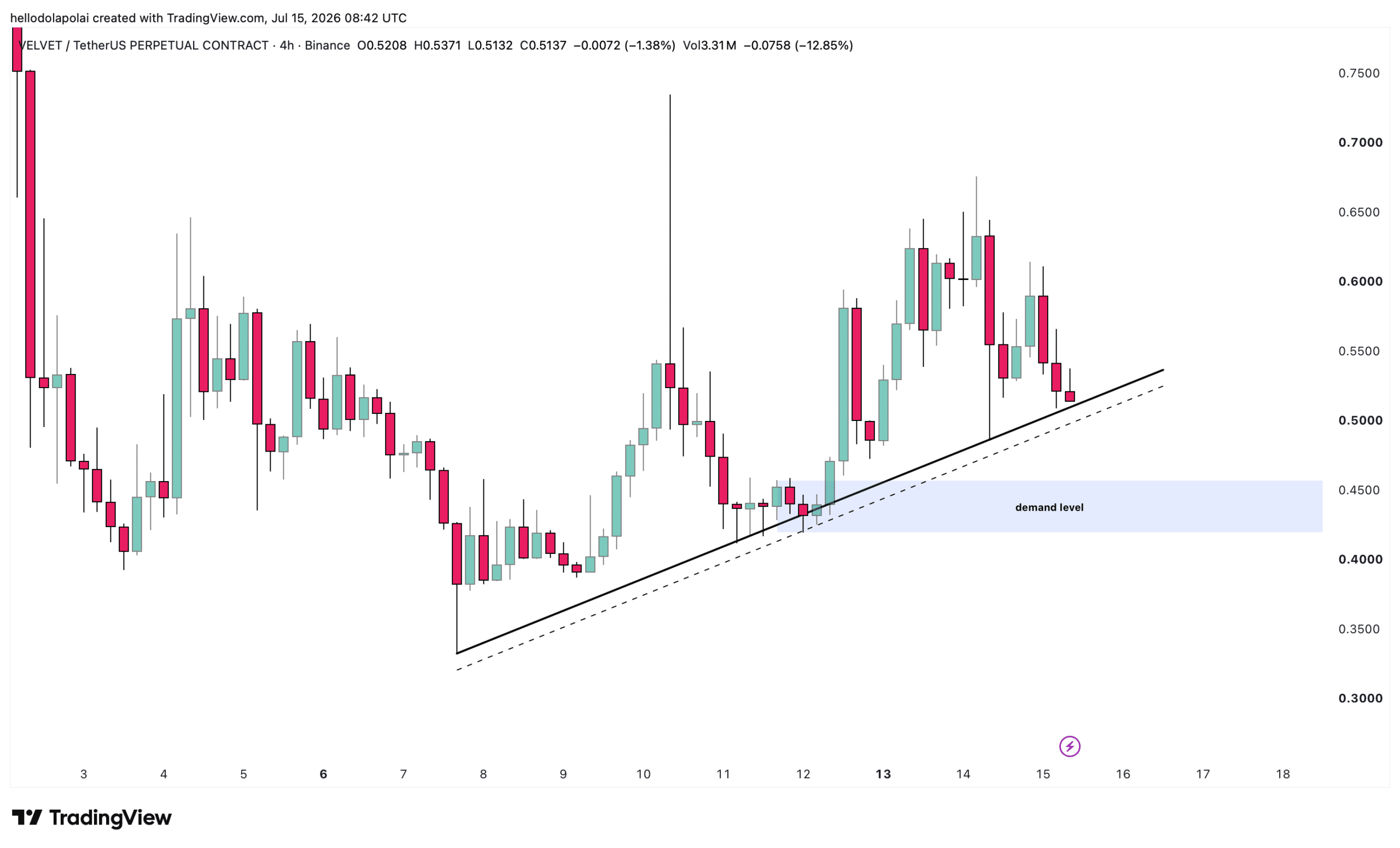
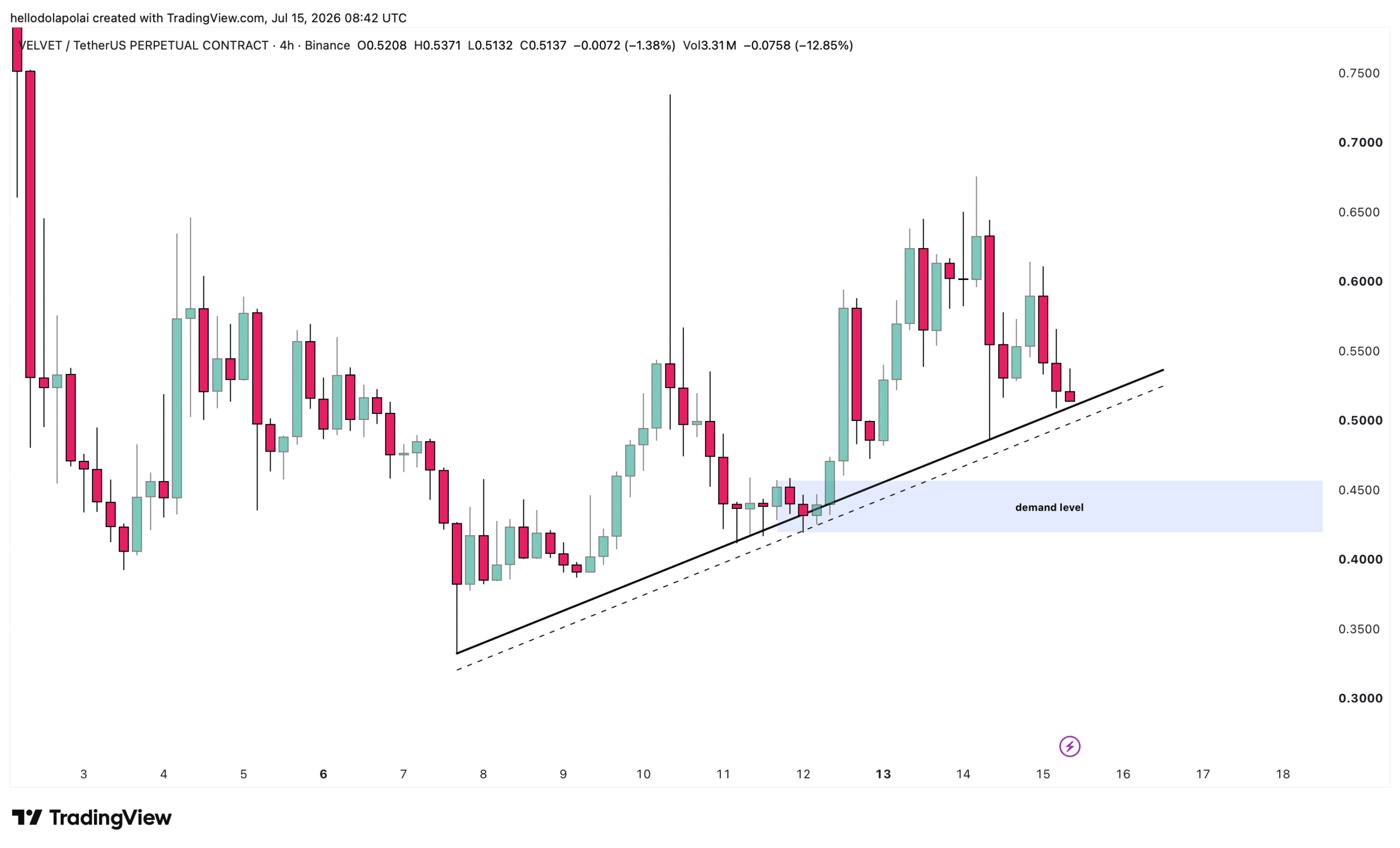
Chart analysis places Velvet a single key level away from either staging a rebound or extending its slide.

That read stems from price trading into an ascending support line that has powered rebounds on multiple occasions, at least three times so far.

A breakdown from this level could send Velvet tumbling once more toward $0.45, where a key demand zone sits and could serve as a rebound catalyst.
Source: TradingView

Should the ascending support hold instead, Velvet’s rebound could already be taking shape. The support level remains the chart’s decisive area to watch for the next move.


Final Summary

  • Velvet fell roughly 18% in a single day, but it remains one of the market’s top performers over the past three months, gaining 571% in 90 days and beating every other top-100 token.
  • $24 million left the perpetual market over 2 weeks, yet longs still control the balance.

Trending Cryptos

Related Questions

QAccording to the article, what was the percentage decline of VELVET over the past day?

AVELVET declined roughly 18% over the past day.

QHow much has VELVET gained over the past 90 days, and how does this compare to other assets?

AVELVET has gained 571% over the past 90 days, outpacing every other asset in the top 100 by market capitalization. The next-best performer, Audiera [BEAT], gained 530%.

QWhat does the net outflow of approximately $24 million from VELVET's perpetual Futures market over two weeks indicate?

AThe $24 million net outflow indicates that capital is leaving the market, which typically reflects bearish sentiment and profit-taking by investors.

QDespite the capital outflow, what does the Funding Rate data suggest about trader sentiment in VELVET's perpetual market?

AThe Funding Rate data, which reached 0.0044%, suggests that longs still maintain command of the market balance, indicating a prevailing bullish outlook among traders.

QWhat is the key chart level that will determine whether VELVET rebounds or continues to slide lower?

AThe key level is an ascending support line. If it holds, a rebound is likely. A breakdown could send the price tumbling toward the next significant demand zone around $0.45.

Related Reads

RWA's "Robinhood Moment": A Complete Overview of Early-Stage Projects

**RWA's "Robinhood Moment": An Overview of Early Projects** Robinhood's recent focus on Real-World Assets (RWAs) has sparked significant activity on its newly launched Robinhood Chain. Following CEO Vlad Tenev's public interest in projects integrating stock tokens and RWAs, several early-stage initiatives have emerged on the network. Key projects include: * **Arcus:** A DEX for stock tokens and crypto, built by dYdX Labs and Robinhood Crypto, focusing on spot and perpetual trading. Future token distribution will prioritize the dYdX community. * **Lighter:** A ZK-powered DEX for perpetual contracts and stock tokens, offering rewards in its LIT token to users, especially those trading via Robinhood Wallet. * **Rialto:** An official AMM for Robinhood Chain aiming to support crypto, stocks, ETFs, and commodities with a focus on robust quoting, market making, and settlement. * **The Index (INDEX):** A protocol that distributes stock tokens to INDEX holders, funded by transaction fees from its platform. It also offers a leveraged trading product for RWA assets. * **Arrow Finance (ARROW):** A crypto/stock token collateralized lending protocol currently on testnet, allowing users to mint aUSD stablecoin against deposited assets. * **Meridian:** A platform for RWA perpetual contracts and prediction markets, settled in USDe. It was previously known as Ethereal. * **Vimen (VIM):** Creates fully collateralized index basket tokens (e.g., "MAG7" for major tech stocks) that represent a group of underlying stock tokens or crypto assets. * **RoodFi (ROODFI):** Attempts to tokenize US municipal tax liens and tax deeds on-chain for purchase and secondary trading. * **Fletcher (FLETCHER):** A project bridging physical graded trading cards (via Solana NFTs) to Robinhood Chain as mirrored NFTs, featuring a gacha-style "loot box" mechanic. * **Sherwood Exchange (SWOOD):** Aims to provide a privacy layer for RWA trading on Robinhood Chain using zero-knowledge proofs, while utilizing public liquidity pools. * **Fletch Finance:** A yield-tokenization protocol similar to Pendle, splitting stock tokens into Principal Tokens (PT) and Yield Tokens (YT) representing future dividends. **Important Note:** The RWA ecosystem on Robinhood Chain is highly nascent. Most projects are very new, with unproven product viability, user demand, and sustainability. Mentions or features by ecosystem accounts like Virtuals do not constitute formal endorsements or guarantees. Significant risks exist, including incomplete products, low liquidity, smart contract vulnerabilities, and high volatility. Extreme caution and independent research (DYOR) are strongly advised.

Foresight News17m ago

RWA's "Robinhood Moment": A Complete Overview of Early-Stage Projects

Foresight News17m ago

Warsh Concludes Capitol Hill Visit! A Breakdown: What Did He Say Over These Two Days?

Walsh Concludes Capitol Hill Testimony: Key Takeaways on Independence, Inflation, and AI In his first congressional hearings as Fed Chair, Kevin Walsh faced intense scrutiny over the central bank's independence, internal reforms, and policy transparency. Over two days before House and Senate committees, lawmakers, particularly Democrats, questioned his ties to the Trump administration and recent initiatives like an AI task force led by venture capitalist Marc Andreessen. Walsh staunchly defended the Fed's independence, stating, "Trump selected an independent person to do an independent job," and vowed to ignore political pressure on interest rates. He emphasized a "zero tolerance" approach to inflation, downplaying the significance of a single favorable CPI report and signaling that rate hikes remain an option to restore price stability. He addressed criticism of the Andreessen-led AI working group by clarifying it only has an advisory role. On AI's economic impact, Walsh suggested the investment boom might not be inherently inflationary and could boost productivity and wages over time. Regarding policy, Walsh reiterated his preference to move away from detailed forward guidance, promising all decisions would be released publicly and simultaneously. He framed his internal reform efforts, including five new working groups starting "from a blank slate," as necessary because past Fed policy contributed to current inflation. The hearings ended with a mix of skepticism and a "wait-and-see" attitude from Washington. While Walsh navigated the initial challenge through hawkish rhetoric and debate skills, observers noted his credibility will ultimately depend on concrete actions to fight inflation and safeguard the Fed's autonomy.

marsbit34m ago

Warsh Concludes Capitol Hill Visit! A Breakdown: What Did He Say Over These Two Days?

marsbit34m ago

Understanding the Q2 Crypto Market in 5 Charts: RWA Booms, Fundamentals Continue to Improve

"5 Charts to Decrypt the Crypto Market in Q2: RWA Explosion and Fundamentals Rebound" In Q2 2026, the crypto market presented a complex picture. While major cryptocurrencies fell 36% in H1, underperforming most major asset classes except gold, crypto-related equities surged 23%, doubling the S&P 500's return. This highlights diverse investment opportunities within the sector, from AI-benefiting miners to Wall Street-linked tokenization platforms. Key takeaways from five crucial charts: 1. **Divergence:** A significant performance gap emerged between crypto assets and publicly traded crypto companies. 2. **Robust Fundamentals:** The top 10 crypto applications generated $5.9B in revenue over the past year, with leaders like PancakeSwap nearing $1B, demonstrating real business traction. 3. **RWA Boom:** Tokenized real-world assets (RWA) reached a record $33B, up 12% QoQ and 45% YTD, fueled by tokenized treasuries, credit, and equities. 4. **Prediction Market Growth:** Prediction market open interest hit a new high of $1.8B, with Q2 volume reaching $43B, driven largely by sports and upcoming political events. 5. **Attractive Correlations:** The Bitwise Crypto Innovators 30 Index showed low or negative 90-day rolling correlations with most major assets (like stocks, bonds, gold), offering potential diversification benefits alongside high returns. Overall, despite bearish price action, the data reveals resilient industry fundamentals with continued growth in users, revenue, and institutional adoption, laying groundwork for future cycles.

marsbit1h ago

Understanding the Q2 Crypto Market in 5 Charts: RWA Booms, Fundamentals Continue to Improve

marsbit1h ago

Bitcoin's Anti-Spam Data Soft Fork BIP110: Miner Collective Boycott, Already Doomed to Fail?

The article discusses the controversial Bitcoin Improvement Proposal (BIP) 110, a "data reduction" soft fork aimed at limiting non-monetary data, such as certain scripts, within Bitcoin transactions. Proponents argue this data violates network principles, but the author strongly disagrees. The core argument is that Bitcoin's fundamental value lies in its open-access, censorship-resistant ledger. Anyone can write data by paying fees, and attempting to police how data is interpreted externally is both impossible and contrary to Bitcoin's ethos. The author compares this to free speech and notes that Bitcoin's existing protocol limits (block size, sigops) already manage network load effectively, even spurring layer-2 innovation. Technically, BIP110 would impose significant new restrictions on script size, Taproot features, and upgradability, applying to UTXOs created within about a year of activation. Its deployment mechanism is criticized for having an unusually low 55% miner signaling threshold and a forced activation timeline, representing the most aggressive script limitations since 2010. The author finds the rationale weak, stating the "problem" it addresses is already managed, and the fork's rushed process ignores broader ecosystem consensus. Importantly, they note that users of so-called unwanted data have already adapted their software to work around the proposed rules. The conclusion is that BIP110 is destined to fail. It attempts the impossible—controlling how an open ledger is used—based on flawed reasoning and via a reckless process. The article reports that miners, developers, and the broader community have rejected it, and Bitcoin will emerge stronger by continuing its normal operation without this change.

marsbit1h ago

Bitcoin's Anti-Spam Data Soft Fork BIP110: Miner Collective Boycott, Already Doomed to Fail?

marsbit1h ago

Trading

Spot

Hot Articles

How to Buy DATA

Welcome to HTX.com! We've made purchasing DATA Network (DATA) simple and convenient. Follow our step-by-step guide to embark on your crypto journey.Step 1: Create Your HTX AccountUse your email or phone number to sign up for a free account on HTX. Experience a hassle-free registration journey and unlock all features.Get My AccountStep 2: Go to Buy Crypto and Choose Your Payment MethodCredit/Debit Card: Use your Visa or Mastercard to buy DATA Network (DATA) instantly.Balance: Use funds from your HTX account balance to trade seamlessly.Third Parties: We've added popular payment methods such as Google Pay and Apple Pay to enhance convenience.P2P: Trade directly with other users on HTX.Over-the-Counter (OTC): We offer tailor-made services and competitive exchange rates for traders.Step 3: Store Your DATA Network (DATA)After purchasing your DATA Network (DATA), store it in your HTX account. Alternatively, you can send it elsewhere via blockchain transfer or use it to trade other cryptocurrencies.Step 4: Trade DATA Network (DATA)Easily trade DATA Network (DATA) on HTX's spot market. Simply access your account, select your trading pair, execute your trades, and monitor in real-time. We offer a user-friendly experience for both beginners and seasoned traders.

350 Total ViewsPublished 2026.07.01Updated 2026.07.01

How to Buy DATA

Discussions

Welcome to the HTX Community. Here, you can stay informed about the latest platform developments and gain access to professional market insights. Users' opinions on the price of DATA (DATA) are presented below.

活动图片