Unsteady Ground, Room to Bounce

insights.glassnodePublished on 2026-03-04Last updated on 2026-03-04

Abstract

Bitcoin remains in a tenuous consolidation below the $70k resistance level, with weakening buy-side momentum and declining realized profits. The Percent of Supply in Profit has fallen to levels historically associated with early bear markets. Short-term holder cost basis near $70k presents a key resistance zone. However, signs of stabilization are emerging: spot and ETF selling pressure is moderating, derivatives leverage is compressing, and options markets show fading downside fear with growing upside call interest around the $75k strike. The market appears to be transitioning from a stressed regime toward a more balanced state, though a sustained recovery depends on renewed spot demand.

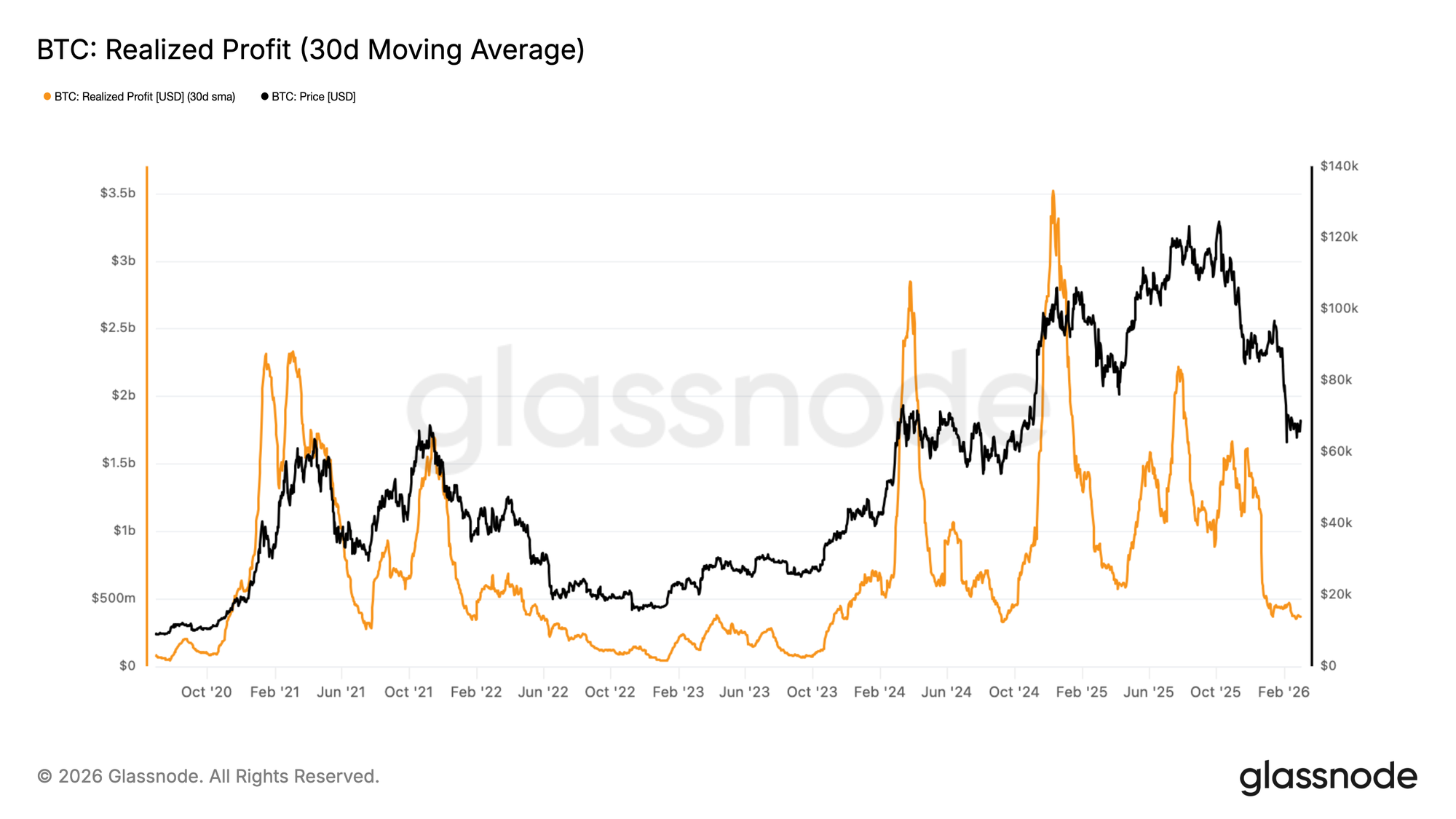
Since early February, Bitcoin has repeatedly failed to post a weekly close above $70k, establishing this region as a meaningful near-term resistance level. To assess whether this price rejection reflects a genuine deterioration in demand, we turn to the 30-day Simple Moving Average (30D-SMA) of Realized Profit, a metric that aggregates the USD-denominated profit locked in by on-chain participants at the moment coins are spent, smoothed to filter short-term noise.

As price stabilized beneath the $70K threshold, this indicator contracted sharply from above $1B per day to approximately $370M per day, a decline of roughly 63%. This compression in monthly-averaged realized profit signals that the cohort of buyers willing to transact at a premium has materially thinned, with buy-side liquidity now at its weakest since the August–September 2024 period.
Taken together, the evidence suggests that upside momentum has stalled, leaving the price in a state of directionless consolidation until fresh demand catalysts emerge.

Live Chart

Regime Detection in Bear Market

Sideways price action is a recurring structure across both bull and bear market cycles, therefore context is everything. Two periods of horizontal consolidation can carry vastly different implications depending on the underlying demand regime, making it essential to look beneath price for corroborating evidence.

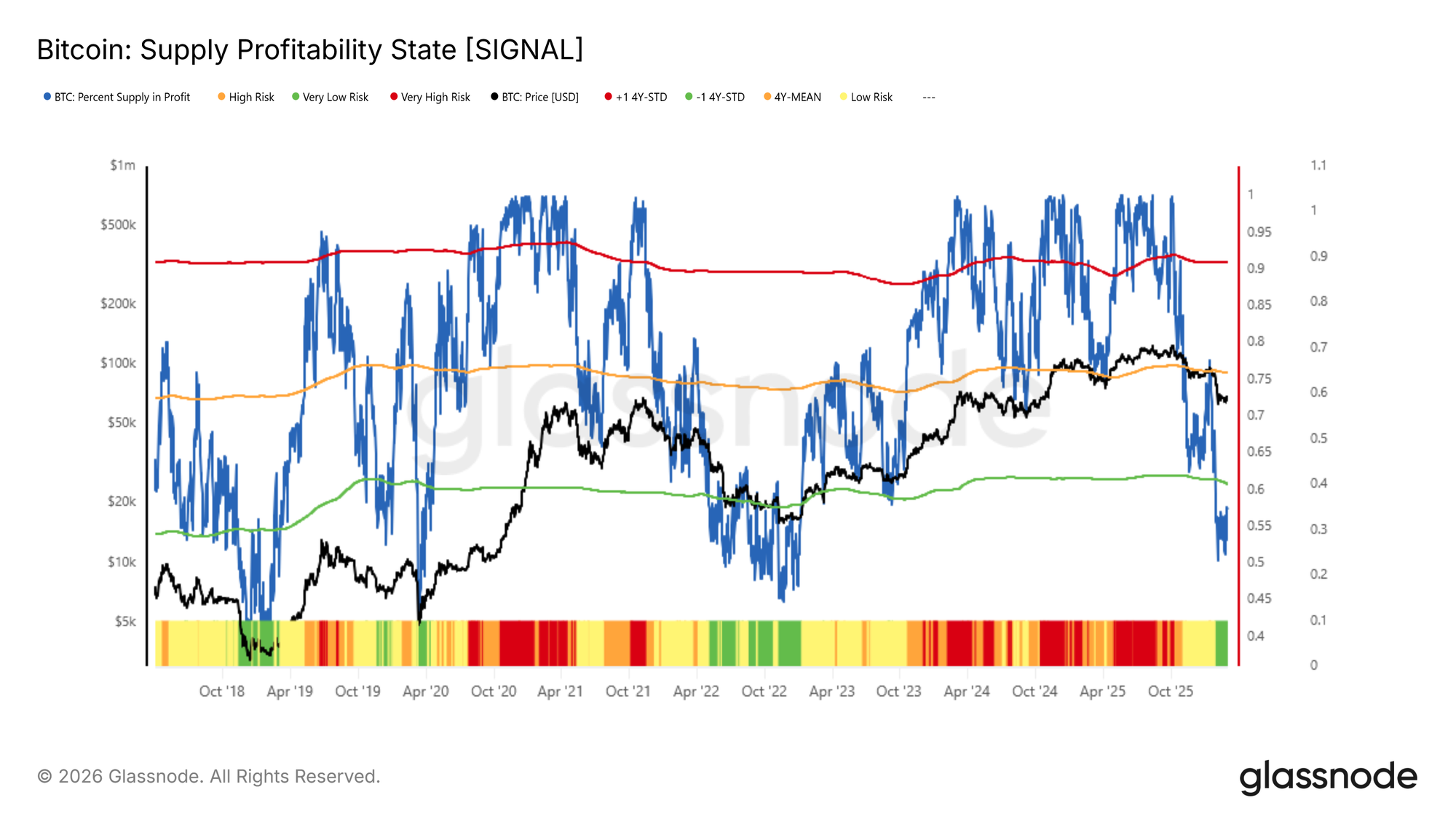
One effective lens for this purpose is the Percent of Supply in Profit, which measures the share of circulating Bitcoin supply held at an unrealized gain relative to each coin's on-chain acquisition cost.

When broadly elevated, this metric reflects widespread investor confidence; when it deteriorates, it signals a growing cohort of underwater holders, a condition historically associated with sustained selling pressure.

Since early February, this indicator has broken below its -1 standard deviation threshold near 60%, and currently sits at approximately 57%. Readings at this level have historically coincided with the early stages of deep bear markets, most notably May 2022 and November 2018. This suggests the present consolidation may be less a springboard for recovery, and more a continuation of the prevailing adverse market regime in mid-term.

Live Chart

Short-Term Relief Rallies and the Cost Basis Ceiling

Despite the headwinds posed by diminishing buy-side liquidity and a market regime starved of broad unrealized profitability, the multi-week sideways consolidation is not without a constructive interpretation. A local equilibrium of this nature can, and often does, precede short-term relief rallies.

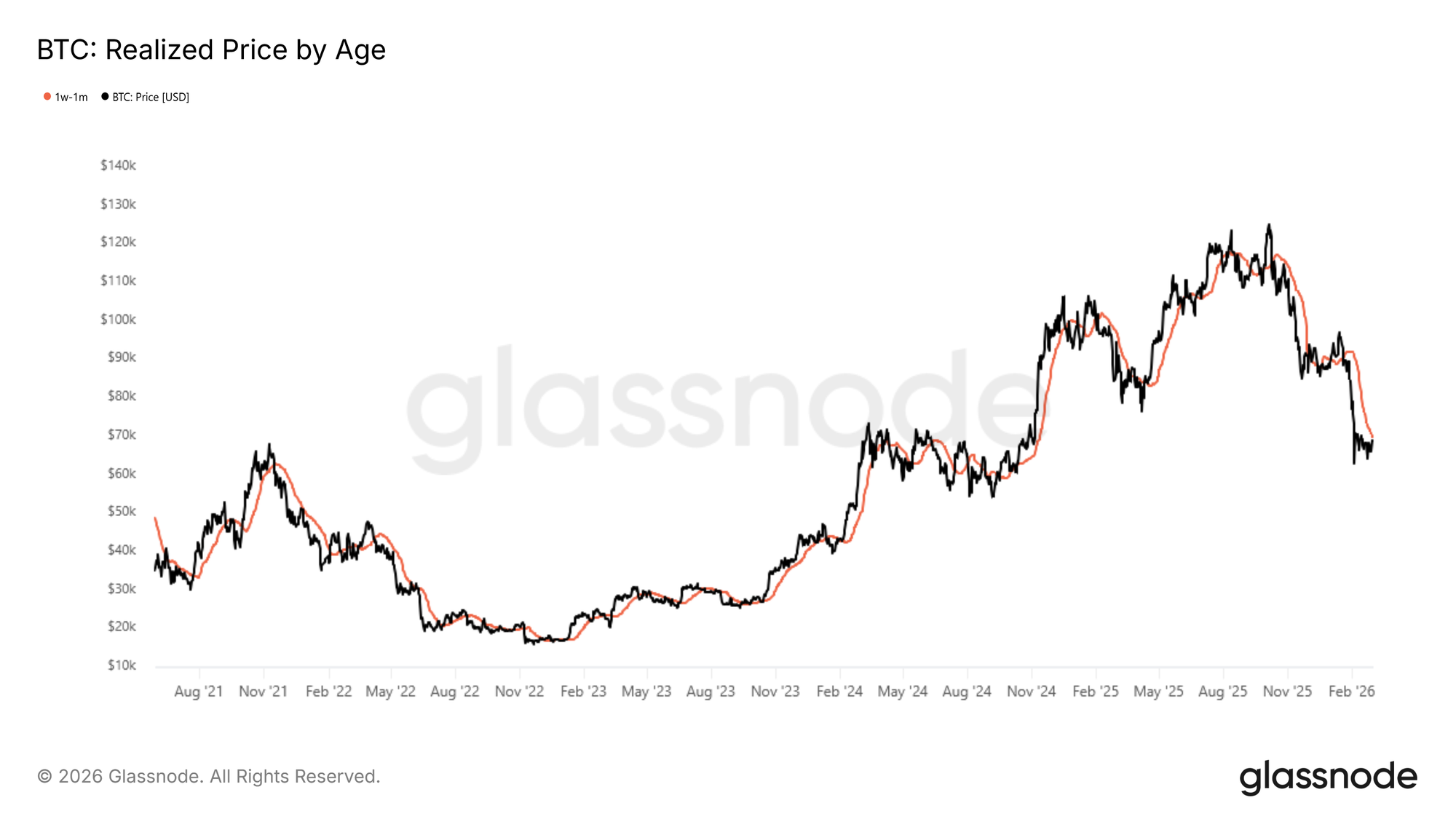
A practical on-chain tool for gauging the potential exhaustion point of such rallies is the Short-Term Holder Cost Basis, specifically for coins aged between one week and one month. This cohort represents the most recent wave of market participants, whose acquisition price acts as a key behavioral anchor: in the deeper stages of a bear market, local bounces tend to stall as these recent buyers approach breakeven, incentivizing them to exit positions or lock in thin profit margins before conditions deteriorate further.

Currently, the cost basis of this 1W–1M holder cohort sits near $70k, meaning the ±2% zone surrounding this level — roughly $68.5k to $71.5k— represents a significant potential resistance and distribution zone for any near-term price recovery.

Live Chart

Off-Chain Insights

Spot Flows Shows Signs of Recovery

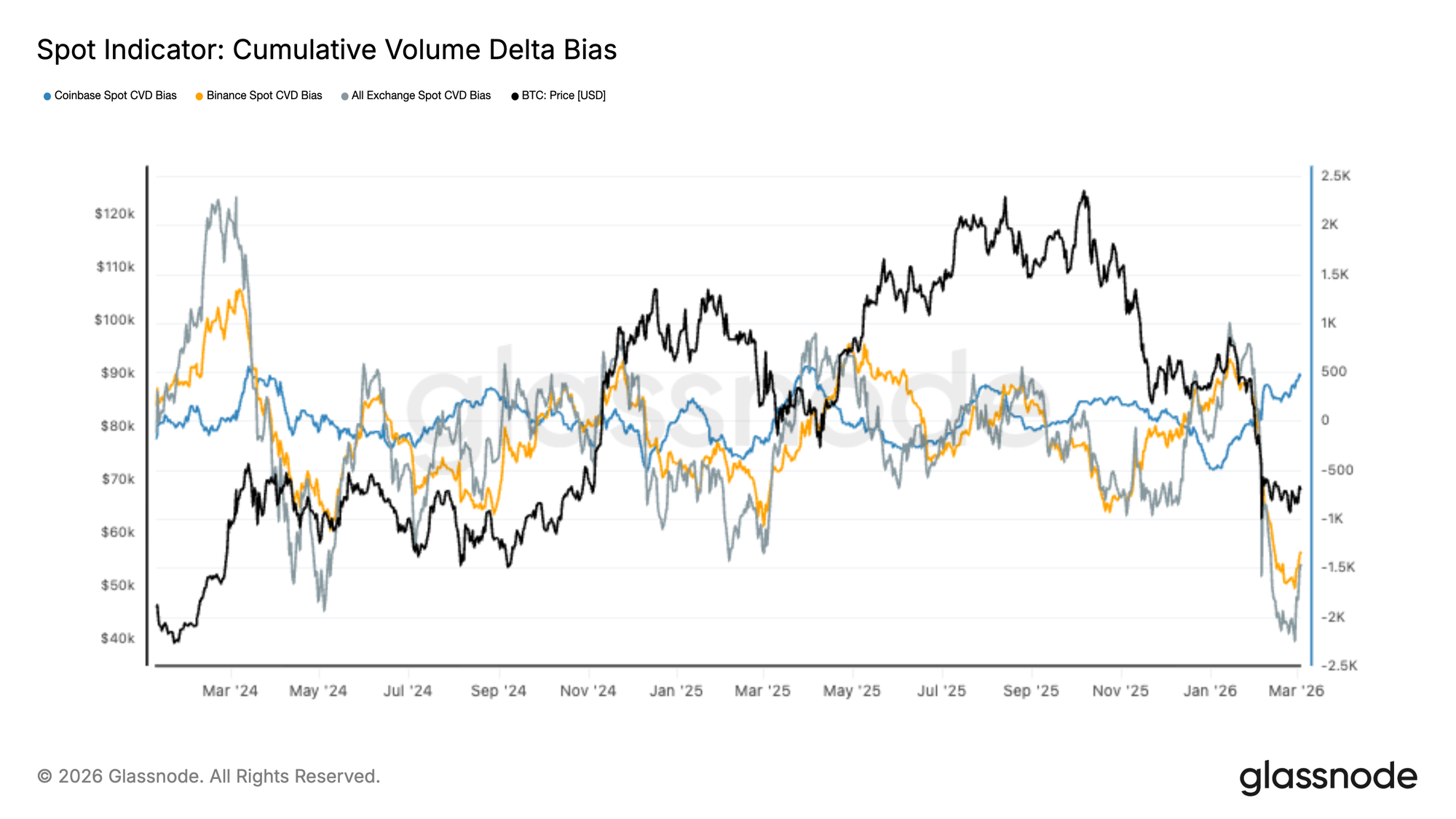
Spot markets recently experienced a sharp wave of sell-side dominance, with Cumulative Volume Delta (CVD) across major exchanges plunging to deeply negative levels as aggressive market sell orders drove the latest price drawdown.

Over the past few days, however, the pace of selling appears to be moderating. Coinbase spot CVD has begun to rebound, suggesting early signs of renewed bid-side activity, while Binance and aggregate exchange flows remain weak but are no longer accelerating lower.

This shift hints that the most intense phase of spot-driven distribution may be easing. Nevertheless, a sustained recovery will likely require broader improvement in spot bid absorption across multiple exchanges before stronger accumulation dynamics can take hold.

Live Chart

ETF Outflows Ease as Early Inflows Reappear

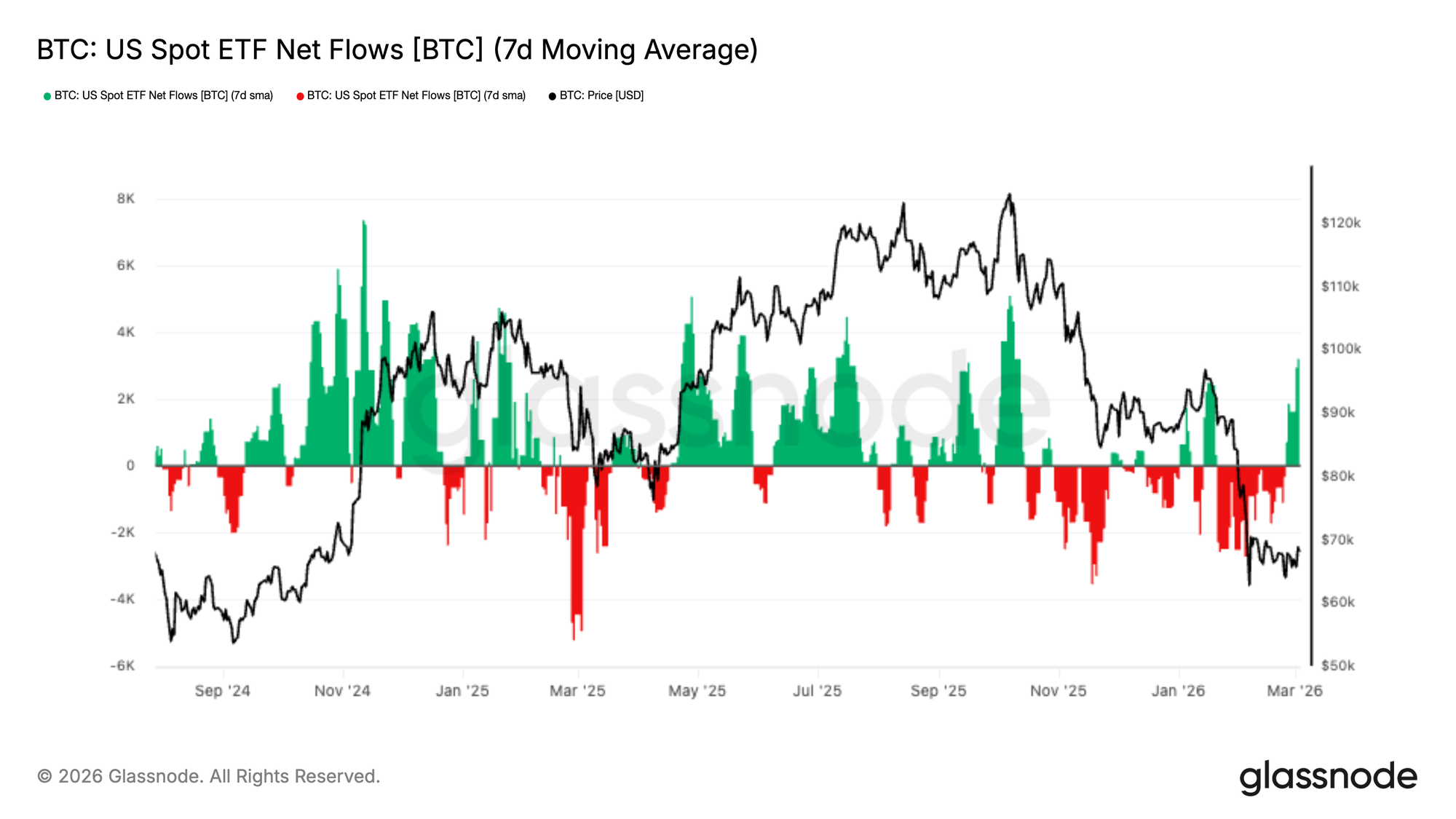
US Spot Bitcoin ETFs experienced sustained outflows during the recent market decline, reflecting persistent institutional de-risking as prices moved lower. The 7-day moving average of net flows remained negative for several weeks, reinforcing the broader risk-off environment across regulated investment channels.

Over the past few days, however, flows have begun to stabilize, with the first signs of renewed inflows emerging. This shift suggests that institutional selling pressure may be moderating as Bitcoin consolidates near recent lows.

While it is too early to confirm a durable reversal in demand, a continued recovery in ETF inflows would signal improving institutional sentiment and could provide an important source of spot-side support for the market.

Live Chart

Perpetual Premium Continues to Compress

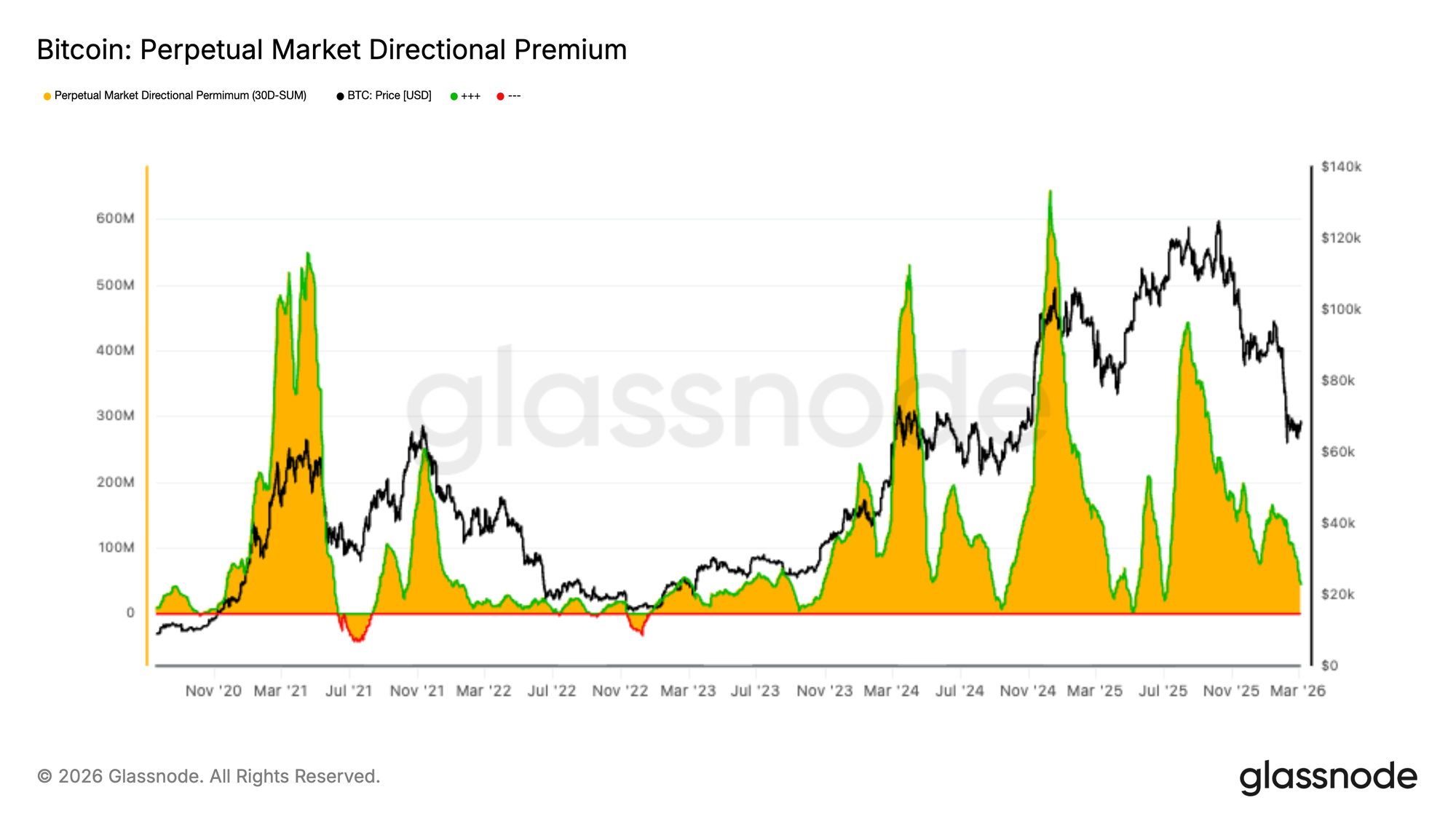
The Perpetual Market Directional Premium continues to trend lower, reflecting a sustained reduction in bullish positioning across perpetual futures markets. The metric has declined steadily in recent weeks as leverage and directional conviction have cooled alongside the broader market pullback.

Over the past few days, the premium has compressed further toward cycle lows, signalling that speculative long exposure is continuing to unwind. This dynamic suggests that derivatives traders remain cautious, with demand for leveraged upside exposure notably subdued.

While the decline reflects weakening bullish momentum, it also indicates that excess leverage is being flushed from the system. A stabilization in the premium could signal that derivatives positioning is approaching a more neutral footing.

Live Chart

Volatility Compression Signals Stabilization

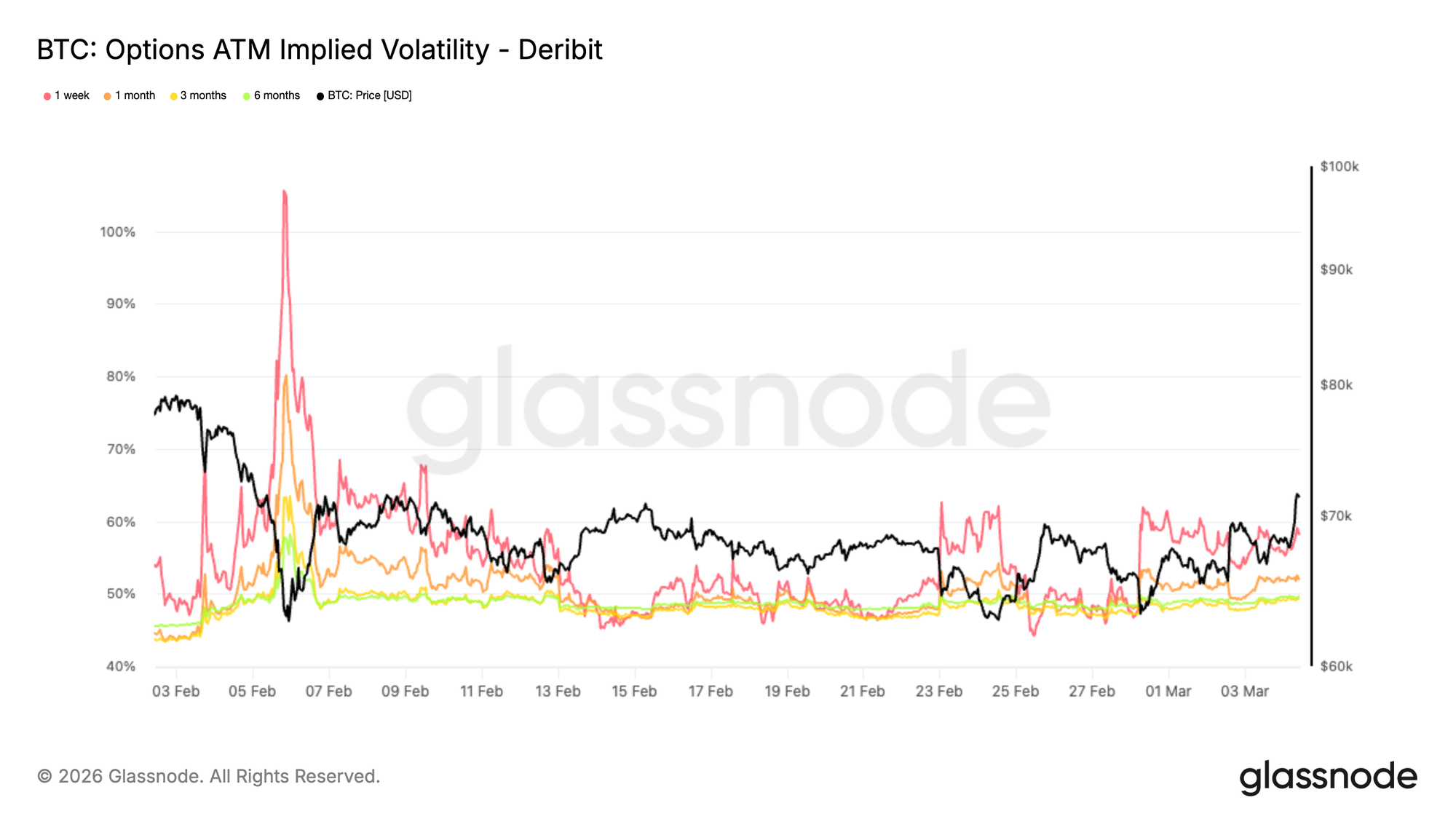
Implied volatility has continued to compress following the spike observed in early February. Across the main tenors, ATM IV has moved materially lower, indicating that traders are no longer aggressively pricing tail risk.

This shift reflects a stabilization in sentiment after a period of forced deleveraging and liquidation-driven volatility. As panic pricing fades, options markets begin transitioning from stress conditions toward a more neutral volatility regime.

Lower implied volatility also changes positioning dynamics. When volatility declines while price stabilizes, long option holders face increasing theta decay, making directional conviction more important.

For now, volatility compression suggests the market is moving away from crisis pricing and into a consolidation phase where positioning, rather than panic hedging, becomes the dominant driver of price action.

Live Chart

Skew Normalization Reflects Fading Downside Fear

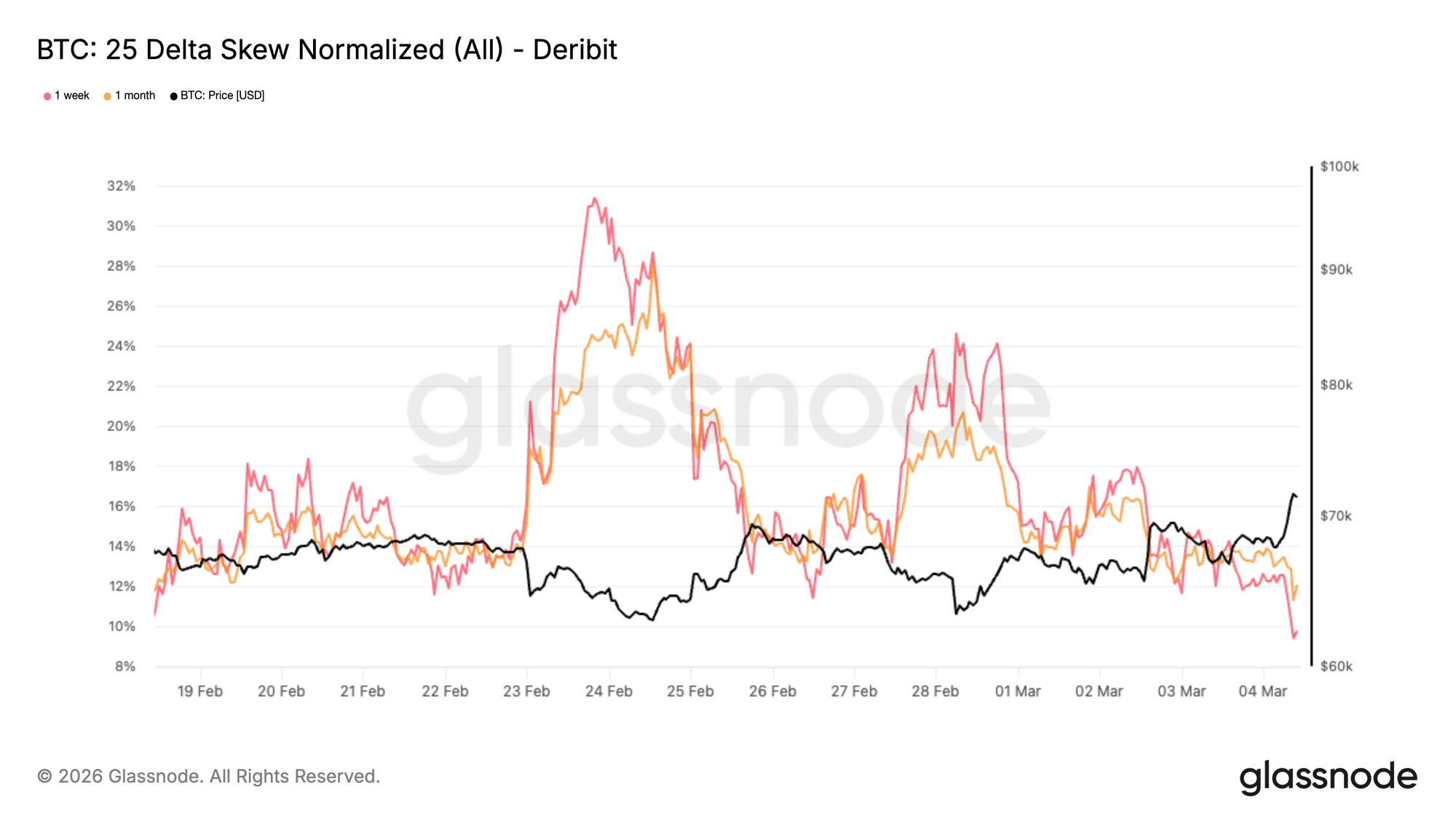
Skew has compressed materially from the extreme levels observed during the February sell-off. Over the past two weeks, as the chart shows, each move lower in BTC price has triggered a progressively milder reaction in the options market. Traders have been far less aggressive in bidding for downside protection, gradually pulling the skew lower. During the peak of the sell-off, put demand surged and pushed skew deep into put territory as traders rushed to hedge against further downside. That urgency has clearly eased.

Rather than a full normalization, what we are seeing is a repricing of risk: skew has moved from the mid-20s to the low-10s, still reflecting demand for protection but at far less stressed levels. This shift suggests that the immediate need for downside hedging is fading. Some protective positioning is being unwound, while interest in upside exposure is slowly reappearing.

Historically, this type of skew compression tends to occur when markets move out of stress phases and begin transitioning into more balanced positioning environments.

Live Chart

Options Flow Rotates Toward Upside Calls

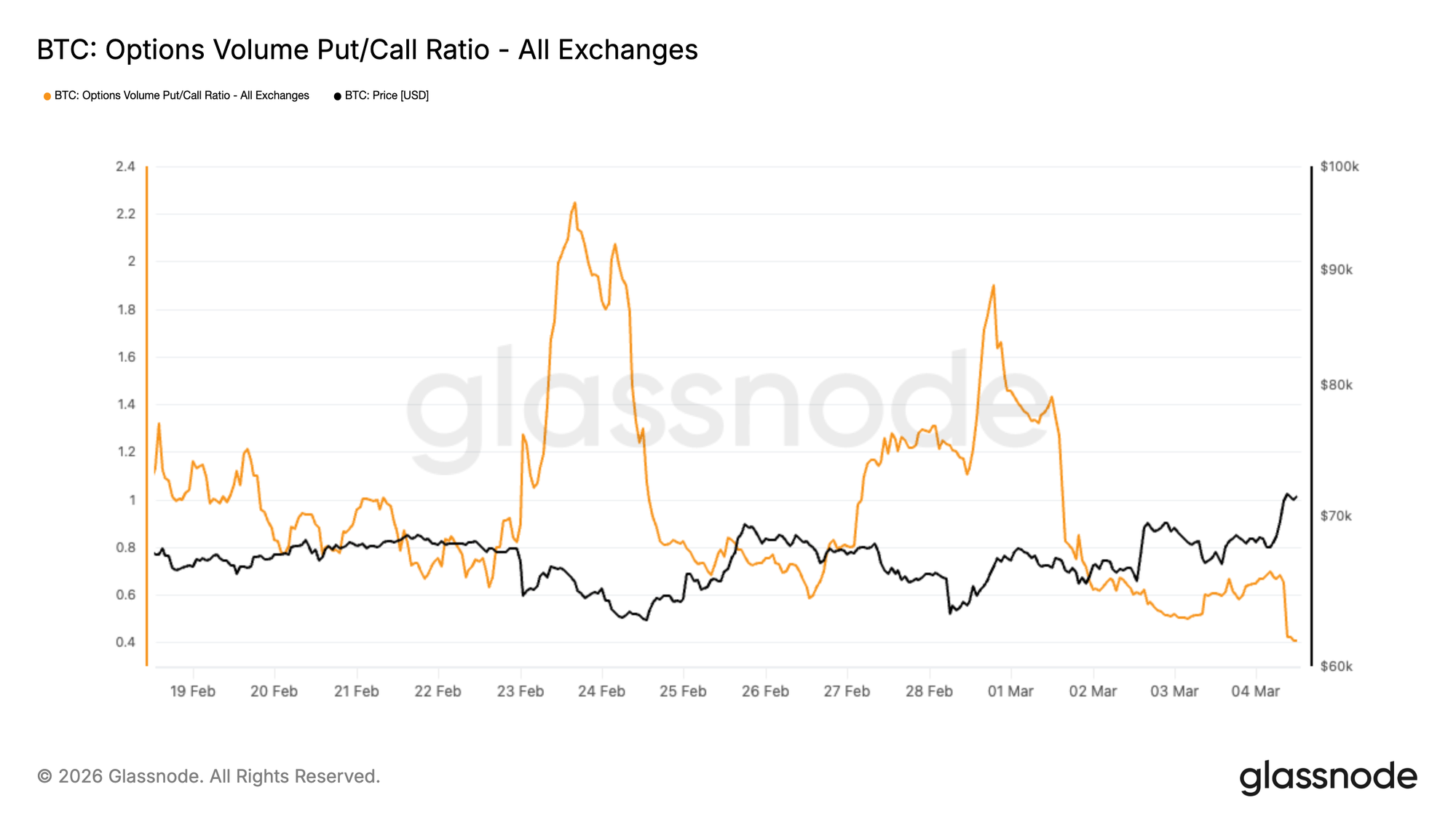
The Put/Call volume ratio measures the relative trading activity between puts and calls. When the ratio declines, it indicates that call activity is increasing relative to puts.

As implied volatility compresses, put holders face increasing theta decay and mark-to-market pressure. With downside momentum weakening, these positions become more costly to carry, prompting traders to buy back their hedges. This dynamic can create incremental spot demand as protective positions are unwound.

This environment has incentivized traders to position for a tactical upside move, a shift that is visible in the Put/Call volume ratio. Since February 28th, the ratio has moved from 1.89 to 0.4, marking a significant reversal in options flows and highlighting the growing willingness of the market to position for upside.

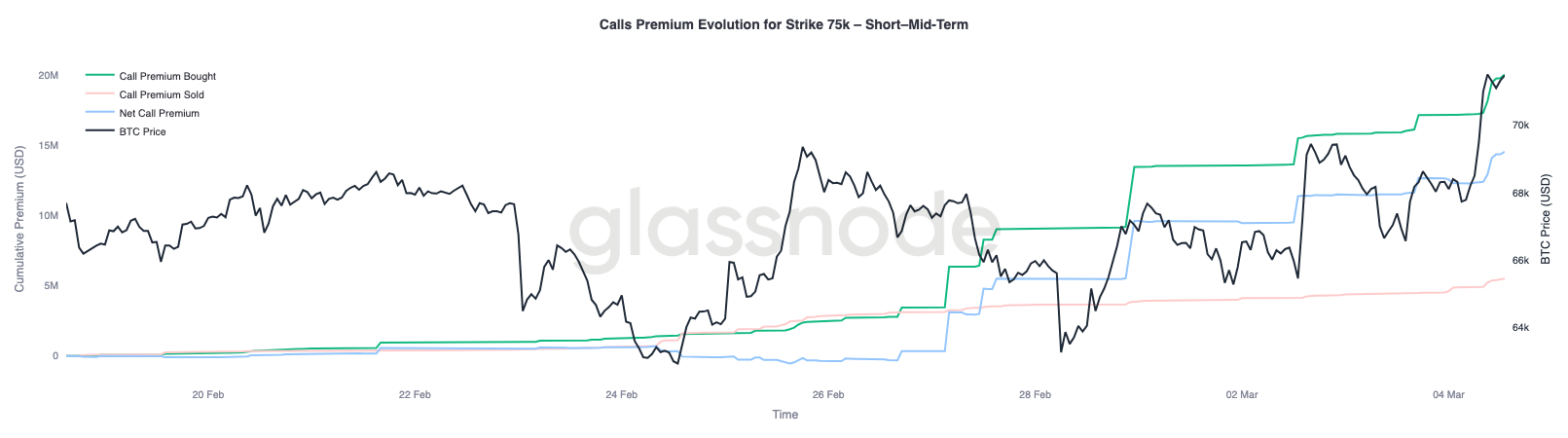
This shift is also reflected in the increasing interest around the $75,000 strike.

The combination of declining volatility and rising call activity suggests a market gradually transitioning away from defensive hedging toward more opportunistic upside positioning.

Live Chart

$75K Emerges as the Key Gamma Magnet

The rotation toward call activity is also visible in the growing interest around the $75,000 strike, which has become the most significant negative gamma level for dealers.

The $75,000 strike currently hosts a substantial concentration of negative gamma, estimated at around $2.3 billion across expiries, with approximately $1.8 billion concentrated in the March 27th expiry.

Negative gamma environments can amplify price movements as dealer hedging flows reinforce the prevailing trend. When price approaches these zones, hedging activity can pull the market toward the strike, creating a magnet effect. Over the past week, this magnet has effectively shifted from the $60K to $65K area up toward the $75K strike.

For now, $75K stands out as the key level where positioning and liquidity could converge in the coming sessions.

Looking at the premium dynamics for the $75K calls across the next three monthly expiries, roughly $14.5 million in net call premium has been traded. This represents the difference between premium bought and premium sold.
Notably, nearly two thirds of this net premium has been accumulated over the past week, helping fuel the current rebound.

Live Chart

Conclusion

Bitcoin remains locked in a tenuous consolidation below the $70k threshold, with several indicators suggesting that buy-side momentum has materially weakened. Realized profit has contracted sharply, highlighting reduced willingness among market participants to transact at elevated prices, while the decline in the Percent Supply in Profit places the current regime within a historical context often associated with the early stages of bear market conditions. At the same time, the cost basis of short-term holders near $70k is emerging as a key behavioural ceiling, likely acting as a distribution zone should price attempt a near-term recovery.

Beneath the surface, however, some signs of stabilization are beginning to appear. Spot selling pressure is moderating at the margin, ETF outflows are easing with early inflows returning, and derivatives leverage continues to be flushed from the system. In options markets, volatility and skew are normalizing as panic hedging fades and positioning rotates toward upside exposure. With the $75k strike emerging as a major gamma magnet, the market appears to be transitioning from stress-driven selling toward a more balanced positioning regime. Whether this evolves into a sustainable recovery will ultimately depend on the return of stronger spot demand to absorb overhead supply.


Disclaimer: This report does not provide any investment advice. All data is provided for informational and educational purposes only. No investment decision shall be based on the information provided here, and you are solely responsible for your own investment decisions.

Exchange balances presented are derived from Glassnode’s comprehensive database of address labels, which are amassed through both officially published exchange information and proprietary clustering algorithms. While we strive to ensure the utmost accuracy in representing exchange balances, it is important to note that these figures might not always encapsulate the entirety of an exchange’s reserves, particularly when exchanges refrain from disclosing their official addresses. We urge users to exercise caution and discretion when utilizing these metrics. Glassnode shall not be held responsible for any discrepancies or potential inaccuracies.

Related Questions

QWhat key resistance level has Bitcoin repeatedly failed to close above since early February, and what does this indicate about current market momentum?

ABitcoin has repeatedly failed to post a weekly close above $70k since early February, establishing it as a significant near-term resistance level. This, combined with a sharp 63% contraction in the 30-day SMA of Realized Profit, indicates that upside momentum has stalled, leaving the price in a state of directionless consolidation.

QAccording to the 'Percent of Supply in Profit' metric, what does the current reading of approximately 57% historically suggest about the market regime?

AThe 'Percent of Supply in Profit' metric breaking below its -1 standard deviation threshold near 60% and sitting at approximately 57% suggests that the present consolidation may be less a springboard for recovery and more a continuation of the prevailing adverse market regime. Historically, readings at this level have coincided with the early stages of deep bear markets, such as in May 2022 and November 2018.

QWhat is the significance of the Short-Term Holder (1W-1M) Cost Basis being near $70k, and what zone does it create?

AThe cost basis of Short-Term Holders (coins aged between one week and one month) near $70k is significant because it acts as a key behavioral anchor. The ±2% zone surrounding this level (roughly $68.5k to $71.5k) represents a major potential resistance and distribution zone for any near-term price recovery, as these recent buyers are incentivized to exit their positions or lock in thin profits as they approach breakeven.

QWhat recent shifts in ETF flows and options market activity suggest a potential stabilization or change in sentiment?

ARecent shifts include ETF outflows easing with the first signs of renewed inflows appearing, suggesting institutional selling pressure may be moderating. In options markets, the Put/Call volume ratio has dramatically reversed from 1.89 to 0.4, indicating a significant rotation from defensive put buying to opportunistic call buying, and the $75k strike has emerged as a key gamma magnet, reflecting growing upside positioning.

QHow has implied volatility and skew changed, and what does this signal about the current market phase?

AImplied volatility has compressed materially, indicating traders are no longer aggressively pricing tail risk and that the market is moving away from crisis pricing. Skew has normalized from extreme put-heavy levels (mid-20s) to the low-10s, reflecting a fading immediate need for downside hedging. This compression suggests the market is transitioning from a stress phase into a more balanced consolidation phase where positioning, rather than panic, drives price action.

Related Reads

Trading

Spot
Futures

Hot Articles

What is $BITCOIN

DIGITAL GOLD ($BITCOIN): A Comprehensive Analysis Introduction to DIGITAL GOLD ($BITCOIN) DIGITAL GOLD ($BITCOIN) is a blockchain-based project operating on the Solana network, which aims to combine the characteristics of traditional precious metals with the innovation of decentralized technologies. While it shares a name with Bitcoin, often referred to as “digital gold” due to its perception as a store of value, DIGITAL GOLD is a separate token designed to create a unique ecosystem within the Web3 landscape. Its goal is to position itself as a viable alternative digital asset, although specifics regarding its applications and functionalities are still developing. What is DIGITAL GOLD ($BITCOIN)? DIGITAL GOLD ($BITCOIN) is a cryptocurrency token explicitly designed for use on the Solana blockchain. In contrast to Bitcoin, which provides a widely recognized value storage role, this token appears to focus on broader applications and characteristics. Notable aspects include: Blockchain Infrastructure: The token is built on the Solana blockchain, known for its capacity to handle high-speed and low-cost transactions. Supply Dynamics: DIGITAL GOLD has a maximum supply capped at 100 quadrillion tokens (100P $BITCOIN), although details regarding its circulating supply are currently undisclosed. Utility: While precise functionalities are not explicitly outlined, there are indications that the token could be utilized for various applications, potentially involving decentralized applications (dApps) or asset tokenization strategies. Who is the Creator of DIGITAL GOLD ($BITCOIN)? At present, the identity of the creators and development team behind DIGITAL GOLD ($BITCOIN) remains unknown. This situation is typical among many innovative projects within the blockchain space, particularly those aligning with decentralized finance and meme coin phenomena. While such anonymity may foster a community-driven culture, it intensifies concerns about governance and accountability. Who are the Investors of DIGITAL GOLD ($BITCOIN)? The available information indicates that DIGITAL GOLD ($BITCOIN) does not have any known institutional backers or prominent venture capital investments. The project seems to operate on a peer-to-peer model focused on community support and adoption rather than traditional funding routes. Its activity and liquidity are primarily situated on decentralized exchanges (DEXs), such as PumpSwap, rather than established centralized trading platforms, further highlighting its grassroots approach. How DIGITAL GOLD ($BITCOIN) Works The operational mechanics of DIGITAL GOLD ($BITCOIN) can be elaborated on based on its blockchain design and network attributes: Consensus Mechanism: By leveraging Solana’s unique proof-of-history (PoH) combined with a proof-of-stake (PoS) model, the project ensures efficient transaction validation contributing to the network's high performance. Tokenomics: While specific deflationary mechanisms have not been extensively detailed, the vast maximum token supply implies that it may cater to microtransactions or niche use cases that are still to be defined. Interoperability: There exists the potential for integration with Solana’s broader ecosystem, including various decentralized finance (DeFi) platforms. However, the details regarding specific integrations remain unspecified. Timeline of Key Events Here is a timeline that highlights significant milestones concerning DIGITAL GOLD ($BITCOIN): 2023: The initial deployment of the token occurs on the Solana blockchain, marked by its contract address. 2024: DIGITAL GOLD gains visibility as it becomes available for trading on decentralized exchanges like PumpSwap, allowing users to trade it against SOL. 2025: The project witnesses sporadic trading activity and potential interest in community-led engagements, although no noteworthy partnerships or technical advancements have been documented as of yet. Critical Analysis Strengths Scalability: The underlying Solana infrastructure supports high transaction volumes, which could enhance the utility of $BITCOIN in various transaction scenarios. Accessibility: The potential low trading price per token could attract retail investors, facilitating wider participation due to fractional ownership opportunities. Risks Lack of Transparency: The absence of publicly known backers, developers, or an audit process may yield skepticism regarding the project's sustainability and trustworthiness. Market Volatility: The trading activity is heavily reliant on speculative behavior, which can result in significant price volatility and uncertainty for investors. Conclusion DIGITAL GOLD ($BITCOIN) emerges as an intriguing yet ambiguous project within the rapidly evolving Solana ecosystem. While it attempts to leverage the “digital gold” narrative, its departure from Bitcoin's established role as a store of value underscores the need for a clearer differentiation of its intended utility and governance structure. Future acceptance and adoption will likely depend on addressing the current opacity and defining its operational and economic strategies more explicitly. Note: This report encompasses synthesised information available as of October 2023, and developments may have transpired beyond the research period.

363 Total ViewsPublished 2025.05.13Updated 2025.05.13

What is $BITCOIN

Discussions

Welcome to the HTX Community. Here, you can stay informed about the latest platform developments and gain access to professional market insights. Users' opinions on the price of BTC (BTC) are presented below.

活动图片