Written by: Ugo
Compiled by: Luffy, Foresight News
In February 2024, I entered the world of Meme coin trading with $80 and lost everything—a devastating experience I went through twice.
It was then that I realized I hadn't figured out how this market works and had been using the wrong approach all along.
Later, I re-entered the market with $50, but this time I employed a wallet tracking strategy. In less than a year, by February 2025, that $50 had grown to over $1 million.
Early Pitfalls
My previous logic for buying Meme coins was simple: "This coin has a fun meme, great promotional content, and a clean website—let's buy it."
Admittedly, this method occasionally made some money, but most of the time, it was pure gambling. You had no solid basis or objective reason to determine how high the price could go.
To achieve consistent profits, you need a way to access key information before the trend starts, rather than following the crowd after the price has already surged.
I used to obsess over rumors on X (formerly Twitter) and Telegram groups: "This coin will definitely hit a $100 million market cap this week, just wait and see." Later, I learned that most of these messages were from paid shills or people who had already accumulated 15% of the token supply at low prices. You rush in excitedly, only to end up as the bag holder.
If your profit-taking targets aren't based on real information, your actions are merely responding to others' interests rather than truly following market trends.

Turning the Tide with Wallet Tracking
I quickly realized that my previous approach was missing a critical element. I would watch top traders and wonder, "How do they predict the market so well, while I can't?" So I had to find a solution.
Wallet tracking completely changed my perspective on trading. I stopped guessing market tops and bottoms, stopped chasing narratives, and stopped being led by hype on X. Instead, I focused on one thing: where the smart money was flowing.
Every major market move originates not on social media but in a small number of wallets. These wallets could belong to project teams, large holders, early institutional investors, insiders, KOLs, industry experts, market makers, or newly created anonymous addresses.
My success wasn't due to luck in a single trade but to repeatedly capturing replicable market patterns.
At that moment, it all clicked: I didn't need to be smarter than the entire market, nor did I need to rely on subjective judgments or market hype. I just needed to focus on data, analyze fund movements, and execute my trading strategy decisively.
From then on, my goal became crystal clear: build a trading system that reacts solely to the movements of smart money, not to rumors.

My Practical Wallet Tracking Methods
Tracking KOL Wallets
When I started in February 2024, wallet tracking was straightforward. Back then, people rarely changed wallet addresses frequently.
All you had to do was find the hidden wallet addresses of influential KOLs and follow their moves. That was it.
They accumulated at low prices → hyped it up → the price surged 10x instantly.
Using this method, I turned $50 into $5,000 in the first month. The next month, $5,000 became $30,000.
For example, on February 24: A project team launched a token specifically for a KOL. This industry heavyweight quietly accumulated the token using multiple hidden wallets when its market cap was only $20,000. I followed his lead and bought in at a $30,000 market cap. He then aggressively promoted it on Telegram and X, and the token's market cap instantly soared to $400,000. I took partial profits at this level.
Later that day, the market cap climbed to $1 million, and I cashed out again. In just a few hours, my initial investment had multiplied about 30 times.
At that time, my capital was small, so I had no concerns about liquidity and could exit cleanly.
Tracking Conspiracy Group Wallets
A few months later, I shifted from tracking individual KOLs to monitoring the wallets of conspiracy groups (small manipulation teams). As people started changing wallet addresses more frequently, tracking a group of people with aligned actions became far more reliable than following a single wallet. For instance, 10 different wallets, all part of the same circle, executing identical moves simultaneously.
This kind of signal gave me much more confidence than a single wallet ever could.
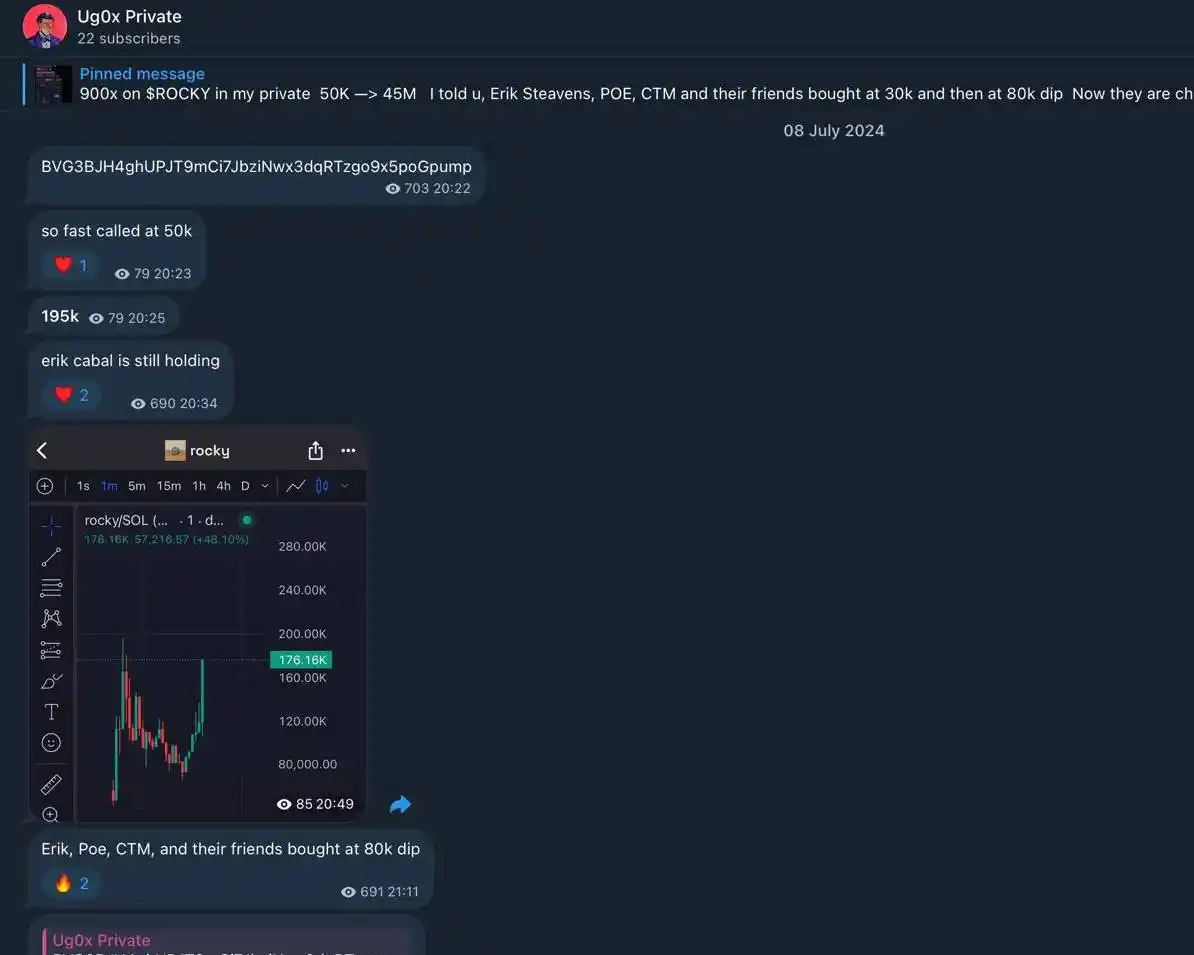
July 8, 2024, was a perfect example with the $ROCKY token. At that time, Erik Steavens, POE, DOGEN, and CTM were all quietly buying between a $10,000 and $80,000 market cap.
Seeing this signal, I knew it wasn't a coincidence—they were planning a pump.
I bought 2.8% of the circulating supply at a $40,000 market cap.
Over the next few days, these大佬联合发力拉盘 (big players jointly drove up the price), and the token's market cap skyrocketed to $45 million.
I took profits between $2 million and $10 million market cap, exiting on average around $6 million.
This trade multiplied my initial investment by 150 times. Although holding until the peak would have yielded 1100x, I strictly followed my exit plan and was more than satisfied with my first six-figure profit.
Tracking New Wallets, Project Team Wallets, and Large Holder Wallets
By January 2025, the crypto market was buzzing with activity, but wallet tracking had become more challenging. To stay ahead of insider information, I had to constantly refine my methods and adapt.
The key to tracking these insiders' wallets was finding their new wallets that had just withdrawn funds from centralized exchanges like Binance. This required precisely tracing fund transfers between multiple Binance addresses and their timestamps. Though time-consuming, it was absolutely worth it.
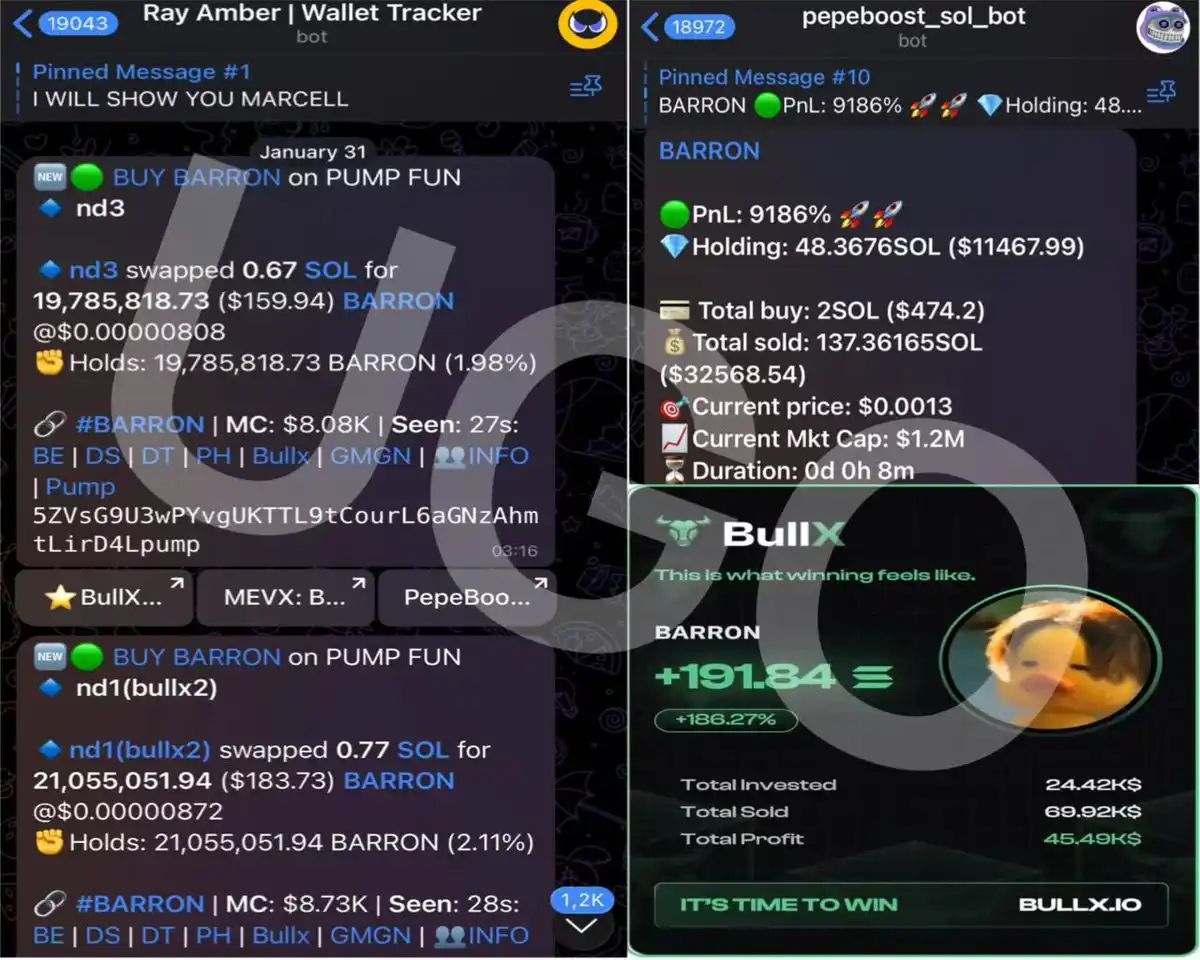
For example, I was closely monitoring Marcell's wallet movements, so I saw his newly funded wallets daily. On January 31, he personally launched and accumulated a large position in the $BARRON token.
I built my position across three wallets between a $15,000 and $25,000 market cap. About three minutes later, Marcell started posting to hype and pump the token. I quickly took profits between a $1 million and $2.5 million market cap.
This was one of my fastest trades ever: an initial investment of $1,300 turned into over $110,000. (The trading platform BullX showed my buy amount as $24,000 because I later added to my position during dips in this wallet, maximizing the profit.)
Tracking Market Maker Wallets
Market maker wallets are addresses controlled directly by the token project team, primarily used to manipulate prices for the benefit of the team or the token itself.
Common manipulation tactics include: placing large buy/sell orders to trigger stop-loss orders and scalp retail traders, or dumping the price by 30% in minutes to cause panic selling, allowing new investors to buy in low.
However, market makers often transfer tokens between wallets shortly after launch. If these wallets aren't newly created or are easily identifiable, we can directly track the project team's movements and precisely catch their every new token launch opportunity.
I did exactly this with the $HOOD token on January 31, 2025.
This project team launched a new token roughly every month. They completed their large accumulation around a $2 million market cap, and I bought in decisively at this level, getting in before top KOLs started hyping. Hours later, I took profits between an $80 million and $120 million market cap, netting about a 50x return on this trade.
Simultaneously, during breaks from managing my initial position's exit, I also leveraged the market maker's large sell-offs to re-enter heavily, making 40% to 70% gains in just minutes.
My total profit for the day was a staggering $152,000. Until the ASTER token trade in September of the same year, January 31st remained my most profitable trading day.

My Ironclad Trading Rules
I always strictly adhere to capital management rules. For example, the capital allocated to any single trade never exceeds 5% of my total portfolio. I also adjust my risk exposure flexibly based on the quality of the opportunity and my confidence level.
When trading with a wallet tracking strategy, you must never use large positions. If the target you're tracking detects your presence, they can easily turn around and rug pull you.
You also need to learn to think from their perspective—understand their interests, operational habits, and timing—to minimize the risk of being rug pulled and achieve consistent profitability.
Of course, I strictly follow my trading plan and never let emotions dictate decisions. I rarely struggle with this aspect because I started learning forex trading at 14, so discipline is deeply ingrained.
That said, I've also experienced several painful lessons of profit drawdowns. But these setbacks didn't break me; instead, they fueled my determination. Driven by this不甘 (reluctance to accept defeat), I studied even harder, continuously honing my trading edge.
Finally
I'm writing this article not to boast. On one hand, I want it to serve as a diary to look back on in five years and see how far I've come. On the other hand, I hope to inspire and help more people understand: as long as you are willing to actively seek change and put in the effort, there is always a way to achieve your goals.
I must clarify one point: I never use these tracking techniques against friends or people close to me. Everything I do is purely to understand the underlying logic of the market and then go with the flow.
I am also very grateful to those I track, and to the project teams who genuinely work hard. I always approach trading with reverence and without hostility. I am also sincerely thankful for all the friends I've met on this journey who have helped me tremendously. Thank you all, and thank heaven for its blessings.