Trump’s Teleprompter Operator Investigated for Insider Trading, "Whistleblower" Turns Out to Be Prediction Platform Kalshi

Foresight NewsPublished on 2026-07-17Last updated on 2026-07-17

Abstract

According to reports from CNBC and ABC, a longtime teleprompter operator for President Trump, Gabriel Perez, is under federal investigation for allegedly using insider information to place bets on the prediction market platform Kalshi. Perez, who had handled Trump's speeches since 2016, is suspected of trading on over a dozen upcoming presidential addresses, including the State of the Union, based on his advance knowledge of speech content. Kalshi's monitoring systems flagged the atypical trading patterns in March, leading to his account being frozen and the case being referred to the Commodity Futures Trading Commission (CFTC). Perez reportedly profited over $90,000, though most funds are held by the platform. He is now in settlement talks with the CFTC and has been placed on unpaid leave by the White House. This incident is part of a broader pattern of insider trading on prediction markets. Similar cases involve a congressional candidate betting against his own attendance, military personnel using classified information, and a Google engineer trading on internal data. The growing liquidity of these markets, with some contracts seeing over $150,000 in volume, creates incentives for abuse. In response, platforms like Kalshi are enhancing monitoring, requiring occupational disclosures, and cooperating with regulators. The CFTC and the Justice Department are pursuing civil and criminal actions, while the White House has issued memos explicitly barring staff from such trading.


By: Nicky, Foresight News


On July 16, according to reports from CNBC and ABC, a long-serving teleprompter operator for President Donald Trump has been suspended by the White House and is under investigation by federal regulators for allegedly using insider information to place bets on a prediction market platform.
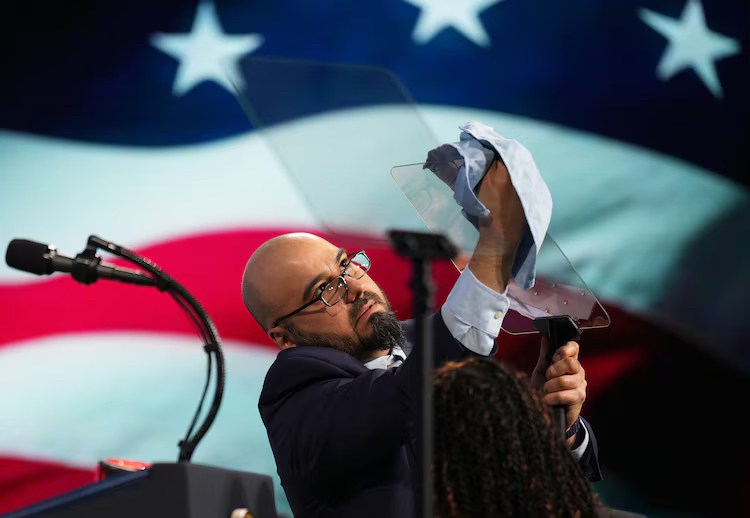

March 27, 2026, Miami Beach, Florida. Perez cleaning the teleprompter before Trump's speech at the Future Investment Initiative Institute summit.


The person involved, Gabriel Perez, has been operating teleprompters for Trump since 2016. He was typically the last among aides to handle and adjust the president's speeches, even receiving last-minute changes from Trump himself. Citing sources familiar with the matter, ABC and CNBC reported that investigators from the Commodity Futures Trading Commission (CFTC) discovered Perez had traded on over a dozen of Trump's public speeches in about three months, covering events such as the State of the Union address, speeches at the World Economic Forum in Davos, prime-time addresses, and Medal of Honor ceremonies.


He used his advance knowledge of speech content to bet on whether specific words, phrases, or topics would be mentioned in the "Mentions" markets on the Kalshi platform. He even withdrew bets mid-speech on occasion when Trump skipped certain sections.


Perez's trading was detected by Kalshi's monitoring system in March of this year, as the patterns did not match typical buy/sell behavior and were additionally flagged by a market maker through a tip line. The platform subsequently froze the account, withheld nearly all profits, and referred the case to the CFTC. Robert DeNault, Kalshi's Head of Enforcement, stated via CNBC that the monitoring team promptly flagged these trades, the platform is assisting regulators, and has submitted gathered evidence.


CNBC reported that Perez accumulated profits exceeding $90,000, but most of the gains have been frozen by Kalshi. Perez is currently in settlement negotiations with the CFTC and could face consequences including disgorgement of all profits and a ban from engaging in similar trading. The Manhattan U.S. Attorney's Office has been informed but decided not to open a criminal investigation.


White House Press Secretary Karoline Leavitt confirmed at a press briefing that Perez has been placed on unpaid administrative leave, is no longer responsible for teleprompter operations, and will not continue working at the White House. According to CNBC, Leavitt revealed that Trump is aware and considers the matter "very unfortunate, truly a disgrace," and personally made the relevant decisions. Leavitt emphasized the White House has extremely strict ethical guidelines, and an internal memo was specifically issued in March warning staff not to trade on prediction markets using non-public information.


The Perez case is not an isolated incident. As early as May 2025, California gubernatorial candidate Kyle Langford traded about $200 in markets related to his own candidacy, made minimal profits, but was ultimately fined $2,246 and banned from the platform for five years. From August to September 2025, a video editor named Artem Kaptur, who used his job to learn show schedules in advance, was flagged for an abnormally high win rate, profiting about $5,400. He faced disgorgement of profits plus a $15,000 penalty and a two-year ban.


In February 2026, former Congressman George Santos, while publicly pledging to attend Trump's State of the Union address, bet that he would not attend and profited tens of thousands of dollars. His account was frozen and referred to regulators and law enforcement. In April of the same year, three congressional candidates were investigated for making small bets in markets related to their own elections, receiving fines ranging from hundreds to thousands of dollars and five-year bans. Even small profits or unwithdrawn gains can lead to platform penalties and regulatory action for trading on insider information.


Image Source: Internet


Another major prediction market platform, Polymarket, has also experienced similar severe violations. According to a previous CNBC report, U.S. Army Special Forces Staff Sergeant Gannon Ken Van Dyke, during his participation in a military operation to capture former Venezuelan President Nicolás Maduro from December 2025 to January 2026, used classified information to purchase large volumes of contracts in related Polymarket markets, profiting over $400,000. He was arrested in April of this year and faces criminal and civil insider trading charges. In May of the same year, Google software engineer Michele Spagnuolo was charged for allegedly using internal company "annual search trends" data to trade on Polymarket from October to December 2025, profiting approximately $1.2 million.
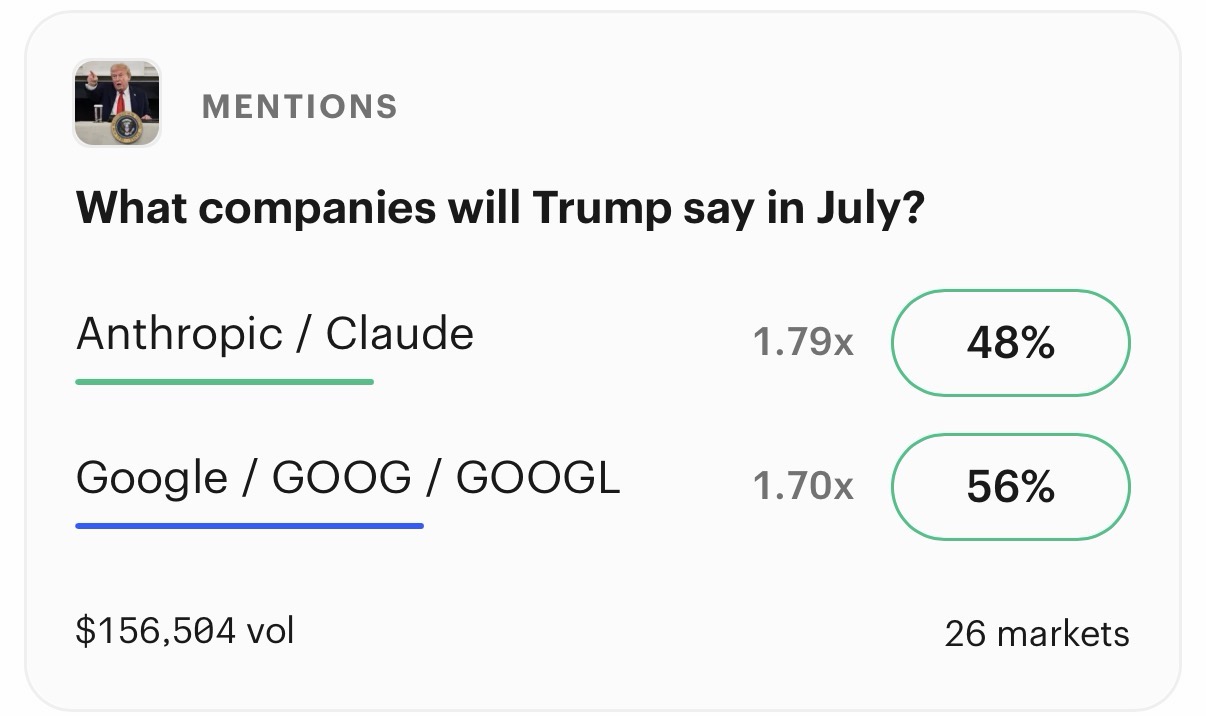


The reason insider trading repeatedly occurs in prediction markets is that informational advantages can be quickly converted into excess returns, and some topic markets have already achieved significant trading volumes that cannot be ignored. For example, on Kalshi, the topic "Which companies will Trump mention in July?" has seen trading volume exceeding $150,000. High-liquidity markets provide ample profit space for insiders, while ordinary users are at a disadvantage due to information asymmetry, damaging market price fairness and platform credibility.


In response to these issues, platforms and regulators are attempting multiple measures to curb them. Kalshi recently updated its policies, requiring traders in certain markets to disclose professional information, and relies on KYC procedures, 24/7 abnormal trading detection, and tip lines to strengthen preventive measures. The platform conducted over 150 investigations in the first quarter of this year, froze more than 100 potentially suspicious trades, and referred over 20 cases to law enforcement agencies.


On the regulatory front, the CFTC has repeatedly cited regulations prohibiting the misuse of non-public information and market manipulation in recent enforcement actions and is collaborating with the Department of Justice to pursue criminal accountability. This means trading using government insider information or corporate data could lead to felony charges such as fraud and money laundering, along with years of imprisonment. The White House has also explicitly prohibited government employees from participating in such betting through internal memos.


Trending Cryptos

Related Questions

QWho is suspected of insider trading related to former President Trump's speeches, and what was their role?

AGabriel Perez, a long-time teleprompter operator for former President Trump, is suspected of insider trading. He was responsible for operating and adjusting the teleprompter for Trump's speeches.

QWhich prediction market platform detected and reported the suspicious trading activity?

AThe prediction market platform Kalshi detected and reported the suspicious trading activity through its monitoring systems and subsequently froze the account and transferred the case to regulators.

QWhat action was taken against Gabriel Perez by the White House following the investigation?

AThe White House placed Gabriel Perez on unpaid administrative leave, relieved him of his teleprompter duties, and he will no longer work at the White House.

QWhat are some other examples of insider trading cases mentioned in the article related to prediction markets?

AOther examples include: former Congressman George Santos betting against his own attendance at a Trump speech; a Google software engineer using internal search trend data on Polymarket; and a U.S. Special Forces sergeant using classified information about a military operation on Polymarket.

QWhat measures are prediction platforms and regulators implementing to prevent insider trading?

AMeasures include: platforms requiring traders in specific markets to disclose their profession, enhancing KYC procedures and real-time monitoring, and cooperating with regulators. Regulators like the CFTC are enforcing rules against misuse of non-public information and market manipulation, and the White House has issued internal memos banning government employees from such betting.

Related Reads

Stable Vaults Are the Final Piece in Aave's Mass Commercialization Puzzle

Aave's introduction of "Stable Vaults" aims to bridge the gap between complex DeFi protocols and mainstream users by offering a simplified, predictable savings product. The core innovation is a fixed-yield layer built atop Aave's volatile underlying lending pools. Partnering platforms (like digital banks or wallets) can offer users a guaranteed interest rate (e.g., 4%), shielding them from market fluctuations. The partner absorbs the risk and profit/loss from the difference between this fixed rate and Aave's variable rate. From the user's perspective, Stable Vaults provide ease of use, predictable returns, and familiar services like customer support and account recovery, addressing key barriers like wallet management and volatility. However, users pay a price: they cap their potential earnings (forgoing higher market yields), add counterparty risk from the partner platform, and may lack transparency into the true spread being captured. For partners, Stable Vaults turn idle user funds into a revenue stream via the yield spread. For Aave, this strategy attracts sticky, "sticky" capital from mass-market applications, providing a stable fee revenue stream crucial for its tokenomics (e.g., buyback mechanisms), especially in bear markets. The article contrasts this approach with direct DeFi interaction, where users keep all yield but face complexity and volatility. It argues that Stable Vaults align with proven consumer behavior: most users prioritize convenience, safety, and predictability over maximizing returns, willingly paying a "peace of mind" premium. Examples like Coinbase and Robinhood offering similar "savings" products validate this demand. Thus, Stable Vaults represent Aave's strategic move to commercialize by catering to fundamental human preferences for simplicity and stability in finance.

marsbit41m ago

Stable Vaults Are the Final Piece in Aave's Mass Commercialization Puzzle

marsbit41m ago

Support Rate Less Than 1%, BIP-110 Still Pushes Bitcoin Towards a Soft Fork?

Title: BIP-110 Pushes Bitcoin Towards a Soft Fork Despite Less Than 1% Approval With its August mandatory activation window approaching, the controversial BIP-110 proposal is back in the spotlight. Proposed in December 2025 by Dathon Ohm and supported by Bitcoin Core developer Luke Dashjr, BIP-110 aims to impose a one-year limit on arbitrary/non-monetary data in Bitcoin transactions, primarily targeting large data storage like Ordinals and Bitcoin NFTs, to reduce network "spam" and refocus Bitcoin on its monetary function. However, the proposal faces overwhelming opposition. To activate, BIP-110 requires a 55% threshold, yet current miner support is below 1%. Of the 102,674 network nodes, only 14.64% (15,035) signal readiness to enforce it. Despite this lack of consensus, BIP-110 has a contentious "mandatory window" mechanism: if the threshold isn't met by block height 961,632, supporting nodes will begin rejecting non-compliant blocks from height 961,632 to 963,647, attempting to force activation by block 965,664. This could lead to a chain split in early August between a minority chain enforcing BIP-110 and the main chain. Proponents, led by Luke Dashjr (founder of Ocean mining pool), argue that inscriptions constitute an "attack" on Bitcoin, congesting block space and raising transaction fees, thereby undermining Bitcoin's primary use as money. They view BIP-110 not as a change but as a reversal of a harmful change. Opponents, including figures like Adam Back, Jameson Lopp, and Michael Saylor, contend that BIP-110 fails to solve the spam problem while creating new risks. They warn it could stifle future innovation (e.g., impacting BitVM), introduce transaction censorship—eroding Bitcoin's neutrality—and potentially cause a damaging chain split that fragments developer resources, hash power, and monetary consensus. They argue market-based fee pressure and block size limits already manage congestion effectively. Potential outcomes post-activation include: 1) The BIP-110 chain stalling due to insufficient hash power; 2) The BIP-110 chain becoming the longest chain if it gains majority miner support (though currently, Ocean holds only 2.6% of hash power vs. opponents like F2Pool at 13.6%); or 3) A persistent minority chain that remains economically unviable, potentially leading to a permanent fork. Most analysts and prediction markets deem BIP-110's success unlikely, with one market giving only a 10% probability that it will become the accepted longest chain by September 2026.

marsbit46m ago

Support Rate Less Than 1%, BIP-110 Still Pushes Bitcoin Towards a Soft Fork?

marsbit46m ago

Mining Stocks Are Moving Further Away from Crypto

Title: Mining Stocks Are Drifting Away from Crypto Summary: Despite Bitcoin (BTC) falling approximately 46% over the past year, leading Bitcoin mining stocks (e.g., HUT, WULF, IREN) have surged significantly. This divergence stems from a fundamental shift in how the market values these companies. Their stock prices are no longer tied primarily to crypto prices, mining output, or hash rates. Instead, investors are now pricing them as AI infrastructure plays. Mining companies possess critical assets for AI data centers: pre-permitted land, grid-connected power capacity, and operational expertise for high-load facilities—resources facing severe shortages and long lead times for new entrants. For example, CleanSpark signed a 20-year, ~$6.6 billion infrastructure lease for an AI data center, while Marathon Digital acquired a project with up to 2 GW of planned power capacity. Analysts note a strong correlation between a mining company's market valuation and its contracted or potential AI power capacity in North America. CoinShares predicts that by year-end, up to 70% of revenue for listed miners could come from AI/HPC, compared to about 30% at the start of 2026. However, this re-rating introduces new risks: 1) Valuation volatility linked to the broader AI/semiconductor sector, 2) Potentially low baseline return rates (estimated at 4-5% for some firms), and 3) Execution risks including massive financing needs, regulatory permits, and tenant quality. This strategic pivot is also changing miner behavior. They are selling BTC holdings more aggressively to fund AI capex, meaning selling pressure may persist regardless of Bitcoin's price. Furthermore, once power and sites are locked into long-term AI contracts, they are unlikely to return to Bitcoin mining, potentially altering the network's hash rate dynamics long-term. In essence, mining firms are being valued for what they are becoming—AI infrastructure providers—rather than pure-play crypto miners.

链捕手52m ago

Mining Stocks Are Moving Further Away from Crypto

链捕手52m ago

Trading

Spot

Hot Articles

Discussions

Welcome to the HTX Community. Here, you can stay informed about the latest platform developments and gain access to professional market insights. Users' opinions on the price of S (S) are presented below.

活动图片