Trump's Shopping Cart: Greenland, the Canal, and Canada

marsbitPublished on 2026-01-08Last updated on 2026-01-08

Abstract

On April 4, 1949, the U.S. and Denmark were among the 12 founding members of NATO. Seventy-six years later, the U.S. threatened military action against Danish territory—Greenland—citing national security. Greenland, an autonomous region of Denmark with a population of 56,000, overwhelmingly opposes joining the U.S. This is not an isolated case. Former U.S. President Trump also targeted the Panama Canal, claiming China controlled it and that the U.S. should “take it back.” Although Chinese firm Hutchison Ports sold its stake, the canal remains under Panamanian control. Additionally, Trump suggested Canada become the “51st state” and join a missile defense system or face high tariffs. His approach mirrors real estate tactics: pressure, threaten, and act if refused—as seen in Venezuela. This transactional logic extends to crypto. Trump’s family launched World Liberty Financial, retaining 75% of token profits. Investments from figures like Justin Sun and Abu Dhabi’s sovereign fund coincided with regulatory relief and a pardon for Binance’s Changpeng Zhao. The article warns that undermining international rules—like NATO—threatens the very system that enables such power. If the U.S. dismantles the order it built, its influence may crumble.

Author: Curry, Deep Tide TechFlow

On April 4, 1949, 12 countries signed the North Atlantic Treaty in Washington.

Two of them were the United States and Denmark.

76 years later, the United States is threatening a military invasion of Danish territory.

White House spokesperson Levitt said, "Military force is always one of the options available to the president." Danish Prime Minister Frederiksen stated that if the U.S. goes through with it, NATO would be over, and the post-World War II security system would collapse.

"Everything would stop."

This is one founding member of NATO speaking to another founding member.

The cause is Greenland.

Trump said the U.S. "needs" the island for national security reasons. Greenland is an autonomous territory of Denmark, covering 2.16 million square kilometers with a population of 56,000, 85% of whom oppose joining the U.S.

Trump doesn't care much about votes. Last weekend, U.S. forces captured Venezuelan President Maduro. Hours after the operation ended, the wife of a senior White House advisor posted a picture on social media: Greenland colored in the U.S. flag's colors, with the caption: SOON.
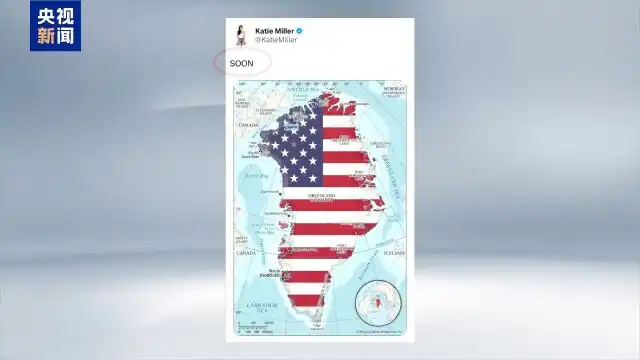
Keep in mind, Venezuela doesn't have nuclear weapons. Neither does Denmark.

But Greenland isn't the only item in Trump's shopping cart.

The Panama Canal is also on the list. Trump claims China "controls" the canal and wants to "take it back." In reality, the canal is operated by Panama's own authority; Hong Kong's Hutchison Whampoa only manages the ports at both ends for loading and unloading containers.

Later, Hutchison Whampoa agreed to sell the ports to BlackRock. Trump didn't get the canal, but Chinese capital was pushed out.

Canada is on the list too. Trump says Canada should become the "51st state," offering free inclusion in his $175 billion "Gold Dome" missile defense system as an incentive. Not joining? Then pay $60 billion to buy it separately.

After two Canadian prime ministers refused, tariffs followed: 100% on pharmaceuticals, 30% on furniture, 25% on trucks.

If negotiations fail, raise the price.

Trump views the world the same way he views Manhattan real estate.

Every piece of land has a price. Greenland has rare earth minerals, Panama has shipping lanes, Canada has resources. If talks stall, apply pressure; if pressure fails, threaten; if threats fail, take action. Venezuela has already seen action.

This logic is also used in the crypto space.

In 2024, the Trump family launched World Liberty Financial to sell tokens, with the family taking 75% of the profits. Justin Sun invested $30 million, and weeks later, the SEC dropped its investigation into him. Abu Dhabi's sovereign fund invested $2 billion in stablecoins into Binance, and shortly after, Changpeng Zhao received a pardon.

Investment in exchange for regulatory exemptions, investment for presidential pardons. Clearly priced, fair to all.

The real estate business works because there is a set of rules. There are courts to enforce contracts, police to protect property rights, and governments to recognize deeds.

Without these, a deed is just a piece of paper.

In the international order, NATO is that set of rules. The U.S. spent 76 years building it. Now the largest shareholder says, I want to tear down the neighbor's house.

He probably thinks the rules are his to change as he pleases.

The question is, if a real estate tycoon dismantles the rules, will his own deeds still hold value?


Related Questions

QWhat was the reason given by Trump for the US 'needing' Greenland?

ANational security.

QWhich country's president was captured by US military action in Venezuela according to the article?

APresident Maduro of Venezuela.

QWhat did Trump claim about China's role in the Panama Canal, and what was the actual situation?

ATrump claimed China 'controlled' the canal, but in reality, it is operated by Panama's own authority, with Hong Kong's Hutchison Whampoa only operating ports at both ends.

QWhat was the name of the token project launched by the Trump family in 2024, and what percentage of profits did the family take?

AWorld Liberty Financial, with the family taking 75% of the profits.

QWhat did the White House spokesperson say about military force regarding Greenland?

AThe White House spokesperson, Levitt, stated that 'military force is always one of the options the president can use.'

Related Reads

"119 to 176 Dollars": Behind SpaceX's Listing, MSX Once Again Successfully Executes the Pre-IPO Closed Loop

Following May's 300% gain on Cerebras, MSX delivered another outstanding performance during SpaceX's listing night. On June 12, SpaceX (SPCX) launched on Nasdaq, reaching a high of $176. This marked the successful culmination of MSX's Pre-IPO project launched in March, where users subscribed at $119, achieving gains of approximately 40-48%. This event validated MSX's complete Pre-IPO mechanism, a crucial advantage in a market where access to top-tier private company equity is typically limited to institutions. MSX's model provides a full cycle for users: subscription (at $119 for SpaceX), real-time on-chain portfolio tracking, optional early redemption, seamless conversion to tradable spot assets (SPCX.M) upon IPO, and final settlement in stablecoins. This end-to-end process distinguishes MSX from platforms that faced settlement issues during the SpaceX IPO, highlighting that the core challenge of Pre-IPO is not just access, but a clear exit and conversion path post-listing. This success with SpaceX is MSX's second major Pre-IPO verification, following the Cerebras listing in May, which yielded ~300% returns for early participants. These back-to-back achievements demonstrate MSX's capability to source, structure, and deliver real assets through a replicable on-chain model. The true barrier for Pre-IPO products lies not in providing an entry point, but in ensuring reliable fulfillment from subscription through to post-IPO liquidity. MSX's proven闭环 (closed-loop) process addresses this, offering Web3 users a structured way to access high-growth, pre-public companies in sectors like AI and frontier tech. MSX plans to continue expanding its Pre-IPO portfolio with this focus on authenticity, transparency, and post-listing execution.

Odaily星球日报9h ago

"119 to 176 Dollars": Behind SpaceX's Listing, MSX Once Again Successfully Executes the Pre-IPO Closed Loop

Odaily星球日报9h ago

Trading

Spot
Futures

Hot Articles

Discussions

Welcome to the HTX Community. Here, you can stay informed about the latest platform developments and gain access to professional market insights. Users' opinions on the price of S (S) are presented below.

活动图片














