Trump-Era CFTC Rescinds Biden-Era Crackdown on Sports and Election Wagering: $MAXI Set to Dominate

bitcoinistPublished on 2026-02-05Last updated on 2026-02-05

Abstract

The CFTC has rescinded a Biden-era proposal to ban event contracts, including political and sports betting, shifting the regulatory landscape toward free markets. This move is seen as a green light for risk assets and speculative trading, creating a liquidity vacuum that benefits platforms like prediction markets. The decision validates high-stakes crypto trading culture, fueling interest in volatile assets. Maxi Doge ($MAXI) is positioned to capitalize on this shift, offering a gamified trading ecosystem with competitions and staking rewards. The project has raised over $4.5M in presale and attracted significant whale investments, aligning with the new deregulatory environment. It aims to serve as a leverage-focused economy for traders embracing high-risk strategies.

The regulatory pendulum in Washington hasn’t just swung; it snapped back toward free markets.

By officially rescinding the Biden-era proposal to ban contracts involving political contests, gaming, and war, the Commodity Futures Trading Commission (CFTC) has fundamentally altered the landscape for high-risk derivatives. This withdrawal, originally spearheaded by former Chair Rostin Behnam, marks a hard stop to the aggressive ‘nanny state’ oversight that characterized the previous administration’s approach to event contracts.

This creates a massive liquidity vacuum. Previously, platforms like Kalshi and Polymarket faced existential threats just for listing congressional control contracts. Now? The rescission (frankly, a surprise to many legal observers) effectively legalizes the financialization of real-world outcomes.

Markets aren’t just seeing this as a win for election betting; they’re interpreting it as a green light for risk assets across the board. When the regulator steps back, volatility steps up.
The psychological impact on retail traders is immediate.

Removing these barriers validates the ‘high-stakes’ culture that crypto natives have been building for years. Capital previously sidelined by regulatory fear is now hunting for assets that embody this renewed spirit of conviction and leverage.

As the traditional financial guardrails come down, traders are rotating into projects that gamify volatility rather than run from it. That is the exact macro environment fueling the rise of Maxi Doge ($MAXI).

Unleashing The Leverage Economy With Gym-Bro Precision

The CFTC’s retreat creates a specific narrative opening: the normalization of ‘degen’ trading culture. While traditional finance builds products for safety, the current crypto zeitgeist demands products for amplification.

Maxi Doge sits right at that intersection. Unlike typical meme coins that rely solely on passive holding, this project identifies as a ‘trading community’ built for the 1000X mindset. The branding isn’t about cuteness.

With a 240-lb canine juggernaut mascot, it’s about the ‘heavy lifting’ required to survive a volatile bull market.
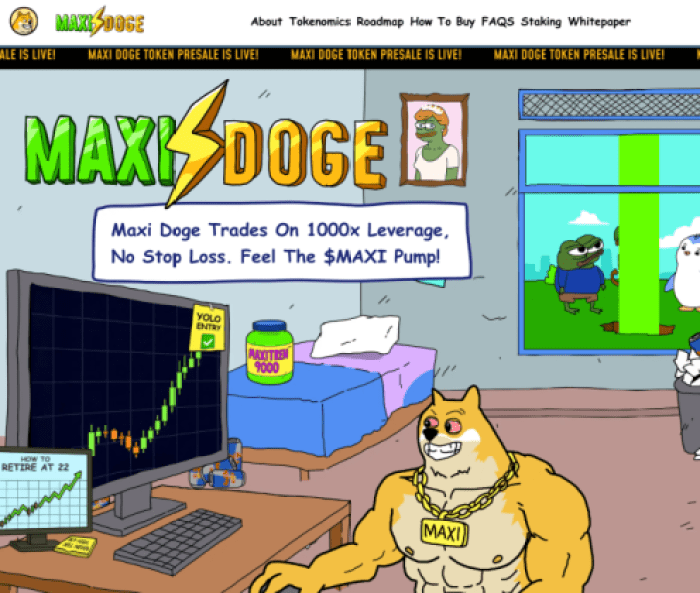

Why does this matter to the post-CFTC news cycle? It comes down to utility. As prediction markets open up, retail traders are looking for arenas to prove their edge. $MAXI plans to integrate ‘Holder-Only Trading Competitions’ directly into its ecosystem, gamifying the very activity regulators tried to suppress.

By offering leaderboard rewards to top ROI hunters, the project creates a synergy with the broader market’s shift toward speculative freedom.

Plus, the ‘Maxi Fund’ treasury introduces a layer of strategic capital management often missing in this sector. (The risk here is usually treasury mismanagement, but the project’s smart contract governance aims to mitigate that).

Rather than just a token, it hopes to function as a localized economy for traders who believe leverage is a feature, not a bug. In an environment where the government has stopped trying to protect traders from themselves, tools empowering aggressive strategies are primed to capture market share.

FIND OUT MORE ABOUT $MAXI

Smart Money Rotates Into High-Octane Assets

While headlines focus on the CFTC’s legal maneuvering, on-chain data suggests institutional capital is already front-running the expected surge in risk appetite. Smart money is moving.

Etherscan data reveals high-net-worth wallets buying $MAXI, up to sums as large as $314K . This specific timing, aligning with the shifting regulatory rumors, suggests sophisticated actors are positioning for a breakout in ‘culture coins’ offering leverage-like returns.

The financial metrics of the Maxi Doge presale back this up. According to the official presale page, the project has already raised over $4.5M, with tokens currently priced at $0.0002802. That level of capital injection during a presale phase indicates a conviction that extends well beyond simple retail FOMO.

Investors are also looking at yield sustainability. The project offers staking rewards with daily automatic distribution, but unlike static yield farms, the dynamic APY is designed to reward long-term conviction. Think of it as the ‘never skip leg day’ philosophy applied to your portfolio.

For traders watching the CFTC clear the runway for speculative markets, the combination of a $4.5M+ raise and significant whale accumulation signals that $MAXI is positioning itself as a primary vehicle for this new, deregulated cycle.

GET YOUR $MAXI BEFORE THE NEXT PRICE INCREASE

This article is for informational purposes only and does not constitute financial advice. Cryptocurrencies are high-risk assets, and presale tokens carry significant volatility. Always conduct your own due diligence before investing.


Related Reads

The Gold Buy-on-the-Dip Guide: Watch Interest Rates, Not Just War

"Gold Buying Guide: Focus on Interest Rates, Not Just War" Four months ago, gold buyers likely didn't anticipate buying at a peak that even a war couldn't sustain. After hitting a record high of $5,596 on January 29, gold entered a bear market just 91 days later, its fastest decline since 2008. A key trigger was the Fed's hawkish shift, highlighting that monetary policy, not geopolitics, is the primary driver. The article argues that the traditional "buy gold in turmoil" script has changed. While the US-Iran conflict initially boosted prices, the sustained rally in oil prices heightened inflation fears, forcing central banks to maintain or consider tighter policy. Since gold yields no interest, higher rates increase its opportunity cost, eroding its appeal. This dynamic was evident when gold fell sharply on May 18 despite positive peace talks, as lower oil prices eased inflation and thus rate hike pressures. The recent sell-off is also part of a broader market deleveraging. Correlations between gold, Nasdaq, and Bitcoin spiked as leveraged investors sold liquid assets to cover losses, creating a synchronized downturn. Historically, gold bottoms align with policy shifts, not conflict resolutions. The 2008 and 2022 bear markets ended with shifts to extreme easing and peak inflation expectations, respectively. For potential buyers, the author suggests monitoring three signals: 1) Peak interest rate hike expectations, 2) Reopening of the Strait of Hormuz (to ease oil/inflation pressure), and 3) A return to net inflows for Gold ETFs, indicating the end of forced selling. While predicting the exact bottom is impossible, the author's personal strategy involves scaling into a position across price levels like $4000, $3700, and $3500, committing no more than 30% of the intended total allocation initially, and adding the remainder only if key signals emerge. The core conclusion: In turbulent times, watching interest rates is more crucial than watching wars.

marsbit9m ago

The Gold Buy-on-the-Dip Guide: Watch Interest Rates, Not Just War

marsbit9m ago

Recent On-Chain Review: No Clear Narrative Under U.S. Stock Market Pressure, Just Hype

This article analyzes the current state of the Solana meme coin and community token ecosystem, highlighting a market caught between two dominant forces: attention-based PvP and a gradual return to community-centric projects. The first part explores the "Attention PvP" dynamic, where success is driven by celebrity endorsements, viral events, and speed. Examples include $JOTCHUA, which surged after its meme creator's social media activity, and $WORLDCUP, which outperformed a similar Base chain project ($PITCH) largely due to influencer support. The recent "pump.fun GO" feature, allowing bounty tasks for token promotion, is critiqued for fostering sensationalist and often negative stunts—like people getting token tickers tattooed on their bodies for rewards—reminiscent of old internet shock content. In contrast, the article points to a resurgence of organic, community-driven tokens that survive market volatility through strong holder bases and shared ideology, not just hype. Influencer Ansem is cited, arguing that durable meme coins rely on communities willing to endure losses and promote their core message daily. Examples given are older tokens like $neet (anti-work ethos), $troll, $buttcoin, and $triplet, which have maintained relative price stability. A prime example of this community-build model is the new project $KINS, the token for the browser-based MMORPG Kintara. Its success stems not from advanced graphics but from consistently delivering updates, fostering player trust, and creating genuine engagement (e.g., in-game economies, events, property auctions). It has attracted a growing player base and even notable KOLs as participants, demonstrating that sustainable growth can come from building trust rather than orchestrating pumps. The article concludes by questioning whether the market is ultimately a game of mutual trust or mutual deception, expressing hope that such reflection might lead to a healthier ecosystem.

marsbit9m ago

Recent On-Chain Review: No Clear Narrative Under U.S. Stock Market Pressure, Just Hype

marsbit9m ago

On-Chain Scene on Opening Day: $20 Billion Already Staked, How Do On-Chain Contracts Know Who Wins?

On the opening day of the 2026 World Cup, over $2 billion had already been wagered on just the "tournament winner" contracts on platforms like Polymarket and Kalshi. This article explores how these blockchain-based prediction markets actually function once the games begin. It breaks down the massive volume and explains how single-game and tournament-long contracts are priced, with values moving between 1-99 cents to reflect implied probabilities. A key mechanism highlighted is "elimination zeroing," where a team's "champion yes" contract immediately settles to zero once they are mathematically eliminated. The core technical question answered is: how does a smart contract "know" who won a real-world match? The answer lies in oracles. The article details two primary paradigms: UMA's "optimistic oracle" (used by most of Polymarket), which allows a challenge period after a proposed result, and Chainlink's multi-source data aggregation (used by FIFA partners like ADI Predictstreet), which automates settlement with minimal dispute windows. Finally, the article injects a note of caution, citing research estimating that a significant portion of historical trading volume on these platforms might be "wash trading" to inflate numbers. It concludes by contrasting the legal status of these "event contracts" under CFTC rules in the U.S. versus traditional, state-regulated sports betting. As the tournament progresses, the real-time operation of this multi-billion dollar machine—its settlements, eliminations, and underlying mechanisms—becomes a story as compelling as the football itself.

marsbit24m ago

On-Chain Scene on Opening Day: $20 Billion Already Staked, How Do On-Chain Contracts Know Who Wins?

marsbit24m ago

Sequoia Dialogue with Jensen Huang: Computing Model Undergoes a 60-Year Transformation; You Won't Be Replaced by AI, But You Will Be Dimensionality-Reduced by 'Those Who Master AI'

NVIDIA founder and CEO Jensen Huang, in a conversation with Sequoia Capital's Konstantine Buhler, argues that we are witnessing the most significant computing shift in 60 years—from retrieval-based to generative computing. Instead of just storing and retrieving data, future systems will generate highly personalized content (text, images, video) on demand, powered by massive "AI factories." Huang envisions a global "intelligence network" that will envelop the planet, following the historical patterns of energy and communication grids. He outlines a five-layer investment framework: 1) Energy, 2) Chips/Computers, 3) Infrastructure (data centers), 4) AI Models, and 5) Applications. He predicts this ecosystem will reach a scale of $20 trillion annually. Crucially, Huang pushes back against fears of AI-driven job loss. He distinguishes between specific "tasks" (e.g., typing, analyzing images) and overall "jobs" (e.g., CEO, radiologist). While AI automates tasks, it increases efficiency and demand for the higher-value problem-solving aspects of professions, thus creating more jobs and "up-leveling" careers. The real risk, he asserts, is not being replaced by AI, but being outperformed by someone who effectively leverages it. He urges everyone to embrace AI as a tool for augmented capability and innovation.

marsbit1h ago

Sequoia Dialogue with Jensen Huang: Computing Model Undergoes a 60-Year Transformation; You Won't Be Replaced by AI, But You Will Be Dimensionality-Reduced by 'Those Who Master AI'

marsbit1h ago

Trading

Spot
Futures

Hot Articles

Ethena: Building a New Era of Web3‑Native Digital Dollars

Ethena is an Ethereum‑based synthetic dollar protocol that delivers crypto‑native monetary solutions, including USDe, a synthetic dollar, and sUSDe, a globally accessible U.S. dollar savings asset.

53.2k Total ViewsPublished 2026.03.16Updated 2026.03.16

Ethena: Building a New Era of Web3‑Native Digital Dollars

Discussions

Welcome to the HTX Community. Here, you can stay informed about the latest platform developments and gain access to professional market insights. Users' opinions on the price of ERA (ERA) are presented below.

活动图片