Top 5 Crypto Companies That Have Earned the Most from AI

cryptonews.ruPublished on 2026-08-03Last updated on 2026-08-03

Abstract

Here is a summary in English of the article titled "Top 5 crypto companies that earned the most from AI": The growth of the AI market is prompting many crypto miners to shift their business strategies, leasing their computational power for training neural networks instead of mining Bitcoin. This is due to AI offering more stable demand, long-term contracts, and often higher returns. The top earners are: 1. **Hut 8**: Leading with $26 billion in AI revenue, the company builds and operates energy infrastructure and large data centers, now leasing dedicated AI facilities to major tech clients. 2. **IREN**: Earned approximately $4 billion by providing GPU clusters from its data centers for AI training and inference, while still mining Bitcoin. 3. **Core Scientific**: Generated about $31 million by managing large data centers for both mining and AI, having retrofitted some mining sites for powerful GPU systems to serve cloud AI providers. 4. **TeraWulf**: With revenue of roughly $21 million, it creates energy-powered data centers for high-performance computing, hosting client equipment while continuing its mining operations. 5. **Bitdeer**: Earned around $3.7 million by offering full-cycle mining infrastructure and renting out NVIDIA GPU-based computing power for AI model training. Other notable companies mentioned include Cipher Mining and CleanSpark, which also lease their facilities for high-performance computations.

The growth of the AI market has forced many crypto miners to change their business strategies. Instead of mining bitcoin, they are increasingly renting out their computing power for training neural networks. The reason is simple: AI provides more stable demand for services, long-term contracts, and often higher profitability than mining.

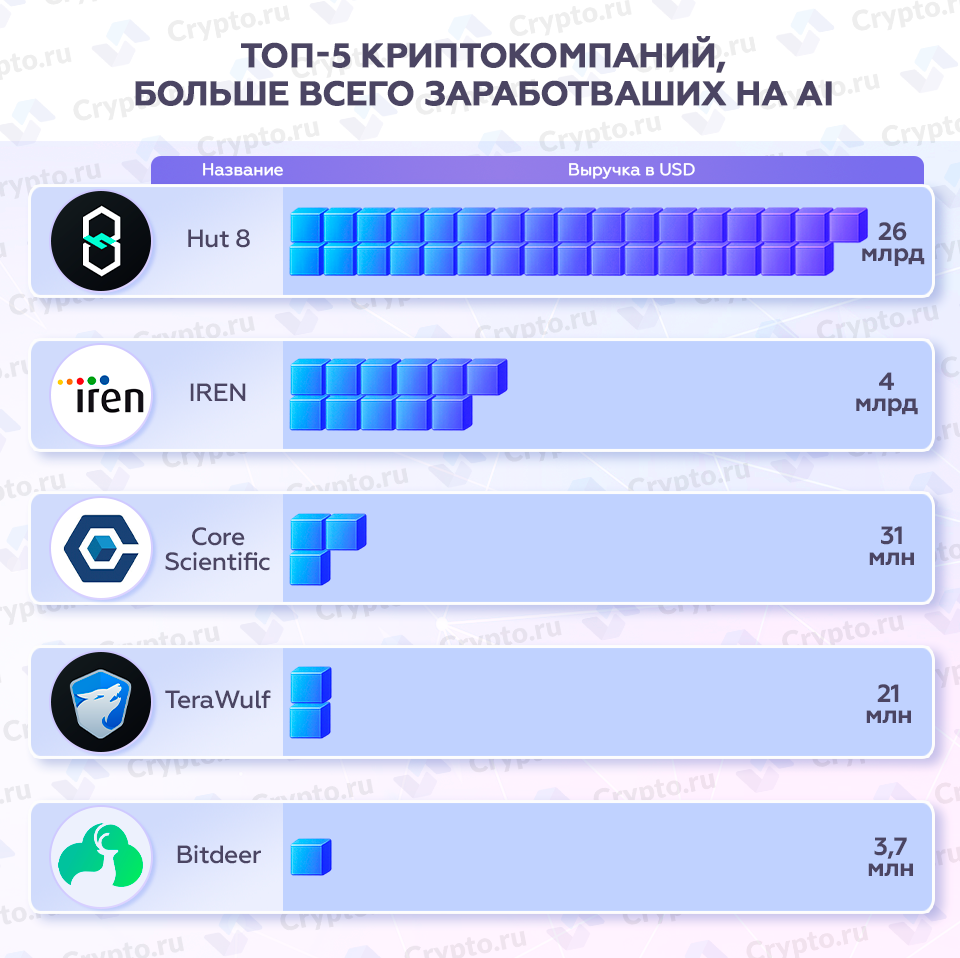
The leader of the ranking is the company Hut 8, which earned $26 billion in the AI sector. The company builds and operates energy infrastructure and large data centers. Previously, the company was actively involved in mining, but is now developing separate sites for artificial intelligence and leasing them on a long-term basis to major technology customers.

Next is the service IREN. The company managed to earn about $4 billion. The company owns data centers and provides computing power for artificial intelligence. Clients rent GPU clusters from IREN for training and running neural networks. The company also continues to mine bitcoin, but its main development is linked to AI Cloud and the construction of specialized AI centers.

Third place is occupied by Core Scientific with revenue of about $31 million. The service manages large data centers for mining and artificial intelligence development. The company has repurposed part of its mining facilities to house powerful GPU systems. It also provides infrastructure to cloud AI providers, including power supply, cooling, and technical maintenance.

Next is the company TeraWulf with revenue of approximately $21 million. The platform creates energy-powered data centers for high-performance computing. The company hosts client equipment, providing it with electricity, cooling, and network infrastructure. At the same time, the organization still engages in mining.

Rounding out the top five is the organization Bitdeer with revenue of about $3.7 million. It develops a full cycle of infrastructure for mining. Regarding the AI direction, the service leases capacity based on NVIDIA graphics processors. This allows users to train AI models and conduct energy-intensive computations. Several other companies did not make it into the final ranking, but they deserve mention:

  • Cipher Mining. Considered one of the largest miners in the USA.
  • CleanSpark. Another American miner. Leases its sites for high-performance computing.

We remind you that earlier the Crypto.ru editorial team published an infographic about the largest crypto exchanges with a MiCA license in July 2026.
end-content

Trending Cryptos

Related Questions

QWhat is the main reason why many crypto miners are shifting their business strategies from Bitcoin mining to AI-related services according to the article?

AAccording to the article, the main reason is that AI provides more stable demand for services, long-term contracts, and often higher profitability compared to mining.

QWhich company is ranked first in the list of crypto companies earning the most from AI, and what is its reported revenue?

AThe company ranked first is Hut 8, which reportedly earned $26 billion in the AI sector.

QWhat does the company IREN primarily provide to its clients, and what is its approximate revenue from AI?

AIREN owns data centers and provides computing power for artificial intelligence. Its clients rent GPU clusters from IREN for training and running neural networks. The company earned approximately $4 billion.

QName two crypto companies mentioned in the article that were not included in the top five but are worthy of mention.

AThe two companies mentioned are Cipher Mining, described as one of the largest miners in the USA, and CleanSpark, another American miner that rents out its sites for high-performance computing.

QWhat is a common activity that several of the top-earning crypto companies, like IREN, TeraWulf, and Bitdeer, still engage in alongside their AI services?

ASeveral of these companies, including IREN, TeraWulf, and Bitdeer, still engage in Bitcoin mining alongside their AI-related services.

Related Reads

Once-Popular Web3 Enters Wave of Layoffs

The once-hot Web3 industry is experiencing a severe wave of layoffs. While many companies attribute job cuts to AI-driven restructuring, the primary reason is often financial pressure. The Web3 sector, at the intersection of tech and finance, has been hit particularly hard. Employees at major cryptocurrency exchanges report sudden, impersonal layoffs—often with system access revoked overnight—and minimal or no severance. Common tactics include setting impossible performance targets or terminating employees for minor policy violations. The working atmosphere has become toxic, marked by intense monitoring, excessive meetings, and management obsessed with control and internal politics rather than product innovation. The industry's core business model is collapsing. Exchange revenue from trading fees and listing charges has plummeted due to a decline in quality projects and retail investor exodus. Events like the massive forced liquidation on October 10th further shattered confidence. Competition from on-chain derivatives platforms and prediction markets is intensifying the downturn. As layoffs continue, displaced workers struggle to find new opportunities. Many transition to the AI sector, but face significant bias from traditional finance and even some AI firms, which view crypto industry experience with suspicion. The current downturn appears more structural than cyclical, driven by unsustainable practices, internal strife, and a failure to innovate, raising questions about the industry's future trajectory.

marsbit22m ago

Once-Popular Web3 Enters Wave of Layoffs

marsbit22m ago

Sales Drop 26% But Prices Rise? Xiaomi's Dilemma

Xiaomi, facing a significant 26.3% year-on-year decline in global smartphone shipments in Q2 2026, has implemented its third price hike of the year. On August 2nd, prices were raised for nine models, including the flagship Mi 17 series (up 400-500 yuan) and Redmi K90/Turbo 5 series (up 300 yuan). This move completes a pattern where cost pressure, originating from surging memory chip prices, has climbed from entry-level to mid-range and now flagship products. The primary driver is a severe supply squeeze on consumer-grade DRAM and NAND flash memory, as major manufacturers like Samsung shift advanced capacity to more profitable HBM for AI applications. According to Xiaomi President Lu Weibing, memory prices for the same configuration have skyrocketed nearly fourfold since Q1 2025, adding roughly 1500 yuan to the cost of a mainstream 12GB+512GB phone. IDC estimates consumer memory costs have risen nearly 300% year-on-year. While the price increases hurt demand and contributed to the sales slump, Xiaomi's strategy of reducing entry-level models and upgrading its product mix also played a role. Domestically, its market share in China fell to 12% (5th place), while leaders Huawei and Apple saw shipments grow over 24%. To mitigate future risks, Xiaomi is accelerating its in-house "Surge" chip development and optimizing memory configurations across its lineup. Xiaomi is not alone; major brands like OPPO, vivo, and Apple have already raised prices in 2026, with industry insiders predicting another round of increases (200-800 yuan) in the second half. A full-scale industry-wide涨价 cycle is underway, forcing both manufacturers and consumers to recalibrate their strategies and purchasing decisions amid sustained cost pressures.

marsbit33m ago

Sales Drop 26% But Prices Rise? Xiaomi's Dilemma

marsbit33m ago

Three Consecutive Quarters of Decline: The Crypto Market is Experiencing Its Longest Ebb Since 2022

The cryptocurrency market experienced its third consecutive quarterly decline in Q2 2026, marking its longest downturn since 2022, according to a CoinGecko report. The total market capitalization fell 12.6% to $2.1 trillion, a retreat of roughly 52% from its October 2025 peak. Multiple indicators signal an orderly capital exit from the sector. For the first time since Q3 2023, the total stablecoin market cap shrank (-1.6% to $305.1B), indicating funds are leaving the ecosystem entirely, not just rotating to safer crypto assets. Trading volumes on centralized exchanges dropped 27.9%, while DeFi's Total Value Locked (TVL) plummeted 23.4%. Both Bitcoin (-14.2%) and Ethereum (-25.4%) underperformed traditional risk assets like equities in Q2, breaking from previous correlative narratives. Ethereum saw its first-ever three-quarter losing streak, with its market share falling to around 10%. A few areas saw growth. Prediction market volumes surged 48.7%, largely driven by sports betting. Hyperliquid's HYPE token entered the top 10 by market cap, and tokenized collectibles platforms grew, though primarily via gamified mechanics. Despite a ~9.8% Bitcoin rebound in July, historical trends suggest caution for August. The market, now ~49% below its 2025 high, is undergoing a measured retreat. Its recovery hinges on future Federal Reserve policy and the industry's ability to develop sustainable revenue streams beyond speculation.

marsbit47m ago

Three Consecutive Quarters of Decline: The Crypto Market is Experiencing Its Longest Ebb Since 2022

marsbit47m ago

Trading

Spot

Hot Articles

Discussions

Welcome to the HTX Community. Here, you can stay informed about the latest platform developments and gain access to professional market insights. Users' opinions on the price of AI (AI) are presented below.

活动图片