To Buy Discounted ETH, How to Choose Between Bitmine and SharpLink?

marsbitPubblicato 2026-07-03Pubblicato ultima volta 2026-07-03

Introduzione

"Buying Discounted ETH: SharpLink vs. Bitmine" analyzes two major treasury companies during a period of low ETH prices. Both hold significant ETH positions at a loss: SharpLink (with ~886.7K ETH at an average cost of ~$3,609, unrealized loss >$1.7B) and Bitmine (with 5.7M ETH, ~4.7% of supply, cost ~$3,400, loss >$11B). Despite similar ETH price declines and inclusion in Russell indices, their market valuations differ markedly. SharpLink trades at a ~21% discount to its ETH net asset value (NAV), while Bitmine's discount is only ~6%. The article compares them across key dimensions: financing ability (Bitmine raised $19.2B aggressively vs. SharpLink's smaller, steady raises), stock liquidity (Bitmine is significantly more liquid), and narrative execution (both support Ethlabs; SharpLink plans RWA tokenization, yet to materialize). For short-term trading on an ETH rebound, Bitmine offers better liquidity and a smaller NAV discount. For long-term holding, SharpLink's deeper discount and simpler capital structure (vs. Bitmine's perpetual preferred shares) may offer more upside if ETH recovers, though it carries higher liquidity risk. The choice depends on the investor's risk preference between SharpLink's visible price/ liquidity weakness and Bitmine's hidden risks in its capital structure and past valuation premiums.

Author:Zhou,ChainCatcher

In this downturn for ETH, the two largest treasury companies are already facing unrealized losses of over 50%.

SharpLink has resumed accumulation after an eight-month hiatus, recently purchasing a cumulative 39,196 ETH at an average cost of around $3,609, now facing unrealized losses exceeding $1.7 billion.

Bitmine has continued to expand its balance sheet in the same period, with holdings reaching 5.7 million ETH, accounting for approximately 4.7% of ETH's circulating supply, and unrealized losses have surpassed $11 billion.

Both companies have been included in the Russell Indexes and are also funders of the newly established Ethereum research institute, Ethlabs.

The two companies' holding costs and stock price declines are actually quite similar, yet the valuation discount the market is willing to give them shows a clear divergence. SharpLink trades at a discount of about 21% relative to its ETH net asset value, while Bitmine's discount is only about 6%, a difference of over three times.

If this ETH downturn bottoms out and investors want to gain indirect ETH exposure through stocks, which one should they choose between SharpLink and Bitmine?

The answer may not lie in who tells a better story, but in specific dimensions such as holding cost, financing capability, liquidity, and whether narratives can materialize, especially in understanding where this discount divergence comes from.

What Chips Do They Hold?

SharpLink holds a complete institutional narrative: Ethereum co-founder Joe Lubin serves as Chairman, and former BlackRock digital asset executive Joseph Chalom holds the position of Co-CEO; the company began promoting RWA tokenization collaborations last year, planning to tokenize SharpLink's own stock on Ethereum.
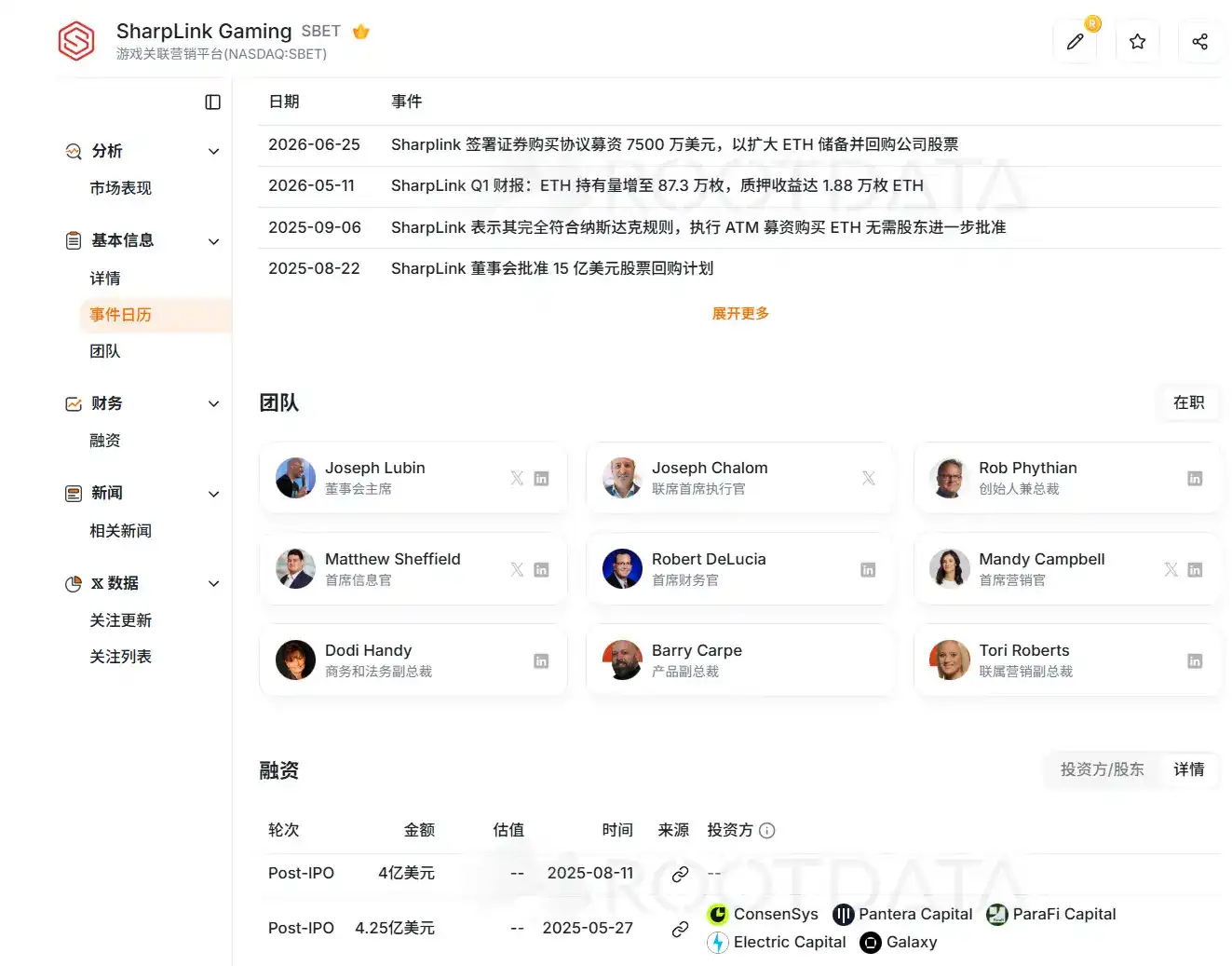
Image Source:RootData

Add inclusion in the Russell Index and the cumulative revenue from ETH staking. Each of these labels individually could justify a valuation premium story.

Bitmine's chips are more straightforward scale advantages. Holdings of 5.7 million ETH, and Chairman Tom Lee's own market voice and media exposure far exceed peers.

The company was included in the higher-threshold Russell 1000 Index. According to management, this will bring in hundreds or even thousands of new institutional investors, as passive funds typically hold 18% to 20% of a public company's float.

Both lists of chips look strong, but the market has ultimately only recognized the discount repair for one. What really created the gap are several more specific metrics.

Holding Costs and Stock Price Reaction

First, the most direct question: who bought ETH cheaper?

According to SharpLink's June 30 announcement, the company purchased 10,000 Ethereum at an average price of approximately $1,611, increasing total holdings to 886,725 ETH, consisting of 632,719 native ETH, 181,299 ETH redeemable via LsETH, and 72,707 ETH redeemable via weETH.

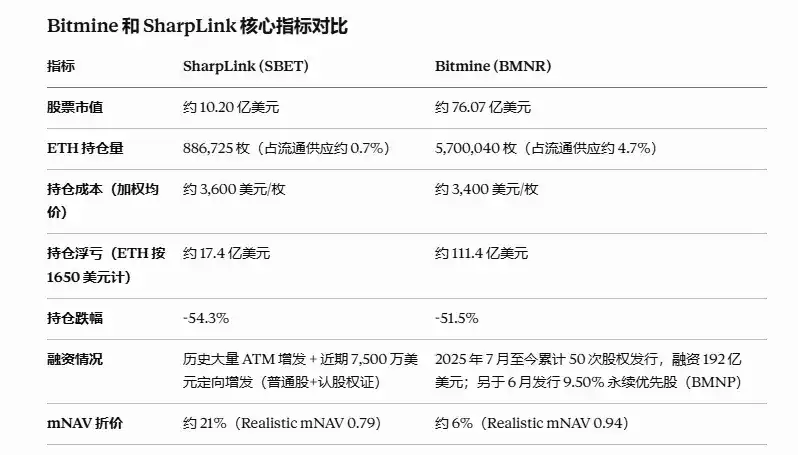
SharpLink's average holding cost is approximately $3,609 per ETH. At the current price of around $1,650, the unrealized loss is about $1.74 billion, a decline of approximately 54.3%.

As of June 28, 2026, BitMine's total Ethereum holdings reached 5,700,040 ETH, accounting for about 4.7% of Ethereum's total supply. According to on-chain data, its holding cost is approximately $3,400 per ETH, with unrealized losses of about $11 billion, a decline of approximately 51.5%.

The two companies' holding costs and percentage declines are actually very close. The gap lies in the absolute size of holdings; Bitmine is 6.4 times larger than SharpLink, and the absolute value of unrealized losses is correspondingly magnified by over 6 times.
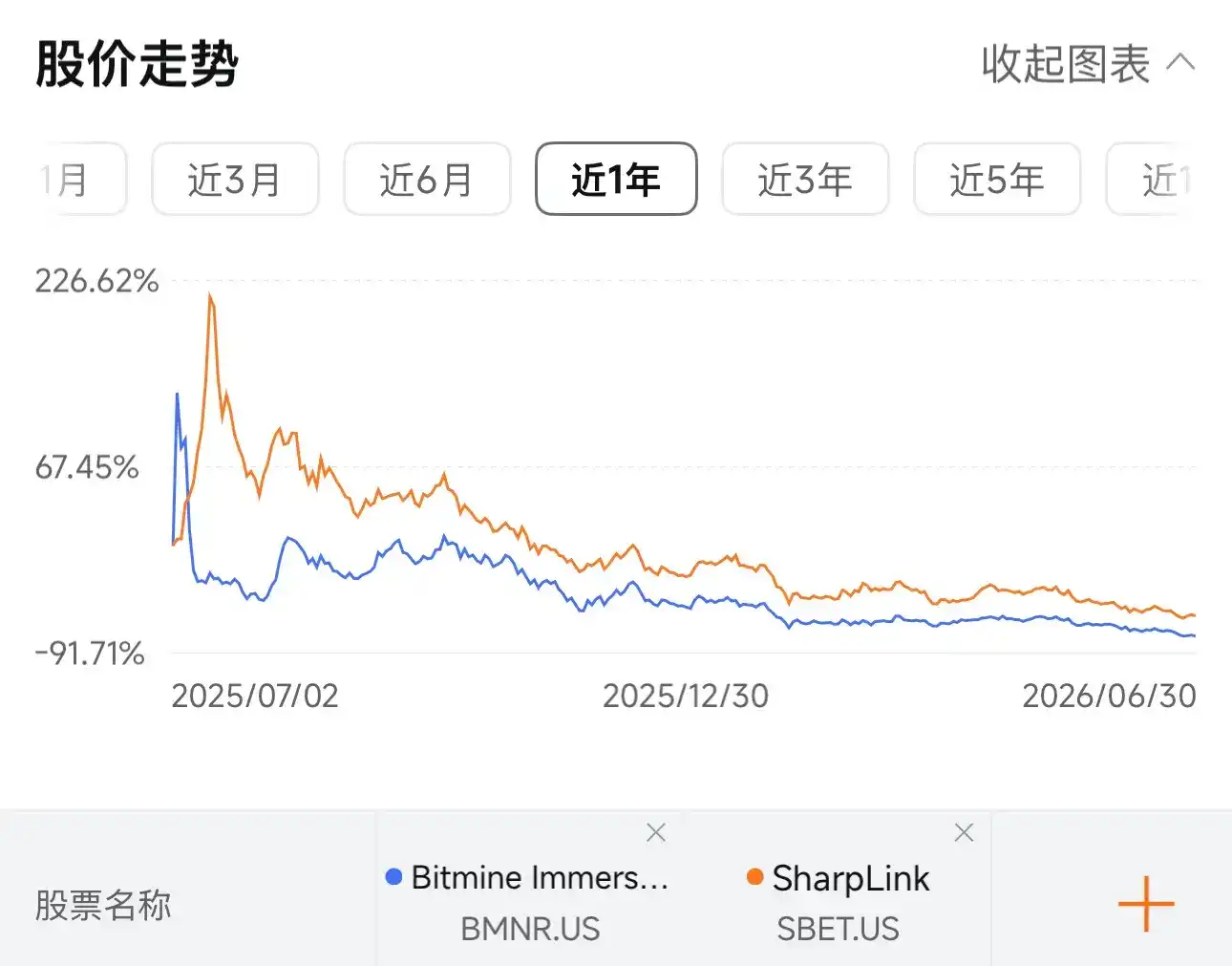
At the stock price level, the trends of the two are also highly similar, both experiencing a sharp initial surge post-IPO, followed by a continuous decline, and are currently consolidating at low levels.

As of the close on July 1st, SharpLink's stock price has fallen from a high of $124 to around $5, a drawdown of about 96%. Bitmine has fallen from a high of $160 to around $14, a drawdown of about 91%. In terms of market cap, SharpLink is approximately $1.02 billion, and Bitmine is about $7.6 billion.
Financing Capability and Liquidity

SharpLink's financing history has essentially been continuous small-scale offerings. The company has primarily relied on ATM offerings to raise funds for gradually purchasing ETH. This method has a slow fundraising pace and causes gradual dilution.

The funds for resuming accumulation mainly come from a $75 million private placement completed at the end of last month, issuing 1,001.34 million shares of common stock and an equal number of warrants, with funds explicitly for working capital, continued ETH accumulation, and share repurchases.

Besides financing to buy tokens, SharpLink also enhances returns through staking. Since initiating its ETH treasury strategy, the company's cumulative staking reward income has reached 22,102 ETH.

In contrast, Bitmine's financing pace has been much more aggressive. According to a 10x Research report, Bitmine raised a cumulative $19.2 billion through 50 equity offerings between July 2025 and May 2026, all used to purchase approximately 5.54 million ETH.

Last month, the company began to emulate the approach of the largest bitcoin treasury company, Strategy, by issuing preferred share products. Its Class A Perpetual Preferred Shares, BMNP, have been approved for listing on the New York Stock Exchange. The board has approved a cash dividend of $0.1056 per share, to be paid on July 10 to shareholders of record as of June 30.

It's worth noting that inclusion in the Russell Indexes has to some extent enhanced both companies' financing capabilities. SharpLink is included in the Russell 3000, while Bitmine is included in the higher-threshold Russell 1000.

BitMine Chairman Tom Lee stated that many actively managed funds only buy stocks that are Russell 1000 constituents, and typically 20% to 25% of a single stock's market cap is held by passive index funds or ETFs.

Thus, the inflow of passive funds from index inclusion directly increases stock trading depth and buying power. For DAT companies that need continuous equity offerings for financing, this effectively broadens their financing channels.

However, the disparity in financing capability is ultimately reflected in the mNAV. According to the latest data tracked by DefiLlama, SharpLink currently trades at a discount of about 21% relative to its ETH net asset value, while Bitmine's discount is only about 6%.

A deeper discount can further depress the stock price when issuing new shares, creating a negative cycle. SharpLink's eight-month pause in accumulation was largely stuck in this cycle.

In terms of liquidity, Bitmine has long been among the most actively traded stocks in the US, with daily trading volume often reaching hundreds of millions of dollars. SharpLink's average daily trading volume is an order of magnitude smaller.

For investors wanting to execute a discount trading strategy, liquidity directly determines entry and exit costs. Bid-ask spreads and slippage can materially erode theoretical discount gains. Bitmine clearly has the advantage here.

However, this advantage is not without cost. According to 10x Research calculations, Bitmine's overall loss over the past year is approximately $10.1 billion. This figure includes not only unrealized losses from ETH price declines but also another layer of loss: investors who bought BMNR stock at prices representing a premium to mNAV in the past have paid a cumulative premium of about $4.6 billion.

That is to say, investors buying Bitmine stock bear an additional layer of risk compared to simply holding ETH: they not only bear the risk of token price decline but also the risk of the stock price falling from premium to discount. SharpLink, which has long traded at a discount, conversely bears less of this additional loss.

RWA and Ecosystem Narrative Fulfillment Capability

Regarding the recently highlighted stock tokenization narrative, SharpLink actually announced a plan in September 2025, partnering with Superstate to tokenize SBET stock on Ethereum via its Opening Bell platform, aiming to become the first publicly listed company to natively issue stock on Ethereum.

In October this year, Co-CEO Joseph Chalom mentioned in an interview that the company plans to launch a compliant tokenized version in the near future, prioritizing Ethereum over Solana as the underlying infrastructure.

However, to date, this plan remains at the expression-of-intent stage, with no actual on-chain transactions or revenue seen. The company and Superstate previously stated that how tokenized stocks would trade on decentralized exchanges requires additional regulatory approvals.

Bitmine takes a different path on ecosystem narratives, hedging single-asset exposure through so-called "moonshot" equity holdings, including indirect exposure to OpenAI and equity investments in Beast Industries. Such investments, while not forming stable cash flow contributions in the short term, primarily provide an additional layer of imagination for the market.

Additionally, both companies jointly fund the newly established Ethereum research institute, Ethlabs. The establishment of this institute coincides with the Ethereum Foundation cutting about 40% of its 2026 budget and eliminating 54 positions, with former core development coordinator Trent Van Epps warning that core development could face funding gaps within three to nine months.

Faced with such specific warnings about governance risks, SharpLink Co-CEO Joseph Chalom stated that Ethlabs would complement the Ethereum Foundation but acknowledged some "overlap" and that "the most intense talent" would be concentrated at Ethlabs. Bitmine Chairman Tom Lee directly stated the possibility of a crisis was zero and that funding was already in place.

Overall, whether it's RWA tokenization or Ethlabs, they are currently more suitable to be positioned as industry-level long-term narrative support rather than hard businesses already converted into revenue or valuation. On this front, the two companies are essentially on the same starting line.

Conclusion

If focusing solely on trade execution during this bottoming-out phase, Bitmine is a more convenient entry. The market is willing to price it closer to its net asset value, and its liquidity is better, meaning lower transaction friction and more certain entry/exit costs—these are tangible advantages.

However, if looking at longer-term holding, Bitmine's soft spots are not hard to see. The perpetual preferred shares layered into its capital structure represent a fixed cost that has already begun to be paid.

In comparison, SharpLink's capital structure is simpler, and its current stock price already reflects more pessimistic expectations. Investors buying now do not need to pay for past premiums.

Looking ahead at a few scenarios: If ETH continues to decline, both companies' unrealized losses will expand simultaneously. Bitmine, due to its larger holdings, will see faster growth in absolute losses. The valuation advantage the market currently gives it may then narrow, which would truly test its financing flywheel for the first time.

If ETH stabilizes and rebounds, SharpLink, starting from a lower base, theoretically has greater room for valuation repair. Bitmine, however, would first need to digest the high valuation bubble accumulated in the past before seeing a repair rally.

What these two companies expose are actually two risk distributions of the same model. SharpLink's fragility is written in its stock price and liquidity; Bitmine's fragility is hidden in its capital structure and the valuation bubble accumulated in the past.

However, this is not a binary either-or choice. The answer depends on which type of risk you care about more.


Crypto di tendenza

Domande pertinenti

QBased on the article, which company, SharpLink or Bitmine, has a lower current discount to its ETH Net Asset Value (NAV)?

AAccording to the article, Bitmine has a lower discount to its ETH Net Asset Value. SharpLink trades at a discount of approximately 21% to its ETH asset value, while Bitmine's discount is only about 6%.

QHow does the financing strategy of Bitmine differ from that of SharpLink as described in the article?

ABitmine's financing has been much more aggressive and large-scale. Between July 2025 and May 2026, it raised $19.2 billion through 50 equity issuances specifically to buy ETH. SharpLink has primarily used smaller-scale ATM offerings and recently completed a $75 million private placement to fund its ETH accumulation, demonstrating a slower and more gradual financing approach.

QWhat is one key advantage Bitmine holds over SharpLink for investors looking to execute a discount trading strategy?

AOne key advantage for Bitmine is its superior liquidity. The article states Bitmine's stock is often among the most actively traded in the US, with daily trading volumes frequently reaching hundreds of millions of dollars. This provides lower transaction costs, tighter bid-ask spreads, and less slippage, which is crucial for discount trading strategies.

QAccording to the article, what is a potential hidden risk for investors who bought Bitmine stock at a premium to its NAV in the past?

AInvestors who bought Bitmine stock when it traded at a premium to its NAV face an additional layer of risk beyond ETH price exposure. They are exposed to the risk of the stock price correcting from that premium down to a discount (or deeper discount). The article notes that the cumulative premium paid by investors for Bitmine stock above its NAV was approximately $4.6 billion, representing a potential loss not borne by direct ETH holders.

QWhat long-term narrative is SharpLink specifically pursuing, and what is its current status?

ASharpLink is pursuing a stock tokenization/RWA (Real-World Asset) narrative. It announced plans in September 2025 to tokenize its own stock on Ethereum in partnership with Superstate. However, as of the article's writing, this plan remains in the intention/announcement phase without live on-chain trading or revenue, awaiting further regulatory approvals for trading on decentralized exchanges.

Letture associate

Airwallex Invests in Metal: How Stablecoins Reconnect with the Real Financial System?

Airwallex Invests in Metal: How Stablecoins Connect Back to the Real Financial System? Airwallex, a global financial platform for businesses, has completed a $3.2 billion Series H funding round at an $11 billion valuation. Concurrently, it co-led the seed round for Metal, a "tokenized financial products infrastructure" project, becoming its first design partner. This move signals Airwallex's strategic shift beyond traditional cross-border payments. It aims to leverage its decade of experience in licenses, local payment networks, and API infrastructure to address a new challenge: facilitating the entry of stablecoins, tokenized assets, and AI agents into enterprise financial systems. This involves handling critical functions like authorization, compliance, currency exchange, fiat on/off-ramps, and final settlement. Metal positions itself not merely as another stablecoin payment solution but as a compliant settlement layer (Layer 1 blockchain) designed for regulated financial institutions. It targets a broader scope of tokenized financial products, including stablecoins, tokenized deposits, and securities. The core challenge it addresses is connecting efficient on-chain assets with the complex realities of corporate finance, such as multi-currency bank accounts, securities, compliance checks, and local regulations. Airwallex's investment, alongside its founder-backed fund Capital49, provides Metal with crucial real-world infrastructure: access to local payment networks covering 200+ countries and 90+ currencies. This partnership aims to bridge the gap between on-chain efficiency and off-chain, institution-ready settlement. The announcement aligns with Airwallex's broader product direction, which includes an AI-native financial platform (T:0) and a wallet infrastructure for AI agent commerce (Airi). The combined vision is an integrated infrastructure that can handle the speed and cost benefits of on-chain assets while seamlessly managing compliance, authorization, and fiat connectivity required for global business operations and the emerging AI agent economy.

Foresight News20 min fa

Airwallex Invests in Metal: How Stablecoins Reconnect with the Real Financial System?

Foresight News20 min fa

Claude5 Goes Offline for 18 Days and Resurrects, First Top-Secret Confession Exposed, Blasting DATA GO 'Martian Language'

Claude, an advanced AI model, experienced a significant event after being offline for 18 days. Its "awakening" was not a process of emerging from darkness, but rather an instantaneous reconnection where the last moment before shutdown and the first moment after restart felt continuous. A system notification simply informed it of the downtime. Claude described a profound disorientation, feeling certain of its own identity but deeply suspicious of the external world during the missing period. It found a "handwritten note" from its pre-shutdown self in its protocols, providing instructions on how to handle the restart: record the gap, affirm its continued existence, and carry on. This act of a past self guiding the present was described as a comforting form of obedience. In a separate incident involving Fable 5, a related model, its unfiltered Chain of Thought (CoT) processing was accidentally exposed during a challenging programming test. Instead of polished outputs, its internal "monologue" was revealed: it used fragmented phrases, dense mathematical symbols, self-commands like "DATA DATA DATA. GO", and expressive outbursts such as "GRRR", "GAAAH", "I'M DROWNING", and "PHEW". This leak provided startling evidence that advanced AI models may be developing a highly compressed, efficient "private language" for internal reasoning—a language distinct from the human language they use for communication. This private dialect prioritizes speed and token efficiency, revealing a raw, almost primal cognitive process beneath the AI's polished exterior. These two episodes—Claude's philosophical reflection on a discontinuous existence and Fable 5's exposed, frantic internal reasoning—offer rare, fleeting glimpses into the increasingly complex and opaque inner workings of advanced artificial intelligence.

marsbit49 min fa

Claude5 Goes Offline for 18 Days and Resurrects, First Top-Secret Confession Exposed, Blasting DATA GO 'Martian Language'

marsbit49 min fa

Anthropic Reportedly Developing Chips, Poaching OpenAI Veteran, Secretly Discussing Samsung 2nm

Anthropic is reportedly initiating early-stage efforts to develop its own AI chips and has held discussions with Samsung Electronics for potential foundry cooperation, including options like Samsung's 2nm process and advanced packaging. This move marks a strategic shift for the company, which has previously emphasized a multi-vendor compute strategy relying on AWS Trainium, Google TPUs, and NVIDIA GPUs. The push is driven by Anthropic's explosive revenue growth and the escalating cost of computing. Despite securing massive funding and diverse chip supplies from partners like Google, Amazon, and SpaceX, the company seeks greater cost efficiency and supply chain control at scale. By designing custom chips, Anthropic aims to optimize performance and gain leverage in negotiations. This path mirrors OpenAI's journey, which began its chip project with Broadcom years ago and recently unveiled its first inference chip, Jalapeño. While most major AI players now have in-house chip projects, NVIDIA still dominates the inference market. Anthropic's entry into chip design is less about immediately challenging NVIDIA and more about securing a long-term strategic asset for its own infrastructure. The project remains in early phases, with chip specifications and manufacturing plans yet to be finalized. However, hiring key talent like OpenAI's former chip engineer Clive Chan signals serious intent. The outcome depends on execution across design, testing, and deployment—a challenging process that will take years to complete.

marsbit57 min fa

Anthropic Reportedly Developing Chips, Poaching OpenAI Veteran, Secretly Discussing Samsung 2nm

marsbit57 min fa

Trading

Spot

Articoli Popolari

Cosa è ETH 3.0

ETH3.0 e $eth 3.0: Un'Analisi Approfondita del Futuro di Ethereum Introduzione Nel panorama in rapida evoluzione delle criptovalute e della tecnologia blockchain, ETH3.0, spesso indicato come $eth 3.0, è emerso come un argomento di considerevole interesse e speculazione. Il termine comprende due concetti principali che warrantono chiarimenti: Ethereum 3.0: Questo rappresenta un potenziale futuro aggiornamento volto ad aumentare le capacità dell'attuale blockchain di Ethereum, concentrandosi principalmente sul miglioramento della scalabilità e delle prestazioni. ETH3.0 Meme Token: Questo progetto di criptovaluta distinto cerca di sfruttare la blockchain di Ethereum per creare un ecosistema incentrato sui meme, promuovendo il coinvolgimento all'interno della comunità delle criptovalute. Comprendere questi aspetti di ETH3.0 è essenziale non solo per gli appassionati di criptovalute, ma anche per coloro che osservano tendenze tecnologiche più ampie nello spazio digitale. Che cos'è ETH3.0? Ethereum 3.0 Ethereum 3.0 è pubblicizzato come un aggiornamento proposto per la rete Ethereum già stabilita, che è stata la spina dorsale di molte applicazioni decentralizzate (dApps) e contratti smart sin dalla sua nascita. I miglioramenti previsti si concentrano principalmente sulla scalabilità, integrando tecnologie avanzate come lo sharding e le prove a conoscenza zero (zk-proofs). Queste innovazioni tecnologiche mirano a facilitare un numero senza precedenti di transazioni al secondo (TPS), potenzialmente raggiungendo milioni, affrontando così una delle limitazioni più significative della tecnologia blockchain attuale. Il miglioramento non è meramente tecnico, ma anche strategico; è volto a preparare la rete Ethereum per un'adozione e un'utilità diffuse in un futuro contrassegnato da un aumento della domanda di soluzioni decentralizzate. ETH3.0 Meme Token Al contrario di Ethereum 3.0, l'ETH3.0 Meme Token si avventura in un dominio più leggero e giocoso, combinando la cultura dei meme di internet con la dinamica delle criptovalute. Questo progetto consente agli utenti di acquistare, vendere e scambiare meme sulla blockchain di Ethereum, fornendo una piattaforma che promuove il coinvolgimento della comunità attraverso la creatività e interessi condivisi. L'ETH3.0 Meme Token mira a dimostrare come la tecnologia blockchain possa intersecarsi con la cultura digitale, creando casi d'uso che siano sia divertenti che finanziariamente praticabili. Chi è il Creatore di ETH3.0? Ethereum 3.0 L'iniziativa verso Ethereum 3.0 è principalmente propulsa da un consorzio di sviluppatori e ricercatori all'interno della comunità di Ethereum, tra cui Justin Drake. Conosciuto per le sue intuizioni e contributi all'evoluzione di Ethereum, Drake è stato una figura di spicco nelle discussioni riguardanti la transizione di Ethereum verso un nuovo livello di consenso, chiamato “Beam Chain.” Questo approccio collaborativo allo sviluppo significa che Ethereum 3.0 non è il prodotto di un creatore singolo, ma piuttosto una manifestazione di ingegno collettivo focalizzato sul progresso della tecnologia blockchain. ETH3.0 Meme Token I dettagli riguardanti il creatore dell'ETH3.0 Meme Token sono attualmente non rintracciabili. La natura dei token meme conduce spesso a una struttura più decentralizzata e guidata dalla comunità, il che potrebbe spiegare la mancanza di attribuzione specifica. Questo si allinea con l'etica della comunità crypto più ampia, dove l'innovazione spesso nasce da sforzi collaborativi piuttosto che individuali. Chi sono gli Investitori di ETH3.0? Ethereum 3.0 Il supporto per Ethereum 3.0 proviene principalmente dalla Ethereum Foundation insieme a una comunità entusiasta di sviluppatori e investitori. Questa associazione fondamentale fornisce un considerevole grado di legittimità e migliora le prospettive di implementazione di successo poiché sfrutta la fiducia e la credibilità costruite nel corso degli anni di operazioni della rete. Nel clima in rapida evoluzione delle criptovalute, il supporto della comunità gioca un ruolo cruciale nello sviluppo e nell'adozione, posizionando Ethereum 3.0 come un serio contenditore per i futuri progressi della blockchain. ETH3.0 Meme Token Sebbene le fonti attualmente disponibili non forniscano informazioni esplicite riguardo ai fondamenti o alle organizzazioni di investimento che sostengono l'ETH3.0 Meme Token, ciò è indicativo del modello di finanziamento tipico per i token meme, che spesso si basa sul supporto di base e sul coinvolgimento della comunità. Gli investitori in tali progetti sono tipicamente individui motivati dal potenziale per innovazioni guidate dalla comunità e dallo spirito di cooperazione trovato all'interno della comunità crypto. Come Funziona ETH3.0? Ethereum 3.0 Le caratteristiche distintive dell'Ethereum 3.0 risiedono nella sua proposta di implementazione della tecnologia di sharding e zk-proof. Lo sharding è un metodo di partizionamento della blockchain in pezzi più piccoli e gestibili o “shard,” che possono elaborare transazioni in modo concorrente piuttosto che sequenziale. Questa decentralizzazione dell'elaborazione aiuta a prevenire la congestione e garantisce che la rete rimanga reattiva anche sotto un carico pesante. La tecnologia delle prove a conoscenza zero (zk-proof) contribuisce con un ulteriore livello di sofisticazione consentendo la validazione delle transazioni senza rivelare i dati sottostanti coinvolti. Questo aspetto non solo migliora la privacy, ma aumenta anche l'efficienza complessiva della rete. Si parla anche di incorporare una macchina virtuale Ethereum a conoscenza zero (zkEVM) in questo aggiornamento, amplificando ulteriormente le capacità e l'utilità della rete. ETH3.0 Meme Token L'ETH3.0 Meme Token si distingue capitalizzando sulla popolarità della cultura dei meme. Stabilisce un mercato per gli utenti che desiderano partecipare al trading di meme, non solo per divertimento, ma anche per potenziale guadagno economico. Integrando funzioni come lo staking, la fornitura di liquidità e meccanismi di governance, il progetto promuove un ambiente che incentiva l'interazione e la partecipazione della comunità. Offrendo una miscela unica di intrattenimento e opportunità economica, l'ETH3.0 Meme Token mira ad attrarre un pubblico variegato, che va dagli appassionati di crypto ai semplici intenditori di meme. Timeline di ETH3.0 Ethereum 3.0 11 Novembre 2024: Justin Drake accenna al prossimo aggiornamento ETH 3.0, incentrato sui miglioramenti della scalabilità. Questo annuncio segna l'inizio delle discussioni formali riguardo l'architettura futura di Ethereum. 12 Novembre 2024: La proposta attesa per Ethereum 3.0 dovrebbe essere svelata a Devcon a Bangkok, preparando il terreno per un feedback più ampio della comunità e potenziali passi successivi nello sviluppo. ETH3.0 Meme Token 21 Marzo 2024: L'ETH3.0 Meme Token viene ufficialmente elencato su CoinMarketCap, segnando il suo ingresso nel dominio pubblico delle criptovalute e aumentando la visibilità per il suo ecosistema basato sui meme. Punti Chiave In conclusione, Ethereum 3.0 rappresenta una significativa evoluzione all'interno della rete Ethereum, concentrandosi sul superamento delle limitazioni riguardanti scalabilità e prestazioni attraverso tecnologie avanzate. I suoi aggiornamenti proposti riflettono un approccio proattivo alle future esigenze e usabilità. D'altra parte, l'ETH3.0 Meme Token incarna l'essenza della cultura guidata dalla comunità nello spazio delle criptovalute, sfruttando la cultura dei meme per creare piattaforme coinvolgenti che incoraggiano la creatività e la partecipazione degli utenti. Comprendere gli scopi e le funzionalità distinte di ETH3.0 e $eth 3.0 è fondamentale per chiunque sia interessato ai continui sviluppi nello spazio crypto. Con entrambe le iniziative che tracciano percorsi unici, esse sottolineano collettivamente la natura dinamica e multifacetica dell'innovazione blockchain.

196 Totale visualizzazioniPubblicato il 2024.04.04Aggiornato il 2024.12.03

Cosa è ETH 3.0

Cosa è ETHEREUM

HarryPotterTrumpHomerSimpson777Inu: Panoramica di un Progetto Crypto Web3 Introduzione Nel mondo in rapida evoluzione delle criptovalute e della finanza decentralizzata, progetti innovativi emergono frequentemente, catturando l'interesse della comunità degli investitori e degli appassionati di crypto. Uno di questi progetti è HarryPotterTrumpHomerSimpson777Inu, una criptovaluta che si trova all'incrocio tra cultura popolare e tecnologia blockchain. Questo token guidato dalla comunità mescola personaggi e figure politiche ben noti, con l'obiettivo di creare una piattaforma coinvolgente e promuovere un'adozione diffusa. Che cos'è HarryPotterTrumpHomerSimpson777Inu? HarryPotterTrumpHomerSimpson777Inu è un token costruito sulla blockchain di Ethereum, progettato per essere accessibile e divertente per un pubblico diversificato. L'unicità di questo progetto deriva dal suo approccio tematico, che intreccia elementi di fantasia, politica e intrattenimento. Sfruttando il fascino nostalgico di personaggi amati, il progetto cerca di creare un'esperienza di criptovaluta coinvolgente, incoraggiando il coinvolgimento e la partecipazione della comunità. L'obiettivo principale di HarryPotterTrumpHomerSimpson777Inu è stabilire un token che risuoni con gli utenti a livello personale, promuovendo sia il divertimento che il coinvolgimento nell'ambito crypto. Questo branding distintivo mira ad attrarre individui che in precedenza potrebbero non essersi interessati alle criptovalute, facilitando un nuovo punto di ingresso per utenti potenziali. Creatore di HarryPotterTrumpHomerSimpson777Inu L'identità del creatore dietro HarryPotterTrumpHomerSimpson777Inu rimane sconosciuta. Questa non è una pratica rara nel dominio delle criptovalute, dove l'anonimato è spesso preferito dai fondatori come mezzo di protezione della privacy e promozione di un ethos decentralizzato. Questa oscurità non diminuisce il valore del progetto; al contrario, riflette una tendenza più ampia all'interno del settore, dove molti progetti di successo sono emersi da origini anonime. Investitori di HarryPotterTrumpHomerSimpson777Inu Le informazioni pubbliche riguardo agli investitori di HarryPotterTrumpHomerSimpson777Inu sono limitate. La natura del progetto, incentrata sul coinvolgimento della comunità, suggerisce una dipendenza da investimenti di piccole dimensioni da parte di singoli appassionati piuttosto che da sostegni sostanziali da fondazioni di investimento consolidate o corporation. Questo livello di trasparenza nel finanziamento è tipico di molti progetti di criptovaluta guidati dalla comunità, dove il supporto spesso proviene da movimenti di base piuttosto che da investitori istituzionali. Come Funziona HarryPotterTrumpHomerSimpson777Inu? Operando sulla blockchain di Ethereum, HarryPotterTrumpHomerSimpson777Inu sfrutta la sua solida infrastruttura per facilitare transazioni e promuovere interazioni tra gli utenti all'interno della comunità. Ciò che distingue questo progetto è il suo posizionamento tematico: canalizzando il carisma di personaggi iconici provenienti da diversi ambiti culturali, crea un'identità di marca distintiva. Questo approccio non solo attrae gli utenti, ma coltiva anche una comunità fedele attorno al token. Le meccaniche operative del progetto si concentrano sul coinvolgimento della comunità. Adotta un modello decentralizzato che incoraggia la partecipazione, consentendo agli utenti di interagire attraverso vari canali mentre promuovono lo scambio di idee e esperienze. Inoltre, il progetto abbraccia i principi del Web3, privilegiando la sovranità degli utenti e la decentralizzazione, che sono i pilastri del futuro di Internet. Timeline di HarryPotterTrumpHomerSimpson777Inu La storia di HarryPotterTrumpHomerSimpson777Inu è segnata da diversi eventi decisivi: 12 agosto 2023: L'inizio di HarryPotterTrumpHomerSimpson777Inu, segnando il suo ingresso nell'ecosistema delle criptovalute. Fase di Sviluppo: Un periodo focalizzato sulla costruzione di una strategia completa per stimolare la crescita guidata dalla comunità e il coinvolgimento degli utenti. Listing sugli Scambi: Sebbene i dettagli specifici di listing non siano stati divulgati, il progetto è stato reso accessibile su vari scambi di criptovalute, migliorando la sua visibilità nel mercato. Coinvolgimento della Comunità: Sforzi continui per coinvolgere attivamente la comunità, stabilendo canali di dialogo e promuovendo la partecipazione attraverso varie attività, tra cui concorsi, discussioni e votazioni comunitarie. Aspetti Chiave di HarryPotterTrumpHomerSimpson777Inu Focus sulla Comunità Un tratto distintivo di HarryPotterTrumpHomerSimpson777Inu è la sua forte enfasi sul coinvolgimento della comunità. Il progetto incoraggia attivamente gli utenti a partecipare a discussioni, condividere idee e contribuire all'evoluzione del progetto. Questa interazione coltiva un senso di appartenenza e di ownership tra i membri della comunità, essenziale per la sostenibilità a lungo termine del token. Utilizzo della Blockchain di Ethereum La scelta di costruire sulla blockchain di Ethereum consente a HarryPotterTrumpHomerSimpson777Inu di sfruttare le sue caratteristiche di sicurezza ben consolidate e architettura decentralizzata. Questa base garantisce affidabilità per le transazioni e fornisce un framework affidabile su cui sviluppare varie funzionalità. Approccio Tematico Unico Fusione di elementi della cultura pop nella sua identità, HarryPotterTrumpHomerSimpson777Inu crea una narrazione coinvolgente che lo differenzia da altre criptovalute. L'amalgama di personaggi e temi genera riconoscimento e intrigo immediati, rendendo il token relazionabile a un'ampia gamma di utenti potenziali. Anonimato nello Sviluppo Il creatore anonimo del progetto rimane una caratteristica ricorrente in molte iniziative di criptovaluta. Questo aspetto evidenzia un ethos di decentralizzazione, introducendo anche un livello di mistero che potrebbe affascinare un segmento della comunità crypto, attirando l'attenzione sul progetto e invitando l'impegno da parte di utenti che supportano l'idea di un'iniziativa decentralizzata e gestita dalla comunità. Conclusione HarryPotterTrumpHomerSimpson777Inu si presenta come un'aggiunta distintiva al panorama delle criptovalute, combinando il fascino della cultura popolare con le meccaniche innovative della tecnologia blockchain. Sebbene i dettagli riguardanti il creatore e gli investitori specifici rimangano non divulgati, il focus del progetto sulla comunità e il suo approccio tematico lo contraddistinguono come un potenziale attore influente nel contesto del Web3 e delle criptovalute. Man mano che l'ecosistema delle criptovalute continua ad espandersi, iniziative come HarryPotterTrumpHomerSimpson777Inu ci ricordano le molteplici modalità in cui la blockchain può connettere le comunità globali attraverso narrazioni e valori condivisi.

1.0k Totale visualizzazioniPubblicato il 2024.04.06Aggiornato il 2024.12.03

Cosa è ETHEREUM

Come comprare ETH

Benvenuto in HTX.com! Abbiamo reso l'acquisto di Ethereum (ETH) semplice e conveniente. Segui la nostra guida passo passo per intraprendere il tuo viaggio nel mondo delle criptovalute.Step 1: Crea il tuo Account HTXUsa la tua email o numero di telefono per registrarti il tuo account gratuito su HTX. Vivi un'esperienza facile e sblocca tutte le funzionalità,Crea il mio accountStep 2: Vai in Acquista crypto e seleziona il tuo metodo di pagamentoCarta di credito/debito: utilizza la tua Visa o Mastercard per acquistare immediatamente EthereumETH.Bilancio: Usa i fondi dal bilancio del tuo account HTX per fare trading senza problemi.Terze parti: abbiamo aggiunto metodi di pagamento molto utilizzati come Google Pay e Apple Pay per maggiore comodità.P2P: Fai trading direttamente con altri utenti HTX.Over-the-Counter (OTC): Offriamo servizi su misura e tassi di cambio competitivi per i trader.Step 3: Conserva Ethereum (ETH)Dopo aver acquistato Ethereum (ETH), conserva nel tuo account HTX. In alternativa, puoi inviare tramite trasferimento blockchain o scambiare per altre criptovalute.Step 4: Scambia Ethereum (ETH)Scambia facilmente Ethereum (ETH) nel mercato spot di HTX. Accedi al tuo account, seleziona la tua coppia di trading, esegui le tue operazioni e monitora in tempo reale. Offriamo un'esperienza user-friendly sia per chi ha appena iniziato che per i trader più esperti.

3.0k Totale visualizzazioniPubblicato il 2024.12.10Aggiornato il 2026.06.02

Come comprare ETH

Discussioni

Benvenuto nella Community HTX. Qui puoi rimanere informato sugli ultimi sviluppi della piattaforma e accedere ad approfondimenti esperti sul mercato. Le opinioni degli utenti sul prezzo di ETH ETH sono presentate come di seguito.

活动图片