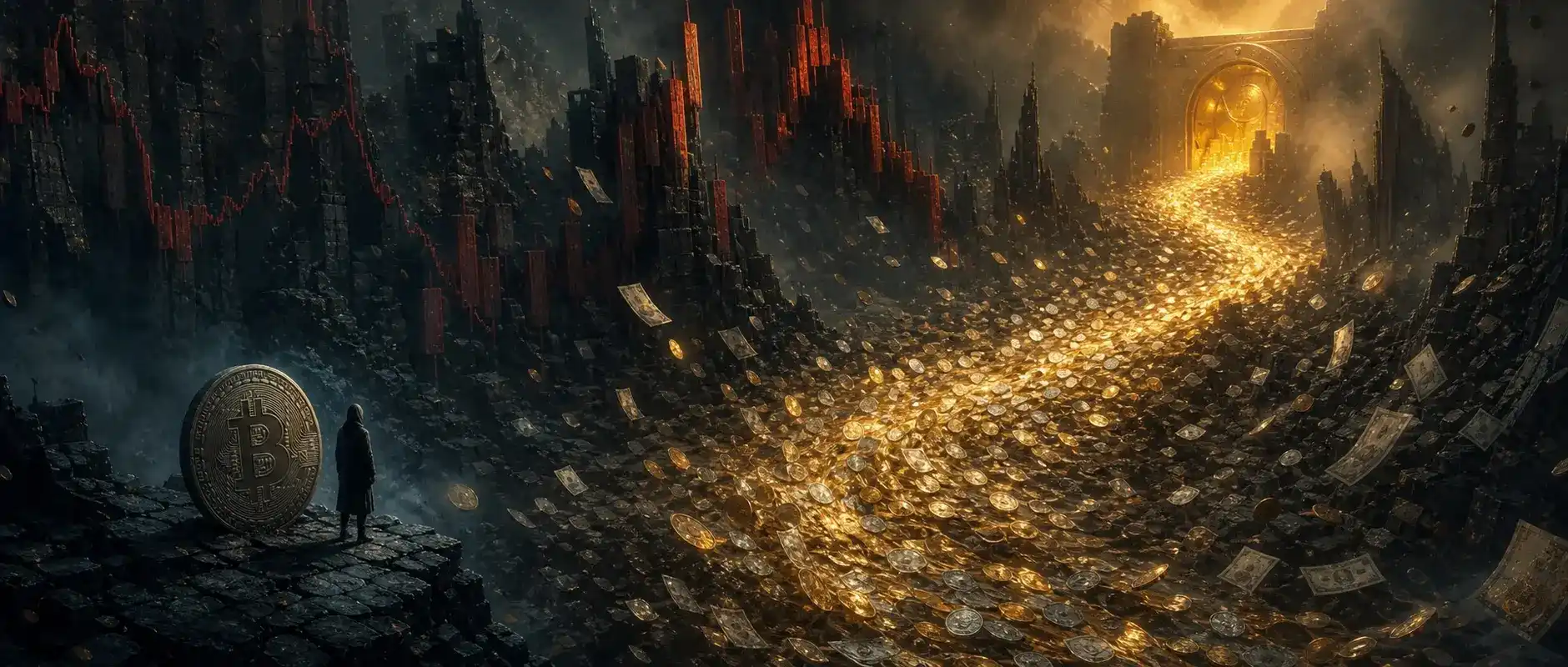
The Trillion-Dollar Stablecoin War: Binance Decides to Re-enter the Fray

marsbitPublished on 2025-12-24Last updated on 2025-12-24

Abstract

The stablecoin market, with $27.6 trillion in on-chain transfers in 2024, has surpassed the combined volume of Visa and Mastercard. This marks a shift from a niche crypto product to a critical piece of global financial infrastructure. The article outlines the evolution of stablecoins. The 1.0 era was defined by first-mover advantage and passive monopolies. Tether's USDT dominates with a 60% market share, while Circle's USDC, despite its compliance focus, faced a crisis during the 2023 Silicon Valley Bank collapse, proving that network effect is the ultimate moat. Binance's journey reflects this competitive landscape. Its first stablecoin, the regulated BUSD, was shut down by U.S. regulators in 2023. It then pivoted to supporting FDUSD and has now taken a strategic stake in a new model with the launch of $U. Unlike traditional stablecoins, $U is a "stablecoin ETF" or "套娃" (nesting doll), backed by a basket of existing stablecoins: USDT, USDC, and the politically-connected USD1 from the Trump family. USD1's rapid growth, including a $2 billion investment into Binance from an Abu Dhabi fund, highlights a new dimension: stablecoins. The article argues that stablecoins are no longer just financial tools but vehicles for political capital and a new front in the battle for monetary influence, as evidenced by the U.S. passing the GENIUS Act to establish a federal regulatory framework. The "nesting doll" structure of $U aims to mitigate single-point risks (e.g., USDT's opacity, US...

In 2024, the total on-chain transfer volume of stablecoins reached $27.6 trillion, surpassing the combined total of Visa and Mastercard for the first time.

This figure was $300 billion five years ago and close to zero a decade ago.

On December 18, a project named United Stables launched a new stablecoin, $U, in Dubai. Its reserves are not U.S. dollar cash or treasury bonds but a combination of three stablecoins: USDC, USDT, and USD1. Using stablecoins to collateralize stablecoins is known in the industry as "nesting."

Binance Wallet integrated immediately, with official endorsement from BNB Chain, and full support from PancakeSwap and Four.Meme.

This configuration sends a clear message in the crypto circle: Binance is personally entering the fray.

$U itself may be insignificant. But the trend it represents is clear: stablecoins are moving from wild growth to a state of rival regimes, and a new battle is beginning.

Stablecoin 1.0 Era: The Monopoly of First Movers

The essence of stablecoins is "on-chain dollars." Users deposit $1 with the issuer and receive 1 token, which can circulate on any blockchain globally, 24/7, with second-level settlement and fees of just a few cents.

Compared to Alipay or bank transfers, the core advantage of stablecoins is that they require no real-name verification, no bank account, and no regulatory approval. A wallet address is the only barrier to entry.

When Tether issued USDT in 2014, the entire crypto market's capitalization was less than $50 billion. So Tether seized the opportunity window: traditional banks generally refused to provide services to cryptocurrency companies. The only way to cash out profits after trading cryptocurrencies was to exchange crypto assets for USDT, locking in dollar-denominated gains.

USDT's rise was not just due to a superior product but also because users had no other choice. This "passive monopoly" has continued to this day. As of December 2025, USDT's market capitalization is approximately $199 billion, accounting for 60% of the stablecoin market.

In 2018, Circle, in partnership with Coinbase, launched USDC, emphasizing compliance: monthly reserve audit reports, funds custodied with regulated financial institutions, and adherence to the U.S. securities regulatory framework. The subtext was that Tether's black-box model would eventually cause problems.

By 2022, USDC's market cap once approached 70% of USDT's. Wall Street bet that the compliant faction would ultimately prevail.

In March 2023, Silicon Valley Bank collapsed. Circle had $3.3 billion in reserves deposited there. USDC briefly depegged to $0.87—an asset promised to always equal $1 had lost 13% of its value.

The lesson the market drew was: compliance is a plus, but not a moat. Banks can fail, regulators can change course; the real barrier is network effects—when your user base and liquidity are large enough, you become the de facto standard.

The survival rule of the Stablecoin 1.0 era was simple: first-mover advantage trumps everything.

Binance's Three Pivots

Exchanges are the traffic hubs of the crypto world, and stablecoins are the unit of account for trading. Whoever controls the mainstream stablecoin holds pricing power. Binance cannot afford to give up this position.

In 2019, Binance partnered with Paxos, a New York-licensed trust company, to issue BUSD. This was a compliant stablecoin regulated by the New York Department of Financial Services, with a peak market cap of $16 billion, second only to USDT and USDC.

BUSD once accounted for 40% of Binance's trading volume. It was a core tool for Binance to establish its autonomous "monetary sovereignty."

In February 2023, the SEC issued a Wells Notice to Paxos, alleging that BUSD was an unregistered security. On the same day, the New York Department of Financial Services ordered Paxos to stop minting new BUSD. Nine months later, Binance founder CZ pleaded guilty in the U.S., and Binance paid a $4.3 billion fine.

$16 billion in stablecoin assets was reduced to zero under regulatory pressure.

Binance reacted quickly. Shortly after BUSD was halted, the Hong Kong company First Digital launched FDUSD,恰好 coinciding with the launch window of Hong Kong's virtual asset licensing system. FDUSD quickly became one of the main stablecoins on the Binance platform, although the two parties never publicly confirmed a partnership.

The move from BUSD to FDUSD was passive survival; the move from FDUSD to $U is active positioning.

The design logic of $U is fundamentally different from the previous two: it does not directly compete with USDT, USDC, or USD1 but incorporates them all into its reserve pool. In a sense, $U is a "stablecoin of stablecoins" or a "stablecoin ETF."
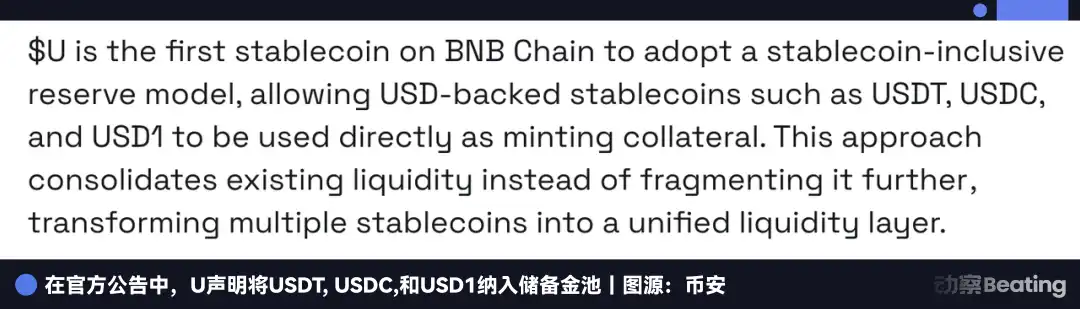
Binance's lesson is: stablecoins reliant on a single regulatory framework always have their lifelines held by others.

The Presidential Family Enters the Fray

The most noteworthy component in $U's reserves is USD1.

In March 2025, the Trump family issued the USD1 stablecoin through World Liberty Financial. According to public disclosures, Trump family-related entities hold 60% of the parent company's equity and receive 75% of the net income share. Trump himself serves as the "Chief Cryptocurrency Advocate," while his sons Eric and Donald Jr. serve as "Web3 Ambassadors."

By December 2025, the Trump family had already profited over $1 billion from the project.

Two months after its issuance, USD1 received its first major order: the Abu Dhabi sovereign wealth fund MGX invested $2 billion in Binance, using USD1 as the payment tool.

This was the largest cryptocurrency payment in history, instantly providing the nascent stablecoin with $2 billion in "practical endorsement."

As of December, USD1's market cap is approximately $2.7 billion, ranking seventh among stablecoins and becoming one of the fastest-growing.

Now, USD1 has been included in $U's reserves. This implies a hidden chain of interests: part of Binance's ecosystem trading volume is converted into usage scenarios for USD1; part of USD1's usage scenarios is converted into income for the Trump family.

The deeper game lies in the monetization of political capital. After Trump returned to the White House, the SEC suspended investigations into several crypto projects, including cases involving Sun Yuchen, a major investor in World Liberty Financial. Treasury Secretary Besant stated clearly at the White House Crypto Summit: "We will use stablecoins to maintain the dollar's status as the world's reserve currency."

Stablecoins are no longer just financial tools; they are becoming carriers of political resources.

The Logic of Nesting

Using stablecoins to collateralize stablecoins might seem redundant. But this design is based on three considerations.

Risk Diversification. USDT's hidden danger lies in its opaque reserves; USDC's隐患在于 its over-reliance on the U.S. banking system, as the Silicon Valley Bank incident warned; USD1's隐患在于 its deep binding with Trump's political fate. Holding any one alone means bearing its specific risk. Combining the three theoretically allows for risk hedging.

Liquidity Aggregation. The pain point of the stablecoin market is fragmented liquidity. USDT has its liquidity pools, USDC has its own, and funds are scattered across dozens of public chains and hundreds of DeFi protocols. $U attempts to connect these isolated pools, providing users with a unified liquidity entry point.

Narrative Upgrade. The competitive dimension of Stablecoin 1.0 was "who is more transparent" and "who is more compliant"—a rhetoric repeated for a decade. $U attempts to provide a new narrative framework: "settlement currency designed for the AI era," "supporting gasless signature transfers."

Of course, gasless transfers are part of the EIP-3009 standard, which existed in 2020, and USDC already supports it. So "AI-native" is more of a universal label; any on-chain stablecoin can be called by smart contracts and enable automatic machine-to-machine payments. $U's real differentiation lies not in technology but in its ecosystem and aggregated architecture.

Naturally, the nested structure also implies risk transmission: if one layer has a problem, the effects ripple through.

If USDT were to collapse one day, $U would not go to zero completely but would certainly承受 the impact: reserves shrinking, redemption pressure surging, depegging risk rising.

所谓 "Risk diversification" is more accurately "diversifying the intensity of impact from a single point of failure," ensuring that holders don't lose everything if any underlying asset fails. It's a bottom-protection mindset, not a risk-free design.

From Gray Zone to Great Power Game

2025 is the first year of stablecoin regulation.

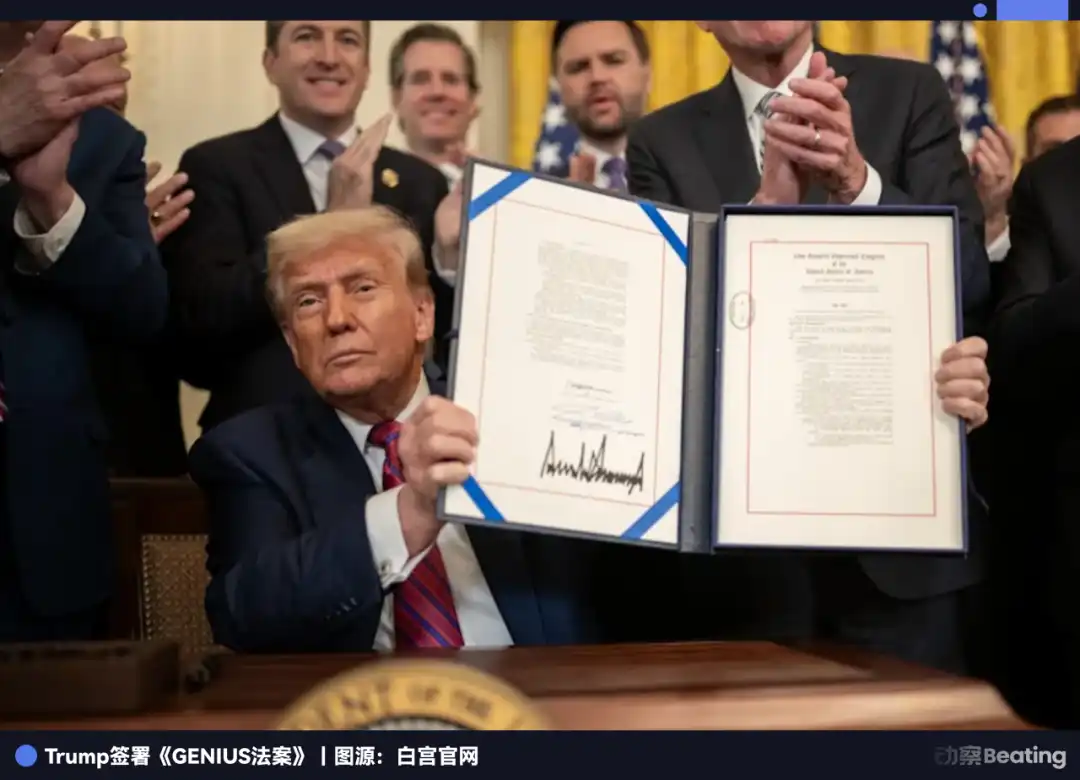
In June, Circle listed on the NYSE, with an IPO price of $31, closing at $69 on the first day, its market cap approaching $20 billion, becoming the "first stablecoin stock." In the same month, the U.S. Senate passed the GENIUS Act with 68 votes in favor, establishing a federal regulatory framework for stablecoins for the first time. The EU's MiCA regulations came into full effect, and Hong Kong, Japan, and Singapore相继 introduced licensing systems.

Over the past decade, stablecoins existed in a gray area, with regulators lacking grounds for intervention. Now, with an annual transfer volume exceeding the world's largest payment network, no government can continue to pretend not to see it.
Data shows: 34% of adults in Turkey hold USDT to hedge against the lira's depreciation; nearly 30% of remittances in Nigeria are completed via stablecoins; tech workers in Argentina普遍 use USDC to receive salaries, bypassing local currency inflation. In these countries, stablecoins are already the de facto "shadow dollar."

The foundation of dollar hegemony is not the Fed's money-printing ability but the inertia of global trade being denominated and settled in dollars. If stablecoins become the next-generation cross-border payment infrastructure, controlling stablecoins means controlling dollar hegemony in the digital age.

This is the underlying logic behind the Trump family's entry and the reason why the GENIUS Act passed with rare bipartisan consensus: in Washington, stablecoins are no longer a小众 issue for the crypto circle but a strategic resource concerning national interests.

The Imminent Battle

Whether $U will succeed is still uncertain. Its current circulating market cap is negligible compared to USDT's nearly $200 billion and USDC's nearly $80 billion.

But it represents a new paradigm in stablecoin competition.

Competition in the 1.0 era was about going it alone: Tether established a monopoly with first-mover advantage, Circle tried to leverage compliance to撬动 the market, and Binance fought for pricing power through BUSD. The core question was "who can survive."

Competition in the 2.0 era is about forming alliances. PayPal issued PYUSD, Ripple launched RLUSD, Robinhood teamed up with Galaxy Digital and Kraken to form the USDG alliance. Traditional financial giants, crypto-native players, sovereign capital, and political forces have all entered the arena.

The new core question becomes "who can tie more players together."

$U's strategy is to achieve aggregation through "nesting": not making enemies with any party, but turning everyone into its "underlying asset." Binance's intention is to build a "decentralized centralization": using an aggregated architecture to分散 regulatory risk while maintaining control over the core ecosystem.

This hundred-army battle has no final outcome. The regulatory balance is still swaying, technological boundaries are still expanding, and political variables are still accumulating.

The only certainty is: stablecoins have moved from being supporting actors in cryptocurrency to key infrastructure in the global financial system. An annual trading volume of $27 trillion is enough to make anyone who underestimates it pay the price.


Related Questions

QWhat is the total on-chain transfer volume of stablecoins in 2024, and how does it compare to Visa and Mastercard?

AIn 2024, the total on-chain transfer volume of stablecoins reached $27.6 trillion, surpassing the combined total of Visa and Mastercard for the first time.

QWhat is the unique feature of the new stablecoin $U launched by United Stables, and what is this structure called in the industry?

AThe unique feature of $U is that its reserves are not US dollars or treasury bonds but a combination of three other stablecoins: USDC, USDT, and USD1. This structure is referred to as a 'nested doll' or '套娃' in the industry.

QWhat was the major event in March 2023 that caused USDC to depeg, and what was the market's lesson from this incident?

AIn March 2023, the collapse of Silicon Valley Bank caused USDC to depeg, briefly dropping to $0.87. Circle had $3.3 billion in reserves held at the bank. The market learned that compliance is an advantage but not a moat; the real barrier is network effect—when a stablecoin has enough users and liquidity, it becomes the de facto standard.

QHow did the Trump family get involved in the stablecoin market, and which major transaction significantly boosted the credibility of their stablecoin USD1?

AThe Trump family entered the stablecoin market in March 2025 by issuing USD1 through World Liberty Financial. A major transaction that significantly boosted its credibility was the Abu Dhabi sovereign fund MGX's $2 billion investment in Binance, which was paid using USD1.

QWhat are the three main considerations behind the design of the 'nested doll' stablecoin $U, as mentioned in the article?

AThe three main considerations behind the design of $U are: 1) Risk diversification by combining multiple stablecoins to hedge against specific risks; 2) Liquidity aggregation to connect fragmented liquidity pools across different blockchains and DeFi protocols; 3) Narrative upgrade, positioning it as a settlement currency for the AI era and promoting features like gasless transfers.

Related Reads

Trading

Spot
Futures

Hot Articles

What is BNB WHALES

Understanding BNB Whales: A Deep Dive into the Cryptocurrency Landscape Introduction to BNB Whales In the vibrant world of cryptocurrencies, new projects regularly emerge, often promising innovative solutions and unique experiences. One such project is BNB Whales, launched in 2023 and built on the BNB Smart Chain (BEP20). BNB Whales sets out to establish a distinctive presence within the cryptocurrency ecosystem, focusing on creating an engaging platform that combines the benefits of blockchain technology with social and gaming interactions. This article aims to delve deeper into BNB Whales, exploring its core components, mechanics, and developmental trajectory. What are BNB Whales? BNB Whales is a cryptocurrency initiative that seeks to provide a diverse range of features and opportunities for its users in the burgeoning Web3 environment. Utilizing the BEP20 standard, the project operates with a total token supply of 100 trillion (100,000,000,000,000,000). Despite this significant figure, it is noteworthy that no tokens are currently in circulation, indicating that the project may still be in its early developmental stages. The primary goal of BNB Whales is to create a platform where users can participate in various interactive activities while benefiting from the security and transparency afforded by blockchain technology. By fostering a unique and engaging environment, BNB Whales aims to build a strong community of users who are invested in the project and its development. Who is the Creator of BNB Whales? The identity of the creator of BNB Whales remains undisclosed at this time, presenting a challenge for those looking to understand the project's founding principles and visionary insights. This absence of publicly available information regarding the project's leadership may raise questions among potential investors and users about its governance and accountability structure. Who are the Investors of BNB Whales? As BNB Whales continues to evolve, information concerning specific investors or support from investment foundations is currently unavailable. The project’s official documentation, including its whitepaper, does not disclose either individual or institutional financial backers. The lack of transparency in this regard can sometimes raise questions about the legitimacy and sustainability of new projects within the cryptocurrency ecosystem. How Does BNB Whales Work? BNB Whales operates on the BNB Smart Chain utilizing the BEP20 standard, which is known for its efficiency and low transaction fees, attracting a variety of developers and projects. The unique aspect of BNB Whales lies in its focus on creating a community-driven platform. While precise operational details are scarce, the project emphasizes interaction and engagement, potentially incorporating gamified elements into its offerings. The emphasis on community is pivotal, as it aligns with prevailing trends in the cryptocurrency space, where user input and participation often dictate a project's success. Further innovation may be anticipated, but at present, the specific mechanisms and features that differentiate BNB Whales from other crypto initiatives remain to be fully elucidated. Without detailed information regarding its functionality, it is challenging to evaluate the project's differentiators comprehensively. Timeline of BNB Whales The development of BNB Whales has unfolded across key milestones, marking its journey in the cryptocurrency landscape. Below is a timeline of significant events pertaining to the project: 2023: Launch of BNB Whales, marking the project's entry into the market. 2023: Publication of the project's whitepaper, which lays out the overarching goals and operational framework. Ongoing: BNB Whales continues to develop its features, aiming to build a robust user base and expand its offerings. Key Points About BNB Whales Platform: BNB Smart Chain (BEP20) Total Supply: 100 trillion tokens (100,000,000,000,000,000) Circulating Supply: 0 tokens (indicating a nascent stage) Project Goal: To foster an engaging cryptocurrency platform for interaction and community building. Creator: Unknown Investors: Not disclosed Operational Status: Active with ongoing development and expansion Conclusion As BNB Whales navigates the competitive cryptocurrency landscape, it offers a glimpse into the potential of community-driven projects built on the foundations of blockchain technology. By focusing on engagement and interaction, the initiative stands at the forefront of innovation in the Web3 space. However, the project's success ultimately hinges on the clarity of its operational mechanics, the disclosure of its governance, and the establishment of a solid user community. For potential users and investors alike, BNB Whales represents a case study in the evolving nature of cryptocurrency projects—one that illustrates both the exciting possibilities and the complexities associated with new initiatives. As the landscape continues to evolve, it will be essential to monitor BNB Whales' progress and its impact on the broader cryptocurrency ecosystem.

3.1k Total ViewsPublished 2024.04.01Updated 2024.12.03

What is BNB WHALES

What is PONKE BNB

Ponke BNB: A New Approach in the Cryptocurrency Space Introduction Ponke BNB, a newcomer in the cryptocurrency arena, was launched in 2024 and operates on the BNB Smart Chain (BEP20) platform. This innovative project seeks to build a distinctive and engaged community, focusing on sustainable reward generation. As the cryptocurrency landscape evolves, Ponke BNB aims to address critical issues surrounding reward sustainability, making it a project worth observing for enthusiasts and investors alike. What is Ponke BNB? At its core, Ponke BNB is a cryptocurrency designed specifically for the BNB Smart Chain ecosystem. Boasting an immense total supply of 370,000,000,000,000,000 tokens, it is worth noting that currently, there are no tokens in circulation. The guiding mission of Ponke BNB is to foster a sustainable reward system that mitigates the challenges associated with rewards depletion, a common pitfall in many cryptocurrencies today. The mechanics of Ponke BNB's functionality centre around encouraging user participation, while simultaneously providing rewards that can stand the test of time. The unique structure of its reward system is aimed at ensuring longevity and stability, addressing essential market concerns. Who is the Creator of Ponke BNB? Despite extensive exploration, the identity of Ponke BNB's creator remains unknown. There is a notable absence of publicly available information regarding the project’s founder or its development team. This anonymity, while not uncommon in the cryptocurrency space, raises some questions about transparency and accountability in project management. Who are the Investors of Ponke BNB? Similar to the lack of clarity surrounding its creator, there is no public information available regarding any investment foundations or organizations that support Ponke BNB. This absence of investor data can often breed uncertainty among prospective investors, who typically prefer a clear understanding of the backing behind cryptocurrencies they consider engaging with. How Does Ponke BNB Work? Ponke BNB stands out through its inventive two-layered sustainable reward generating system. This system is built to tackle the issue of rewards depletion effectively. By engaging users and creating a vibrant community, Ponke BNB seeks to provide a stable and enjoyable environment, which emphasizes user interaction and rewards. The operation framework of Ponke BNB encourages participation through various activities and challenges that are designed to incentivise users while ensuring that the reward system remains sustainable. It aims to stimulate the community and promote an engaging atmosphere where members can feel valued and appreciated. Timeline of Ponke BNB The evolution of Ponke BNB can be summarized through a few key milestones: 2024: The inception of Ponke BNB on the BNB Smart Chain (BEP20) platform marked a significant entry into the cryptocurrency market. 2024: The release of the project’s whitepaper and official website provided comprehensive insights into Ponke BNB’s goals and objectives, forming the foundation for its community-driven approach. Key Features of Ponke BNB Ponke BNB is built on several key features that set it apart from other cryptocurrency projects: Sustainable Reward System The two-layered reward system is designed to foster engagement, prevent depletion of rewards, and ensure the longevity of returns for participants in the Ponke BNB ecosystem. Community Engagement The project places a strong emphasis on active community engagement, driving participation through activities designed to create a social and collaborative environment. This community-centric approach empowers users to have a hand in shaping the project's future directions. BNB Smart Chain Integration Operating on the BEP20 platform, Ponke BNB is reinforced by the security and efficiency offered by the BNB Smart Chain. Users benefit from fast and cost-effective transactions, positioning Ponke BNB well within the broader cryptocurrency ecosystem. Conclusion In summary, Ponke BNB is an emergent cryptocurrency project aiming to carve a niche for itself in the growing digital currency landscape. With its focus on a sustainable reward system and community engagement, it presents a fresh outlook in an otherwise volatile sector. While uncertainties linger concerning the project's creators and investors, Ponke BNB continues to strive for transparency and innovation. As the cryptocurrency market continues to develop, Ponke BNB’s principles of sustainability and community-driven dynamics place it in a promising light for future observers and participants alike.

2.9k Total ViewsPublished 2024.04.01Updated 2024.12.03

What is PONKE BNB

What is BNB CARD

Understanding BNB Card: Revolutionizing Digital Identity in Web3 In the rapidly evolving landscape of blockchain technology and cryptocurrency, the BNB Card or $BNBCARD stands out as a noteworthy project. This community-driven utility meme token leverages the BNB Smart Chain (BSC), aiming to integrate meme culture with innovative digital identity solutions. As more users dive into the realms of decentralization, it is crucial to dissect what BNB Card offers, its operational nuances, and its potential market impact. What is BNB Card ($BNBCARD)? At its core, BNB Card represents a meme token with substantial utility. It is designed to empower users by enabling the creation of personalized digital identity cards that are both expressive and functional. The project encapsulates several key features: Customizable ID Cards: Users have the ability to design Binance-themed digital ID cards, providing them with a platform for self-expression and enhanced community interaction. Decentralized Framework: Developed on the BSC, BNB Card emphasizes key attributes such as security, transparency, and user sovereignty. The decentralized nature of the framework allows for transactions that are both efficient and secure. Community-Centric Model: The emphasis on grassroots participation rather than laboratory-driven financial models creates an engaging environment for its users. By leveraging the inherent virality of meme culture, BNB Card fosters a robust community movement. The primary goal of BNB Card is to democratize digital identity tools in Web3, offering accessible solutions that benefit the users without the encumbrances typically associated with traditional identity management systems. Creator and Investors When exploring the identity behind BNB Card, it is important to note that no singular creator is explicitly credited. Instead, the project appears to be community-driven, suggesting a collective effort inspired by the notion of Binance's “Early Builder Card.” This organic development approach is common among projects within the meme token spectrum, where development is often influenced by the community's passion rather than a central authority. In terms of investment, the absence of publicly disclosed institutional backers further highlights the project's grassroots foundation. It thrives on organic community support, reflecting a usual characteristic of meme-driven projects that often engage their audience through social channels rather than formal investment routes. How It Works BNB Card employs several mechanisms that delineate its functioning and innovative spirit: Token Utility: The BNBCARD token allows users access to a suite of ID creation tools while also providing a platform for community governance. The token serves as the linchpin that enables these functionalities. Blockchain Integration: By utilizing the BSC, BNB Card ensures compatibility with Ethereum Virtual Machine (EVM)-based applications. This integration provides users with the benefits of low transaction fees while enhancing accessibility. DIY Ecosystem: Central to BNB Card’s appeal is its do-it-yourself (DIY) approach to digital identity card generation. This participatory element encourages users to engage in creative expression, fostering an inclusive culture that thrives on contribution and collaboration. Timeline Chronology is vital to understanding BNB Card's trajectory. Important milestones in the project’s history include: March 18, 2025: BNB Card was listed on LBank, marking a significant step in its exchange journey and opening doors for liquidity and user accessibility. March 19, 2025: A pivotal moment occurred as the token experienced an astronomical surge of 26,000% within 24 hours, garnering attention for its potential and the community’s enthusiasm. Ongoing Developments: The project is continuously expanding its partnerships with decentralized exchanges (DEXs) like PancakeSwap, further enhancing liquidity and user engagement. Innovation and Differentiation Understanding what sets BNB Card apart involves deeper exploration into its innovative framework: Meme-Utility Hybrid: BNB Card successfully merges the playful allure of meme culture with practical applications in digital identity management. This niche approach effectively caters to a broad demographic, appealing to both tech-savvy users and those new to crypto. Decentralized Governance: Operating devoid of centralized control allows the project to harness community input directly. The collective decision-making process buoyed by community involvement empowers users, ensuring their voices contribute to the development and direction of the project. Scalability: BNB Card stands to benefit immensely from the 2025 roadmap upgrades to the BNB Chain, which include enhancements such as increased transaction speeds and the integration of artificial intelligence tools. These improvements position the project advantageously within a highly competitive environment. Conclusion BNB Card is emblematic of a new wave of digital identity solutions within the Web3 ecosystem. By blending fun, community engagement, and practical utility, it invites users to participate actively in shaping their digital personas. As the project navigates the dynamic cryptocurrency landscape, its success will likely hinge on maintaining strong community support while adapting to technological advancements and user needs. The integration of decentralization with meme culture serves not only as a means for user-driven engagement but also as a foundation for the evolving narrative surrounding digital identity in the age of blockchain. In summation, BNB Card not only exemplifies the convergence of creativity and utility within the crypto space but also underscores the importance of community in steering the future of decentralized technologies.

3.4k Total ViewsPublished 2025.03.26Updated 2025.03.26

What is BNB CARD

Discussions

Welcome to the HTX Community. Here, you can stay informed about the latest platform developments and gain access to professional market insights. Users' opinions on the price of BNB (BNB) are presented below.

活动图片