The Myth Of USD Weakness Boosting Bitcoin: Inflation, Liquidity, Or Fear Changes The Outcome

bitcoinistPublished on 2026-01-27Last updated on 2026-01-27

Abstract

Bitcoin has declined below $87,000 amid ongoing selling pressure and macroeconomic uncertainty, raising questions about whether this is a temporary pullback or the beginning of a deeper correction. Concurrent US dollar weakness has revived the debate over whether a softer dollar inherently benefits Bitcoin. However, the relationship is not straightforward—it depends on the underlying cause of the dollar's decline. A weak dollar can support Bitcoin if it stems from inflationary pressures (promoting Bitcoin as "digital gold") or excess liquidity from rate cuts (driving capital into risk assets like crypto). But if the dollar weakens due to fear, risk aversion, or market stress—as seen recently with rumors of yen intervention—investors tend to flee to traditional safe havens like gold rather than Bitcoin. In such cases, Bitcoin behaves like a risk asset and falls alongside equities. Current outflows from Bitcoin ETFs reinforce that, in times of panic, investors still favor conventional refuges. For Bitcoin to rise, dollar weakness must coincide with risk appetite, not fear.

Bitcoin has slipped below the $87,000 level, extending its pullback as selling pressure and macro uncertainty keep traders on the defensive. After multiple failed attempts to regain key resistance zones, BTC is now trading in a fragile range where momentum remains weak, and liquidity conditions can amplify short-term moves. With risk appetite fading, the market is once again questioning whether this decline is a temporary shakeout or the start of a deeper corrective phase.

At the same time, the US dollar has been weakening, reigniting a familiar debate across financial markets: Does a softer dollar automatically lift Bitcoin? The answer is not that simple. A falling dollar can support BTC, but only under the right macro conditions. The driver is not the dollar itself, but why it is falling, and how investors interpret that shift in terms of risk.

In inflation-driven environments, dollar weakness can push capital toward hard assets, allowing Bitcoin to behave more like a “digital gold” narrative. In liquidity-driven cycles, rate cuts and easier financial conditions can also push investors into higher-beta assets like crypto.

But when the dollar declines due to stress, intervention fears, or escalating uncertainty, capital often rotates into traditional safe havens instead—leaving Bitcoin to trade like a risk asset alongside equities.

A Weak Dollar Isn’t Automatically Bullish For Bitcoin

A CryptoQuant report argues that the relationship between a falling US dollar and Bitcoin is indirect and conditional, not mechanical. In other words, a weaker dollar can support BTC, but only under specific macro regimes. The key variable is not the dollar move itself, but the underlying driver behind that devaluation and the broader risk environment investors are reacting to.
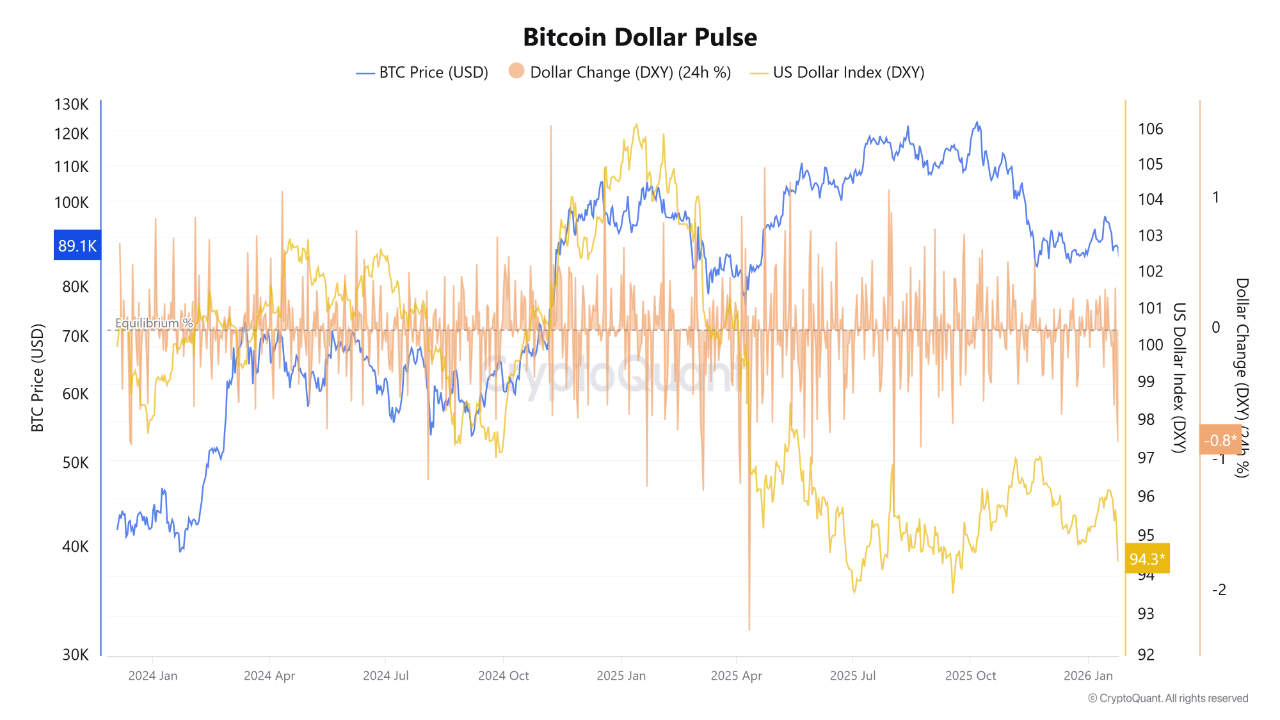
Bitcoin Dollar Pulse | Source: CryptoQuant

CryptoQuant outlines three scenarios. First, if dollar weakness reflects persistent inflation and a growing search for protection, Bitcoin can benefit as investors treat it like a form of “digital gold.” Second, if the decline is driven by rate cuts and excess liquidity, risk assets typically outperform, and cheaper capital can rotate into crypto as investors seek upside in higher-beta markets. In both cases, the dollar weakness aligns with conditions that can lift Bitcoin.

The third scenario, however, is the most important for the current market. If the dollar is weakening due to a confidence shock and extreme risk aversion—such as the present episode tied to rumors of yen intervention—crypto tends to fall alongside equities. In that environment, the weak dollar is only a backdrop, not a bullish engine.

The conclusion is clear: the market is rotating from the dollar into gold, while Bitcoin ETFs see heavy outflows, showing that in panic, investors still choose the traditional refuge. For Bitcoin to thrive, dollar weakness must come from risk appetite, not fear.


Related Questions

QAccording to the article, what are the three scenarios in which the relationship between a weak US dollar and Bitcoin is analyzed?

AThe three scenarios are: 1) Dollar weakness driven by persistent inflation, which can benefit Bitcoin as a 'digital gold'. 2) A decline driven by rate cuts and excess liquidity, which helps risk assets like crypto. 3) A weakening due to a confidence shock and extreme risk aversion, where crypto falls alongside equities.

QWhy does a falling dollar not automatically lead to a rise in Bitcoin's price?

AA falling dollar does not automatically lift Bitcoin because the relationship is indirect and conditional. The key factor is not the dollar's move itself, but the underlying driver behind its devaluation and the broader risk environment. If the decline is due to fear or uncertainty, capital flows into traditional safe havens, not Bitcoin.

QWhat current market behavior shows that investors are choosing traditional safe havens over Bitcoin during a period of dollar weakness?

AThe article states that the market is rotating from the dollar into gold, while Bitcoin ETFs are seeing heavy outflows. This indicates that in a panic, investors still prefer the traditional refuge of gold over Bitcoin.

QIn what type of macro environment does Bitcoin behave more like 'digital gold' according to the article?

ABitcoin behaves more like 'digital gold' in an inflation-driven environment, where dollar weakness pushes capital toward hard assets as investors search for protection from inflation.

QWhat is the main conclusion of the CryptoQuant report mentioned in the article regarding the dollar-Bitcoin relationship?

AThe main conclusion of the CryptoQuant report is that the relationship between a falling US dollar and Bitcoin is indirect and conditional, not mechanical. For Bitcoin to thrive, dollar weakness must come from factors that boost risk appetite, such as inflation or excess liquidity, not from fear or uncertainty.

Related Reads

First Batch of Keynote Speakers and Partners Announced! Web2+3 Summit: Defining the Next Generation of Digital Economy

Web2+3 Summit: Defining the Next Generation of Digital Economy The 6th BEYOND International Technology Innovation Expo (BEYOND Expo 2026), Asia's largest tech and ecosystem exhibition, is launching a dedicated Web2+3 stage for the first time. Co-hosted by BEYOND Expo and ChainNeXT Group, the Web3 Summit will take place from May 28–30, 2026. Against the backdrop of accelerating global tech integration, the boundaries between Web2 and Web3 are rapidly blurring. With clearer global regulations for blockchain-driven internet (Web3) and the special issuance of a Hong Kong dollar stable币 license by the Hong Kong SAR government on April 10, 2026, Web3's decentralized principles are quickly merging with traditional industries (Web2) such as e-commerce, finance, and artificial intelligence. Focused on blockchain-driven digital economy elements, the summit will center on three core principles—implementability, commercial viability, and compliance. It will bring together top Web3 experts to discuss key integration areas like stablecoin payment finance (PayFi), real-world asset tokenization (RWA), and decentralized AI (DeAI), unveiling new opportunities for industrial innovation. The first wave of confirmed speakers includes Jack Kong (Director of Hong Kong Cyberport, Chairman of Nano Labs), Yat Siu (Chairman of Animoca Brands), Michael Wu (Co-founder & CEO of Amber Group), Michael Heinrich (Co-founder & CEO of 0G), and Art Abal (Co-founder of Vana). More Web3 ecosystem pioneers, AI, and fintech experts will be announced soon. Core forum topics include: - Web2+DeAI: New AI Paradigms Driven by Decentralized Infrastructure - Web2+RWA: Real-World Asset Tokenization and Global Liquidity - Web2+PayFi: Cross-Border Payments and Financial Innovation Powered by Crypto Infrastructure - Web2+3 AI: Autonomous Agents and the Crypto Economy - Web2+3 Wealth: On-Chain and Off-Chain Integrated Investment Ecosystems - Web2+3 Commerce: A New Landscape for Global Trade Driven by Stablecoins Additional agenda details will be released in the near future.

marsbit2h ago

First Batch of Keynote Speakers and Partners Announced! Web2+3 Summit: Defining the Next Generation of Digital Economy

marsbit2h ago

Trading

Spot
Futures

Hot Articles

What is $BITCOIN

DIGITAL GOLD ($BITCOIN): A Comprehensive Analysis Introduction to DIGITAL GOLD ($BITCOIN) DIGITAL GOLD ($BITCOIN) is a blockchain-based project operating on the Solana network, which aims to combine the characteristics of traditional precious metals with the innovation of decentralized technologies. While it shares a name with Bitcoin, often referred to as “digital gold” due to its perception as a store of value, DIGITAL GOLD is a separate token designed to create a unique ecosystem within the Web3 landscape. Its goal is to position itself as a viable alternative digital asset, although specifics regarding its applications and functionalities are still developing. What is DIGITAL GOLD ($BITCOIN)? DIGITAL GOLD ($BITCOIN) is a cryptocurrency token explicitly designed for use on the Solana blockchain. In contrast to Bitcoin, which provides a widely recognized value storage role, this token appears to focus on broader applications and characteristics. Notable aspects include: Blockchain Infrastructure: The token is built on the Solana blockchain, known for its capacity to handle high-speed and low-cost transactions. Supply Dynamics: DIGITAL GOLD has a maximum supply capped at 100 quadrillion tokens (100P $BITCOIN), although details regarding its circulating supply are currently undisclosed. Utility: While precise functionalities are not explicitly outlined, there are indications that the token could be utilized for various applications, potentially involving decentralized applications (dApps) or asset tokenization strategies. Who is the Creator of DIGITAL GOLD ($BITCOIN)? At present, the identity of the creators and development team behind DIGITAL GOLD ($BITCOIN) remains unknown. This situation is typical among many innovative projects within the blockchain space, particularly those aligning with decentralized finance and meme coin phenomena. While such anonymity may foster a community-driven culture, it intensifies concerns about governance and accountability. Who are the Investors of DIGITAL GOLD ($BITCOIN)? The available information indicates that DIGITAL GOLD ($BITCOIN) does not have any known institutional backers or prominent venture capital investments. The project seems to operate on a peer-to-peer model focused on community support and adoption rather than traditional funding routes. Its activity and liquidity are primarily situated on decentralized exchanges (DEXs), such as PumpSwap, rather than established centralized trading platforms, further highlighting its grassroots approach. How DIGITAL GOLD ($BITCOIN) Works The operational mechanics of DIGITAL GOLD ($BITCOIN) can be elaborated on based on its blockchain design and network attributes: Consensus Mechanism: By leveraging Solana’s unique proof-of-history (PoH) combined with a proof-of-stake (PoS) model, the project ensures efficient transaction validation contributing to the network's high performance. Tokenomics: While specific deflationary mechanisms have not been extensively detailed, the vast maximum token supply implies that it may cater to microtransactions or niche use cases that are still to be defined. Interoperability: There exists the potential for integration with Solana’s broader ecosystem, including various decentralized finance (DeFi) platforms. However, the details regarding specific integrations remain unspecified. Timeline of Key Events Here is a timeline that highlights significant milestones concerning DIGITAL GOLD ($BITCOIN): 2023: The initial deployment of the token occurs on the Solana blockchain, marked by its contract address. 2024: DIGITAL GOLD gains visibility as it becomes available for trading on decentralized exchanges like PumpSwap, allowing users to trade it against SOL. 2025: The project witnesses sporadic trading activity and potential interest in community-led engagements, although no noteworthy partnerships or technical advancements have been documented as of yet. Critical Analysis Strengths Scalability: The underlying Solana infrastructure supports high transaction volumes, which could enhance the utility of $BITCOIN in various transaction scenarios. Accessibility: The potential low trading price per token could attract retail investors, facilitating wider participation due to fractional ownership opportunities. Risks Lack of Transparency: The absence of publicly known backers, developers, or an audit process may yield skepticism regarding the project's sustainability and trustworthiness. Market Volatility: The trading activity is heavily reliant on speculative behavior, which can result in significant price volatility and uncertainty for investors. Conclusion DIGITAL GOLD ($BITCOIN) emerges as an intriguing yet ambiguous project within the rapidly evolving Solana ecosystem. While it attempts to leverage the “digital gold” narrative, its departure from Bitcoin's established role as a store of value underscores the need for a clearer differentiation of its intended utility and governance structure. Future acceptance and adoption will likely depend on addressing the current opacity and defining its operational and economic strategies more explicitly. Note: This report encompasses synthesised information available as of October 2023, and developments may have transpired beyond the research period.

363 Total ViewsPublished 2025.05.13Updated 2025.05.13

What is $BITCOIN

Discussions

Welcome to the HTX Community. Here, you can stay informed about the latest platform developments and gain access to professional market insights. Users' opinions on the price of BTC (BTC) are presented below.

活动图片