The First 'Prediction Market' Stock Emerges!

Odaily星球日报Published on 2026-06-15Last updated on 2026-06-15

Abstract

"Prediction market pioneer Kalshi faces a major new challenge from its former key partner, Robinhood. Following a successful collaboration starting in March 2025, where Kalshi provided prediction market infrastructure to Robinhood's user base, Robinhood has now launched its own competing platform, Rothera Exchange. This move, leveraging Robinhood's control over massive retail user distribution, threatens to divert a significant portion of Kalshi's order flow. Rothera strategically launched during the high-traffic 2026 World Cup, quickly processing tens of millions of contracts. Analysts estimate the partnership previously contributed 25%-35% of Kalshi's volume, translating to potential annual revenue diversion worth hundreds of millions of dollars. The shift underscores a broader industry trend: in commoditized markets, control over user access and distribution channels, rather than just the underlying trading platform, may become the ultimate source of power and profit."

Original | Odaily Planet Daily(@OdailyChina)

Author | Azuma(@Azuma_eth)

The fires of the World Cup have been lit, and the total trading volume across prediction markets continues to hit new highs. However, as the industry leader, Kalshi might not be in the best mood right now.

The reason isn't due to fluctuations in Kalshi's own business data, but because a formidable new rival has "suddenly" appeared in front of Kalshi, following Polymarket. This opponent was once Kalshi's most important ally.
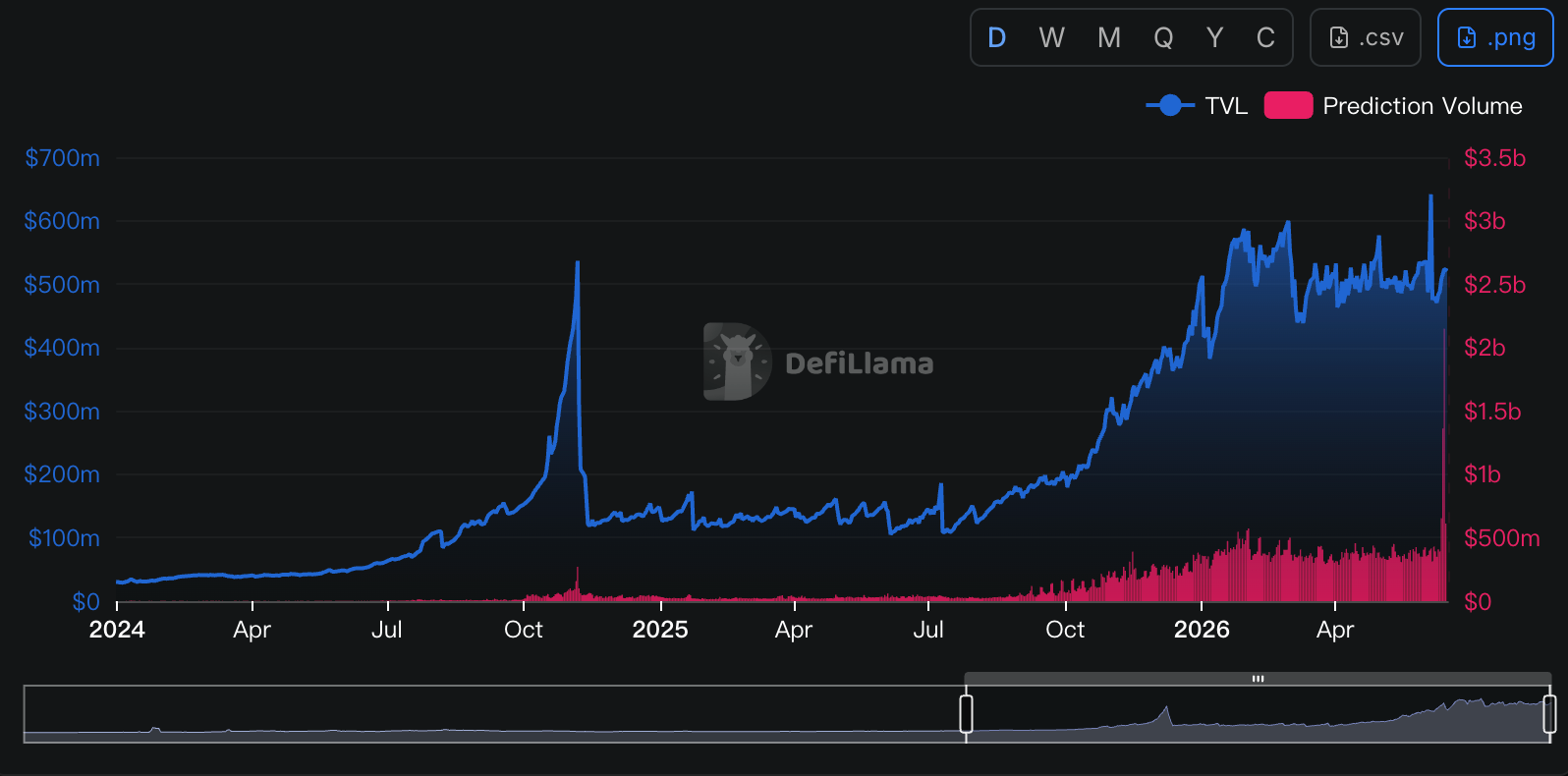
  • Odaily Note: Data sourced from Defillama.

Kalshi's Most Crucial Traffic Channel — Robinhood

Let's turn the clock back to March 2025. At that time, Kalshi announced a partnership with the U.S. online brokerage Robinhood. The latter would leverage Kalshi to offer its users prediction market trading services, allowing users to place bets on events like politics, economics, and sports.

From a business model perspective, this was a typical case of "mutual benefit" — Robinhood, responsible for user access and trade distribution, could directly use Kalshi's mature product. Kalshi, responsible for the underlying market, matching, clearing, and regulatory compliance system, could access Robinhood's massive pool of retail user traffic.

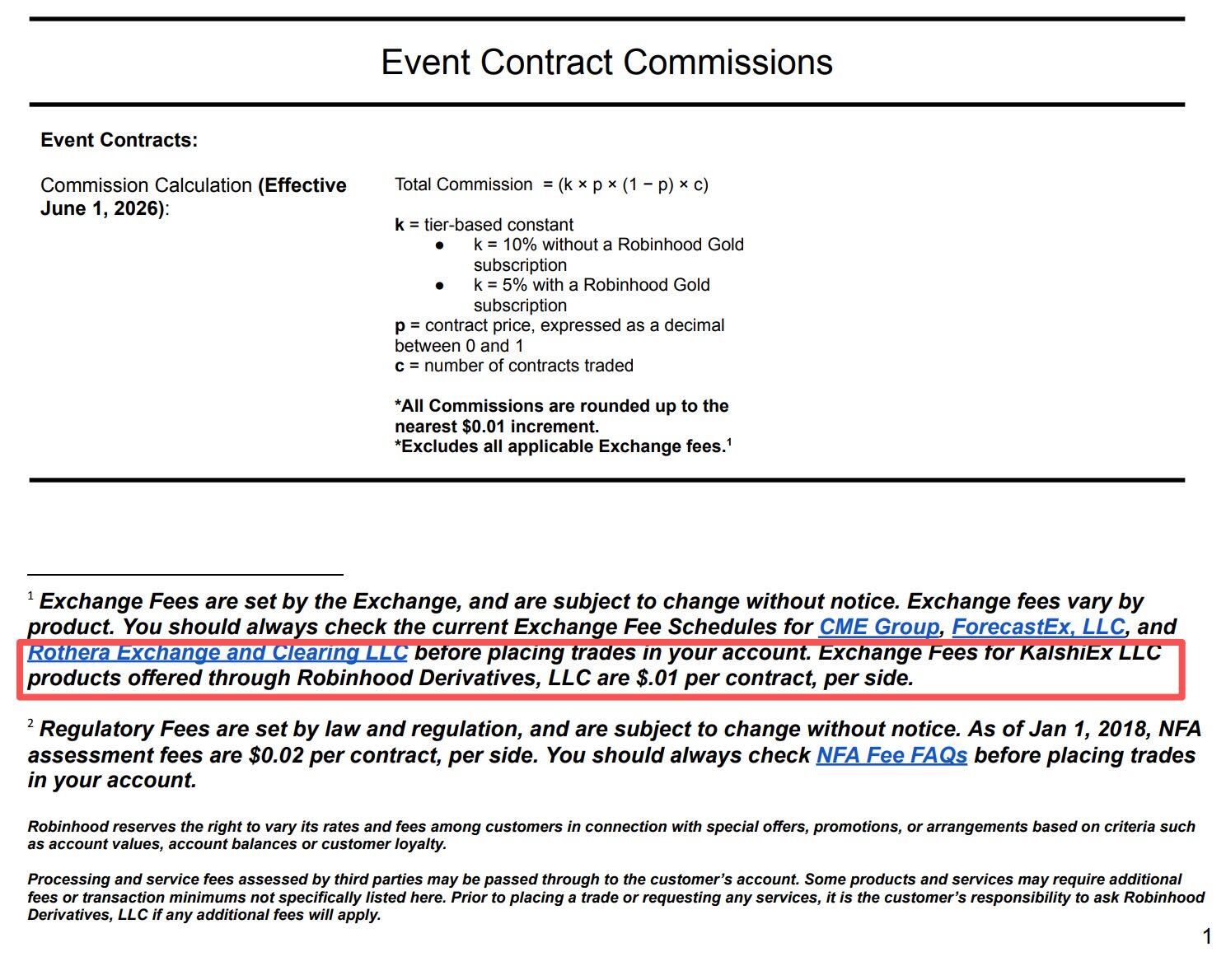
The subsequent story proved the "win-win" outcome of this collaboration. Through Robinhood's distribution channel, Kalshi indirectly gained vast amounts of users and trading volume. Piper Sandler analysts estimated that "trading volume completed through the Robinhood channel accounted for about 25%-35% of Kalshi's total trading volume." These orders ultimately translated into revenue on both parties' ledgers — Robinhood independently charged for all Kalshi event contracts traded through its channel, $0.01 per contract per side, before sharing profits with Kalshi (the specific split was not disclosed).
The Q1 financial report disclosed at the end of April this year showed that Robinhood transacted 8.8 billion event contracts in Q1, driving "other transaction revenue" to increase 320% year-over-year, reaching $147 million. Prediction markets had become the brightest growth engine in Robinhood's product line.

But recently, this relationship has undergone some subtle changes.

Robinhood's Ambition: Reclaiming the Cake Shared with Kalshi

As internet history has proven countless times, when a distribution channel gains enough clout, it is no longer satisfied with being just a channel. Robinhood is no exception.

Although the partnership with Kalshi also brought Robinhood considerable revenue, as prediction markets became one of the fastest-growing new businesses on the platform, Robinhood was no longer content with the current profit-sharing arrangement.

In the partnership model, Kalshi provided the market and infrastructure, while Robinhood provided the users and order flow. However, as the collaboration deepened, Robinhood gradually realized that what might truly be scarce was not the market itself, but the user entry point it firmly controlled. After all, for most Robinhood users, they don't care whether orders are ultimately filled on Kalshi or another platform — users only see a trading entry point within the Robinhood app, not the underlying infrastructure provider.

In other words, Robinhood always controlled one of the most important resources for a prediction market — distribution capability. If the users belonged to itself, then why should the order flow go to someone else?

In fact, while Robinhood was rapidly validating the demand for prediction markets through Kalshi, another Plan B was quietly launched shortly after.

In November 2025, Robinhood announced the formation of a joint venture with Wall Street quantitative trading giant Susquehanna and planned to acquire the CFTC-regulated derivatives exchange MIAXdx. According to the official statement, the joint venture would operate an independent futures and derivatives exchange and clearinghouse in the future, with prediction markets being one of its key focuses. At the time, the outside world mostly viewed it as an infrastructure investment. However, as more information was disclosed later, people gradually realized that Robinhood's ambition far exceeded merely finding a new partner for prediction markets.

In January 2026, the deal was officially completed. Robinhood and Susquehanna gained 90% control of MIAXdx, along with a complete CFTC regulatory framework, including Designated Contract Market (DCM) and Derivatives Clearing Organization (DCO) licenses. Subsequently, MIAXdx was renamed Rothera Exchange, and its clearinghouse was renamed Rothera Clearing.

At this point, Robinhood already possessed the core elements required to independently operate a prediction market. What was missing was only a mature product comparable to Kalshi's, but for Robinhood with its rich internet product development experience, this was clearly not a challenge.

Rothera's Opportunity: The World Cup

In June 2026, after about half a year of accelerated development, the Rothera product began to take shape. Robinhood finally made the move that seemed almost inevitable — gradually shifting the order flow that originally went to Kalshi into its own controlled system.

Robinhood specifically chose an excellent debut battlefield for Rothera — the World Cup. For prediction markets, the World Cup is undoubtedly one of the most traffic-generating trading themes. Whether it's match outcomes, advancement results, or the final champion, related markets can attract a large number of new users to trade in a short time. For the new Rothera platform just starting up, there's no better scenario than the World Cup for a cold launch.

According to Robinhood's official disclosure, during this World Cup, which consists of 104 matches, some event contracts would be directed to Rothera for matching and clearing. These include markets for individual World Cup match results, the ultimate World Cup champion, and total goals in single matches. Compared to the previous model that relied entirely on Kalshi, this marked the first time Robinhood would import prediction market orders into its own trading system on a large scale.
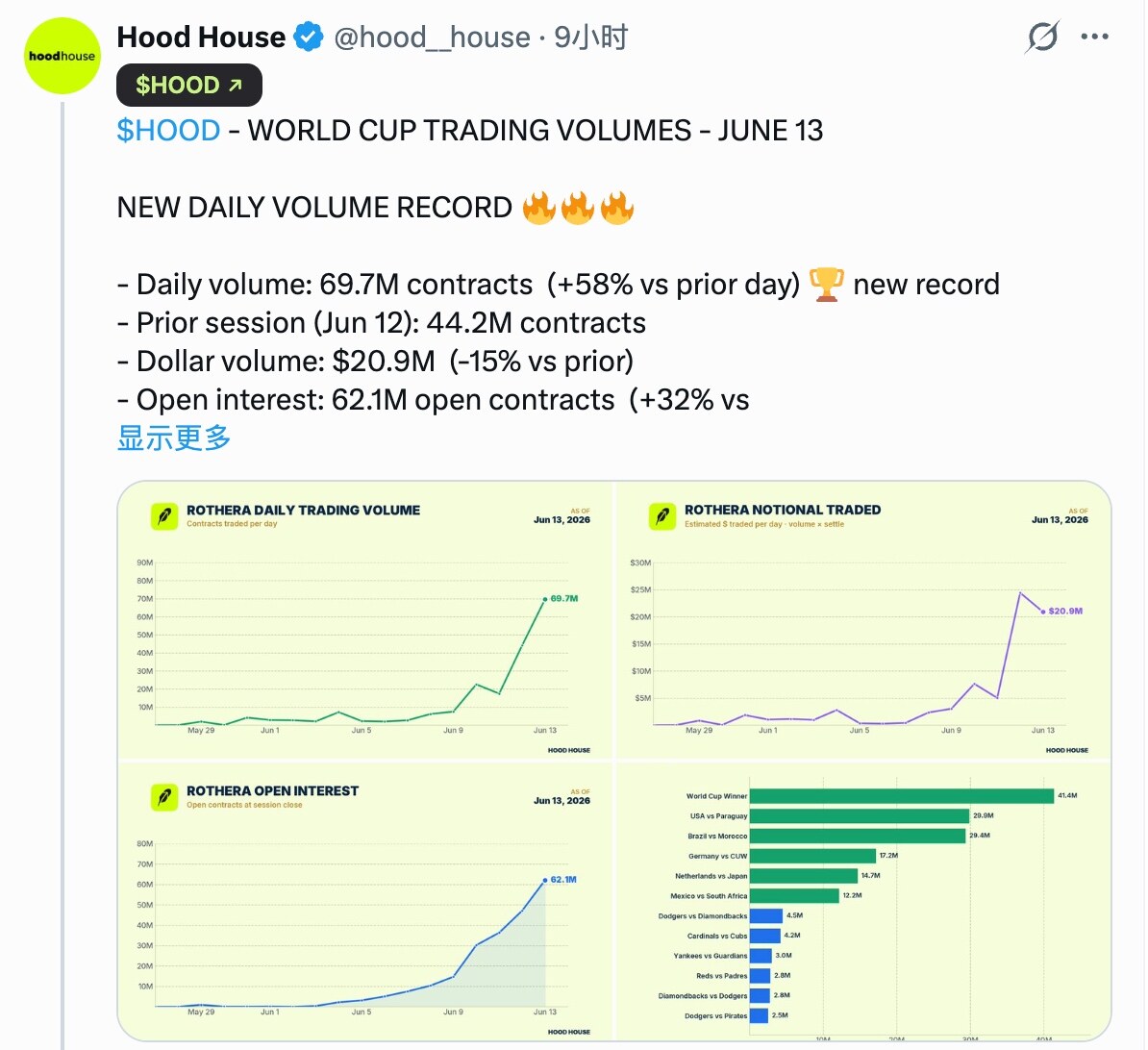
Judging by the results, Rothera clearly seized this opportunity. According to data disclosed by Hood House, a research-focused media outlet tracking Robinhood dynamics, on June 12, Rothera transacted 44.2 million contracts, corresponding to a dollar trading volume of approximately $24.4 million. On June 13, Rothera transacted 69.7 million contracts, corresponding to a dollar trading volume of approximately $20.9 million... Although these figures still have a gap compared to Kalshi's hot markets with billions of dollars in trading volume, considering that Rothera had literally just launched a few days prior, this performance data is already sufficiently successful.

For both Robinhood and Kalshi, this indicates that the balance in their collaboration has begun to tilt. From Robinhood's perspective, the commission revenue that previously needed to be shared with Kalshi can now be retained within its own ecosystem. From Kalshi's perspective, this means that one of its most important growth engines is starting to show signs of weakening.

And the World Cup is clearly just the beginning of Rothera's encroachment on Kalshi. Looking further into the future, Robinhood is bound to expand Rothera's coverage to more sports events as well as economic and political themes. Those orders that originally flowed to Kalshi will be successively intercepted by Rothera.

Since Robinhood and Kalshi have never disclosed their profit-sharing ratio, we cannot know the exact value of this interception. However, considering that Robinhood alone generated $147 million in prediction market-related revenue in Q1, and the Q2 World Cup and the more distant midterm elections will likely bring larger-scale trading activity, the value of this interception could reach billions of dollars on an annual basis.

Who Controls Distribution, Controls Everything

The drama of Robinhood and Kalshi moving from allies to opponents once again illustrates a logic repeatedly proven in the internet market — products are easy to build, but traffic is hard to find; whoever controls distribution controls everything.

Over the past few years, the market generally believed that Kalshi's core moat came from regulatory licenses, exchange qualifications, and clearing capabilities. Therefore, whether it's brokerages like Robinhood or various media, communities, and traffic platforms, they were essentially just Kalshi's distribution channels and traffic inlets. However, the emergence of Rothera proves one thing: in an era of severe product homogenization, the product itself might not be the most important element. What remains truly scarce is always the user.

Where the users are, the liquidity is; where the liquidity is, the market will be. When Robinhood controls the entry point for tens of millions of retail users, it has full capability to direct these users to any trading venue. For users, they don't care whether orders are ultimately filled on Kalshi or Rothera. As long as the experience isn't significantly different, who handles the matching and clearing behind the scenes doesn't matter.

If the theme of the prediction market industry in the past few years was the market battle between Polymarket and Kalshi, then the theme for the coming years might become a channel war. Robinhood incubating Rothera is essentially a reverse integration initiated by the distribution side towards the market layer. As more and more platforms with traffic inlets begin to realize the strategic value of prediction markets, similar stories are highly likely to continue. Whether it's exchanges, brokerages, social platforms, or media platforms, any could become a new entry point for prediction markets.

And when inlets start to control the market, and channels begin to possess pricing power, the ultimate winner in the prediction market industry might no longer be the platform responsible for matching orders, but the one closest to the user, the one who can best control distribution.

This was true in the internet era, and also true in the mobile internet era. This time, it's no exception.


Related Questions

QWhat was the strategic significance of the partnership between Robinhood and Kalshi announced in March 2025?

AThe partnership was strategically significant for both parties. Robinhood leveraged Kalshi's established prediction market product and regulatory infrastructure to offer event contract trading to its user base. In return, Kalshi gained access to Robinhood's massive retail investor traffic. It was a 'win-win' where Robinhood handled distribution and Kalshi provided the underlying market, matching, clearing, and compliance systems.

QAccording to the article, what prompted Robinhood to launch its own prediction market platform, Rothera Exchange?

ARobinhood's launch of Rothera Exchange was driven by its realization that it controlled the most valuable asset: user distribution. As prediction markets became a major growth driver on its platform, Robinhood became dissatisfied with sharing revenue with Kalshi. Recognizing that users trade through the Robinhood interface and are indifferent to the backend provider, Robinhood decided to capture more value by building its own CFTC-regulated market and clearing infrastructure.

QWhat event did Robinhood choose to launch Rothera Exchange, and why was it an opportune moment?

ARobinhood chose the 2026 FIFA World Cup to launch Rothera Exchange. This was an opportune moment because the World Cup is one of the most high-traffic events for prediction markets, attracting大量 new users to trade on match outcomes, tournament winners, and other related markets. It provided the perfect scenario for the 'cold start' of their new platform.

QWhat core industry dynamic does the Robinhood-Kalshi-Rothera case illustrate, according to the article's conclusion?

AThe case illustrates the core dynamic that 'who controls distribution, controls everything.' In a market where products are increasingly commoditized, the article argues that the truly scarce resource is not the trading platform itself, but the user base and the distribution channels. Entities controlling user access (like Robinhood) hold ultimate pricing power and can redirect liquidity, making them the potential ultimate winners, not necessarily the underlying market operators.

QHow does the article characterize the future competitive landscape of the prediction market industry following this development?

AThe article characterizes the future competitive landscape as shifting from a 'market war' (like between Polymarket and Kalshi) to a 'channel war.' It predicts that platforms with significant user traffic—such as exchanges, brokerages, social media, and media platforms—will recognize the strategic value of prediction markets. Following Robinhood's model, these channels may initiate reverse integration by building or acquiring their own market infrastructure, leading to more consolidation where distribution controls the market.

Related Reads

pump.fun's New Feature Brings 'Black Mirror' Into Reality

The article begins by recounting a dark fictional story from *Black Mirror* (Season 7, Episode 1 "Common People"), where a man is forced to perform humiliating tasks online to pay for his wife's life-sustaining medical subscription. It then draws a parallel to a new real-world feature on the crypto platform pump.fun called "Pump.fun Go," which allows users to post and complete paid bounty tasks. This feature gained mainstream attention, often negatively, through extreme examples. A prominent case involved a bounty of 40 SOL (~$2,600) offered to permanently tattoo "$bountywork" on one's forehead. An Indian man completed the task, stating the money "changed his life," and later earned significantly more from a related meme coin. Another bounty paid 200 SOL (~$14,000) for a "bounty.fun" forehead tattoo, with the participant simply stating, "We need the money." The article highlights how this system can amplify darkness, citing the dev behind $Bountywork who spent thousands on bounties for attention-grabbing stunts like eating bugs or drinking hot sauce for small sums. It compares this to past tragic live-streaming incidents where people harmed themselves for money, noting regulation cannot stop those in desperate need. However, it also points to positive, altruistic bounties that have emerged, such as organizing anti-work rallies in New York, performing random acts of kindness for strangers, organizing community food drives, or even helping an elderly person cross the street. The piece concludes by acknowledging the platform reflects both the dark and light sides of human nature when actions are given a price, hoping for more of the latter.

marsbit4m ago

pump.fun's New Feature Brings 'Black Mirror' Into Reality

marsbit4m ago

As the US and Japan Hike Interest Rates, Which Asset Class is Most at Risk?

This week, global markets face two major events: the Bank of Japan's likely interest rate hike and the US Federal Reserve's FOMC meeting. For risk assets, it is a pivotal and volatile week. In the US, expectations for rate cuts have faded dramatically. May's higher-than-expected CPI and resilient jobs data have shifted the Fed's focus from potential cuts to the possibility of future hikes. New Fed Chair Wash is unlikely to raise rates at this meeting, but any hawkish shift in communication, the dot plot, or the policy statement could lead markets to price in tighter policy, pushing up short-term Treasury yields and strengthening the dollar. High-valuation growth stocks, AI-related assets, and small-cap stocks reliant on cheap funding are most vulnerable to rising rates. In Japan, a 25 basis point hike is almost fully priced in (98.3% probability), which would bring the policy rate to 1%, its highest since 1995. The concern is not the hike itself, but its potential to unwind the massive "carry trade," where investors borrowed low-yielding yen to invest globally. Historically, Japan's rate hikes have coincided with global market stress (2000, 2007, 2024). While this well-telegraphed hike may be digested smoothly, two key factors increase uncertainty: 1) Governor Ueda's absence due to illness, putting communication in the hands of less-familiar deputies, and 2) the Fed meeting occurring just days later, creating potential for a compounded market reaction if both central banks sound hawkish. Asset implications: * **Bonds:** US short-term yields sensitive to Fed signals. Japan's rate hike could pressure its massive US Treasury holdings. * **Currencies:** Dollar likely supported by Fed; Yen's reaction hinges on BoJ's forward guidance. * **Equities:** US growth stocks, small-caps most at risk. Japanese stocks face pressure from a stronger yen. * **Crypto:** Assets like Bitcoin face headwinds from higher rates and tighter liquidity; high-beta altcoins are even more vulnerable. The convergence of these two central bank meetings amplifies market volatility risks, with potential spillovers across asset classes globally.

marsbit9m ago

As the US and Japan Hike Interest Rates, Which Asset Class is Most at Risk?

marsbit9m ago

Data Decrypts the BTC Cycle: Three Major Bottom Signals Illuminate Simultaneously, Q4 Could Be a Crucial Turning Point Window?

"Decoding the Bitcoin Cycle: Three Bottom Signals Flash Simultaneously, Is Q4 the Key Turning Point?" The article analyzes Bitcoin's current market position, comparing it to historical cycles. BTC has corrected over 52% from its October 2025 peak of $126,198 to around $59,100 in June 2026. While significant, this drawdown is milder than the 77-86% declines seen in past bear markets. The analysis is framed within Bitcoin's four-year halving cycle. Past cycles show a pattern: prices peak 12-18 months post-halving, bottom 12-14 months after the peak, with lows typically occurring roughly 17 months before the next halving. Following the April 2024 halving and the October 2025 peak, this pattern suggests a potential bottoming window around Q4 2026, ahead of the expected 2028 halving. Three key on-chain metrics are signaling undervaluation: The MVRV Z-Score has dropped near 0.27, approaching historic bottom zones. The market price is only about 9% above the network's average realized price of ~$53,600, a rare low premium. Bitcoin's price recently touched its 200-week moving average (~$62,200), a level that aligned with bottoms in 2015, 2018, and 2020. While US spot Bitcoin ETFs saw record outflows in May/June 2026, indicating retail panic, whale addresses (holding 100+ BTC) reached a yearly high. Entities like MicroStrategy resumed buying, and long-term holders control a near-record 78% of the supply, suggesting accumulation. A major macro overhang was partially removed with a US-Iran ceasefire agreement in mid-June 2026, which eased oil prices and triggered a sharp BTC rally. However, persistent inflation means high-interest rates remain a constraint. The conclusion notes that genuine investment opportunities often arise when confidence is lowest, amidst narratives that "this time is different." While not guaranteeing an immediate bottom, the confluence of cycle timing, undervaluation signals, and shifting macro risks suggests late 2026 may be a critical period for reassessing risk/reward and patient accumulation for long-term believers.

marsbit9m ago

Data Decrypts the BTC Cycle: Three Major Bottom Signals Illuminate Simultaneously, Q4 Could Be a Crucial Turning Point Window?

marsbit9m ago

Trading

Spot
Futures
活动图片