The Final Candidate for Fed Chair: What Is Rick Rieder's Stance on Crypto?

marsbitPublished on 2026-01-13Last updated on 2026-01-13

Abstract

This article discusses Rick Rieder, the Chief Investment Officer of Global Fixed Income at BlackRock, who is being considered by former President Trump as a potential candidate to replace Jerome Powell as the next Chair of the Federal Reserve. Rieder is the final candidate to be vetted, alongside Kevin Warsh, Kevin Hassett, and Christopher Waller. Unlike the other candidates, Rieder has less government experience but is notably pro-cryptocurrency. He has publicly expressed positive views on Bitcoin, referring to it as a durable asset and a viable alternative to gold. He believes digital payment systems and cryptocurrencies are here to stay and has advocated for including Bitcoin in investment portfolios as a hedge against fiat currency devaluation. Under his influence, BlackRock began investing in Bitcoin futures and later launched a successful Bitcoin ETF. If appointed, Rieder’s stance could lead to broader institutional adoption of crypto, support for lower interest rates (he has called for cuts to around 3%), and encouragement of developments in tokenization, stablecoins, and DeFi. However, according to Polymarket data at the time of writing, his probability of being selected was only 7%, the lowest among the candidates. The final decision is expected in January.

Original|Odaily Planet Daily(@OdailyChina)

Author|CryptoLeo(@LeoAndCrypto)
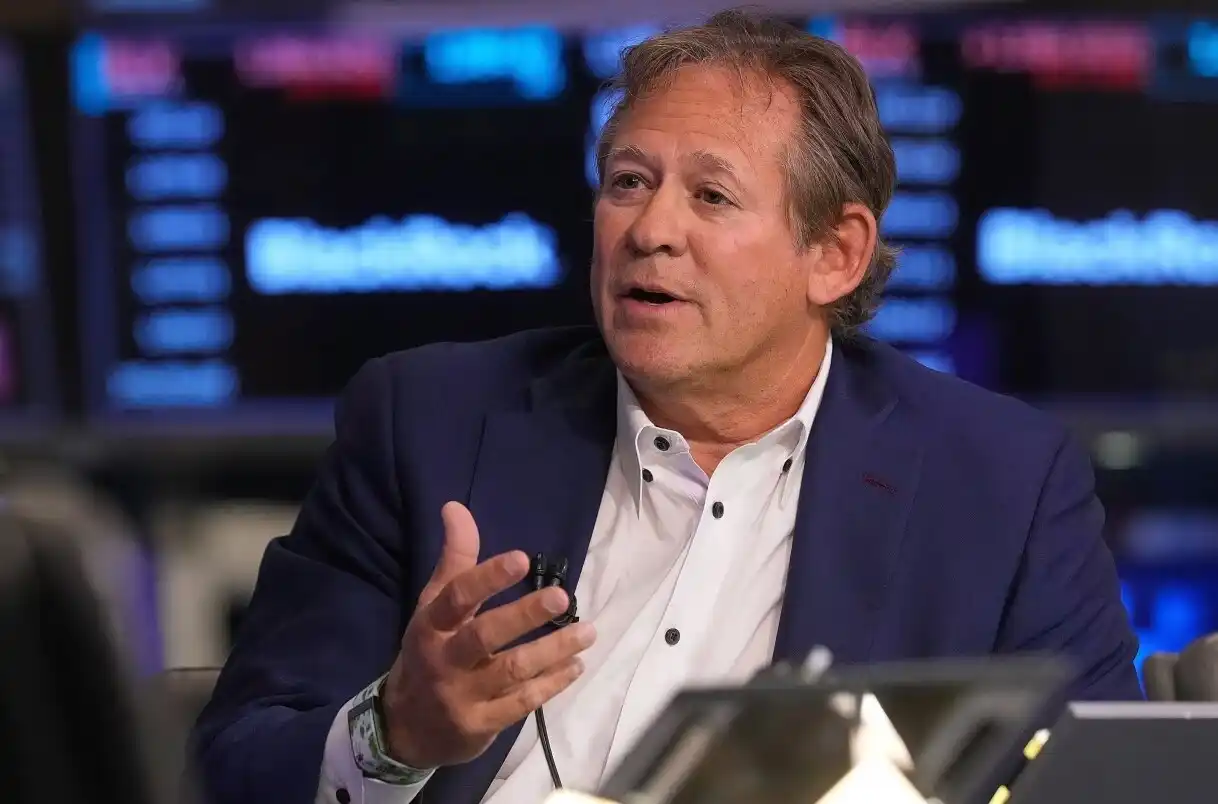
The full list of candidates for Federal Reserve Chair was finalized yesterday. Yesterday, Trump announced that he will interview Rick Rieder, BlackRock's Chief Investment Officer of Global Fixed Income, on Thursday to assess his potential as the next Fed Chair, marking the fourth and final interview for candidates to succeed Chair Powell. Besides Rieder, the final shortlist includes former Fed Governor Kevin Warsh, National Economic Council Director Kevin Hassett, and Fed Governor Christopher Waller. Trump stated that he will make the final decision in January.

Among the four candidates, Rieder is likely the least familiar to most, as Odaily has previously covered the other candidates. Today, we will introduce this potential Fed Chair candidate.

Related references:

"Academic Outsider: Small-Town Professor Waller Emerges as Top Contender for Fed Chair"

"Is BTC's 'Strict Principal' Coming? If He Leads the Fed, the Crypto Party Might End Abruptly"

A Veteran "BlackRocker" Deeply Rooted in Fixed Income

Rieder was born in October 1961. LinkedIn data shows that he studied at Emory University and the Wharton School of the University of Pennsylvania, earning a Bachelor of Business Administration (BBA) in Finance from Emory in 1983 and an MBA from Wharton in 1987.

After graduation, Rieder worked at Lehman Brothers for 20 years from 1987 to 2008, holding senior positions such as Global Head of Credit Business and Global Head of Principal Strategies.

After Lehman Brothers collapsed in 2008, Rieder started his own venture, founding R3 Capital (focused on multi-strategy credit investments) and serving as its CEO. The firm was acquired by BlackRock in 2009. This means Rick Rieder joined BlackRock along with his startup, becoming a Managing Director and leading the Fixed Income Alternatives Portfolio Team.

To date, Rieder has been with BlackRock for 17 years. His current roles include BlackRock's Chief Investment Officer of Global Fixed Income, Head of the Fundamental Fixed Income business, and Head of the Global Allocation Investment Team. Rieder manages trillions of dollars in assets, is a member of BlackRock's Global Executive Committee (GEC) and its GEC Investment Subcommittee, and chairs the firm-wide BlackRock Investment Committee. He is also currently a member of the Alphabet/Google Investment Advisory Committee and the UBS Research Advisory Committee.
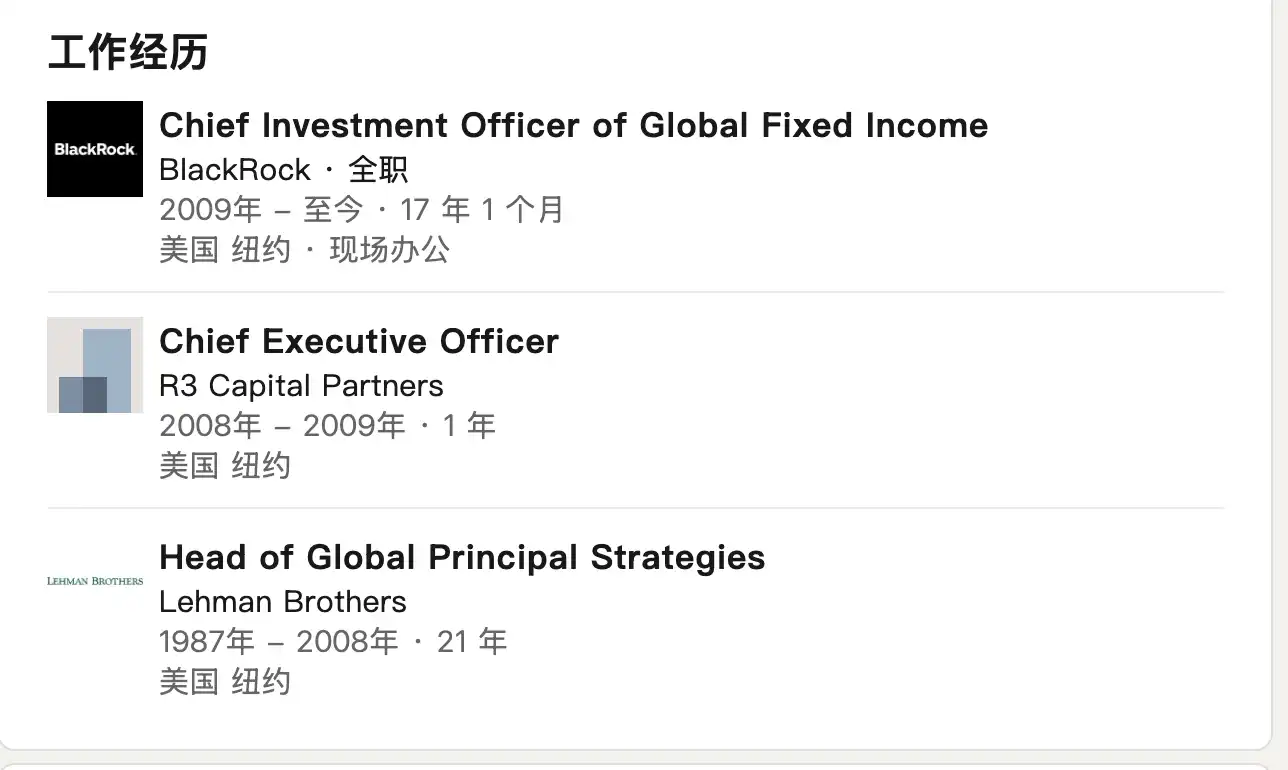
Notably, Rieder has also served as Vice Chairman of the Treasury Borrowing Advisory Committee and as a member of the Federal Reserve's Investment Advisory Committee on Financial Markets.

How Does Rieder Differ from the Other Candidates?

Compared to the other three candidates, Rieder has less experience working directly for the U.S. government. However, for the crypto industry, the key point of interest is: Rieder is decidedly pro-crypto. In recent years, Rieder has repeatedly expressed positive views on cryptocurrencies (especially Bitcoin) in public, evolving from initial caution to recognizing Bitcoin's value as a durable asset and hard asset for investment. Below are his public statements related to crypto:

November 2020: Rieder commented on CNBC, stating that digital payment systems are real, and cryptocurrencies will exist long-term. Bitcoin's mechanism is durable, more functional, and more traceable; it can largely replace gold, especially given the high acceptance of digital payments among millennials.

2021: In an interview with CNBC, Rieder stated that Bitcoin is a durable asset and will be part of the investment landscape long-term. BlackRock had begun "dipping its toes in a small way." Although Bitcoin faces challenges like high volatility and regulation, these will be overcome over time.

Additionally, Rieder mentioned that he personally holds Bitcoin (without disclosing the amount), believing its price will rise significantly and that holding Bitcoin as a speculative tool offers high value.

2022: In an interview with Yahoo Finance, Rieder stated that the crypto market crash was similar to the early internet era. He maintained that Bitcoin and cryptocurrencies are durable assets, but there was excessive investment built around them. The crash was a recalibration for the industry, eliminating some excess leverage. Once the market healthy, he remains bullish long-term, stating, "In just 2 or 3 years, the crypto market will be higher than it is today."

September 2025: In a CNBC interview, Rieder stated that an ideal portfolio should hold "hard assets" like gold and Bitcoin to hedge against fiat currency devaluation. Rieder mentioned BlackRock invests 3–5% in gold but "far less" in cryptocurrency. He believes Bitcoin will rise but considers a 5% allocation potentially too high.

The evolution of his public comments shows that, from his professional investment perspective, Rieder is personally bullish on Bitcoin, affirming its long-term value and viewing institutional Bitcoin holdings as a sound investment strategy.

Potential Impact on Crypto if Rieder Is Elected

Between 2020 and 2025, Rieder repeatedly evaluated Bitcoin from the angles of institutional portfolio construction, macro hedging (e.g., against inflation, fiat devaluation), and liquidity. His recent inclusion on the Fed Chair shortlist makes these comments worth revisiting. Compared to the other candidates, Rieder is decidedly the most pro-crypto figure. If elected Fed Chair, he could indirectly bring several benefits to the crypto industry:

1. Macro Policy: Advocating for Significant Rate Cuts

Rieder has consistently argued in recent months for lowering interest rates to 3%, meaning at least a 50 basis point cut from current levels. Rieder stated: "My stance has been very clear for many months now. The Fed must cut rates, and I don't think it needs to cut by much, ultimately landing at 3%—a level closer to the neutral rate."

Furthermore, Rieder noted that whoever becomes Fed Chair, the entire Federal Open Market Committee (FOMC) will make appropriate decisions based on economic data analysis and assessment.

2. Professional Angle: More Institutional Participation

As BlackRock's Chief Investment Officer of Global Fixed Income, Rieder led the push for BlackRock to allocate to Bitcoin futures as early as 2021, and the subsequent launch of IBIT was very successful. Given Rieder's track record, if elected Fed Chair, his pro-crypto stance would likely attract more institutional investors into the market.

3. Personal Perspective: Bullish on Crypto and Promoting Development

Although Rieder hasn't disclosed his personal Bitcoin holdings, BlackRock's progression from early Bitcoin futures to crypto ETFs shows he doesn't just talk the talk. He is highly bullish on Bitcoin's long-term value, emphasizing its "upside convexity" to amplify crypto returns in a loose monetary environment.

Additionally, as a professional fixed-income analyst, Rieder seeks yield in high-interest/high-volatility environments—areas where crypto markets can excel. He would likely promote development in crypto industry areas like asset tokenization, stablecoins, and DeFi.
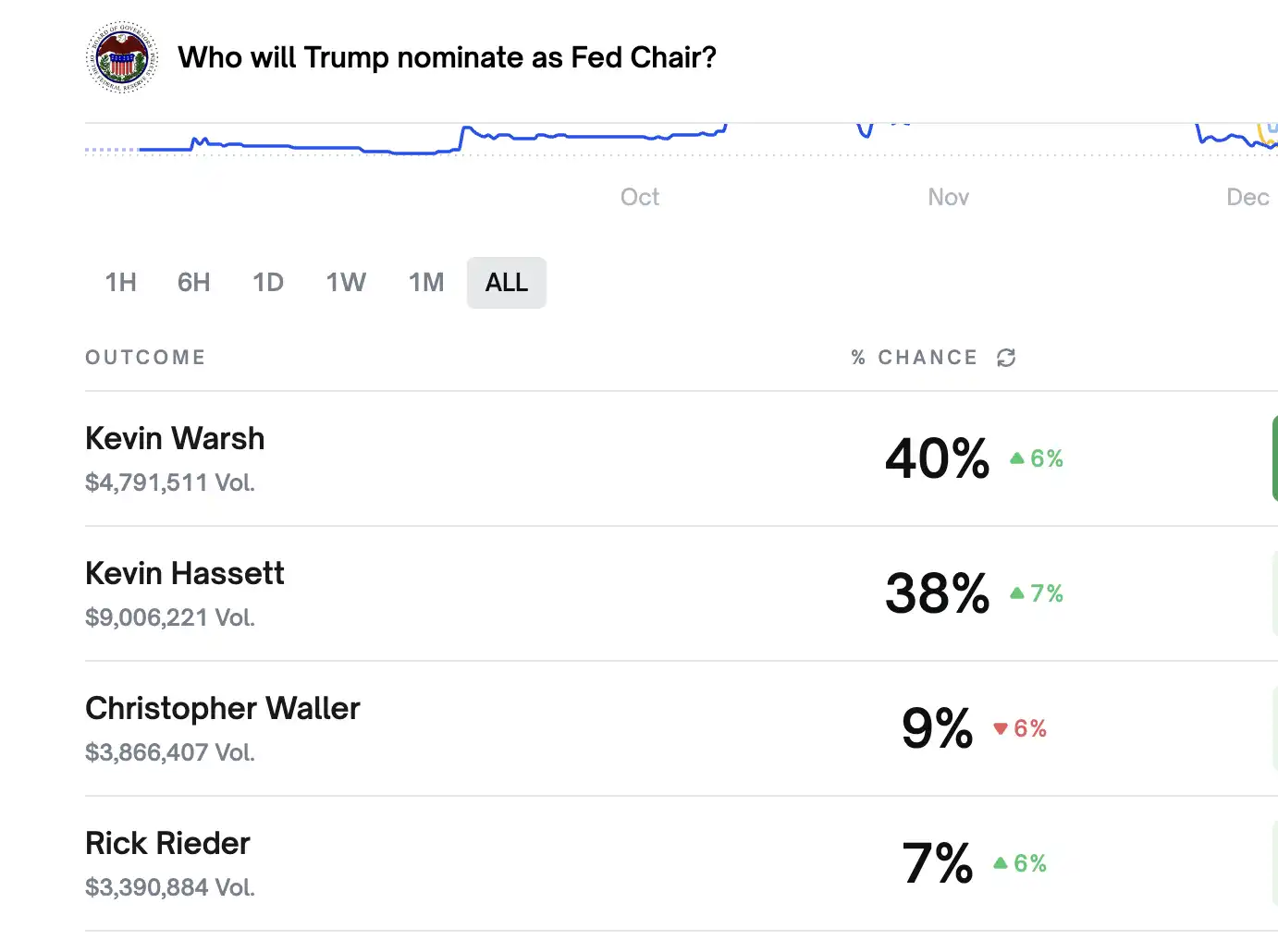
As of writing, Polymarket data shows the probability of Kevin Warsh becoming Fed Chair is temporarily at 40% (up 6%), Kevin Hassett at 38% (up 7%), Christopher Waller at 9% (down 9%), and Rick Rieder has the lowest probability at 7% (up 6%). Although his odds are lower compared to Warsh and Hassett, the 6-point increase means he's soon to overtake Waller.

Furthermore, if Trump's pick is not currently a member of the Federal Reserve Board, that person must first join the Board. For Rieder, to become Chair, he would need a nomination from Trump and confirmation by the Senate to become a Board member—a process that could take months before he could become Fed Chair.

The outcome depends on his meeting with Trump and [presumably, aides] on Thursday. Odaily will provide updates on related developments promptly. Everyone can also closely monitor the data changes for the corresponding contracts on Polymarket.


Related Questions

QWho is Rick Rieder and why is he being considered for the Federal Reserve Chair?

ARick Rieder is the Chief Investment Officer of Global Fixed Income at BlackRock. He is being considered as a potential candidate to replace Jerome Powell as the Federal Reserve Chair, with former President Trump interviewing him as the fourth and final candidate.

QWhat is Rick Rieder's stance on cryptocurrencies, particularly Bitcoin?

ARick Rieder is pro-crypto and has expressed positive views on Bitcoin, considering it a durable asset and a long-term part of the investment landscape. He believes Bitcoin can replace gold and has advocated for its inclusion in investment portfolios as a hedge against fiat currency devaluation.

QHow does Rick Rieder's view on interest rates differ from current Fed policy?

ARieder has consistently called for the Federal Reserve to lower interest rates to around 3%, which is at least 50 basis points below the current level, arguing that this rate is closer to the neutral interest rate.

QWhat potential impact could Rieder's appointment as Fed Chair have on the crypto industry?

AIf appointed, Rieder's pro-crypto stance could lead to more institutional adoption of cryptocurrencies, promote developments in asset tokenization, stablecoins, and DeFi, and create a more favorable macroeconomic environment through lower interest rates.

QAccording to Polymarket data, what is the probability of Rick Rieder becoming the next Fed Chair?

AAs of the article's publication, Polymarket data shows Rick Rieder has a 7% probability of becoming the next Federal Reserve Chair, which is the lowest among the four candidates but has increased by 6 percentage points.

Related Reads

La Liga Team Bets $1 Million Against Themselves Before Match: Does Using Prediction Markets for Insurance Comply with Sports Regulations?

A Spanish La Liga club, reportedly Osasuna, purchased insurance against relegation and was linked to a transaction of over $1 million on the prediction market platform Kalshi, betting against its own victory in a crucial season-ending match. While Osasuna confirmed buying €1.2 million insurance for a potential €6 million payout in case of relegation through broker Howden, it did not confirm involvement with Kalshi. The reported trade involved intermediaries like Game Point Capital and Greenlight Commodities, with quant firm Susquehanna as the counterparty. This incident highlights the blurring line between financial hedging and gambling in prediction markets. Such markets allow trading on future event outcomes, like sports results. In the US, Kalshi operates as a regulated event contract market under the CFTC. However, Spanish authorities recently initiated penalties against Kalshi and Polymarket, considering their activities unlicensed gambling. The case raises core questions about prediction markets: who can trade, how insider information is handled, and whether participants can influence outcomes, especially in sports where results are human-driven. While leagues like La Liga and Serie A have partnered with Polymarket in North America, the regulatory clash and potential for conflicts of interest, as seen in this club's alleged transaction, present significant challenges as prediction markets evolve toward institutional risk management.

Foresight News29m ago

La Liga Team Bets $1 Million Against Themselves Before Match: Does Using Prediction Markets for Insurance Comply with Sports Regulations?

Foresight News29m ago

From Shouting 150 Dollars to Liquidating HYPE in Just Three Days, How Much Credibility Does Arthur Hayes Have Left?

How much of Arthur Hayes's market credibility remains? Recently, the "godfather of crypto perpetual swaps" and BitMEX co-founder has faced public criticism, including accusations from on-chain investigator ZachXBT about creating exit liquidity for his followers. Starting last week, Hayes executed multiple sudden sell-offs. He had repeatedly publicly predicted the HYPE token would reach $150. After a $100,000 bet defending Hyperliquid on June 1st, he announced just three days later that he had completely sold his HYPE and NEAR holdings, successfully exiting near the peak. He also sold ZEC and WLD. His sale of WLD appeared to be a classic "pump and dump" maneuver. On June 3rd, he publicly set a $10 target for WLD, causing its price to surge over 35%. By June 6th, he announced he had sold his WLD, citing "anomalous" SpaceX pre-IPO price action, which triggered a sharp price drop. On June 9th, Hayes published a lengthy article explaining his actions, citing factors like rising energy costs and a potential AI bubble burst. Consequently, his family office, Maelstrom, now holds positions in US energy producers and only core crypto assets BTC and ETH, having sold AI-related stocks and non-core cryptocurrencies. This pattern is not new. In 2025, he similarly touted HYPE before selling it at what turned out to be a cycle peak, only to repurchase it at the next cycle's low. Similar scenarios played out with tokens like ETHFI and ENA. Long-term observers have developed a strategy: ignore Hayes's public statements but closely monitor his on-chain actions—be cautious following his buys, but decisively follow his sells. If he continues these tactics, especially as seen with the WLD case, his market credibility risks being permanently damaged. As Hayes himself admitted in his latest article, "I remain an unapologetic gambler."

marsbit47m ago

From Shouting 150 Dollars to Liquidating HYPE in Just Three Days, How Much Credibility Does Arthur Hayes Have Left?

marsbit47m ago

Fundraising is Like a Strange Dance: The 'Absurd Drama' of Silicon Valley Founders' Capital Raises

The article details a series of absurd and revealing anecdotes shared by Silicon Valley founders about their venture capital fundraising experiences, sparked by Greg Isenberg's story of pitching to a sleeping a16z partner. Founders describe surreal pitch meetings: one faced a barefoot, peanut-eating investor who offered triple the requested amount after 30 seconds; another performed a pitch in a VC's parked car; a founder discovered his audience understood no English beyond "yes." These stories highlight the often irrational and performative nature of fundraising. Beyond the absurdity, darker power imbalances are exposed. Stories include investors suggesting founders fire co-founders for their equity, blatant market misjudgments, disrespectful behavior from LPs, and discriminatory remarks. A debate also emerges around "Sequoia's" practice of splitting a round into two valuations. However, the thread isn't solely critical. Positive counter-narratives celebrate supportive VCs who offered crucial advice during crises, respected founders' timelines, and showed simple gestures of respect—like a partner personally fetching coffee before a major pitch. Ultimately, the collective sharing acts as a pressure release, illustrating that fundraising is a complex dance of power, trust, and sometimes sheer theater. It underscores that beyond capital, mutual respect and integrity remain the most enduring foundations of the founder-investor relationship.

marsbit1h ago

Fundraising is Like a Strange Dance: The 'Absurd Drama' of Silicon Valley Founders' Capital Raises

marsbit1h ago

Trading

Spot
Futures

Hot Articles

Discussions

Welcome to the HTX Community. Here, you can stay informed about the latest platform developments and gain access to professional market insights. Users' opinions on the price of S (S) are presented below.

活动图片














