The Ethereum Doomsday Scenario: Inside The Bank Of Italy’s Crisis Simulation

bitcoinistPublished on 2026-01-13Last updated on 2026-01-13

Abstract

The Bank of Italy published a technical analysis exploring the potential consequences if Ethereum's value were to fall to zero and remain there. The paper frames this as a stress test on infrastructure, not just asset prices. It warns that if ETH loses its value, the economic incentive for validators—who are paid in ETH—would disappear. This could lead validators to exit the network, severely slowing or even stopping transaction settlement. The paper further cautions that other assets on the chain, such as tokenized securities or stablecoins, could become difficult to move or face security risks. While the scenario is not presented as likely, the analysis highlights how market risk can transform into infrastructure risk, especially since there is no formal mechanism to orderly shut down a permissionless blockchain.

The Bank of Italy ran a technical analysis that asks a stark question: What happens if Ethereum (ETH) falls to zero and stays there?

The recently released paper is authored by Claudia Biancotti for the Bank’s Markets, Infrastructures, Payment Systems series. It is listed as Number 74 and runs 11 pages.

Bank Of Italy Issues Technical Analysis

According to the Bank, permissionless blockchains like Ethereum act as settlement systems for a wide range of tokens and contracts. The institution treats the question as a stress test on infrastructure rather than only on asset prices.

The note warns that if a native token loses most of its market value and the drop remains persistent, the economic incentives that keep validators running could vanish. Validators might exit, the paper says, and that could make settlement slow or stop.

Source: Bank of Italy
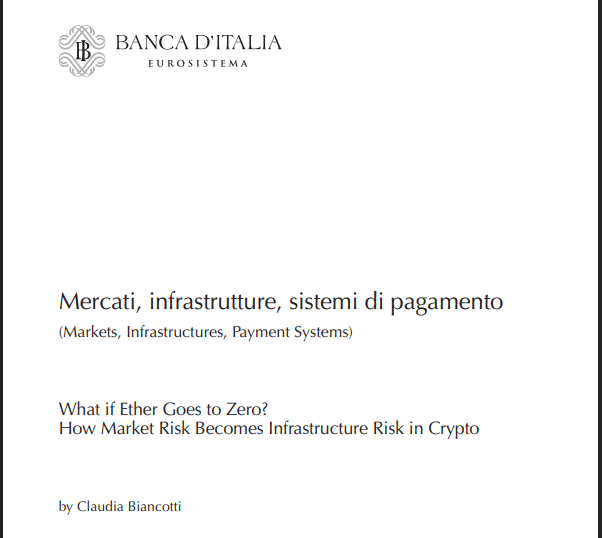
What The Paper Found

Based on reports in the Bank’s paper, the chain of effects is simple and worrying. Validators are paid in ETH. If ETH has next to no value, that payment no longer motivates operators.

As a result, transaction settlement could slow dramatically or, in extreme cases, halt. The paper also highlights that other assets using the chain — for example, tokenized securities or fully backed stablecoins — could become hard to move or could face security problems if the network’s defenses weaken.

Ethereum: Context And Reaction

Italy’s broader regulators have recently stepped up their look at crypto risks. Reports show the Economy Ministry ordered a review of safeguards, and the Bank of Italy’s paper fits into that wider push to quantify risks tied to new payment systems.

Reuters and other outlets covered the regulator-level review in December and January as authorities pressed firms to meet emerging rules.

Potential System Risks

The authors do not claim the scenario is likely. Instead, the exercise is framed as a way to show how market risk can turn into infrastructure risk. The paper points out there is no formal mechanism to “shut down” a permissionless chain in an orderly way.

Any mitigation would rely on voluntary action by validators, major staking firms, or protocol changes proposed and adopted by the community. That uncertainty is the main policy concern.

The Bank of Italy’s note is a technical, measured look at a worst-case scenario. It uses concrete data to argue that a collapse in Ethereum market value would not only hit holders but could also impair the functioning of systems that now run on Ethereum.

Featured image from Gemini, chart from TradingView

Related Questions

QWhat is the main question explored in the Bank of Italy's technical analysis paper?

AThe paper explores the question of what would happen if Ethereum (ETH) were to fall to zero and stay there, treating it as a stress test on financial infrastructure.

QAccording to the paper, what is the primary risk if the value of ETH becomes nearly worthless?

AThe primary risk is that the economic incentives for validators would vanish, which could cause them to exit the network, leading to dramatically slowed or even halted transaction settlement.

QBeyond the native ETH asset, what other types of assets on the Ethereum chain could be affected in this doomsday scenario?

AOther assets like tokenized securities or fully backed stablecoins could become hard to move or could face security problems if the network's defenses weaken due to validator exit.

QHow does the Bank of Italy frame the likelihood of this 'Ethereum falling to zero' scenario actually happening?

AThe authors do not claim the scenario is likely. Instead, they frame the exercise as a way to show how market risk can transform into infrastructure risk.

QWhat is identified as the main policy concern stemming from this analysis?

AThe main policy concern is the uncertainty, as there is no formal mechanism to 'shut down' a permissionless blockchain in an orderly way, and any mitigation would rely on voluntary action from validators, staking firms, or the community.

Related Reads

XRP Ledger Daily Fees Drop Below $400 As Network Activity Question Returns

The XRP Ledger is drawing attention as daily network fees have fallen below $400. While low fees align with XRPL's design for affordable transactions and are often seen as a strength, the metric can also serve as an indicator of network demand and paid transaction volume. This data point of around $3,100 in weekly fee burn highlights the stark contrast with higher-fee chains like Ethereum and Bitcoin. The development fuels an ongoing debate. Proponents view low fees as a sign of efficiency and accessibility, while critics may question if the network is generating sufficient high-value activity relative to its market cap and payments-focused narrative. The article cautions against overstating the finding, noting a single low-fee day does not signify network failure. It instead adds context to discussions about XRPL's usage, especially alongside Ripple's broader initiatives in stablecoins (RLUSD), AI payments, and enterprise infrastructure. The report recommends monitoring for a fee rebound, checking transaction counts for a fuller picture, and confirming the trend via native explorers like Bithomp. It frames the story within a larger market shift where on-chain data, protocol updates, and infrastructure developments are becoming crucial alongside price action. The editorial stance is to present the verified data, explain its significance for assessing network activity, and avoid hype, positioning it as part of the daily crypto conversation.

bitcoinist3h ago

XRP Ledger Daily Fees Drop Below $400 As Network Activity Question Returns

bitcoinist3h ago

Trading

Spot
Futures

Hot Articles

Discussions

Welcome to the HTX Community. Here, you can stay informed about the latest platform developments and gain access to professional market insights. Users' opinions on the price of S (S) are presented below.

活动图片















