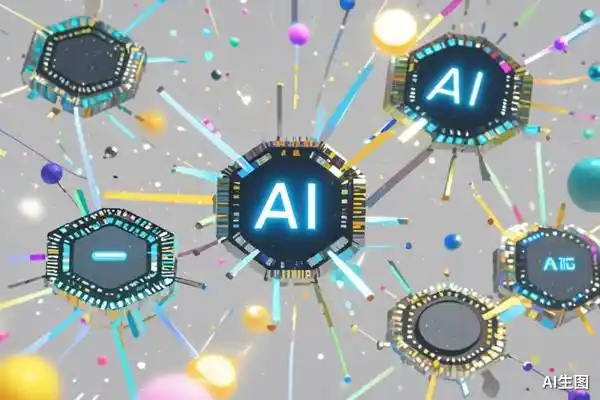
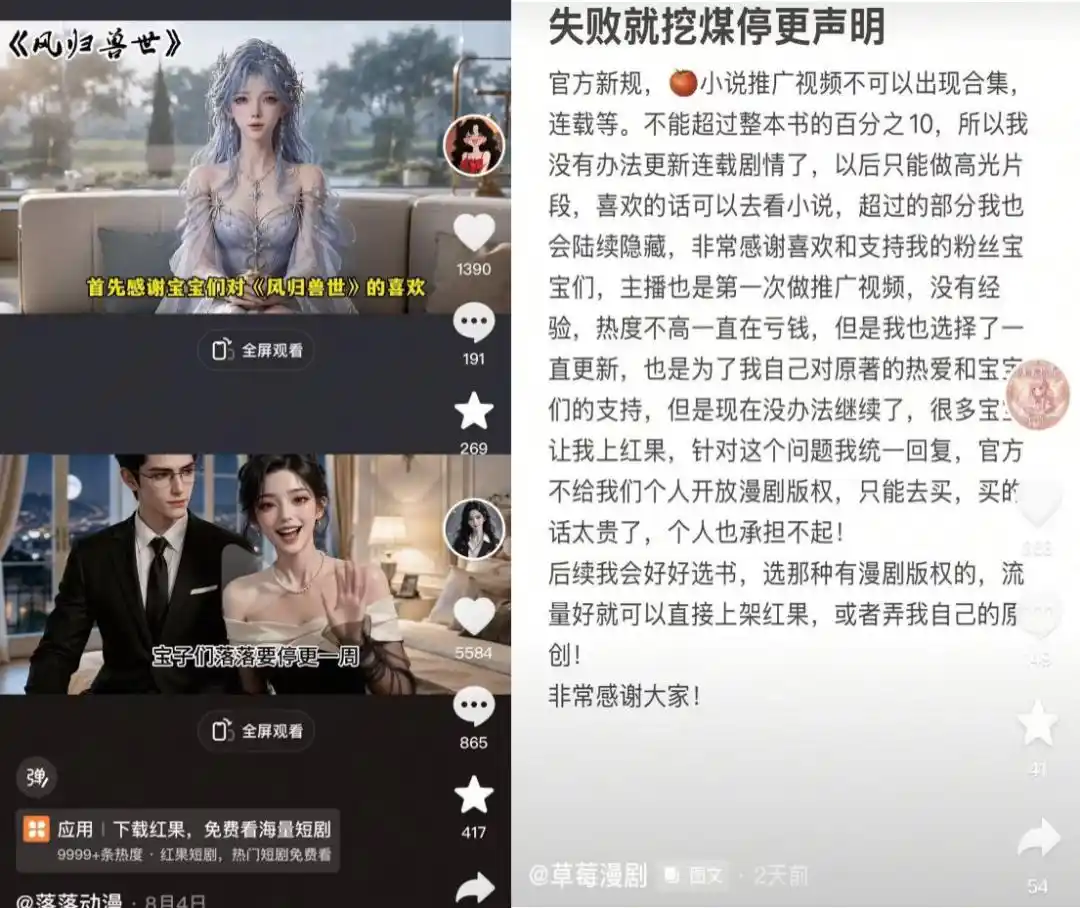
"Thank you all for your love. I must apologize here, as the official business adjustments force us to temporarily pause updates." "Update Suspension Notice: We are very sorry to disappoint the love of all our babies..." Not long ago, a wave of accounts, including those for AI comic dramas, AI art, and AI tutorials—once seen as "low-barrier entry entrepreneurial trends"—collectively went silent within the same timeframe.
The sudden wave of update suspensions was directly triggered by the "New User Acquisition Regulations" formally implemented by Tomato Novel on August 17th—a set of content and copyright compliance requirements targeting "Hongguo Free Short-Form Dramas" (comic dramas).
However, the new regulations were merely the last straw. What truly pushed this track to the edge of a reshuffle was the convergence in a single summer of tightening platform rules, increased copyright demands, rising cost pressures, and content homogenization.
In half a year, AI comic dramas have gone from clamorous enthusiasm to a collective retreat. The low-hanging fruit of traffic has been picked clean. Ultimately, those who can stay are the ones who understand how to make AI work for them and persist with the content itself.
The Odds Game of AI Comic Dramas
The computational power cost of large models was, first and foremost, the most important ticket for these grassroots creators to enter the entrepreneurial arena.
An AI comic drama creator calculated for Phoenix Network Technology: "My computational power cost, including wasted frames, is about 1 yuan per second, and the editing cost is about 0.7 yuan per second. I can only produce a maximum of five minutes of finished video per day." Converted, if updating five minutes daily, the combined computational power and editing cost alone would be nearly 510 yuan per day. "But a video with 60,000 views only earns about 45 yuan," making the input-output ratio extremely disproportionate.
Many creators still remember the viral hits that appeared earlier in the industry, which earned hundreds of thousands with costs of just a few thousand yuan.
For example, the 4-minute-plus AI short film "Huo Qubing" was fully produced by a small team of three people with less than 3,000 yuan in computational power costs in 48 hours before trending online; the related team has already secured business orders worth tens of thousands of yuan. "Zombie Scavenger" similarly went viral across the internet and overseas with only 3,000 yuan in computational power costs.
But this is what the public sees. The vast majority of small and medium creators cannot replicate the success of these AI viral dramas; accounts that can stably receive platform traffic recommendations are few and far between.
"Most people don't have a background in directing or screenwriting, so the content is highly uncertain. They also lack the capital for operations and ad spending. Natural traffic is basically tens of thousands to a few hundred thousand views. Combined income from Hongguo and Douyin platforms is just over nine thousand yuan, and that's already considered a hit." "The reality is that most individual creators won't have a hit, and even if they do, it might only cover costs," the aforementioned creator told Phoenix Network Technology.
In an environment where everyone wants to enter the AI industry, how easy is it for an individual creator without script reserves, team collaboration, or an ad budget to create a viral hit? Most people update a few minutes daily, only to barely cover costs or even incur continuous losses.
Hit — earn a basic wage + computational power costs; No hit — earn dozens or hundreds of yuan. The severe imbalance between input and output has left many AI comic drama creators wavering.
Hesitant Creators Meet the Final Straw
If unsustainable operations have left many creators in a dilemma, then the recent new user acquisition regulations from Tomato Novel directly caused a large number of creators to suspend updates.
The core essence of the new regulations is also clear: comic drama adaptations must obtain formal authorization from the original author or copyright holder; unauthorized works cannot be listed or must be taken down; a single video must not exceed 15 minutes, and the novel plot displayed in the video cannot exceed 10% of the original full text; titles and covers cannot contain words like "Episode 1," "Episode 2," "Series," or "Collection."
Upon release, the new regulations precisely targeted the previous business model of "batch production, traffic arbitrage" in the comic drama industry and shattered the basic survival foundation for most AI comic drama creators. For small creators still in the exploratory phase, it's difficult to bear copyright costs. Instantly, a large number of AI comic drama bloggers on platforms like Douyin and Hongguo Short Drama collectively announced the suspension of work, with some accounts directly clearing all past video content.
Comment sections saw many loyal comic drama fans expressing dissatisfaction with the new regulations. Regarding the suspension of dramas they were following, they found it hard to accept: "The sky has fallen; the dramas I like won't have endings," "The quality was quite good, what a pity." Some comic drama fans felt angry and regretful. Some fans even publicly posted opposition: "If it weren't for authors adapting novels into comic dramas, who would read the novels?"
But for novel authors, this is undoubtedly good news.
A web novel author involved told Phoenix Network Technology that their original work was infringed upon by a short drama company, and one AI live-action short drama didn't even pay copyright fees. "Although the platform is helping me with the process, they have been handling it coldly without responding. I still haven't received any compensation." Similar维权困境s are not isolated cases in the web novel circle. Many authors, after discovering their works "lifted" for AI comic dramas, face obstructed投诉channels and high举证costs, often ending up letting it go.
In fact, the野蛮生长of AI comic dramas was originally built on a fragile, grey foundation.
In 2026, AI comic dramas relied on AI image generation software and AI配音large models to adapt web novel scripts, quickly producing satisfying animation short dramas. A large number of individual bloggers and small/medium studios flocked to join, once seen as a low-barrier AI entrepreneurial trend.
Before August 17th, the AI comic drama industry largely followed a "board first, buy ticket later" development path: creators used large models,输入publicly available comic material and novel text to train专属models, batch-generated storyboards and dialogue, added AI voiceovers, and released the finished product. The entire process had low barriers and small costs, potentially making an account popular within months.
However, behind the "high efficiency," copyright issues have always loomed. Phoenix Network Technology搜索found on Douyin that many AI comic dramas like "Wind Return Beast," "Villainess Ran Ran," "Fail and Dig Coal" had already released update suspension notices. The原因was无一例外pointed to lack of copyright authorization.
The final rule, "violating commissions directly清零," instantly炸开了the entire AI comic drama circle. Suspending updates became the only rational choice for withdrawal for creators at the moment.
The Second Half of AI Comic Dramas: "Let Content Speak"
In fact, due to reusing统一的AI model templates, AI comic dramas may seem "crudely made," but their题材concentrated on爽文genres like重生,逆袭, system flow. The character archetypes and plot套路were highly convergent, yet they硬控了不少people scrolling through short videos. However, as public审美疲劳set in, "polished but unmemorable" became a common观众吐槽, and "physiological disgust towards AI faces" also frequently trended on热搜. AI lowered the barrier to content production but did not lower the barrier to creating a hit.
The sudden suspension of updates by大批AI bloggers led观众to believe the AI industry is starting to decline. But behind the suspensions is not the failure of current AI technology; it's the necessary adjustment as an industry moves from野蛮生长to精耕细作. In the past, the motivation for大量creators to enter the AI comic drama track was快速变现, not content creation itself.
AI comic dramas are no longer a "lawless zone." The low-hanging fruit of traffic has been picked clean. The good works that truly remain will ultimately rely on solid content.
After the落地of these new regulations, some creators have undertaken "票补" actions, purchasing copyrights from original authors to comply with the new rules and continue updates in the future.
However, obtaining formal adaptation authorization for a web novel may take several weeks or even months.
When assembly-line speed replaces工匠精神, mass-produced items can only be fast-moving consumer goods, not works of art. Once the novelty wears off,观众倦怠and逃离become inevitable.
The "Micro Short Drama Development Management Measures" issued by the National Radio and Television Administration will come into effect on September 1, 2026. This regulatory出台is actually not unexpected. An industry transitioning from野蛮生长to规范发展will inevitably undergo a reshuffle. Only by淘汰掉those practitioners who只想赚快钱can真正会用好AI的创作者gain创作空间.
This article is from the WeChat public account "Phoenix Network Technology," author: Li Xinyang