The Bitcoin-to-gold ratio fell 50% in 2025: Here’s why

cointelegraphPublished on 2025-12-16Last updated on 2025-12-16

Abstract

In 2025, the Bitcoin-to-gold ratio fell by 50%, declining from 40 to 20 ounces of gold per BTC. This shift was driven by gold's strong performance amid a unique macroeconomic environment, rather than a collapse in Bitcoin demand. Gold surged 63% YTD, surpassing $4,000/oz, fueled by central bank purchases of 254 tonnes and record ETF inflows of 397 tonnes in H1, despite high real yields and restrictive monetary policy. Meanwhile, Bitcoin faced headwinds as spot ETF assets dropped from $152B to $112B in H2, and long-term holders sold over 500,000 BTC. Gold’s role as a safe-haven asset dominated, while Bitcoin’s higher correlation with equities and opportunity costs contributed to its relative underperformance.

The Bitcoin-to-gold ratio, which highlights the ounces of gold required to purchase one BTC, has retraced to 20 ounces per BTC, down roughly 50% from around 40 ounces in December 2024. Rather than a collapse in Bitcoin (BTC) demand, this sharp shift reflected the unique macroeconomic regime of 2025, where gold’s asset performance dominated that of the crypto asset.

Key takeaways:

  • The BTC–gold ratio fell from 40 to 20 ounces per BTC between December 2024 and Q4 2025.

  • Gold absorbed sustained inflows as central banks purchased 254 tonnes through October, and global gold ETF holdings increased by 397 tonnes in H1 2025.

  • Bitcoin demand softened in H2 as spot ETFs’ AUM declined from $152 billion to $112 billion, while long-term holders sold over 500,000 BTC.

Why gold dominated the store-of-value bid in 2025

Gold led the global store-of-value bid in 2025, delivering a year-to-date (YTD) gain of 63% and breaking above $4,000 per ounce in Q4. What made this rally distinct was that it unfolded despite restrictive monetary conditions.

The rise took place while US interest rates remained restrictive for most of the year, with the Federal Reserve delivering its first basis-point cut only in September. Historically, such an environment would pressure non-yielding assets, yet gold advanced sharply, highlighting a structural shift in demand.
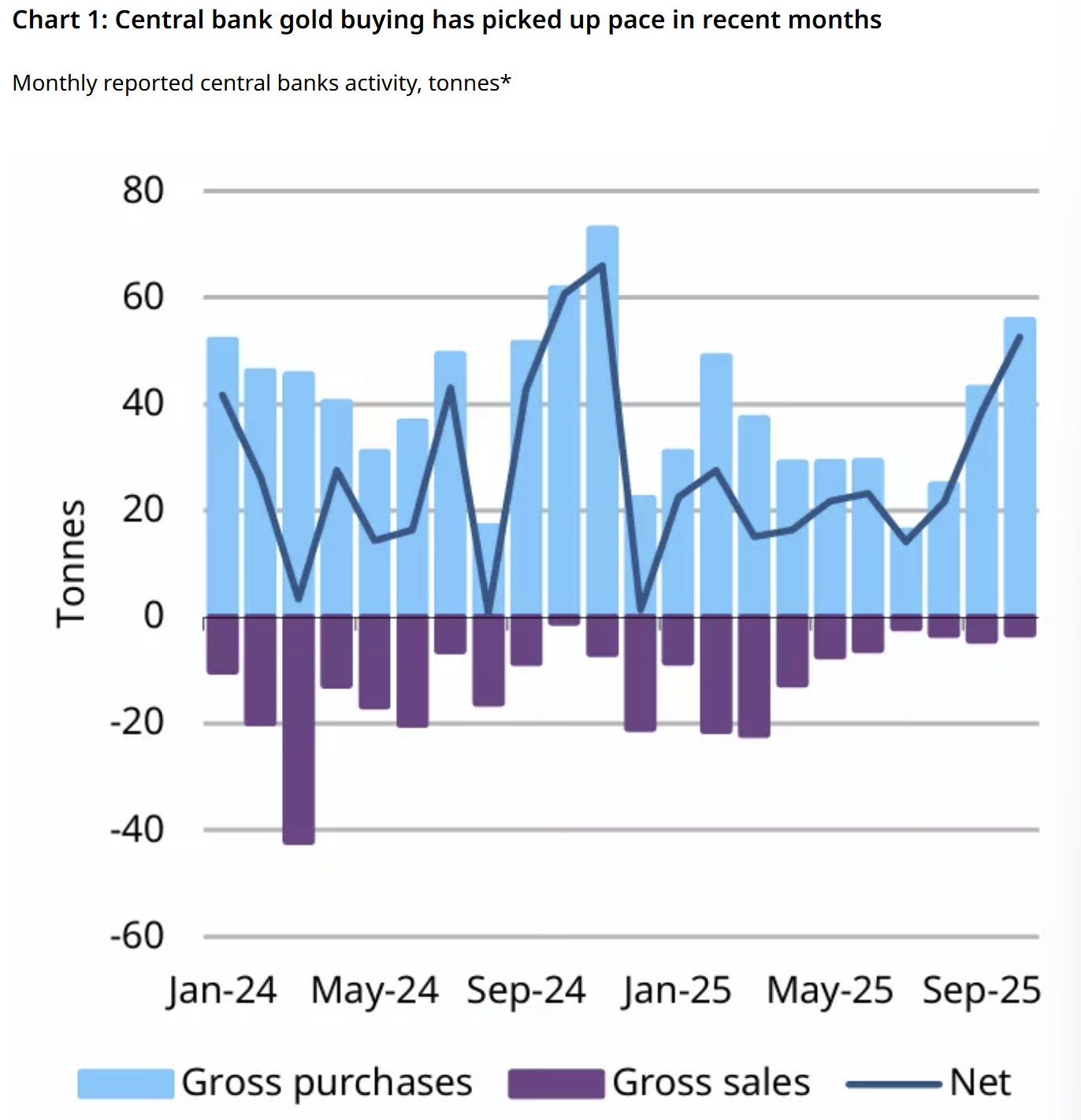
Central Banks’ gold accumulation in 2025. Source: World Gold Council

Central banks were at the core of this move. Global official sector purchases totaled 254 tonnes through October, with the National Bank of Poland leading the charge, by adding 83 tonnes. At the same time, Global gold exchange-traded funds (ETFs) holdings expanded by 397 tonnes in H1 2025, reaching a record high of 3,932 tonnes by November.

This was a significant reversal of the 2023 outflow pattern. This inflow occurred despite real yields averaging 1.8% across developed markets in Q2, during which gold still rallied 23%, signaling a clear decoupling from its traditional inverse relationship with yields.
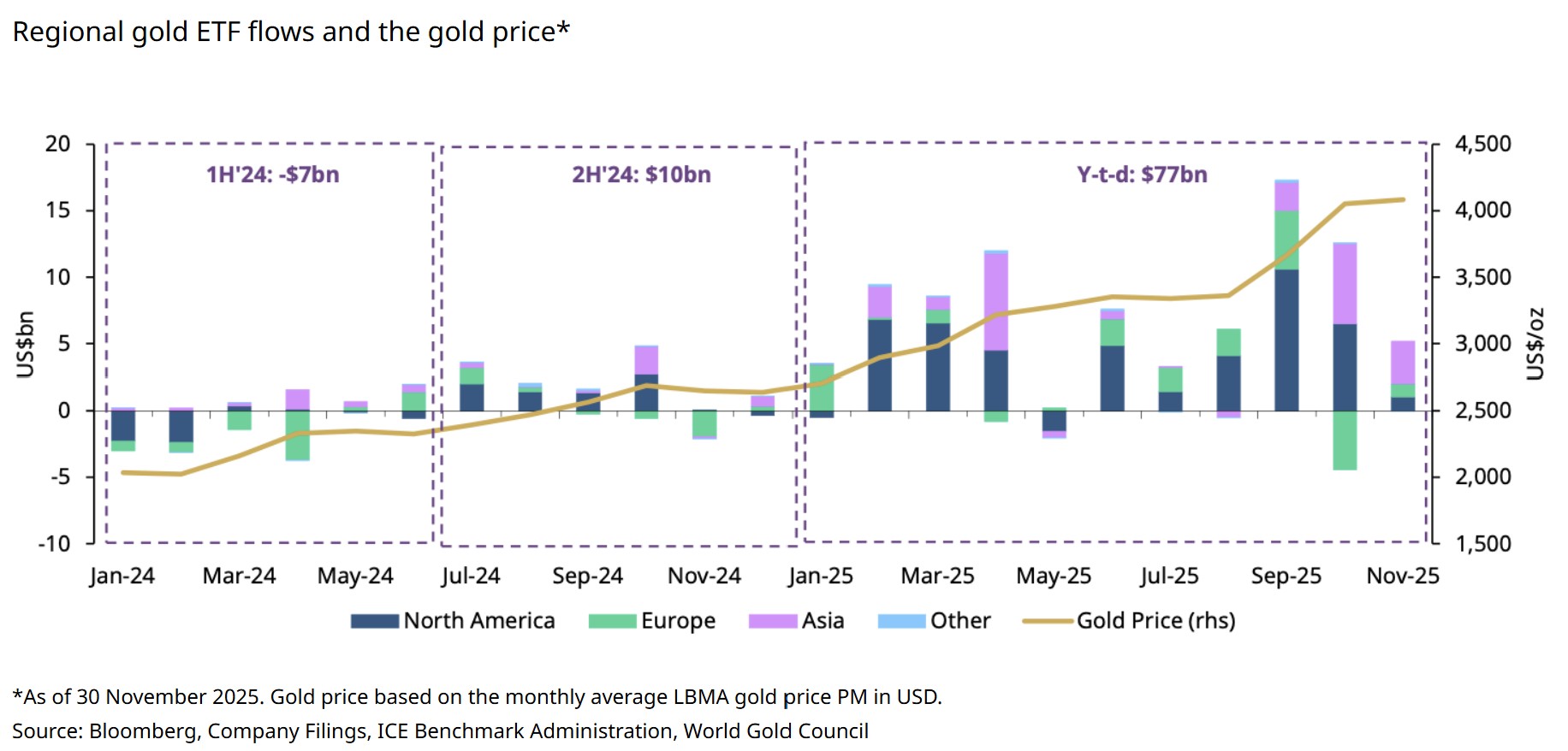
Gold ETF flows and gold price. Source: World Gold Council

Elevated uncertainty further reinforced gold’s appeal. The VIX (Volatility Index) averaged 18.2 in 2025, up from 14.3 in 2024, while geopolitical risk indexes climbed 34% year-over-year. Gold’s equity beta compressed to negative 0.12, its lowest since 2008, confirming demand from both risk-off hedging and long-term allocation.

Thus, defined by tight US financial conditions and delayed policy easing, gold functioned less as an inflation hedge and more as a broad portfolio insurance in 2025.

Related: Bitcoin sharks stack at the fastest pace in 13 years, with BTC down 30%

Why Bitcoin lagged gold on a relative basis

Bitcoin delivered solid returns through 2025, reaching six-figures and benefiting from demand for spot BTC ETFs. However, relative to gold, Bitcoin underperformed as demand conditions weakened during the second half of the year.

Spot Bitcoin ETFs saw strong early momentum, with total assets under management (AUM) rising from $120 billion in January to a peak of $152 billion by July 2025. Since then, AUM declined steadily to around $112 billion over the following five months, reflecting net outflows during price pullbacks and a slowdown in fresh capital formation. This contrasted with consistent inflows into gold ETFs over the same period.
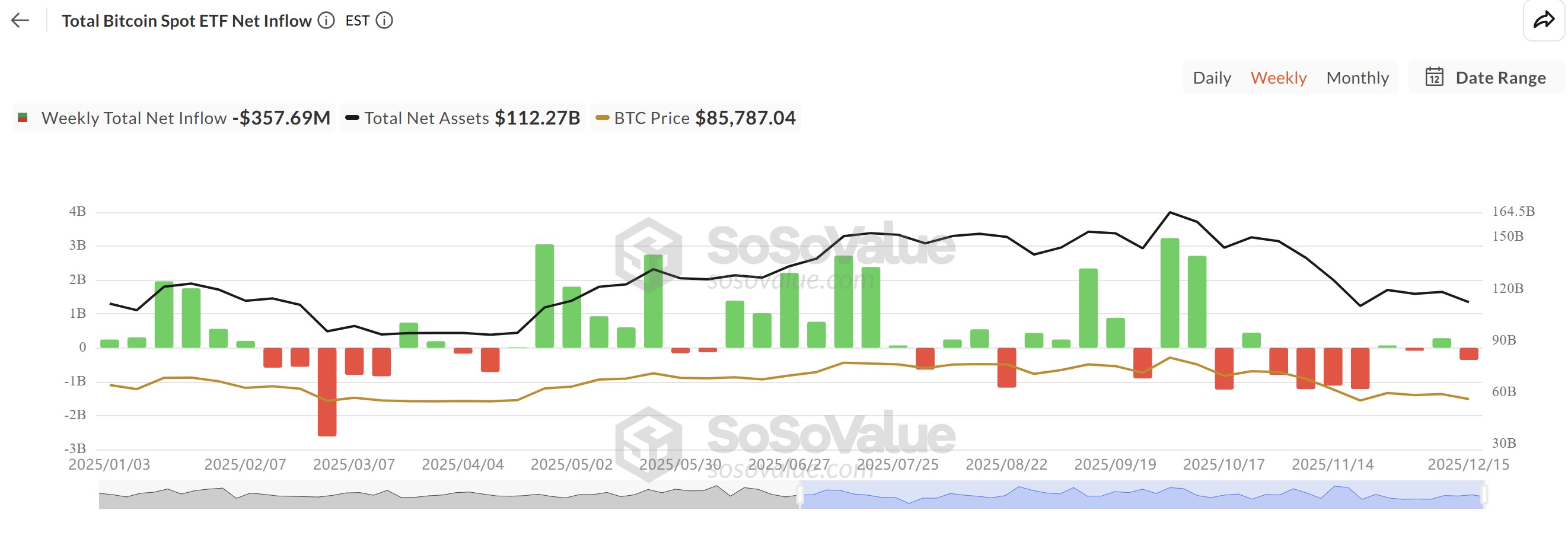
Total net assets in spot BTC ETFs in 2025. Source: SoSoValue

Onchain data also pointed to distribution. According to Glassnode, long-term holder (LTH) profit realization exceeded $1 billion per day on a seven-day average throughout much of July, marking one of the largest profit-taking phases on record.

While realized profits moderated in August, selling resumed later in the year. In October, long-term holders sold roughly 300,000 BTC, worth $33 billion, representing the most aggressive LTH distribution since December 2024. As a result, LTH supply declined from 14.8 million BTC on July 18 to about 14.3 million BTC at present.
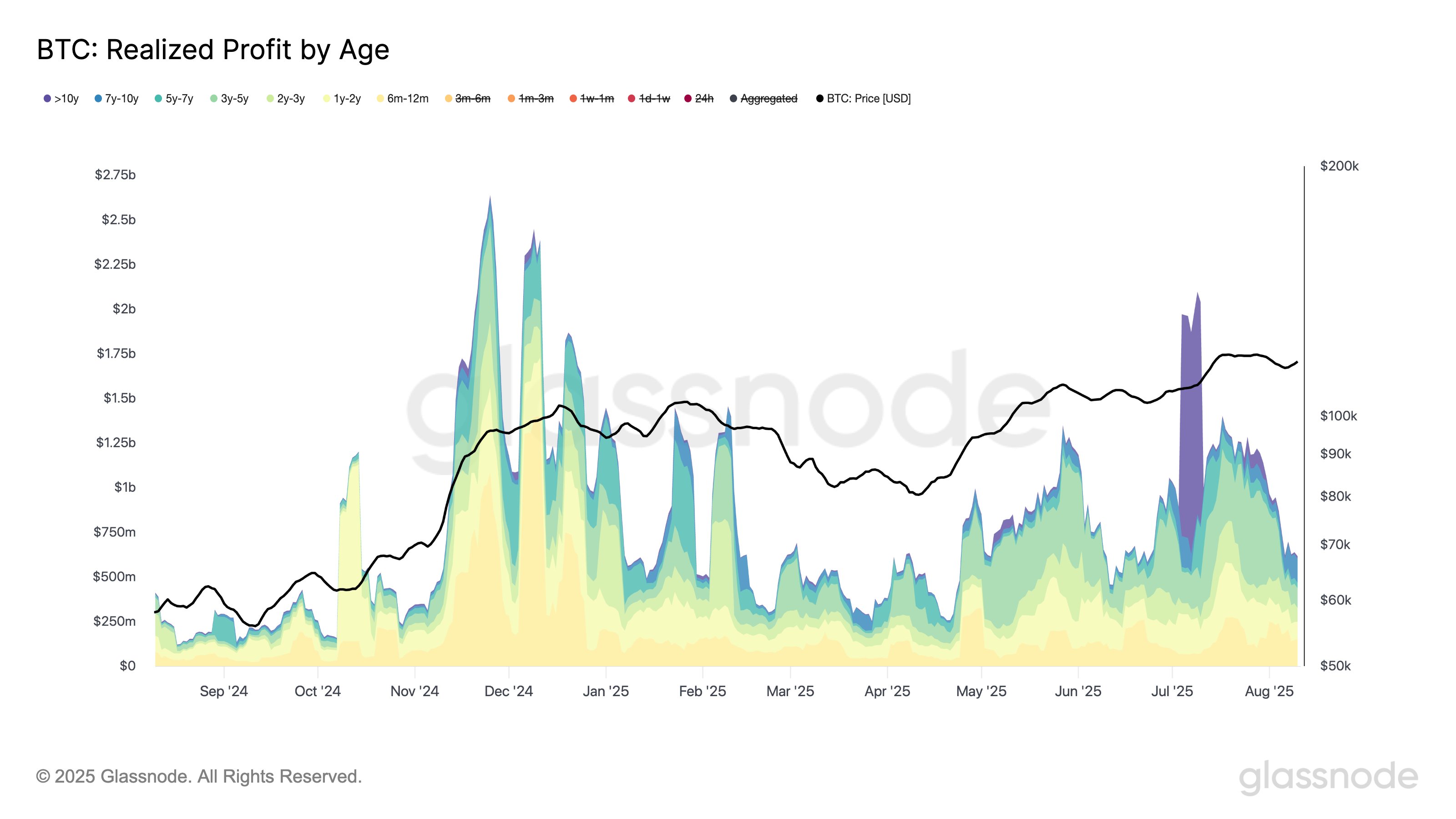
Bitcoin profit taking peak by LTH in July. Source: Glassnode

Elevated real yields through most of 2025 raised the opportunity cost of holding Bitcoin, while its correlation with equities remained relatively high. Gold, by contrast, benefited from safe-haven and reserve-driven demand. This divergence in demand regimes explains the compression in the BTC–gold ratio, reflecting cyclical repricing rather than a structural breakdown in Bitcoin’s long-term thesis.

Related: Bitcoin parabola breakdown raises chance for 80% correction: Veteran trader

This article does not contain investment advice or recommendations. Every investment and trading move involves risk, and readers should conduct their own research when making a decision. While we strive to provide accurate and timely information, Cointelegraph does not guarantee the accuracy, completeness, or reliability of any information in this article. This article may contain forward-looking statements that are subject to risks and uncertainties. Cointelegraph will not be liable for any loss or damage arising from your reliance on this information.


Trending Cryptos

Related Reads

Blood Loss of $55 Million Selling 3,588 BTC, Strategy Becomes a Literal Scumbag

On July 6th, Strategy (formerly MicroStrategy) disclosed in an SEC filing that it sold 3,588 Bitcoin (BTC) between June 29th and July 5th for approximately $216 million, at an average price of ~$60,200. This marked the company's largest net sale since initiating its Bitcoin strategy in 2020 and its first institutionalized reduction of its core holding. The sale resulted in a realized loss of about $54.8 million, as the selling price was below its average cost basis of ~$75,476 per BTC. The proceeds were used to pay preferred stock dividends and replenish USD reserves. This move follows a new "Digital Credit Capital Framework" approved on June 29th, authorizing the sale of up to $1.25 billion in Bitcoin. The sale consumes roughly 17% of this authorized amount in its first week. Strategy's foundational narrative, built by founder Michael Saylor, was a commitment to "never sell" Bitcoin. The recent institutionalized selling framework and these substantial sales represent a significant shift from that original promise. While the amount sold is only 0.4% of Strategy's total holdings of 843,775 BTC, the action challenges the premium at which its stock (MSTR) trades relative to its Bitcoin holdings. Investors had priced in the "never sell" narrative. The company now faces a contradiction: it sells Bitcoin at a loss to pay dividends on the preferred stock it issued to fund Bitcoin purchases. Saylor has framed selling as a tool for future strategic purchases, but each sale erodes the credibility of the original commitment, potentially threatening the premium valuation of MSTR shares.

Foresight News1h ago

Blood Loss of $55 Million Selling 3,588 BTC, Strategy Becomes a Literal Scumbag

Foresight News1h ago

Dialogue with Yihui Capital, SoundAI Technology, Ling Universe, and Zhongbo Jili: Opportunities and Challenges in the AI Smart Hardware Track

On June 28, 2026, an event titled "New Opportunities in AI Hardware: The Battle for Interactive Entry Points Begins" was held in Beijing. It featured a report from ITJuzi and discussions with experts from SoundAI, Ling Universe, One Reed Capital, and Zhongbo Juli on the opportunities and challenges in China's AI hardware sector. Key report findings highlight the sector's intense activity: 327 out of 431 startups founded post-2023 have secured funding, with 179 investments in H1 2026 alone. The landscape is dominated by embodied intelligent robots, while wearable tech like smart rings and AI glasses shows rapid growth. Geographically, Shenzhen leads, leveraging its superior hardware supply chain, followed by Beijing and Shanghai. The overarching trend is for companies to focus on micro-innovations within specific scenarios rather than reinventing foundational technology. Industry leaders shared several critical insights: 1. **Balancing Innovation & Market Readiness**: Entrepreneurs face the "hammer looking for a nail" dilemma. Success requires balancing technical capability with user acceptance, cost control, and incremental design improvements rather than chasing disruptive innovation. 2. **Competitive Landscape**: The future interactive entry point may not be a single super-device but a mix of universal terminals and specialized, scenario-specific hardware. While large companies have ecosystem advantages, startups can win by deeply targeting vertical markets and specific user groups. 3. **Core Challenges & Business Models**: Key hurdles include deep understanding of AI models and navigating non-transparent hardware supply chains. Viable business models may involve selling hardware at cost and generating revenue through software subscriptions, but this requires tight control over both hardware BOM and model inference costs. 4. **The Road to Commercialization**: The ultimate test is market validation—achieving sales growth and sustainable cash flow. Companies must find the right application scenario, use edge computing effectively, and close the loop from technology to commercial success. 5. **The Future of Interaction**: Proactive, context-aware interaction is the next frontier, though it's currently limited by issues like model hallucinations and environmental perception. The near-term focus should be on identifying target users and creating a coherent experience in specific domains, such as health wearables. In summary, to succeed in the competitive AI hardware arena, companies must strategically choose their niche, build a team with the right geographical advantages (e.g., leveraging Shenzhen's supply chain), and most importantly, execute a flawless commercialization strategy that translates technology into market-accepted products and sustainable business growth.

marsbit1h ago

Dialogue with Yihui Capital, SoundAI Technology, Ling Universe, and Zhongbo Jili: Opportunities and Challenges in the AI Smart Hardware Track

marsbit1h ago

Trading

Spot

Hot Articles

Discussions

Welcome to the HTX Community. Here, you can stay informed about the latest platform developments and gain access to professional market insights. Users' opinions on the price of S (S) are presented below.

活动图片