The Art of Speculation: When Coin Launches Become a Mind-Reading Game Centered on Leaders' Social Dynamics

比推Published on 2026-01-08Last updated on 2026-01-08

Abstract

The article "The Art of Reading Between the Lines: When Coin Listings Become a Game of Guessing Leaders' Social Cues" critiques the culture of speculation and sycophancy in the cryptocurrency space, particularly around Binance’s listing process. It draws a parallel to a Shandong dining custom where the fish head is pointed toward the guest of honor as a sign of respect—a tacit social rule that requires intuition rather than explicit instruction. The piece centers on a recent event where He Yi, Binance’s co-founder, posted a cryptic New Year’s tweet saying “我踏马来了” (roughly: “Here the f*ck I come”). Shortly after, a community-created meme token with the same name was listed on Binance Alpha, despite He Yi’s earlier statements against favoritism and “insider coins.” The author argues that this reflects a deeper cultural issue: the shift from merit-based innovation to a system where success depends on interpreting the subtle hints of influential figures. Unlike traditional industries where technical skill or product quality drive progress, the crypto industry often prioritizes access to information, relationships, and the ability to please key decision-makers. The piece suggests that this “Shandong mindset”—where insiders learn to “read the room” rather than challenge or create—undermines transparency and rewards those who excel at flattery rather than genuine contribution. While He Yi may not have directly endorsed the token, the very fact that her social media activity can t...

Author: Kuli, Shenchao TechFlow

Original Title: Where the Fish Head Faces He Yi: Crypto Has Its Shandong-Style Politics Too


There's a rule at Shandong banquets: when the fish is served, the head must face the seat of honor.

Whoever it faces is the main guest and must drink first. This isn't written down anywhere, but everyone in Shandong knows it. No one teaches you; you just learn it.

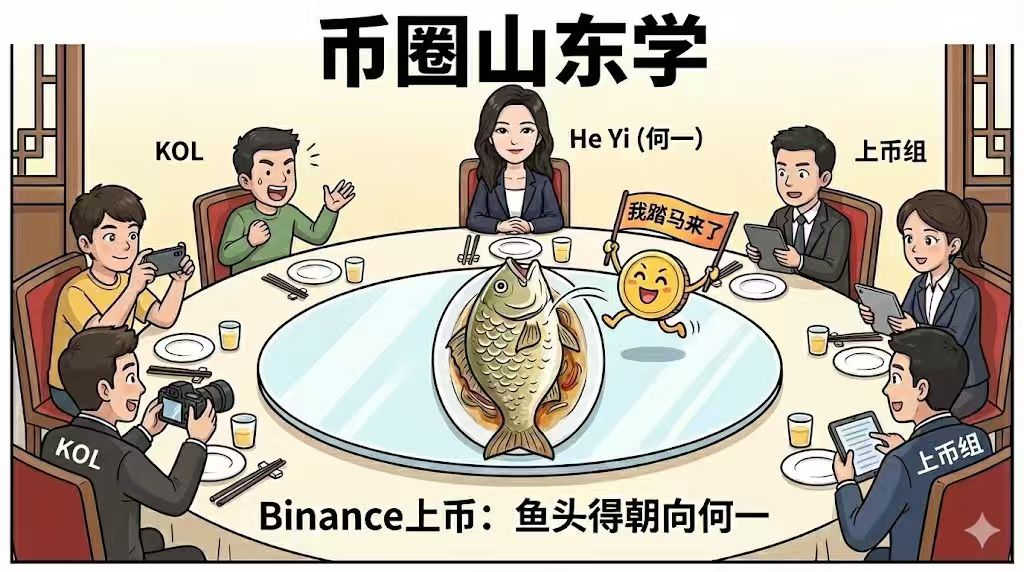
Recently, someone drew a picture called "Crypto Shandong-Style Politics." A group of people sit around a table eating fish, with He Yi in the seat of honor, flanked by KOLs, the listing team, and social media editors.

Caption: For a Binance listing, the fish head must face He Yi.
On January 1st, He Yi posted a New Year's tweet. Riding a white horse by the seaside, caption in four characters:

我踏马来了 (Wǒ tà mǎ lái le - I've f*cking arrived).

A fine New Year's greeting. "Tà mǎ" (踏马), the Year of the Horse, with a bit of playful homophonic wordplay.

Today, Binance Alpha listed a new token called "我踏马来了" (I've F*cking Arrived). It was community-made, with no direct connection to He Yi.

But look at this chain: First Sister tweets, the community creates a token, Alpha lists it.

No one needs to give any orders in the middle.

Last year, Binance was hounded by accusations of "BFF coins," alleging shady listing practices and利益输送 (interest conveyance/corruption). He Yi responded several times, saying they were reflecting, adjusting, and even created Alpha as a screening pool.

In December, she also tweeted saying, don't try to find angles in our official tweets about various Memes; we won't pay attention to this kind of thing anymore.

28 days later, her New Year's tweet became a new token on Alpha.

What was the problem with BFF coins? It was about backdoor deals, favoritism,利益输送 (interest conveyance/corruption).

These require evidence, a paper trail, a specific "BFF."

But "I've F*cking Arrived" doesn't need any of that.

No backdoor, no favoritism, no利益输送. First Sister posted a picture, and the people below just started moving on their own.

This perhaps touches on the essence of Shandong-style politics: the leader doesn't need to speak; you have to figure it out yourself.

Someone in the community commented that Alpha is now just a tool for currying favor, its purpose is to make First Sister happy.

Crude wording, but it describes a certain atmosphere.

When a platform's direction starts revolving around someone's social media activity, when "which coin to list" becomes "guess what she likes," rules cease to matter.

What matters is揣摩 (speculation/reading intentions).

Some put it more harshly: If you want to know if an industry has a future, ask one question—In this industry, do people who are good at flattery succeed more easily than people who are good at doing the work?

If the answer is "yes," then this industry is on the decline.

In crypto, this trick really works. And the most successful ones, everyone knows which direction the flattery should be aimed.

The core resources in the AI circle are technology and products; you have to deliver. Jensen Huang won't allocate you GPUs just because you call him daddy every day.

The core resources in the crypto circle are listing power, traffic, and who knows the news first. These things aren't in the code; they're in people's hands.

Things in people's hands must be obtained through human methods.

The more Shandong-style politics prevails, the more it relies on connections and information asymmetry, not innovation and technology.

He Yi might not even know about this. A small MEME worth a few million market cap isn't enough to bother the Co-CEO.

But that's precisely the problem.

She doesn't need to know. The fish head will turn by itself.

This is really much more efficient than BFF coins.

BFF coins at least required a BFF. Shandong-style politics only requires an atmosphere.

And those who see through this set of rules and implement them thoroughly are, in a way, also talented.

After all, in this society, people laugh at the poor, not the prostitute. (笑贫不笑娼 - A saying criticizing societal values that scorn poverty but overlook the means of acquiring wealth).


Twitter:https://twitter.com/BitpushNewsCN

BitPush TG Discussion Group:https://t.me/BitPushCommunity

BitPush TG Channel: https://t.me/bitpush

Original link:https://www.bitpush.news/articles/7601064

Related Questions

QWhat is the core argument of the article 'The Art of Speculation: When Coin Listings Become a Mind-Reading Game Around a Leader's Social Media'?

AThe article argues that in the crypto space, especially around Binance, the process of token listings has shifted from being based on innovation and technology to a culture of揣摩 (speculation/guessing) where community members and projects try to interpret the social media posts of leaders like He Yi to gain favor, rather than relying on formal rules or merit.

QWhat is 'Shandong Study' (山东学) as described in the article, and how does it relate to Binance's token listing process?

A'Shandong Study' is a metaphor derived from a Shandong dining custom where the fish head is pointed towards the guest of honor. In the context of Binance, it symbolizes a culture where participants automatically align their actions (like creating and listing tokens) to please or anticipate the preferences of leader He Yi, without any explicit instruction, mimicking the unspoken rule of the dining tradition.

QHow does the article contrast the 'Shandong Study' phenomenon with the previous '闺蜜币' (close-friend coin) controversy at Binance?

AThe '闺蜜币' controversy involved allegations of explicit favoritism, backdoor deals, and利益输送 (benefit transfer) through personal connections. In contrast, the 'Shandong Study' phenomenon requires no direct orders or concrete relationships; it operates through an implicit atmosphere where community members spontaneously act to please the leader based on social media cues, making it more efficient and less traceable than the 'close-friend coin' issue.

QAccording to the article, what does the success of the meme token '我踏马来了' (I'm Coming on Horseback) demonstrate about the current state of the crypto industry?

AThe success of '我踏马来了'—a token created and listed on Binance Alpha simply because it was inspired by He Yi's tweet—demonstrates that in the crypto industry, success can be driven by揣摩 (speculating on) and catering to the preferences of influential leaders rather than technological innovation or product merit, indicating a reliance on人际关系 (relationships) and information asymmetry.

QWhat critical question does the article suggest asking to determine if an industry has a future, and what is the implied answer for the crypto space based on the examples given?

AThe article suggests asking: 'In this industry, do people who are good at flattery succeed more easily than those who are good at doing actual work?' The implied answer for the crypto space is 'yes,' as the examples show that tokens gaining traction through揣摩 (speculation) and alignment with leaders' social media are successful, suggesting the industry may be declining if this culture persists.

Related Reads

Anthropic Starts Poaching Scientists? $27K Weekly Onsite Stipend to Fix Claude's Expert-Level Errors

Anthropic has launched a new STEM Fellow program, offering $3,800 per week for a three-month, in-person residency in San Francisco. The role targets experts from science, technology, engineering, and mathematics (STEM) fields—machine learning experience is helpful but not required. Instead, Anthropic values scientific judgment and a willingness to learn quickly. Fellows will work with Claude models and internal tools under the guidance of an Anthropic researcher. Example projects include a materials scientist identifying errors in Claude’s reasoning or a climate scientist integrating atmospheric modeling software with Claude. The goal is to have experts "tell Claude where it's wrong" and improve its scientific capabilities. This initiative is part of Anthropic’s broader strategy to strengthen its scientific ecosystem, following earlier programs like the AI Safety Fellows and AI for Science programs. The company acknowledges that current AI models, while powerful, still produce high-confidence errors and lack end-to-end research autonomy. The program aims to embed domain expertise directly into model development, turning scientists into "high-level reviewers" for AI. Anthropic CEO Dario Amodei has previously emphasized AI’s potential to accelerate scientific breakthroughs, particularly in biology and healthcare. The company believes that the next phase of AI competition will depend not on scaling parameters, but on integrating human expertise to refine model accuracy and reliability.

marsbit49m ago

Anthropic Starts Poaching Scientists? $27K Weekly Onsite Stipend to Fix Claude's Expert-Level Errors

marsbit49m ago

On the Eve of X Money's Launch, Musk Dismantles the Referee First

"X Money Launches After Dismantling Regulator: Musk's 9-Day Power Play" In February 2025, a team from the "Department of Government Efficiency" (DOGE), led by Elon Musk, entered the Consumer Financial Protection Bureau (CFPB) headquarters. Shortly after, the CFPB was effectively dismantled—its funding frozen, activities suspended, and nearly 90% of staff laid off. This move came just nine days after X announced a partnership with Visa and as X Money prepared to launch. The article contrasts this with the decade-long regulatory battles faced by companies like Coinbase and PayPal. Coinbase spent over $75 million in political contributions and endured a major SEC lawsuit to operate legally. PayPal complied with strict state and federal rules for its stablecoin PYUSD, including 100% reserve requirements and monthly audits. However, Musk’s approach was different. After the CFPB introduced a rule placing large digital payment apps under federal oversight, Musk tweeted "Delete CFPB." Within months, the rule was revoked by Congress. Meanwhile, DOGE operatives gained "god-tier" access to CFPB databases, potentially obtaining sensitive competitive information from rivals like Apple, Google, and PayPal. The article also highlights a "suspicious exemption clause" in the GENIUS Act, which allows private companies like X to issue stablecoins with fewer restrictions. Senator Elizabeth Warren questioned whether Musk, who was a senior presidential advisor during the Act’s drafting, influenced this clause. X Money offers a 6% APY on deposits, despite FDIC warnings that stablecoin users are not insured. As X Money launches to 600 million monthly users, the article questions the fairness of a system where Musk can bypass regulations that others spent years and millions to comply with. The dismantling of the CFPB and the alleged regulatory advantages raise concerns about the future of equitable rule-making in the U.S. financial system.

marsbit58m ago

On the Eve of X Money's Launch, Musk Dismantles the Referee First

marsbit58m ago

Trading

Spot
Futures
活动图片