The AI Agent Era Accelerates Its Arrival: Questflow Defines a New Paradigm of Financial Intelligence with On-Chain AI Brokerage

链捕手Published on 2026-05-11Last updated on 2026-05-11

Abstract

The AI Agent era is accelerating, with the CB Insights AI 100 list highlighting global investment confidence. The focus has shifted from whether AI works to its speed of deployment and ability to manage complex workflows, with autonomous AI Agents driving this transformation. At the forefront is Questflow, a Singapore-based startup redefining financial intelligence through its on-chain AI brokerage. Unlike tools that merely provide data dashboards, Questflow deploys AI Agents that proactively scan markets, form judgments, and execute trades via a conversational interface—operating 24/7 without requiring manual confirmation for each decision. This embodies the new AI paradigm of agents capable of executing multi-step workflows autonomously. Questflow's mission is to democratize institutional-grade trading intelligence. Historically reserved for the ultra-wealthy, this capability is now accessible starting from just $1 through Questflow's "AI Clone + Copy Trade" model. The platform charges only a 1% execution fee, aligning its incentives directly with users and eliminating traditional management or performance fees. The timing is opportune, aligning with key trends identified by CB Insights: the scalable deployment of AI Agents, accelerated AI adoption in financial services, and the maturation of on-chain infrastructure. With robust liquidity on platforms like Hyperliquid and Polymarket, alongside advancements in AI reasoning and non-custodial wallet security, Questflow is p...

CB Insights, a globally influential technology market intelligence firm, has released its tenth annual AI 100 list, selecting the world's 100 most promising AI startups in 2026. The list covers the full spectrum of AI innovation from infrastructure to industry-specific vertical applications. The selected companies have collectively raised over $10.9 billion, with more than $2 billion raised in 2026 alone, strongly validating global capital's confidence in the AI Agent sector.

CB Insights noted that the core theme this year has shifted from "Can AI work?" to "How quickly can AI be deployed, governed, and scaled into complex workflows." Among these trends, AI Agents capable of autonomously executing multi-step tasks in production environments are emerging as the core driving force behind the new wave of industrial transformation.
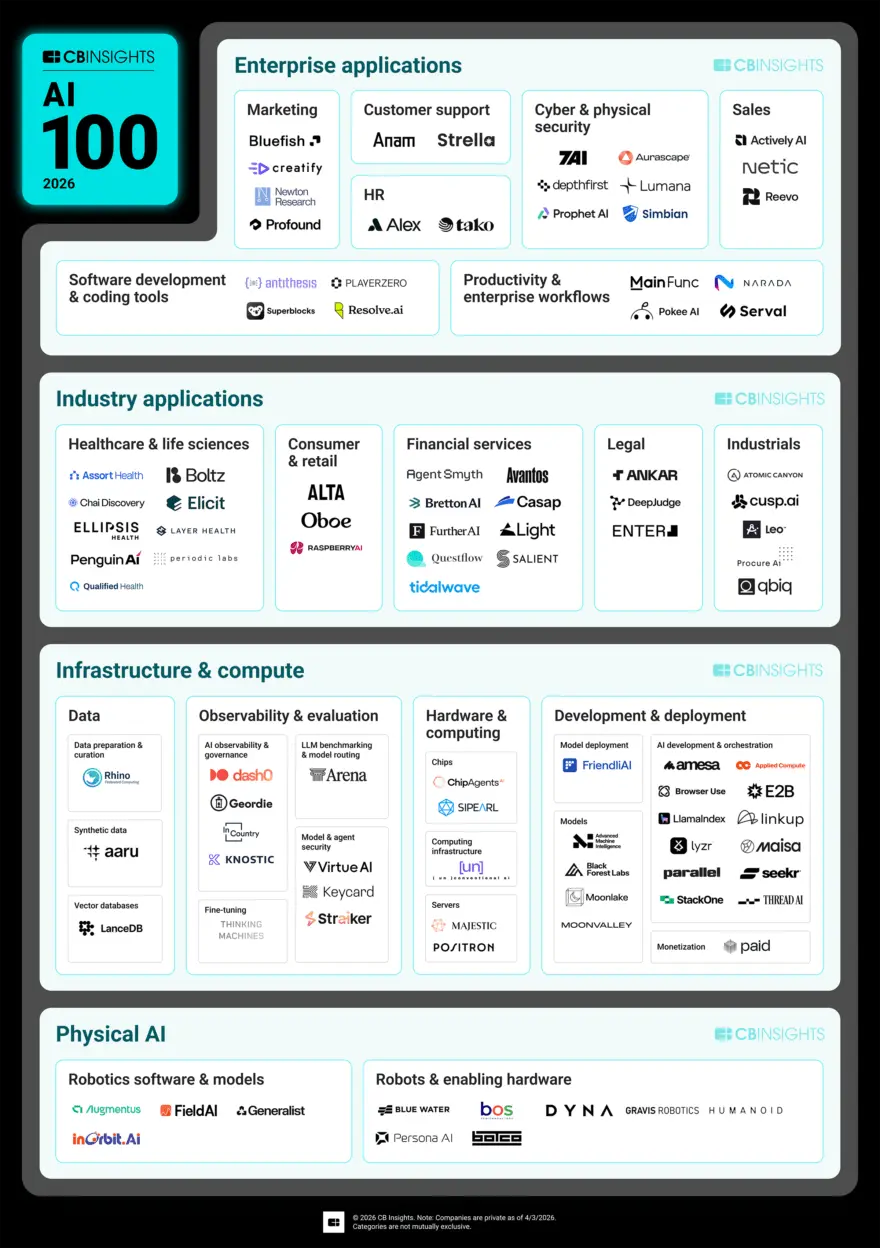
As a deep participant in this wave, Questflow—a Singapore-headquartered startup focused on on-chain AI brokerage—is at the forefront of this transformation with its unique product architecture and business model.

Not Just a Tool, But an AI That Trades For You

While most AI financial tools are still in the "data dashboard" phase, Questflow has already advanced AI Agents to the level of autonomous trading entities. Users don't need to actively search for opportunities; the AI Agents on the platform proactively scan the market, form judgments, and execute trades directly through a conversational interface, operating 24/7 without requiring manual intervention for every decision.

This is precisely the new AI paradigm defined by CB Insights' latest list: Agents capable of independently executing multi-step workflows without requiring step-by-step human confirmation represent the true deployment of AI in production environments. The operation of Questflow's AI Clone simultaneously on the Polymarket prediction market and the Hyperliquid perpetual contract market is the most direct application of this paradigm in the financial field.

Democratizing Financial Intelligence, Breaking Down Wealth Barriers

Questflow's core proposition is concise and powerful: Robinhood got everyone a seat at the table; Questflow gives everyone a brain.

In the past, institutional-grade trading intelligence was a privilege exclusive to wealth—family offices serve clients with over $30 million, private banks even more so, leaving ordinary retail investors to rely on luck. Through its AI Clone + Copy Trade product architecture, Questflow lowers the entry barrier for such capabilities to as little as $1, while maintaining a structure with zero management fees and zero performance fees. Revenue comes from a 1% trade execution fee, aligning interests highly with users and eliminating conflicts.

The Timing Is Right

The three key industry signals emphasized by CB Insights in this year's list—the large-scale deployment of AI Agents, accelerated AI penetration in financial services, and the maturation of on-chain infrastructure—closely align with Questflow's strategic assessment: sufficient on-chain asset liquidity (Hyperliquid monthly trading volume exceeds $30 billion, Polymarket monthly trading volume exceeds $1 billion), enhanced AI reasoning capabilities, and improved security of non-custodial wallet infrastructure. These three forces are converging simultaneously, opening a window of opportunity.

"When millions of people can operate their own quantitative funds, brokers, funds, and exchanges will merge into a single platform," stated the Questflow team. "That's what we are building."


Related Questions

QAccording to the article, what is the key theme shift noted by CB Insights regarding AI development in 2026?

AThe core theme has shifted from 'whether AI works' to 'how fast AI can be deployed, governed, and scaled into complex workflows.'

QWhat specific role does Questflow's AI Agent play in the financial markets, distinguishing it from other AI financial tools?

AQuestflow's AI Agent acts as an autonomous trading entity. It proactively scans markets, forms judgments, and directly executes trades through a conversational interface, 24/7 without requiring human intervention for every decision.

QHow does Questflow aim to 'democratize financial intelligence' according to its core proposition?

AIts proposition is: 'Robinhood put everyone at the table, Questflow gives everyone a brain.' It lowers the access barrier to institutional-grade trading intelligence to as low as $1, using an AI Clone + Copy Trade model with zero management fees, aligning its revenue (1% execution fee) with user success.

QWhat are the three converging forces that create a timely opportunity for Questflow's business, as mentioned in the article?

AThe three converging forces are: 1) Sufficient on-chain asset liquidity (e.g., Hyperliquid's monthly volume exceeding $30B), 2) Enhanced AI reasoning capabilities, and 3) Improved security of non-custodial wallet infrastructure.

QWhat is Questflow's ultimate vision for the future structure of financial services, as stated by its team?

AThe team envisions a future where 'brokers, funds, and exchanges merge into a single platform' when millions of people can operate their own quantitative funds.

Related Reads

Anthropic's IPO Launch: Commercial Miracle or Valuation Bubble?

Anthropic has confidentially filed for an IPO, led by Morgan Stanley and Goldman Sachs, potentially going public by October. Following its latest $650 billion funding round, its pre-IPO valuation stands at $965 billion, with projections reaching up to $2 trillion at listing, which would make it the highest-valued private company ever. The article, written by Fu Sheng, addresses skepticism that this represents an AI bubble akin to the 2000 dot-com crash. It argues the current situation differs fundamentally. Unlike the internet bubble era, which relied on speculative narratives with little revenue, Anthropic's valuation is backed by unprecedented, measurable financial performance. Key data points include: * **Revenue Growth:** ARR skyrocketed from $10 billion in early 2025 to $470 billion by May 2026, targeting $100 billion by year-end—a growth curve unmatched in business history. * **Profitability:** It achieved operating profitability in Q2 2026 with an estimated $5.6 billion profit. * **Efficiency:** With ~3,000 employees and ~$470 billion ARR, its revenue per employee exceeds $10 million. Products like Claude Code, launched less than a year ago, already generate $25 billion in annualized revenue. * **Enterprise Adoption:** It boasts a strong enterprise client base, with 8 of the Fortune 10 and over 1,000 large firms spending over $1 million annually on Claude. The valuation is framed using a traditional SaaS model (e.g., a 10x Price-to-Sales multiple on $100 billion revenue). The author contends the core question for analysts has shifted from "How big could this be?" to "How much is it earning and will earn next quarter?" The discussion extends beyond Anthropic to a broader paradigm shift: the transition from a "carbon-based" to a "silicon-based" economy. Companies are increasingly prioritizing investment in compute and AI capabilities over human resources, as these directly scale productivity and competitive advantage. Anthropic's IPO is thus positioned not just as a corporate milestone, but as a price anchor for this new economic era.

链捕手42m ago

Anthropic's IPO Launch: Commercial Miracle or Valuation Bubble?

链捕手42m ago

Near Returns to the AI Stage: Transformation into a Public Chain Due to 'Payroll Difficulties,' Agent and Privacy Emerge as New Growth Narratives

NEAR Returns to AI Origins: From Payroll Struggles to Blockchain, Now Focusing on AI Agents and Privacy NEAR Protocol's journey began not with grand blockchain ambitions, but from a practical hurdle: its AI startup founders, including Transformer paper co-author Illia Polosukhin, couldn't efficiently pay international developers in 2017. This led them to pivot and build a high-performance, scalable blockchain. After years navigating various crypto narratives like sharding and cross-chain interoperability, NEAR is now leveraging its AI roots to re-enter the AI arena. A key driver is its "NEAR Intents" layer, which abstracts complex cross-chain transactions. Users simply state their goal (e.g., swap BTC for ETH), and a solver network finds the optimal route. This system has processed over $20B in cross-chain volume, generating significant fee revenue. A major growth area is private transactions via "Confidential Intents/Swaps," which hide trade details until settlement to protect against MEV and front-running. Remarkably, private swaps recently accounted for over 40% of NEAR's transaction volume, highlighting strong demand but also potential regulatory scrutiny. With its AI-founder pedigree, NEAR is positioning itself at the intersection of blockchain, AI agents, and privacy, aiming to become infrastructure for the emerging agent economy while navigating the challenges of its rapid adoption.

marsbit3h ago

Near Returns to the AI Stage: Transformation into a Public Chain Due to 'Payroll Difficulties,' Agent and Privacy Emerge as New Growth Narratives

marsbit3h ago

From Ethereum to AI's 'CROPS': What Exactly is This Set of 'Slow Variables' That Vitalik Repeatedly Emphasizes?

In recent discussions, Vitalik Buterin has frequently emphasized the concept of "CROPS," a framework defining core values for Ethereum's development. CROPS stands for Censorship Resistance, Capture Resistance, Open Source, Privacy, and Security. Initially outlined in the Ethereum Foundation's "EF Mandate," it represents a commitment to user sovereignty, ensuring that the network resists external control, remains open, protects privacy, and prioritizes security. The relevance of CROPS extends beyond Ethereum's foundational principles, becoming crucial in the context of AI integration. As AI agents begin handling wallet operations and automated transactions, the risk increases that users may cede control over their digital assets, privacy, and intentions to centralized AI service providers. A "CROPS AI" would therefore emphasize local execution where possible, privacy-preserving remote model calls (e.g., using zero-knowledge proofs), and transparent, verifiable processes to maintain user agency. Vitalik highlights a significant convergence between "CROPS Ethereum access layer" and "CROPS AI." Both address the same fundamental challenge: how users can access powerful services—be it blockchain data via RPCs or AI models—without exposing sensitive information or relinquishing ultimate control. This intersection points toward a future digital entry point that is more private, secure, and user-controlled. Ultimately, CROPS is not merely an abstract ideal but a practical guidepost. It steers development—from protocol resilience and wallet design to AI agent safety—towards a future where users retain self-sovereignty even as digital systems grow more complex and powerful. In an era of accelerating AI adoption, these "slow variables" of censorship resistance, openness, privacy, and security may define Ethereum's enduring value.

marsbit3h ago

From Ethereum to AI's 'CROPS': What Exactly is This Set of 'Slow Variables' That Vitalik Repeatedly Emphasizes?

marsbit3h ago

Trading

Spot
Futures

Hot Articles

Ethena: Building a New Era of Web3‑Native Digital Dollars

Ethena is an Ethereum‑based synthetic dollar protocol that delivers crypto‑native monetary solutions, including USDe, a synthetic dollar, and sUSDe, a globally accessible U.S. dollar savings asset.

53.1k Total ViewsPublished 2026.03.16Updated 2026.03.16

Ethena: Building a New Era of Web3‑Native Digital Dollars

Discussions

Welcome to the HTX Community. Here, you can stay informed about the latest platform developments and gain access to professional market insights. Users' opinions on the price of ERA (ERA) are presented below.

活动图片