# Сопутствующие статьи по теме ZK

Новостной центр HTX предлагает последние статьи и углубленный анализ по "ZK", охватывающие рыночные тренды, новости проектов, развитие технологий и политику регулирования в криптоиндустрии.

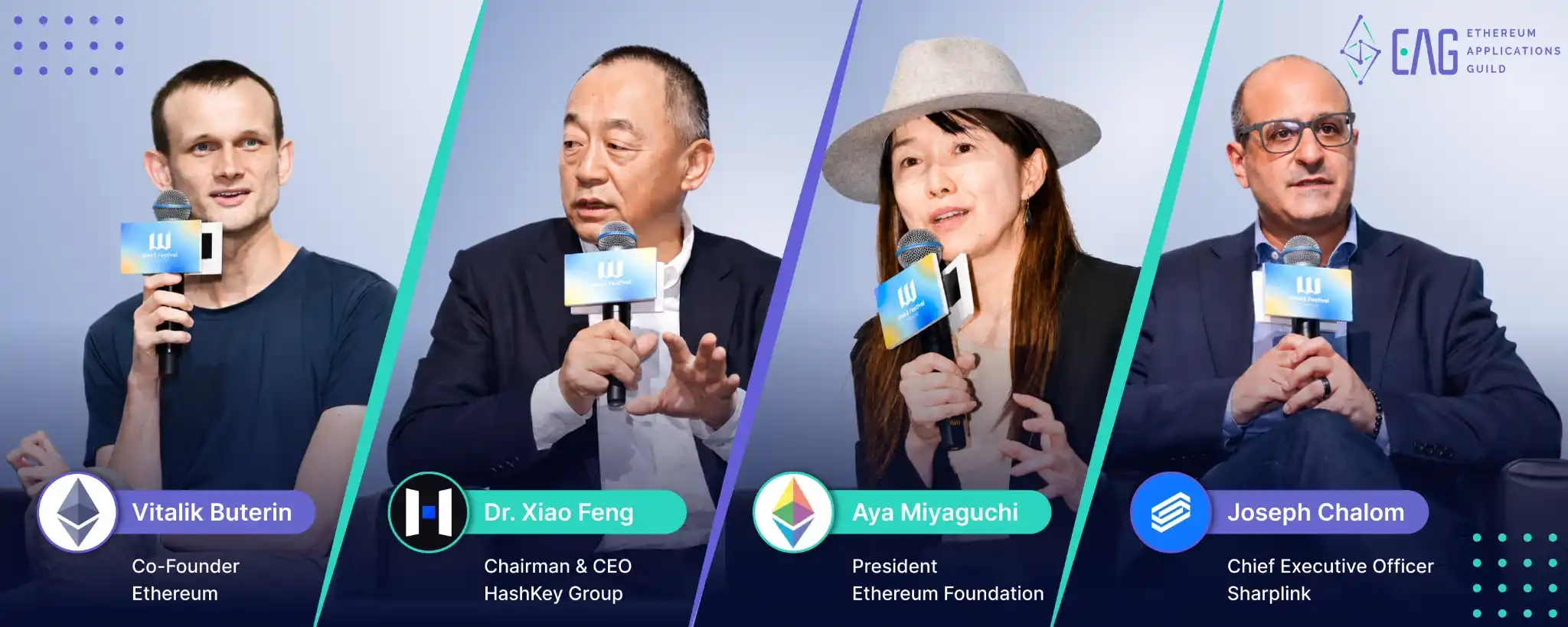
Dialogue with Vitalik, Xiao Feng, Aya Miyaguchi, and Joseph Chalom: From the 'Subtraction Principle' to the Agent Economy

Conversation with Vitalik Buterin, Xiao Feng, Aya Miyaguchi, and Joseph Chalom: Highlights from the Ethereum Application Summit on key future directions. Vitalik Buterin discussed the concept of "Full Stack Open Source Security," extending security from the protocol to hardware layers like wallets and chips. He predicted AI will simplify blockchain interaction, enabling natural language commands for complex operations. He emphasized that Ethereum's future focus should be on security, decentralization, and trustless infrastructure—the areas where it holds its core competitive edge. The fusion of AI, Fully Homomorphic Encryption (FHE), and blockchain is seen as crucial for real-world applications requiring privacy, such as healthcare. Xiao Feng underscored the importance of simplifying technology for mass adoption. He drew parallels to the evolution from command lines to GUIs and apps, suggesting that AI-driven natural language interfaces will be key to bringing more users into Web3. He stressed that while performance is important, Ethereum must continue to uphold its foundational principles of decentralization and user sovereignty. Aya Miyaguchi, Chair of the Ethereum Foundation, explained the evolving role of the Foundation through the "Principle of Subtraction." As the ecosystem matures, the EF is stepping back from areas where the community can take the lead, acting as one of many "gardeners" rather than a central driver. She highlighted that real applications are built on Ethereum's core values: censorship resistance, open source, security, and privacy. The concept of "Local-first" initiatives, like the Ethereum Applications Guild (EAG), was also emphasized for leveraging regional strengths to create global impact. Joseph Chalom, CEO of SharpLink, positioned Ethereum as the future infrastructure for global capital markets, differentiating it from Bitcoin through its "productivity" via staking yields. He envisioned the rise of an "Agent Economy" by 2027, where AI agents, powered by Web3 wallets, will autonomously manage financial tasks like yield optimization and RWA investments. The summit concluded that with core infrastructure maturing, the application layer is now the key driver for Ethereum's next phase of growth and real-world adoption.

marsbit05/12 09:43
Dialogue with Vitalik, Xiao Feng, Aya Miyaguchi, and Joseph Chalom: From the 'Subtraction Principle' to the Agent Economy

marsbit05/12 09:43

Odaily Interviews Aster: DEX Will Ultimately Devour the Entire Trading World, Optional Privacy is the Key Ladder

Odaily Interview with Aster: DEX Will Ultimately Devour the Trading World, Optional Privacy is the Key Ladder Aster has initiated key steps to build institutional-grade private DeFi infrastructure, marked by the launch of its Layer 1 mainnet, Aster Chain, on March 17. The mainnet offers traders fair ordering and optional privacy. This was followed by the launch of its native staking function on March 20. The project has rapidly evolved from an innovative Perp DEX into a complete infrastructure layer, achieving record-breaking trading volumes in late 2025 and a successful TGE. In an interview, CEO Leonard explained their core logic: launching a mainnet *after* securing users and revenue, not with a "cold start." This ensures every step is validated by real market demand. Aster's key differentiator is its unique "optional privacy" value proposition, implemented through a ZK + Stealth Address architecture. This allows for automatic privacy for each transaction while maintaining verifiability. The team believes this feature is a prerequisite for mass adoption and will be a primary driver for institutional use of DEXs, forming the core of their moat. Looking ahead, Aster predicts the DEX landscape will evolve into an oligopoly dominated by a few major players. The project is actively pursuing partnerships with both Web2 and Web3 entities, with significant interest from financial firms looking to build markets or list assets on its chain. For the immediate future, Aster's Q2 focus is on attracting privacy-seeking users and institutions, expanding assets and liquidity, growing its ecosystem via its developer program (Aster Code), and enhancing token utility.

Odaily星球日报03/31 02:33

Odaily Interviews Aster: DEX Will Ultimately Devour the Entire Trading World, Optional Privacy is the Key Ladder

Odaily星球日报03/31 02:33

Ethereum Economic Zone (EEZ) Officially Launched: Someone Finally Tackles the L2 Isolation Problem

The Ethereum Economic Zone (EEZ) is a new framework designed to address the fragmentation and liquidity isolation caused by the proliferation of Layer 2 (L2) rollups on Ethereum. While L2s have successfully scaled Ethereum, they have created siloed ecosystems with separate liquidity pools, bridges, and infrastructure, forcing protocols to deploy across multiple chains and users to pay high costs and risks for cross-chain transactions. EEZ, funded by the Ethereum Foundation and co-initiated by Gnosis and Zisk, introduces synchronous composability between L1 and L2s. This allows smart contracts on an EEZ rollup to atomically call contracts on Ethereum mainnet or other EEZ rollups within a single transaction, eliminating the need for bridges. The result is shared liquidity, a unified security model, and a seamless user experience where assets and identities are portable across environments without explicit bridging steps. Built on Ethereum’s core values of openness, security, and decentralization, EEZ aims to reinforce Ethereum as the foundational settlement layer rather than allowing L2s to fork value away from it. The initiative is developed as open-source public infrastructure, with technical contributions from leaders like Jordi Baylina (creator of Circom) and support from projects including Aave and Centrifuge. EEZ is not a proprietary product but a community-driven effort to unify Ethereum’s economy into a single, composable system.

marsbit03/30 03:26

Ethereum Economic Zone (EEZ) Officially Launched: Someone Finally Tackles the L2 Isolation Problem

marsbit03/30 03:26

活动图片