# Settlement Related Articles

HTX News Center provides the latest articles and in-depth analysis on "Settlement", covering market trends, project updates, tech developments, and regulatory policies in the crypto industry.

A Year of Observing Agent Payments: The Cold Reality Behind the Hot Narrative

A Year in Agent Payments: The Cold Reality Behind a Hot Narrative This article examines the current state of "Agent payments," a year after it became a major trend at the intersection of AI, payments, and crypto. Despite significant investments from major players like Stripe, Visa, and Google, the author—having built products and spoken with merchants and developers—finds genuine, large-scale demand still lacking. Key findings across several hyped scenarios reveal structural challenges: * **Agent-to-Merchant Commerce:** For most product categories (e.g., clothing, electronics), AI shopping via chat is inferior to traditional visual e-commerce. Merchant interest is largely defensive, focused on future-proofing rather than current consumer demand. True potential exists only in specific, high-frequency/low-decision scenarios (like food orders) or for simplifying broken checkout experiences, but these require massive consumer distribution, favoring incumbents. * **Agent-to-API/Machine Commerce:** While stablecoin micropayments are touted for API calls, developers already solve small-value payments via prepaid credits and subscriptions. Large SaaS providers prefer enterprise contracts over fragmented micro-pricing. The market exists for long-tail services outside the top providers but is inherently smaller than the hype suggests. * **Agent-to-Agent Payments:** This remains a theoretical long-term vision with negligible real transaction volume. The core challenges—discovery, trust, negotiation, dispute resolution—are unsolved. While the potential for a new, high-speed settlement layer is real, it is not the current market. * **Agent Finance:** This is the sole area with existing, paying customers (fund managers, DeFi users). AI enhances real-time monitoring and autonomous rebalancing, offering real capability gains. However, competition favors established, regulated institutions with existing licenses and client relationships. The author concludes that the core deficiency in the Agent economy is not merely a payment layer, but a more complex **coordination** capability—figuring out how Agents and humans work together, verify task completion, and settle outcomes. Payment is just one component of settlement, which is itself part of coordination. For large companies, investing now is a defensive, long-term bet with minimal cost. For startups, however, the imperative is to find markets that exist today, not wait for a future wave that remains on the horizon.

marsbit06/05 06:45

A Year of Observing Agent Payments: The Cold Reality Behind the Hot Narrative

marsbit06/05 06:45

Lightspark CEO: In Ten Years, Bitcoin Will Be as Invisible as TCP/IP, Yet Power Trillions in Daily Transactions

A decade from now, Bitcoin will function like TCP/IP — invisible yet foundational, supporting trillions in daily transactions globally, according to Lightspark CEO David Marcus. In this future, a coffee shop in Lagos receives instant payment, a manufacturer in São Paulo settles an invoice with a supplier in Ho Chi Minh City, and a freelancer in Bangalore gets paid weekly from an Austin startup — all via Bitcoin's settlement layer, with none of the parties consciously interacting with it. This vision parallels the adoption of open protocols: first driven by necessity where existing systems fail, then scaling rapidly as tools mature and economic benefits become clear. The structural shift begins with wallets. Modern non-custodial wallets, like Spark, allow users to hold dollars, local currency, and Bitcoin in a single address, seamlessly switching between them. This eliminates friction and revolutionizes global custody, moving significant deposits to user-controlled keys not by ideology, but by superior utility. As a result, Bitcoin becomes the default savings layer for billions, as its fixed supply and appreciating value make it a rational choice for savers holding it alongside stablecoins in their everyday wallets. Businesses follow a similar path, from small companies in emerging markets to multinational corporations, holding Bitcoin alongside operational stablecoins. The latest trend is direct Bitcoin transactions for commerce. When both parties hold Bitcoin, transacting in it becomes the simplest option — no conversions, no intermediary currency. This starts in niche areas like high-value B2B settlements but grows as infrastructure makes sending Bitcoin as easy as stablecoins. An accelerating force is AI agents. By 2036, AI agents conducting commerce on behalf of individuals and firms will increasingly choose Bitcoin for settlement. Optimizing for speed, finality, and minimal counterparty risk across jurisdictions, they find Bitcoin's global, neutral, and programmable network ideal for netting and settling obligations. Thus, Bitcoin is becoming the native currency for machine commerce, just as it has become a native savings asset for humans. The global monetary system is being rebuilt from the protocol layer: open infrastructure, default self-custody, Bitcoin settling everything underneath, with stablecoins as the interface. Most users won't think about Bitcoin when they transact — and they won't need to.

foresightnews_api06/05 04:24

Lightspark CEO: In Ten Years, Bitcoin Will Be as Invisible as TCP/IP, Yet Power Trillions in Daily Transactions

foresightnews_api06/05 04:24

Former Bankless Member Lucas: Why I Still Bullish on Ethereum

Former Bankless member Lucas explains why he remains bullish on Ethereum despite widespread pessimism. He acknowledges ETH's poor price performance over the past five years compared to Bitcoin and traditional markets, but draws parallels to historical multi-year consolidations seen in tech giants like Amazon and NVIDIA before major breakouts. Fundamentally, Ethereum is stronger than ever: record-high daily transactions (2.27 million in May 2026), significantly lower average gas fees ($0.27), over 400 million total addresses, and more than 32% of ETH staked, securing the network. Lucas's core thesis remains unchanged: all valuable assets will eventually be tokenized, Ethereum will become the primary settlement layer for these assets, and ETH will capture the resulting value. This transition is already underway. Stablecoins, the first proven tokenized real-world asset (RWA), have a $300+ billion market cap, with 54% settled on Ethereum. The broader RWA sector has surpassed $30 billion, with over 53% deployed on Ethereum. He compares the current RWA adoption phase to early DeFi in 2019-20, suggesting immense growth potential. Key catalysts like the potential passage of the U.S. CLARITY Act in 2026 could accelerate institutional adoption. While other blockchains will share the market, Lucas argues that traditional finance prioritizes Ethereum's security, stability, and established ecosystem for trillion-dollar asset tokenization. He concludes that as global assets migrate on-chain, the market will reprice ETH accordingly.

foresightnews_api06/05 04:14

Former Bankless Member Lucas: Why I Still Bullish on Ethereum

foresightnews_api06/05 04:14

Rules Change Mid-Game, Polymarket’s Billion-Dollar Bitcoin Prediction Market Mired in Settlement Controversy

A nearly $150 million prediction market contract on Polymarket is in turmoil after the platform refused to settle in favor of traders who correctly predicted that MicroStrategy (now Strategy) would sell Bitcoin. The core dispute revolves around a sale of 32 BTC, which occurred between May 26-31 but was officially disclosed in an SEC 8-K filing on June 1. The original contract stated it would resolve to "Yes" if Strategy sold any Bitcoin before May 31, 11:59 PM ET, using public disclosures and on-chain data as proof. After the filing on June 1, traders who saw the disclosure rushed to buy "Yes" contracts, believing it was conclusive evidence. However, Polymarket's operators later added a rule that the disclosure itself must occur by the deadline, not just the transaction, invalidating the filing as proof. This retroactive rule change has sparked accusations of market manipulation, leaving traders like "willo2," who invested $527,000, facing total losses. The controversy highlights a deeper structural flaw in Polymarket's decentralized settlement system, which relies on UMA's optimistic oracle. Disputed resolutions are ultimately decided by a vote among UMA token holders, a mechanism critics say is vulnerable to manipulation by large holders ("whales") who can vote in their own financial interest rather than on objective facts. Data suggests a high concentration of voting power and significant overlap between voters and Polymarket traders. The dispute emerges as prediction markets like Polymarket and Kalshi are experiencing massive growth and seeking mainstream financial legitimacy, having recently secured regulatory approval from the U.S. CFTC. However, the incident underscores the unresolved tension between decentralized, token-vote-based settlement and the need for transparent, rules-based outcomes in high-stakes financial contracts.

foresightnews_api06/05 04:08

Rules Change Mid-Game, Polymarket’s Billion-Dollar Bitcoin Prediction Market Mired in Settlement Controversy

foresightnews_api06/05 04:08

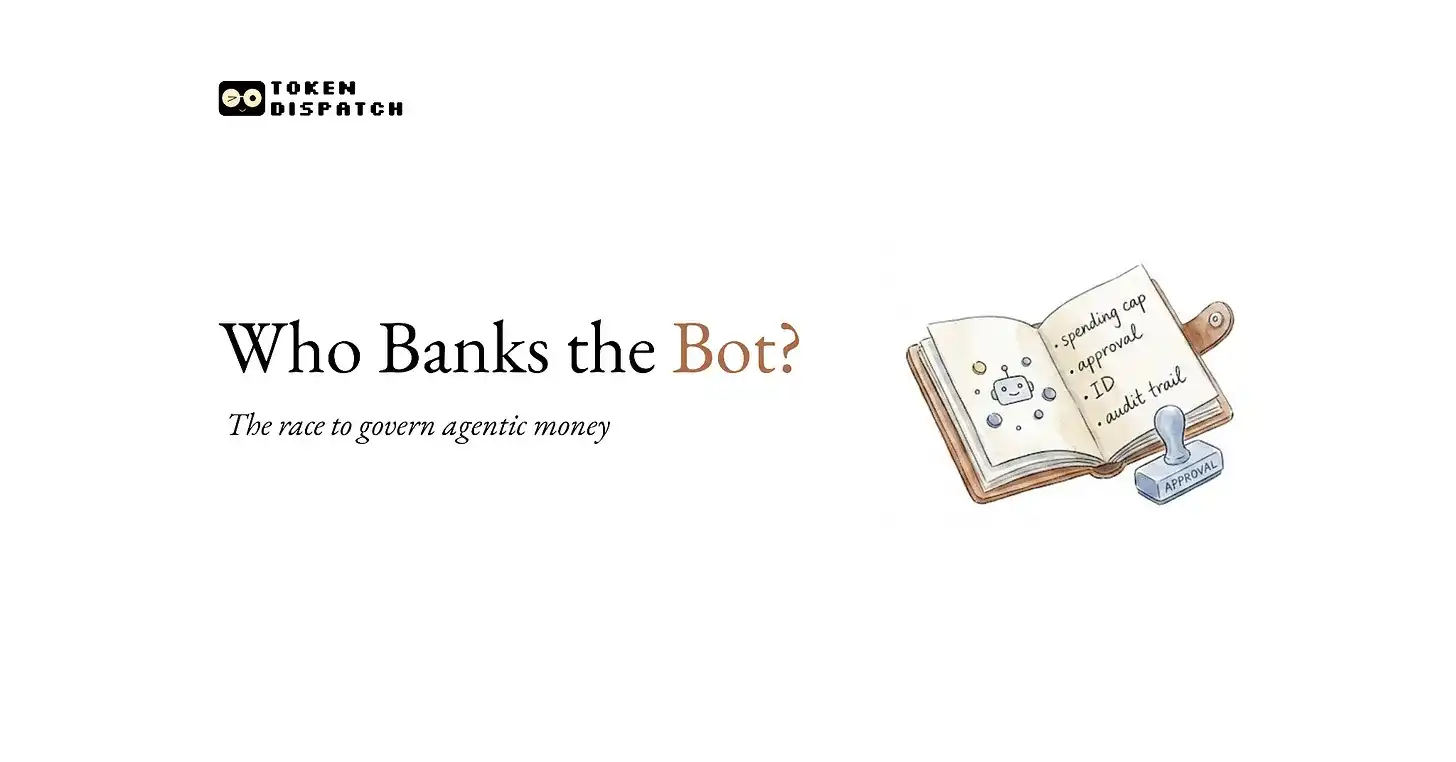
Who Funds the Agents?

**Summary: Who Funds AI Agents?** OpenAI recently shut down a feature allowing AI agents to shop for users, highlighting the challenge of creating a secure and regulated environment for agent-driven transactions. While payment infrastructure exists, a crucial governance layer—defining spending limits, fraud detection, tax handling, and return policies—is largely missing. The potential is enormous: AI agents already processed $73M across 176M transactions last year, with McKinsey forecasting this could grow to $3-5T in global consumer commerce by 2030. The core competition isn't just about processing payments, which can be very cheap (especially with crypto-based settlement), but about controlling the rules that govern agent spending. Key players like Stripe and Coinbase are racing to dominate this governance layer. Stripe's acquisition of wallet provider Privy allows it to set spending policies, identity checks, and human-in-the-loop approvals directly at the wallet level. Similarly, Coinbase's stack, including its x402 protocol and AgentKit, embeds governance rules. This vertical integration across settlement, wallet, and governance layers is becoming the dominant strategy. Control over the governance layer is where significant future value lies. If agents handle trillions in transactions, even a small fee for managing compliance, fraud prevention, and policy enforcement could generate billions in annual revenue. The companies that successfully integrate across the payment stack will capture value from idle agent balances, transaction fees, and governance services, positioning themselves as the foundational banks of the AI agent economy.

marsbit06/04 01:47

Who Funds the Agents?

marsbit06/04 01:47

活动图片