Ripple’s RLUSD Lands In Mastercard’s Stablecoin Settlement Expansion

bitcoinistPublished on 2026-06-04Last updated on 2026-06-04

Abstract

Mastercard is expanding its stablecoin settlement capabilities, adding Ripple's RLUSD alongside other regulated stablecoins like USDC and PYUSD. This move allows issuers and acquirers to settle card transactions using digital assets on various blockchains, including Ethereum, Solana, and the XRP Ledger. The enhancement introduces intraday, weekend, and holiday settlement options, aiming to provide more flexibility, especially for cross-border payments and treasury operations. Mastercard positions this as a network-level addition that complements existing processes, with initial support focused on the US and Latin America. Ripple views RLUSD's inclusion as validation for regulated stablecoins in institutional payment infrastructure, highlighting the growing demand for faster, always-on settlement.

Mastercard is moving deeper into stablecoin infrastructure, adding Ripple’s RLUSD to a broader settlement expansion that will allow issuers and acquirers to settle card transactions through regulated digital assets alongside traditional fiat rails.

The payments giant said Wednesday that it plans to expand its settlement capabilities with intraday, weekend and holiday settlement options, as well as on-chain card settlement using regulated stablecoins. The move is designed to give Mastercard partners more flexibility in how and when they settle transactions across its global payments network, with particular relevance for cross-border payments, treasury operations and payouts.

Ripple Scores Mastercard Settlement Role

For Ripple, the key development is the inclusion of RLUSD among the stablecoins Mastercard plans to support. According to the announcement, Mastercard will enable settlement using Circle’s USDC, Paxos-issued stablecoins including PYUSD, USDG and USDP, Ripple’s RLUSD and SoFi’s SoFiUSD. These assets will be supported across a range of blockchain networks, including Arbitrum, Base, Canton, Ethereum, Polygon, Solana, Tempo and the XRP Ledger.

The announcement places RLUSD inside one of the most closely watched institutional use cases for stablecoins: settlement. Rather than positioning stablecoins primarily as trading instruments or exchange liquidity tools, Mastercard is framing them as part of the back-end financial infrastructure that can support faster money movement between issuers, acquirers and merchants.

“The next phase of stablecoin adoption is about real-world utility, especially in settlement, where timing and liquidity matter most,” said Raj Dhamodharan, executive vice president for Blockchain and Digital Assets at Mastercard. “By introducing intraday and weekend on settlement options across our global network, we’re expanding how partners manage liquidity and operate in an always-on digital economy while maintaining the trust, resilience and safeguards they expect from Mastercard.”

Mastercard said the stablecoin settlement option will sit alongside existing processes, rather than replace them. The company described the expansion as a “network-level enhancement” intended to preserve existing security standards, fraud safeguards and dispute processes while adding digital asset-based settlement as another choice for partners.

Initial support is expected from ARQ, formerly known as DolarApp, CBW Bank, Cross River, Lead Bank and Nuvei, with early focus on the United States and Latin America. Mastercard said further expansion is planned through 2026, subject to regulation, with additional regions, partners and regulated stablecoins expected over time.

Ripple framed the inclusion of RLUSD as validation for regulated stablecoins built for institutional payment flows. Jack McDonald, Ripple’s senior vice president of stablecoins, said Mastercard’s move into on-chain settlement marks “a landmark validation that blockchain technology is ready for the world’s most critical payment infrastructure.”

“RLUSD’s inclusion in Mastercard’s global settlement network reflects growing demand for trusted, regulated stablecoins built for real-world financial use cases on public blockchains like the XRP Ledger,” McDonald added. “We’re excited to support the next evolution of faster, more flexible, always-on settlement.”

Other stablecoin issuers and banking partners echoed that view, focusing on liquidity management and the limits of traditional settlement windows. Circle’s chief commercial officer Kash Razzaghi said demand is growing for infrastructure that can operate beyond banking hours, while Cross River’s Luca Cosentino said stablecoins have emerged as “a powerful tool” for faster and more transparent settlement.

At press time, XRP traded at $1.24.
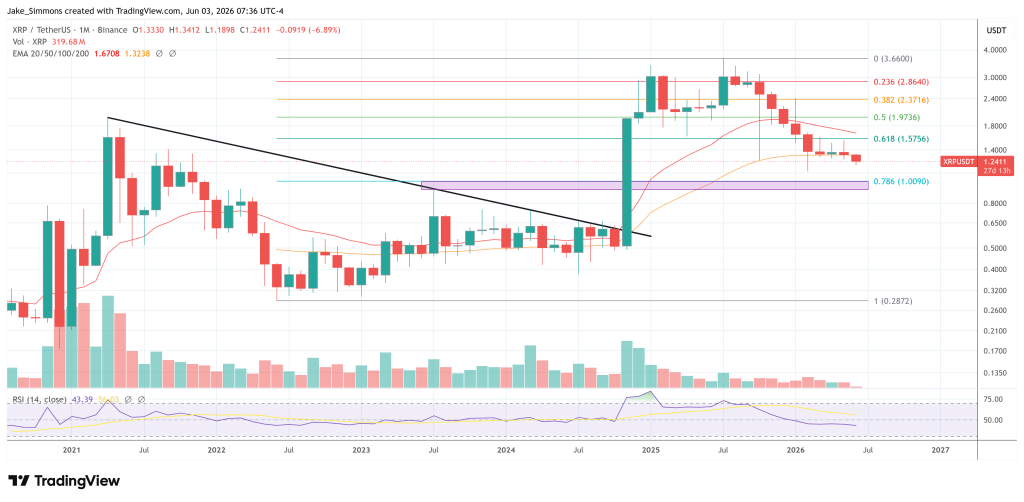
XRP falls below the 50-week EMA, 1-month chart | Source: XRPUSDT on TradingView.com

Related Questions

QWhat is the main announcement made by Mastercard in the article?

AMastercard is expanding its settlement capabilities to include on-chain settlement using regulated stablecoins, including Ripple's RLUSD, alongside traditional fiat methods. This will offer intraday, weekend, and holiday settlement options for its partners.

QWhich stablecoins are specifically mentioned as being supported by Mastercard's new settlement expansion?

AThe stablecoins mentioned are Circle's USDC, Paxos-issued stablecoins (PYUSD, USDG, USDP), Ripple's RLUSD, and SoFi's SoFiUSD.

QAccording to Raj Dhamodharan of Mastercard, what is the next phase of stablecoin adoption about?

ARaj Dhamodharan stated that the next phase of stablecoin adoption is about real-world utility, especially in settlement, where timing and liquidity matter most.

QHow does Mastercard describe the role of the new stablecoin settlement option in relation to its existing processes?

AMastercard said the stablecoin settlement option will sit alongside existing processes as a 'network-level enhancement,' adding it as another choice for partners rather than replacing current methods. It is intended to preserve existing security and fraud safeguards.

QWhat significance does Ripple attribute to RLUSD's inclusion in Mastercard's network, according to Jack McDonald?

AJack McDonald stated that RLUSD's inclusion reflects growing demand for trusted, regulated stablecoins built for real-world financial use cases. He called Mastercard's move a 'landmark validation' that blockchain technology is ready for critical payment infrastructure.

Related Reads

The Revelation from the Raydium Theft Incident: New DeFi Vulnerabilities Lurking in Forgotten Old Contracts

**Raydium Exploit Reveals DeFi's Hidden Risk: Forgotten "Zombie" Contracts** A recent attack on Raydium's deprecated V3 AMM pools resulted in a loss of approximately $1.34 million. The hacker exploited pools that were no longer supported by Raydium's current UI or SDK but remained fully functional and accessible on-chain. This incident highlights a critical, often overlooked category of risk in DeFi: inactive or legacy smart contracts that projects fail to properly decommission. Since March 2025, there have been at least 8 publicly reported attacks targeting such abandoned contracts, with total losses around $10.8 million. Including older pools and deprecated features, the count rises to 10 incidents with roughly $22.5 million in losses. These "zombie contracts" represent a lifecycle management failure rather than a code vulnerability, yet they are typically misclassified under general "code bug" categories in security reports, masking the true scale of the problem. The root cause is that projects often merely document a contract as "deprecated" without taking essential technical steps to secure it: withdrawing remaining assets, disabling external call functions, and implementing ongoing monitoring. These forgotten, under-monitored components become prime targets for attackers. To address this, the industry needs to recognize "zombie contracts" as a distinct risk category and establish standardized decommissioning protocols. Essential steps should include: 1) a formal retirement announcement, 2) removal of all front-end integrations, 3) withdrawal of locked assets, 4) disabling key contract functions, 5) ongoing security monitoring, 6) clear user communication, and 7) a post-mortem analysis. The value of a DeFi project lies not only in its current TVL but also in the security of its historical codebase, which has now become a new attack surface.

Foresight News41m ago

The Revelation from the Raydium Theft Incident: New DeFi Vulnerabilities Lurking in Forgotten Old Contracts

Foresight News41m ago

Robots Begin to 'Consume Data': The Hidden Production Chain from Indian Data Factories to Billion-Dollar Humanoid Robots

Robots have started to 'consume data,' driving the formation of a new industrial supply chain focused on producing training data for embodied AI. Unlike large language models, which are trained on vast internet text corpora, embodied AI models face a 'data desert' in the physical world. This has created a massive demand for first-person perspective video data (Ego Data), captured by workers wearing cameras in places like Indian garment factories. Companies like Neocambrian AI are establishing 'data factories' where workers perform standardized tasks (e.g., sorting clothes, kitchen organization) to generate thousands of hours of video. Research, such as NVIDIA's EgoScale, demonstrates that scaling this human demonstration data predictably improves robot performance, particularly for dexterous manipulation. This has validated a training path combining large-scale human data for pre-training with smaller amounts of robot-specific data for fine-tuning. The value of different data types varies significantly, forming a 'data pyramid.' The base consists of low-cost, large-scale internet and Ego Data. Higher layers include more expensive motion-capture data (e.g., from data gloves), simulation/synthetic data, and the most costly and scarce layer: real robot teleoperation data. This demand has spawned a layered ecosystem of data suppliers: low-cost data factories, motion capture and alignment specialists, robot-native teleoperation service providers, simulation data companies, and platforms aiming for data standardization. Robot companies themselves are adopting a 'layered procurement' strategy: outsourcing generic Ego Data while building in-house capabilities for robot-specific adaptation data and the critical deployment/failure data generated in real-world applications. The industry is shifting focus from hardware and basic mobility to the data pipelines required for general-purpose capability. While parallels exist to data labeling companies like Scale AI in the LLM boom, the physical complexity of robot data—involving action success ambiguity and sim-to-real gaps—requires more integrated solutions for data collection, annotation, and a continuous feedback loop. The race is on to build the data engines that will teach robots to operate reliably in the unstructured real world.

marsbit3h ago

Robots Begin to 'Consume Data': The Hidden Production Chain from Indian Data Factories to Billion-Dollar Humanoid Robots

marsbit3h ago

Spicy Commentary | Michael Saylor's 'Player Talk'; 60-Year-Old Aunt Liquidated After 'Scamming a Young Man'

**"Spicy Commentary": Three Tales of Crypto's Wild Week** This week's "Spicy Commentary" column highlights three dramatic stories from the cryptocurrency world. First, **MicroStrategy's Michael Saylor** addressed the controversy over his company potentially selling Bitcoin. At the BTC Prague event, he clarified, "I never said the company can't sell Bitcoin. I told *you* never to sell *your* Bitcoin." This "do as I say, not as I do" stance was criticized by netizens as peak linguistic gymnastics, noting a history of him previously stating the company would "never" sell. Second, a **bizarre fraud case** emerged from Beijing. A 60-year-old woman, obsessed with getting rich from crypto but unwilling to risk her own savings, posed online as the 20-something "god-daughter" of a high-ranking official. She catfished a young man, convincing him to give her over 200,000 yuan for fabricated emergencies. She then invested all the stolen money into cryptocurrency with 10x leverage, only to lose everything in a market crash. The woman was sentenced to four years in prison for fraud. Finally, a **sobering trader's tale** surfaced on Reddit. A user posted "Tale of a crypto trader," confessing their net worth had plummeted from a peak of $45 million to roughly $17,200, primarily due to holding meme coins too long. The post, described as a crypto "book of confessions," sparked reactions ranging from sympathy to critique about greed, poor risk management, and the perils of treating meme coins as long-term investments instead of taking profits. The column concludes that this week featured masterful rhetoric, elaborate scams, and extreme financial volatility, stitching together another chapter in crypto's unpredictable theater.

Foresight News3h ago

Spicy Commentary | Michael Saylor's 'Player Talk'; 60-Year-Old Aunt Liquidated After 'Scamming a Young Man'

Foresight News3h ago

Tremble Humans, AI Continues Its Accelerated Sprint

Trembling, Humans: AI Continues Its Accelerated Sprint Yes, AI is still rapidly accelerating. While deep learning seemed to stall quickly in its early years, large models after years of development show no sign of hitting their ceiling. At the Zhiyuan Conference 2026, the focus is on enabling AI to move from the digital world into the physical world. Scaling Law remains effective, continuing to drive advancements in both large language models and multimodal models. The industry is now entering a phase of pursuing World Models, though unresolved technical paths and data issues mean this exploration may take 3-5 more years. Concurrently, breakthroughs in Agents are accelerating AI's real-world application in fields like healthcare and meetings. Making Agents truly useful requires key hardware-software co-design, evident from the strong presence of chip vendors at the conference. We stand at a new historical threshold where AI is becoming a foundational force reshaping the world. The first day of the conference highlighted AI's evolution from "knowing how to chat" to "knowing how to work." Scaling Law persists, World Models are the next key battleground, and Agents are transitioning from usable to好用 (user-friendly). Scaling Law is not ending but diversifying. New models like Anthropic's Fable 5 demonstrate scaling through parameter size, synthetic data, and reinforcement learning. Advancements in AI Coding and Agent deployment are enabling a trend of AI self-evolution, potentially allowing AI to take over digital world iterations. World Models represent the next frontier for large models extending into the physical realm, but no current model is truly impressive at solving real-world problems. Technical consensus is lacking, with debates on data sources (video, simulation, real-world). Different approaches are emerging: language-centric, pixel-centric, 3D-structure-centric, and visual-representation-centric models. Zhiyuan Institute is exploring a fifth path: unified latent space modeling fusing language and visual representations, and introduced its own under-development World Model, Physis-v0.1. On the product side, Agents are key to bringing AI into daily life. Since 2025, the "Year of the Agent," products have become more proactive and capable of complex tasks. Zhiyuan showcased four vertical Agents for cardiac diagnosis, autonomous research, meeting summarization, and protein risk discovery. However, technical challenges remain, particularly in context engineering like memory and orchestration. "Harness" – the engineering framework around an Agent – is crucial for maximizing its capabilities by clarifying intent, designing workflows, and incorporating validation and feedback. In summary, AI's breakneck pace continues on multiple fronts: foundational model scaling, the ambitious pursuit of World Models for physical understanding, and the ongoing refinement of practical Agents. The journey from capable to truly reliable and useful AI systems is well underway.

marsbit4h ago

Tremble Humans, AI Continues Its Accelerated Sprint

marsbit4h ago

Trading

Spot
Futures

Hot Articles

Discussions

Welcome to the HTX Community. Here, you can stay informed about the latest platform developments and gain access to professional market insights. Users' opinions on the price of S (S) are presented below.

活动图片