# Foreign Investment Related Articles

HTX News Center provides the latest articles and in-depth analysis on "Foreign Investment", covering market trends, project updates, tech developments, and regulatory policies in the crypto industry.
Kospi Index Drops Below 5,600 Mark Amid Record-Breaking Double Trigger of Circuit Breaker, While Bitcoin Price Surpasses $64,000

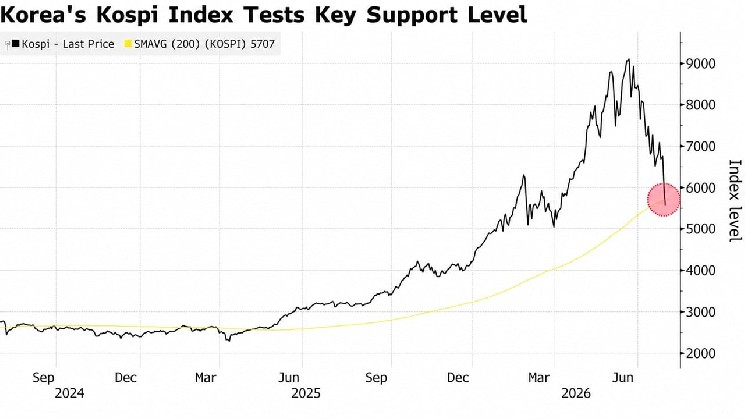
South Korea's stock market experienced unprecedented volatility as both the Kospi and Kosdaq indices triggered circuit breakers for two consecutive days. The Kospi plunged over 8% on Wednesday, falling below 5,600 points, following an over 8% drop the previous day. This historic dual halt was primarily driven by massive sell-offs in heavyweight semiconductor stocks like Samsung Electronics and SK Hynix. The selling pressure persisted despite SK Hynix reporting a 557% surge in quarterly profit, as the results failed to meet inflated market expectations fueled by AI-driven demand, highlighting a disconnect between stock valuations and fundamentals. In contrast, Bitcoin diverged from the equity market downturn. After initially dipping to around $63,000 amid the Kospi's fall and broader macroeconomic concerns, it rebounded to surpass $64,400 within 24 hours, even as South Korea's second circuit breaker was triggered. This marks a second instance in a week where Bitcoin held ground during an AI-related stock sell-off, suggesting its previously tight correlation with semiconductor and tech stocks may be weakening. Analysts note the relationship is complex and driven by shared investor bases rather than direct causality. The ongoing pressure on chip stocks, which dominate the Kospi index, raises the risk of further market halts before stability can return.

cryptonews.ru07/29 10:41

Kospi Index Drops Below 5,600 Mark Amid Record-Breaking Double Trigger of Circuit Breaker, While Bitcoin Price Surpasses $64,000

cryptonews.ru07/29 10:41

Hyperliquid Pre-IPO Contract Priced at $7.2 for CXMT, Foreign Capital Intervenes in Chinese Storage Narrative via DeFi

On the eve of Changxin Technologies' (CXMT) highly anticipated STAR Market IPO, a novel DeFi platform is enabling a pre-market price discovery. Trade.xyz has deployed a CXMT perpetual contract on the Hyperliquid blockchain, currently trading around $7.2 USDC (implying a market cap of ~$482B). This marks the first time such a "pre-IPO" derivative has targeted a Chinese A-share company. The article highlights several key drivers: overseas investors, restricted by China's 500,000 yuan (~$69,000) STAR Market access threshold, are using this contract as a direct entry point to bet on the "China storage substitution" narrative. Changxin, the world's fourth-largest DRAM supplier, is seen as a major beneficiary of the current AI-driven memory chip shortage. Furthermore, the 24/7, leveraged, and shortable nature of the perpetual contract contrasts with A-shares' T+1 settlement and lack of short-selling mechanisms for such stocks, potentially offering a hedging tool. While the $3.5 trillion implied valuation aligns with optimistic analyst projections, the article notes a critical divergence from similar contracts for U.S. listings like SpaceX: due to capital controls, direct arbitrage between the A-share and the on-chain contract is virtually impossible, meaning a price gap may persist. Nonetheless, the very existence of this parallel market underscores intense global investor interest in China's semiconductor rise, complementing the landmark IPO itself, which aims to raise up to $92 billion.

marsbit07/16 00:22

Hyperliquid Pre-IPO Contract Priced at $7.2 for CXMT, Foreign Capital Intervenes in Chinese Storage Narrative via DeFi

marsbit07/16 00:22

Black Tuesday in Japanese and Korean Stock Markets: South Korea Triggers Circuit Breaker, Nikkei Plummets, AI Boom Undergoes Phased Adjustment

"Black Tuesday" for Asian Markets: Korean Stocks Halted by Circuit Breaker, Nikkei Plunges as AI Rally Undergoes Correction Asian stock markets experienced severe turbulence on Tuesday, with South Korea's benchmark KOSPI index plummeting nearly 10% after triggering a market-wide trading halt when its losses exceeded 8%. Japan's Nikkei 225 index also fell sharply by approximately 3.5%, ending an eight-day winning streak. The sell-off was heavily concentrated in the technology and semiconductor sectors, with giants like Samsung Electronics and SK Hynix leading the declines. The plunge reflected a rapid reversal from recent highs, with the KOSPI having retreated over 12% from its mid-June peak. Analysts attribute the sharp correction to multiple converging factors. The direct trigger was weakness in U.S. tech stocks, which fueled profit-taking in overbought Asian markets. Furthermore, stronger-than-expected U.S. jobs data has reinforced expectations that the Federal Reserve will maintain or even raise interest rates, putting pressure on rate-sensitive growth stocks. Structural vulnerabilities also played a role, particularly in South Korea, where the market is highly concentrated in a few semiconductor heavyweights, making it susceptible to shifts in global AI demand and foreign capital outflows. Despite the short-term volatility, the long-term narrative for AI and semiconductors remains intact. Industry forecasts still point to massive growth in global AI capital expenditure over the coming years. South Korean firms like SK Hynix maintain a dominant position in critical segments like High Bandwidth Memory (HBM), with long-term orders secured well into 2027. While near-term fluctuations are expected to continue, driven by U.S. monetary policy signals and upcoming corporate earnings, the current correction may present a buying opportunity for quality assets tied to the enduring AI infrastructure build-out.

marsbit06/23 09:57

Black Tuesday in Japanese and Korean Stock Markets: South Korea Triggers Circuit Breaker, Nikkei Plummets, AI Boom Undergoes Phased Adjustment

marsbit06/23 09:57

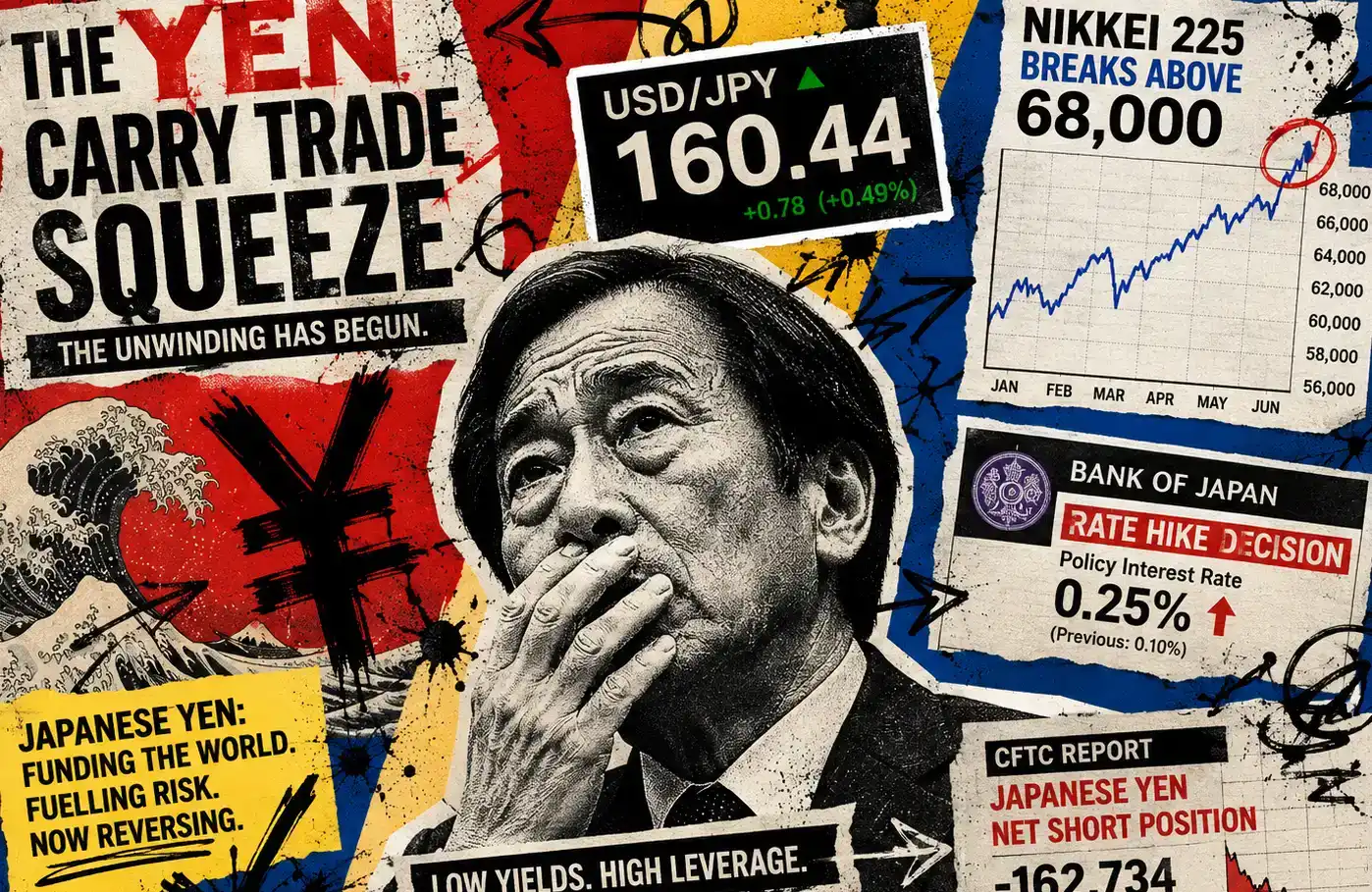
New Wall Street Play: Yen Shorts Still Adding, But Japan Stocks Don't Rely on Carry Trade Unwinding

On June 3rd, USD/JPY hit 160.44, its highest level since July 2024, while the Nikkei 225 surged past 68,000 points. Contrary to popular narratives of an imminent "carry trade unwind" akin to August 2024, data reveals a more complex picture. Speculative net short positions in yen futures have actually increased, reaching -114,667 contracts by late May, suggesting traders are doubling down rather than retreating. Meanwhile, Japan's Finance Ministry conducted its largest-ever single-round FX intervention (11.73 trillion yen) in April-May but failed to hold the 160 yen line. The Nikkei's rally is not driven by carry trade dynamics. Foreign investors are aggressively buying Japanese stocks, with net purchases in 2026 running nearly 16 times higher than 2025 levels. This inflow is concentrated in AI and semiconductor-related stocks like SoftBank and Socionext, fueled by positive sector outlooks, rather than being a flight from unwinding yen shorts. Furthermore, the Nikkei has continued climbing despite the Bank of Japan's (BOJ) rate hikes to 0.75%. This disconnect exists because the current equity boom is fueled by AI-driven foreign investment, not reliant on cheap yen funding. However, this relationship remains fragile. Should the BOJ hike rates further (e.g., to 1.0%) while dollar weakness increases carry trade costs, the trajectories of the yen and Japanese stocks could reconverge, potentially triggering volatility.

marsbit06/04 04:47

New Wall Street Play: Yen Shorts Still Adding, But Japan Stocks Don't Rely on Carry Trade Unwinding

marsbit06/04 04:47

Dumping US Bonds, Buying Japanese Bonds: Wall Street Prepares for 'Capital Repatriation to Japan'

Wall Street is bracing for a potential "great repatriation" of Japanese capital as yields on Japanese Government Bonds (JGBs) soar to multi-decade highs. The 10-year JGB yield recently hit 2.73%, its highest since 1997, while the 30-year yield broke 4% for the first time. This dramatic shift is causing global asset managers to reassess a long-ignored risk: that Japanese investors, who hold roughly $1 trillion in U.S. Treasury debt, could start bringing that money home. For decades, Japan's ultra-low interest rates pushed domestic insurers, pension funds, and banks to seek yield overseas, primarily in U.S. Treasuries. Now, with the Bank of Japan hiking rates and JGB yields climbing, the incentive is reversing. Firms like BlueBay Asset Management are preparing for this shift, believing new Japanese investments will be directed domestically rather than to foreign bonds. Early signs of repatriation are emerging, with record monthly inflows into Japanese sovereign bond funds in March. Some managers, like Ruffer's Matt Smith, hold yen as a hedge, anticipating that market stress could trigger a rapid acceleration of capital returning to Japan. However, analysts caution that a mass exodus hasn't begun yet. Japanese investors were still net buyers of foreign bonds over the past year. Uncertainty remains high as Japan's government fiscal plans could push JGB yields even higher, making investors hesitant to buy immediately. Furthermore, the Bank of Japan's withdrawal as a dominant bond buyer has increased market volatility. Nevertheless, the potential scale of Japanese selling poses a tangible risk to the U.S. Treasury market. As the largest foreign holder of U.S. debt, any sustained shift by Japanese institutions could materially impact supply and demand dynamics, pushing U.S. yields higher. Wall Street's current positioning is a forward-looking bet on this logic becoming increasingly compelling as Japanese yields continue to rise.

marsbit05/18 03:27

Dumping US Bonds, Buying Japanese Bonds: Wall Street Prepares for 'Capital Repatriation to Japan'

marsbit05/18 03:27

活动图片