# Earnings Related Articles

HTX News Center provides the latest articles and in-depth analysis on "Earnings", covering market trends, project updates, tech developments, and regulatory policies in the crypto industry.

All Metrics Smashing Records, Yet Stock Prices Plunge Across the Board

Memory giants like Western Digital (WDC) and SanDisk (SNDK) reported blockbuster earnings in the summer of 2026, featuring毛利率 exceeding 80%, massive customer prepayments, and long-term supply agreements. Despite this seemingly perfect performance, their stocks plummeted post-earnings (WDC down 13%, SNDK down 7%), along with peers like Micron. The collapse highlights a core market rule: "good" isn't enough; results must beat already sky-high expectations. With valuations at peak "perfect asset" levels, even slightly conservative forward guidance triggered a sell-off. The market saw "peak performance" as a signal to exit. Beneath the stellar numbers, four反常 trends emerged: 1. **Financialized Pricing:** Customers provide百亿级 in upfront "interest-free deposits" to secure future capacity. 2. **Reversed Cost Curve:** Advanced DRAM (HBM4, DDR6) costs are rising per bit due to complex packaging, breaking Moore's Law. 3. **AI vs. Consumer Split:** Data center storage demand soars (+103% for SanDisk), while consumer electronics demand weakens under high costs. 4. **HDD Revival:** Hard drives, now used for AI agent context caching, see毛利率 near 55-57%. Underlying隐忧 persist. Soaring capital expenditure (CapEx) by SK Hynix and Micron risks future oversupply. Revenue growth is increasingly driven by price hikes, not surging shipment volumes (bit growth), making profits vulnerable to any price correction. In conclusion, while AI has created a long-term growth narrative, transforming storage into "strategic infrastructure," the market's violent reaction signals that peak valuations and expectations have left no safety margin. The周期 hasn't disappeared; it's merely wearing an AI disguise.

marsbit08/07 10:21

All Metrics Smashing Records, Yet Stock Prices Plunge Across the Board

marsbit08/07 10:21

Citi's Interpretation: Why Does Citi Still Give SanDisk a Target Price of $2500 After Earnings Report Despite a Significant Stock Price Drop?

Citi maintains a "Buy" rating on SanDisk with a $2500 price target despite a post-earnings stock drop. This target, implying an 85.1% upside from the August 5th close of $1350.50, hinges on the firm's view that SanDisk merits a higher valuation than traditional NAND cyclical stocks. Although SanDisk reported strong Q4 FY26 results with revenue up 51% sequentially and robust full-year data center growth (+437%), its stock fell sharply on August 6th. Investors are concerned about potential NAND price growth moderation and guidance that failed to meet elevated market expectations. Citi's bullish thesis centers on SanDisk's new long-term "New Business Model" (NBM) agreements. These contracts, covering a significant portion of its NAND bit output for FY27 and FY28, represent minimum revenue commitments of approximately $94 billion backed by financial guarantees. This structure aims to increase revenue and cash flow predictability. The report links this visibility to AI data center demand, driven by the expansion of inference workloads requiring more storage. Citi estimates data center storage capacity demand will grow about 35% in CY27. However, the analysis notes long-term contracts cannot eliminate the NAND cycle. Risks include potential oversupply from industry capacity expansion, competition, and macroeconomic headwinds. The $2500 target essentially bets that AI demand and these contracts can reduce earnings volatility enough to support a premium valuation (~11x CY27E EPS). Key factors to watch are the execution of the $94B commitments, pricing mechanisms, actual data center demand, and industry supply dynamics.

marsbit08/07 07:16

Citi's Interpretation: Why Does Citi Still Give SanDisk a Target Price of $2500 After Earnings Report Despite a Significant Stock Price Drop?

marsbit08/07 07:16

Is the AI Storage Chip Market at Its Peak Now, or Hitting a Bottom for Bargain Hunting?

The article analyzes the current state of the AI memory chip sector, questioning whether it has peaked or bottomed for a potential investment entry. It highlights a market dilemma following strong Q4 earnings from SanDisk and Western Digital, where both companies reported explosive revenue and profit growth. Despite this, their stock prices fell, signaling a "sell the news" event where future growth expectations, not current profits, are being priced in. This is identified as a potential early warning sign of a sector peak—valuations may have topped out on expectations, even if fundamental metrics like revenue have not. The piece advises against immediate heavy investment ("all-in"), drawing parallels to Nvidia's historical trajectory. After its AI-driven surge, Nvidia's stock entered a prolonged consolidation phase once its毛利率 (gross margin) growth peaked. The author suggests that for memory stocks, which have seen similar dramatic runs, a true buying opportunity may only emerge later, after signals like slowing price increases, declining gross margins, or reduced cloud provider orders confirm a fundamental downturn. In conclusion, the sector is described as being in an ambiguous, high-volatility phase—too early for a major bullish bet but risky to short. The article suggests using tools like options for limited-risk exposure during this uncertain period, reserving more aggressive strategies like margin trading for after clearer bottoming signals appear. A standard investment disclaimer is included.

marsbit08/07 06:51

Is the AI Storage Chip Market at Its Peak Now, or Hitting a Bottom for Bargain Hunting?

marsbit08/07 06:51

Revenue Hits Record High, Why Hasn't AAOI's Profit Kept Pace?

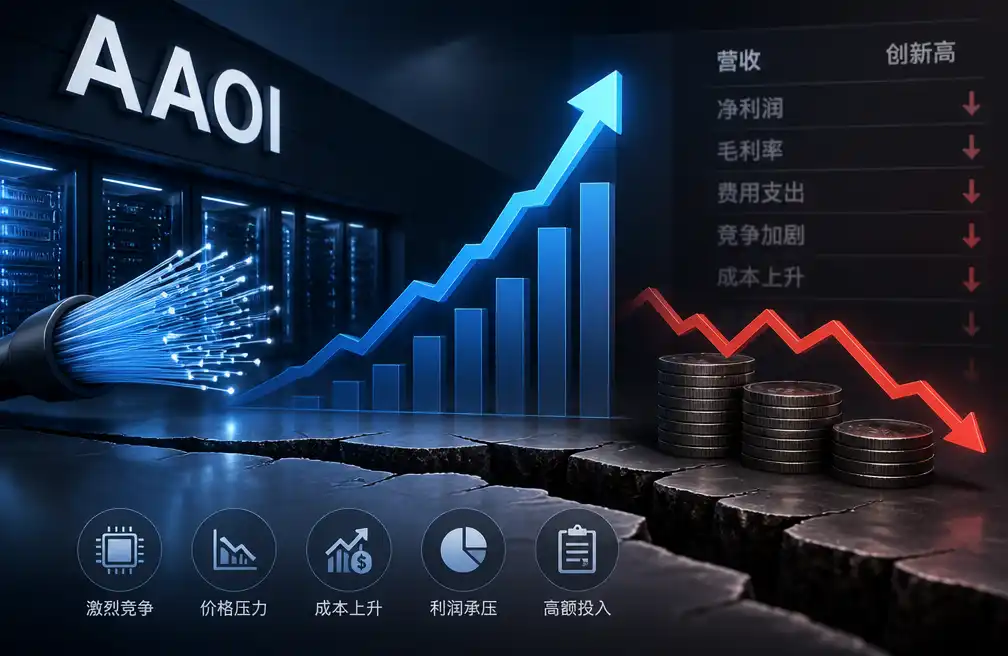
US optical communication equipment maker Applied Optoelectronics (AAOI) reported its Q2 earnings on August 6th, marking its fifth consecutive quarter of record revenue. However, a closer look reveals a more complex picture: alongside the revenue surge, GAAP gross margin hit a near six-quarter low, and GAAP net loss persisted despite non-GAAP profit turning positive. The report depicts a company in rapid expansion mode. While revenue is flowing in, costs related to materials, equipment, and extended payment terms are pulling down profits and cash flow. The analysis focuses on three key drivers: revenue sources, the quality of reported profits, and funding for the expansion. Revenue growth was driven by two segments: data center business (up 140% year-over-year) and CATV/cable broadband (up 44%). This diversification means growth isn't solely dependent on the volatile AI supply chain. However, a significant portion of revenue and accounts receivable is concentrated with a single CATV customer, Digicomm, which receives extended payment terms, creating a timing gap between booked revenue and actual cash collection. Despite increasing scale, GAAP gross margin fell to 27.7%, while non-GAAP was 29.8%. The gap includes costs like expenses for discontinued products, which are excluded from the non-GAAP measure. Management highlighted a more-than-doubling of 800G product shipments and ongoing capacity expansion for next-gen modules, indicating that scaling new, high-speed production involves upfront costs that temporarily pressure margins before efficiency gains are realized. AAOI's non-GAAP net income turned positive, largely due to a $14.26 million tax adjustment related to reconciling items, accounting for about 50.5% of the total GAAP to non-GAAP difference. Other adjustments included stock-based compensation and costs for discontinued products. Notably, adjusted EBITDA remained slightly negative at -$543k, suggesting the core operating cash flow generation is not yet self-sustaining. The expansion is primarily funded externally. In the first half, operating and investing activities consumed a net $707 million, largely for growing receivables, inventory, and capital expenditures. This was offset by $980 million in net financing cash inflows, mainly from a $1.028 billion net proceeds from common stock issuance. The cash balance increased to $509 million, driven by equity financing rather than operational cash flow. In summary, AAOI is experiencing strong top-line growth fueled by data center and CATV demand, but profitability and cash flow are being weighed down by the significant costs and working capital needs of its rapid capacity expansion, which is currently funded through equity markets.

marsbit08/07 04:35

Revenue Hits Record High, Why Hasn't AAOI's Profit Kept Pace?

marsbit08/07 04:35

活动图片