# Data Center Related Articles

HTX News Center provides the latest articles and in-depth analysis on "Data Center", covering market trends, project updates, tech developments, and regulatory policies in the crypto industry.

September 1st, A Major Chip Price Hike

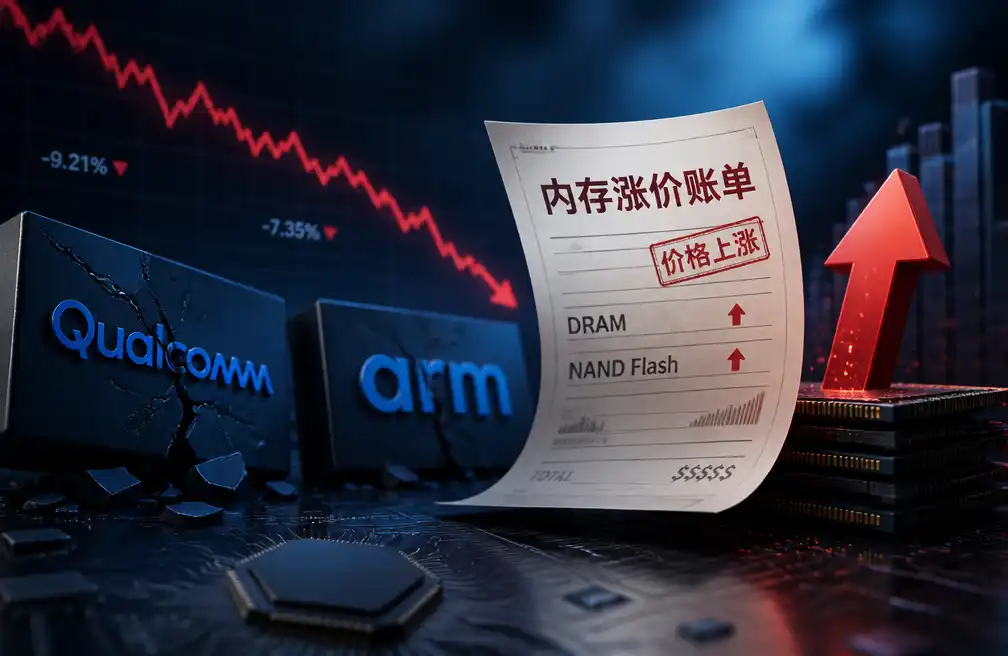
On July 29, 2026 (US time), Qualcomm reported its Q3 FY2026 (Q2 CY) results. Revenue reached $9.95 billion, up 4% and beating estimates, but net profit fell 25% YoY to $2 billion. The "revenue up, profit down" trend is attributed to rising costs across semiconductor manufacturing, testing, packaging, and materials. In response, CEO Cristiano Amon announced price increases for all chip products, effective September 1, to pass on costs and restore historical profit margins. The stock fell over 5% in after-hours trading due to weaker-than-expected Q4 profit guidance. Qualcomm's core chip business (QCT) revenue was $8.5 billion, down 5% YoY. Handset revenue dropped 20% to $5.09 billion, reflecting a weak global smartphone market with declining shipments. In contrast, Automotive revenue surged 61% to $1.59 billion, marking 23 consecutive quarters of double-digit growth, and IoT revenue grew 9% to $1.83 billion. The licensing division (QTL) revenue was $1.28 billion, down 3%. Facing smartphone headwinds and a reduced component share in future iPhones, Qualcomm is aggressively diversifying. It is betting heavily on the data center AI market, maintaining a target of $5 billion in data center revenue for FY2027. The company completed the acquisition of AI software firm Modular to build an open software platform for generative AI. For Q4 FY2026, Qualcomm forecasts revenue between $9.7B and $10.5B, roughly in line with expectations. However, non-GAAP EPS guidance of $2.05-$2.25 fell short of the $2.36 analyst consensus. Management expects the chip price increases to gradually improve margins after September 1, but near-term profitability pressure from costs and the weak handset market persists.

marsbit07/30 08:11

September 1st, A Major Chip Price Hike

marsbit07/30 08:11

Qualcomm and Arm Fall Together: The Bill for Memory Price Hikes Finally Arrives at Mobile Chip Companies

After posting Q2 FY2026 results, Qualcomm and Arm both saw their shares decline, reflecting the impact of memory price increases on the smartphone chip sector. Qualcomm's revenue of $9.95B slightly beat expectations, but EPS of $2.21 fell short. More concerning was its guidance for next quarter, with EPS projections below analyst estimates. The company directly attributed a >$1.50 per share annual EPS headwind to rising memory costs and supply constraints in Android phones, prompting planned price hikes. While automotive revenue grew 61% and is approaching one-third of phone revenue, the mobile segment declined 20%. Qualcomm also confirmed a significant reduction in its modem share for the upcoming iPhone and outlined a plan for data center revenue to replace all Apple-related income by FY2027. Arm's results surpassed expectations with revenue of $1.29B and EPS of $0.45, and its guidance was also strong. However, its stock fell. Key concerns included royalty revenue failing to set a new record and a downward revision to full-year royalty growth guidance from ~20% to the high-teens, citing weak smartphone demand and high memory prices. Despite robust growth in its data center business, Arm's premium valuation (over 100x forward P/E) means even beating expectations isn't enough to push the stock higher, as any sign of uncertainty is magnified. Ongoing global antitrust investigations add another risk factor. The situation highlights a broader shift. Memory price surges, which boosted Samsung's profits, are now pressuring chip designers. Meanwhile, the semiconductor sector saw significant corrections in July, with the hardest-hit stocks often being those with the biggest AI-driven gains year-to-date. Qualcomm, lacking such a premium, was an exception.

marsbit07/30 02:41

Qualcomm and Arm Fall Together: The Bill for Memory Price Hikes Finally Arrives at Mobile Chip Companies

marsbit07/30 02:41

Core Scientific Writes Off $41.9 Million to Accelerate Exit from Bitcoin Mining

Core Scientific reported a $41.9 million payment to terminate a contract with Block and its subsidiary Proto for the supply of Bitcoin mining chips. This move finalizes its exit from plans to grow its hash rate, shifting its business model entirely towards AI colocation. The agreement, announced in July 2024, was for 3nm chips providing roughly 15 EH/s of hash rate. Following the cancellation, Core Scientific stated it will no longer invest in new mining hardware to maintain or expand its cryptocurrency mining capacity. Instead, it will generate cash flow from its existing mining fleet while repurposing its data centers, potentially selling or decommissioning ASIC miners. In Q2 2026, revenue from AI colocation surged to $136.7 million from $10.6 million a year earlier, representing 83% of total revenue. In contrast, its own Bitcoin mining revenue fell 66% to $21.5 million. Quarterly Bitcoin production dropped 53% year-over-year. AI colocation capacity reached 437 MW by mid-July 2026, with CoreWeave accounting for all current hosting revenue and approximately 77% of Core Scientific's total revenue in H1 2026. The company also announced a partnership with AMD for up to 2.5 GW of potential data center capacity, with initial 15-year agreements for about 530 MW estimated to bring in over $14 billion in contract revenue. Total Q2 revenue grew to $164.2 million, while capital expenditures jumped to $797.5 million. As of June 30, 2026, the company reported long-term debt of $4.3 billion and free liquidity of $1.82 billion. The shift aligns with a broader industry trend of major Bitcoin miners accelerating a pivot to AI amid pressure on Bitcoin mining profitability.

cryptonews.ru07/29 13:41

Core Scientific Writes Off $41.9 Million to Accelerate Exit from Bitcoin Mining

cryptonews.ru07/29 13:41

SK Hynix Q2 Profit Soars Sixfold, Still 'Misses Expectations'; Secures Long-Term Agreements with 10 Clients, HBM4 to Accelerate Volume Ramp in Second Half

SK Hynix reported record-breaking Q2 2026 financial results, with operating profit soaring 557% year-over-year to 60.5 trillion won and revenue increasing 257% to 79.3 trillion won, driven by strong demand for AI server memory, HBM, and enterprise SSDs. The operating profit margin reached 76.3%. However, both figures fell short of analyst expectations, leading to a drop in its share price. The company attributed the earnings miss to three factors: a high sales mix of HBM, which limited upside from surging prices of general-purpose DRAM; a deceleration in memory price increases compared to Q1; and long-term supply agreements (LTAs) with major customers that lock in prices, reducing sensitivity to spot market gains. SK Hynix has signed LTAs with about 10 clients, covering roughly half of its sales. Despite the miss, the company remains optimistic about AI-driven demand. Its net profit of 93.9 trillion won was significantly boosted by a one-time gain from the partial sale of its Kioxia stake. Financially, it strengthened its cash position, ending the quarter with a net cash position of 69.4 trillion won. Looking ahead, SK Hynix plans capital expenditures at the high end of its 40-50 trillion won range for 2026 to expand capacity for HBM and advanced NAND products, including accelerating the mass production of HBM4 in the second half of the year.

marsbit07/29 01:47

SK Hynix Q2 Profit Soars Sixfold, Still 'Misses Expectations'; Secures Long-Term Agreements with 10 Clients, HBM4 to Accelerate Volume Ramp in Second Half

marsbit07/29 01:47

Miners Advised Not to Buy GPUs for AI and to Focus on Infrastructure

A founder at an energy investment forum advises bitcoin miners not to purchase GPUs for AI themselves, but to instead focus on infrastructure like power and data center space. Mike Alfred of Alpine Fox stated that while AI infrastructure demand is a long-term, 20-30 year trend, it presents a key choice for miners. The first, riskier model involves owning and operating GPUs, which requires financing expensive hardware that quickly becomes obsolete. The second, more conservative model is akin to real estate: providing colocation services where clients bring their own servers, and the miner sells space, power, cooling, and water. Alfred noted this model is easier to finance. Most existing bitcoin mining sites are difficult and expensive to convert for AI, as AI data centers require far higher construction costs, redundant fiber connections, backup power, complex cooling, and near 100% uptime. A hybrid model, where mining acts as a flexible load to use excess power during AI data center construction or from generation facilities, was discussed. However, participants concluded this is only viable with very cheap power; otherwise, developers are better off focusing solely on AI. Miners are increasingly being evaluated for their available power capacity and project portfolios rather than just bitcoin output. Panelists also warned of risks in the AI sector, predicting at least one major default or contract breach among AI tenants, lenders, or landlords before bitcoin's next halving in 2028.

cryptonews.ru07/28 11:26

Miners Advised Not to Buy GPUs for AI and to Focus on Infrastructure

cryptonews.ru07/28 11:26

Intel Data Center Revenue Soars 59%, CEO Chan: CPU Demand 'Taking Off', Supply Can't Keep Up

Intel Reports Strong Q2 2026 Results, Led by Surging Data Center Revenue Intel demonstrated a robust recovery, posting second-quarter revenue of $16.1 billion, a 25% year-over-year increase—its highest growth rate since 2011. On a non-GAAP basis, net income was $2.2 billion, with earnings per share of $0.42, far exceeding analyst expectations. A key highlight was the performance of the Data Center and AI (DCAI) business, where revenue soared 59% to $6.3 billion, significantly outperforming overall company growth. CEO Patrick Gelsinger noted that "CPU demand is taking off" in the data center segment, with demand outpacing the company's growing supply capacity. This supply-demand dynamic has granted Intel renewed pricing power, with server CPU prices in China reportedly rising over 40% since the start of 2026. The company has secured ten long-term supply agreements with customers. The Client Computing Group (CCG), which includes PC chips, saw revenue grow 13% to $8.9 billion. Intel Foundry revenue grew 31% to $5.8 billion and achieved a milestone by signing its first named external customer, cybersecurity firm Fortinet. The company reported strong progress on its Intel 18A manufacturing process, with yields improving approximately 7% per month. To support future growth, Intel raised its full-year 2026 capital expenditure forecast from $18 billion to $20 billion, including a $5.7 billion investment to expand manufacturing capacity for its Xeon processors. For the third quarter, Intel provided optimistic guidance, projecting revenue between $15.8 billion and $16.8 billion and non-GAAP EPS of approximately $0.38, both above analyst estimates. Following the earnings release, Intel's stock rose about 11% in after-hours trading.

链捕手07/24 07:07

Intel Data Center Revenue Soars 59%, CEO Chan: CPU Demand 'Taking Off', Supply Can't Keep Up

链捕手07/24 07:07

Bitcoin Mining Farms Are Becoming AI Factories

Bitcoin mines are transforming into AI factories. This shift is driven by the convergence of three key assets from the previous crypto cycle: infrastructure, talent, and capital. Crypto mining companies like Crusoe, CoreWeave, and Bitdeer are repurposing their core competency—securing power, land, and grid connections in remote locations—to build data centers for AI clients. These firms are signing multi-billion dollar, long-term contracts with companies like Anthropic, AWS, and Microsoft, as AI's demand for reliable, high-capacity compute surpasses the profitability of Bitcoin mining. Simultaneously, crypto entrepreneurs and engineers are applying their skills to new AI ventures. Examples include OpenSea's co-founder launching OpenRouter (an AI model aggregator), and former Coinbase engineers building Fal.ai (a generative media infrastructure platform). Their experience in building scalable, global software networks translates effectively to the AI space. Furthermore, capital accumulated during the crypto boom is now fueling AI. Figures like Jed McCaleb (co-founder of Ripple) funded Voltage Park, a large-scale GPU cloud provider. Notably, some crypto investments, like FTX's early bets on Anthropic and Cursor, have generated astronomical paper returns, demonstrating how high-risk crypto capital flowed into AI before it became mainstream. The transition is not just about repurposing hardware, but about redirecting critical resources—power infrastructure, distributed systems expertise, and venture funding—to the next technological frontier: artificial intelligence.

链捕手07/22 06:33

Bitcoin Mining Farms Are Becoming AI Factories

链捕手07/22 06:33

活动图片