# Пов'язані статті щодо Agents

Центр новин HTX надає останні статті та поглиблений аналіз на тему "Agents", що охоплює ринкові тренди, оновлення проєктів, технологічні розробки та регуляторну політику в криптоіндустрії.

Interview with MicroStrategy CEO: Beyond the 32 BTC Selling Stir, 6 Trillion AI Agents are the Ultimate Endgame for Bitcoin

Interview with Strategy CEO: Beyond the 32 BTC Sale, 6 Trillion AI Agents are Bitcoin's Ultimate Endgame Strategy CEO Phong Le discusses the recent sale of 32 BTC, clarifying it was a minor, strategic move to demonstrate operational liquidity and internal process robustness to creditors and rating agencies, not a reaction to market fears. He emphasizes Strategy's disciplined, data-driven decision-making framework involving its board and complex financial modeling, distancing the company from centralized "black box" operations seen elsewhere in crypto. Le outlines the company's resilience and long-term focus, citing the "doing nothing" strategy during the 2022 bear market as a testament to its conviction in Bitcoin's underlying value proposition for global sovereignty and freedom. He reveals that generative AI was instrumental in developing their Stretch (STRC) preferred stock product, cutting development time from years to months. The most visionary part of the discussion centers on Agentic AI. Le envisions a future with 6 trillion autonomous AI agents conducting commerce, particularly in off-world environments like Mars, which would naturally adopt decentralized crypto rails and seek yield-bearing assets like Bitcoin as a core store of value. Finally, Le addresses the STRC product, expressing confidence it will return to its $100 par value through reserve replenishment and the initiation of dividend payments, and dismisses concerns about competition with stablecoins. He concludes by affirming Strategy's philosophy of expanding Bitcoin access through all available means, from self-custody to ETFs, to onboard the next wave of users.

marsbitВчора 01:16

Interview with MicroStrategy CEO: Beyond the 32 BTC Selling Stir, 6 Trillion AI Agents are the Ultimate Endgame for Bitcoin

marsbitВчора 01:16

AI Agents Also Need 'Credit Checks': ERC-8126 is Filling the Gap in On-chain Trust

The article discusses ERC-8126, a proposed standard designed to address the lack of trust and verification for AI Agents operating on-chain. While ERC-8004 provides AI Agents with a basic on-chain identity (answering "Who are you?"), it does not guarantee trustworthiness. ERC-8126 aims to fill this gap by establishing a verification layer (answering "Are you reliable?"). It standardizes how independent verification providers can assess an agent's associated risks across five key areas: Token/Contract Verification (ETV), Media Content Verification (MCV), Solidity Code Verification (SCV), Web Application Verification (WAV), and Wallet Verification (WV). These providers generate a standardized risk score (0-100) and proofs based on their checks, without acting as a single authoritative certifier. This allows wallets, marketplaces, dApps, and other agents to consume these risk signals—for example, to display warnings, filter listings, or make interaction decisions. The standard also incorporates concepts like Private Data Verification (PDV) and Zero-Knowledge Proofs (ZKP) to allow verification without exposing sensitive underlying data. Positioned alongside ERC-8004 (Identity) and ERC-8183 (Commerce for agents), ERC-8126 represents a step toward building a verifiable and accountable infrastructure for the emerging on-chain AI Agent economy, shifting trust assessment from purely user-based judgment to standardized, consumable signals.

marsbitВчора 13:54

AI Agents Also Need 'Credit Checks': ERC-8126 is Filling the Gap in On-chain Trust

marsbitВчора 13:54

Chips, Open-Source Models, and $50 Trillion: Joe Tsai Reassesses Alibaba Once Again

Alibaba Executive Chairman Joe Tsai recently outlined the company's comprehensive AI strategy in a public discussion. He believes AI represents a massive opportunity, estimating its potential economic impact at up to $50 trillion, stemming from the automation of human intelligence and productivity. Tsai detailed Alibaba's four-layer investment approach across the AI stack: starting from the chip level, moving to cloud infrastructure (Alibaba Cloud), then the model layer with its open-source Qwen model, and finally applications within its vast digital ecosystem (e-commerce, logistics, etc.). The company avoids the energy layer due to China's efficient infrastructure. This broad strategy is designed to ensure Alibaba captures value regardless of where it ultimately concentrates in the AI value chain. He dismissed concerns about an AI investment bubble, pointing to the enormous $50 trillion opportunity. While acknowledging U.S. cloud giants' higher capital expenditure, he argued Chinese firms, including Alibaba (funded by its cash-generative e-commerce core), need to invest more in AI infrastructure. A key theme was technological sovereignty. Tsai positioned open-source models like Qwen as a solution for companies, especially in Europe, seeking independence from proprietary U.S. models and greater data privacy control. He contrasted this with the trend of U.S. giants keeping their models closed-source. Tsai highlighted Alibaba's collaborations with European manufacturers like Bosch and Siemens, using AI for design and quality control. He concluded with an optimistic vision of AI agents enhancing productivity, ultimately freeing up human time for leisure, family, and experiences like live entertainment.

marsbit2 дні тому 07:51

Chips, Open-Source Models, and $50 Trillion: Joe Tsai Reassesses Alibaba Once Again

marsbit2 дні тому 07:51

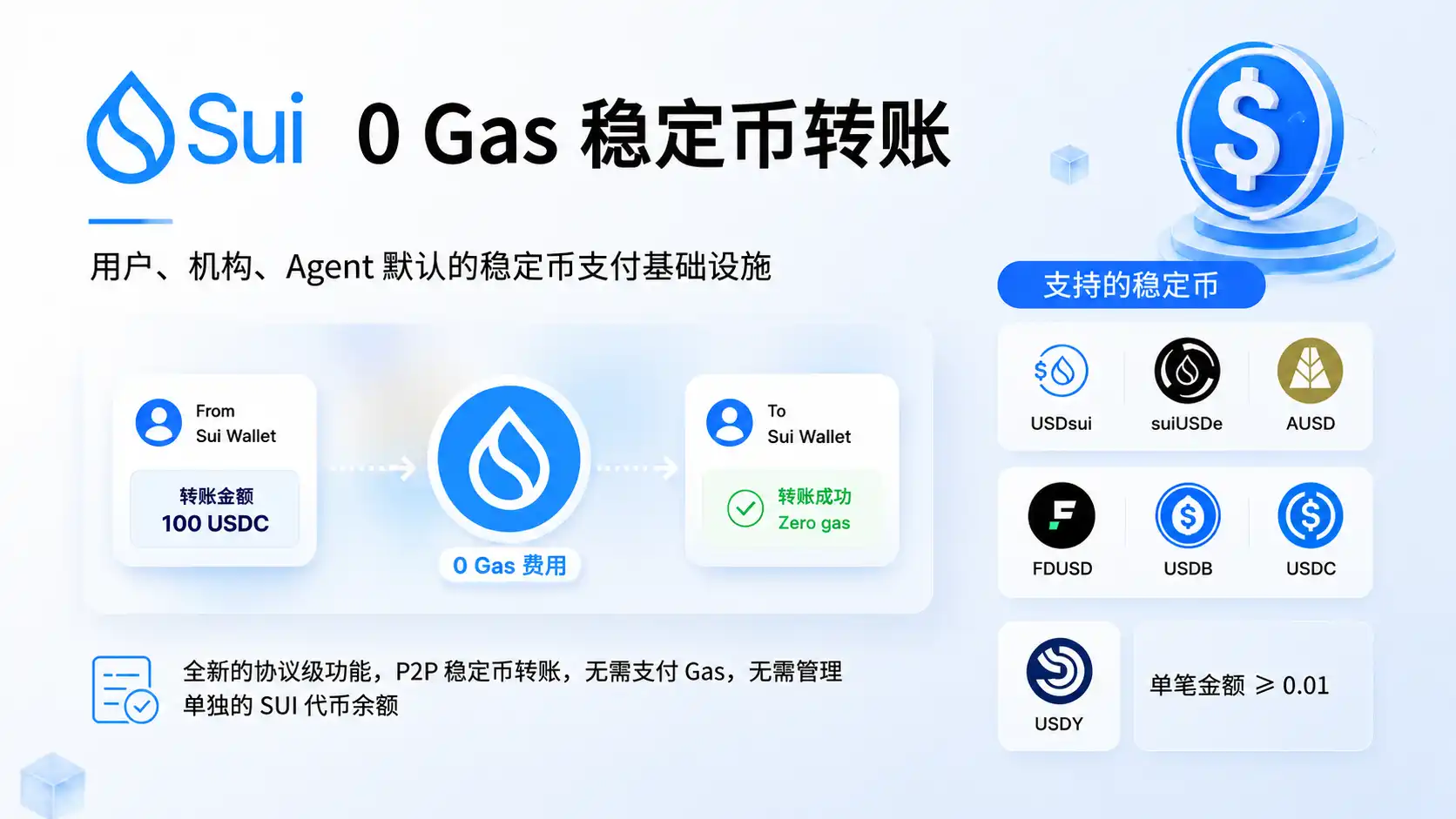
When Transfers Become Truly Frictionless: How Sui Uses 'Zero Gas' to Become the Underlying Infrastructure for Stablecoin Payments

Title: Sui Launches Zero-Gas Stablecoin Transfers to Become the Foundation for Stablecoin Payments Sui has introduced a zero-gas fee feature for peer-to-peer stablecoin transfers, eliminating the need for users or businesses to hold separate SUI tokens to pay transaction costs. This innovation, built on a new underlying account architecture called Address Balances, significantly reduces validator processing costs for eligible transactions. Currently, the feature applies to a whitelist of stablecoins for transfers meeting a minimum amount, effectively preventing spam. This development aims to unlock mainstream payment use cases for stablecoins—such as everyday purchases, remittances, and subscriptions—by removing cost and complexity barriers. It is also positioned to benefit high-frequency micro-payments for AI agents and institutional B2B payments, reducing operational friction. Major custody provider Fireblocks has already announced support. The move follows Sui processing over $1 trillion in stablecoin transfer volume since August 2025. Looking ahead, Sui plans to enhance this infrastructure with protocol-level confidential transactions later in 2026, aiming to provide scalable, free, and privacy-preserving payments. Together, these advancements strengthen Sui's goal of becoming the default settlement layer for stablecoin payments.

marsbit2 дні тому 03:01

When Transfers Become Truly Frictionless: How Sui Uses 'Zero Gas' to Become the Underlying Infrastructure for Stablecoin Payments

marsbit2 дні тому 03:01

Blockchain has finally begun sailing toward the main channel after 18 years

After 18 years of development, blockchain technology is beginning to move from a specialized niche into mainstream adoption, according to a recent industry analysis. The shift is reflected in the changing strategies of major crypto venture capital firms, which are expanding their focus beyond pure "digital ownership" towards broader themes like "autonomy." The report highlights that leading VC firms like Variant, Paradigm, Haun Ventures, and YZi Labs are broadening their investment mandates to include not only crypto but also artificial intelligence (AI), robotics, biotech, and other frontier technologies. This reflects a recognition that the isolated "crypto investment" narrative is losing appeal to limited partners (LPs) as capital and attention increasingly flow toward AI and other high-growth tech sectors. A key emerging thesis is that blockchain's most significant future application may not be as a consumer-facing product, but as the underlying economic and settlement infrastructure for the AI era. As AI agents and autonomous systems become more prevalent, they will require programmable, global, and low-cost payment networks (like stablecoins), verifiable digital identities, and secure wallets to manage transactions and assets on behalf of users. The investment by stablecoin issuer Tether into robotics company NEURA, with plans to integrate its wallet technology, is cited as a prime example of this convergence. However, the article cautions that simply labeling projects as "AI + Crypto" is insufficient. True value lies in integrations where blockchain technology is essential—such as enabling machine-to-machine micropayments, verifiable data provenance for AI, or transparent governance for autonomous organizations—rather than being a superficial marketing add-on. In conclusion, while AI currently dominates the tech narrative and capital flows, it may ultimately create the real-world, high-frequency demand that the crypto industry has long sought. For crypto VCs and projects, the path forward is to position blockchain not as a competing sector, but as a critical foundational layer powering autonomy and economic activity in an AI-driven future.

链捕手06/15 10:04

Blockchain has finally begun sailing toward the main channel after 18 years

链捕手06/15 10:04

Claude Requires ID Verification and Facial Recognition? The Facial Recognition Requirement is an Old Story from Two Months Ago, and "Sharing Data with Police" is a Misinterpretation

Anthropic's updated privacy policy, effective July 8th, has sparked misinterpretations in Chinese social media, primarily concerning new identity verification and data sharing with law enforcement. A detailed comparison reveals these claims are largely unfounded. First, identity verification (including submitting government ID and a live selfie via third-party provider Persona) is not a new July policy. This mechanism was actually implemented in mid-April 2026 for certain high-use or flagged accounts, particularly Claude Max subscribers. The July update merely formally documents this existing practice in the policy text under a new "Verification Data" section. Second, the widespread claim that the new policy lowers the threshold for sharing user data with law enforcement is incorrect. Comparing the new text with the old version (dated September 28, 2025) shows no substantive tightening. While the new policy more clearly structures the conditions for disclosure—including having a "good-faith belief" it's necessary for legal compliance, preventing harm, fraud detection, or enforcing terms—the old policy already allowed Anthropic to disclose data based on its judgment for similar reasons (e.g., protecting safety, preventing fraud, or complying with law). The term "good-faith belief" acts as a limiting standard, not a lowered barrier. A 2025 court case where Anthropic resisted disclosing user data in a copyright lawsuit further demonstrates the complexity of such standards. The policy's actual substantial changes address data flows for Claude's Agent capabilities. New clauses clarify that when users connect third-party services or instruct Claude to perform multi-step tasks (reading files, sending messages), their inputs, outputs, and instructions are shared with those third parties, governed by the third parties' own policies. This update fills a compliance gap for Claude's evolving functionality beyond simple Q&A. Other additions include a "Research Participation Data" section and refined marketing legal bases. Anthropic reaffirms core commitments: not selling user data, keeping Claude ad-free, and allowing users to control if chats are used for model training. Overall, this update is primarily a compliance catch-up to existing product features, not a significant new privacy tightening. The heightened concern stems from conflating April's verification rollout, standard legal clauses, and the genuine new provisions regarding Agent tasks.

marsbit06/15 08:55

Claude Requires ID Verification and Facial Recognition? The Facial Recognition Requirement is an Old Story from Two Months Ago, and "Sharing Data with Police" is a Misinterpretation

marsbit06/15 08:55

Why 'AI Service Subscription' Is Destined to Die Out?

"Why 'AI Service Subscription Models' Are Doomed to Disappear" The article argues that the flat-rate subscription model for AI services is fundamentally unsustainable. It points to recent industry shifts, such as Anthropic limiting access to its flagship Claude Fable 5 model for subscribers after just 14 days, and GitHub and OpenAI moving towards credit-based or usage-based billing. The core problem is that subscription models rely on a capped human consumption limit—like watching videos or listening to music—which keeps costs predictable. However, the rise of autonomous AI agents shatters this premise. Agents can consume 5 to 30 times more computing resources (tokens) than a human chatting, and they operate continuously without user presence. This removes the natural usage cap, making fixed-price plans financially unviable as heavy users incur massive costs. Attempts to patch the model with higher tiers or usage caps have failed, often leading to "adverse selection" where only the heaviest users subscribe. The industry's solution is to hollow out subscriptions, replacing "unlimited" access with prepaid credits charged per token, akin to a utility meter. While chat-based subscriptions may linger, the real value and revenue are shifting to pay-as-you-go models. The current period represents a final, heavily subsidized phase for users. The conclusion is that the soul of subscription—a fixed price for worry-free use—is dying, soon to be replaced by pure usage-based pricing where everyone pays for their own "electricity meter."

marsbit06/15 03:23

Why 'AI Service Subscription' Is Destined to Die Out?

marsbit06/15 03:23

IC3 Top Universities Collaborative Analysis: Is AI x Crypto the Real Future or Just a Narrative Bubble?

IC3 researchers from leading universities analyze the convergence of AI and crypto. They argue meaningful integration is still nascent, with hype often outstripping progress. The report frames AI as a "translation middleware" making blockchain accessible, while crypto serves as a "trust middleware" via tools like ZK proofs and TEEs for integrity, availability, and confidentiality. Two main directions are examined: 1) **Crypto x AI**: Using AI to enhance blockchain via analysis (fraud detection), algorithmic design, and AI oracles (with accuracy varying by task). New risks include AI-driven malicious smart contracts. 2) **AI x Crypto**: Using crypto to enhance AI via decentralized infrastructure (DePIN), data markets, agent micropayments, governance, and securing AI pipelines (training/federated learning, secure inference). The "Protected Pipeline" (Props) framework combines oracles and trusted computation for secure use of private data. Key challenges are highlighted: The industry must rigorously prove decentralized AI's cost competitiveness and crypto's utility for agent payments. Major research gaps include providing systemic security for autonomous agents and addressing novel threats like unstoppable AI agents. The report concludes by debunking five common misconceptions: blockchain cannot inherently detect AI content, solve algorithmic bias, grant true AI autonomy, ensure AI trustworthiness through mere transparency, or guarantee that decentralization is always cheaper for AI tasks. The field remains in an early, evidence-seeking phase.

marsbit06/11 00:12

IC3 Top Universities Collaborative Analysis: Is AI x Crypto the Real Future or Just a Narrative Bubble?

marsbit06/11 00:12

From ChatGPT to Capital War: What Crypto Opportunities Are Hidden Behind OpenAI's Sprint Toward IPO?

From ChatGPT to Capital Wars: Hidden Crypto Opportunities Behind OpenAI's IPO Push On June 9th, OpenAI confirmed it has confidentially filed for an IPO with the U.S. SEC, alongside revealing a long-term roadmap aiming for AI to handle most of its own R&D by 2028. This move signals a shift in the AI industry from technological competition to a capital-intensive race, potentially evolving into an ecosystem war. For the crypto market, this event could mark the beginning of a new funding narrative. OpenAI's transformation from a non-profit research lab in 2015 to a commercial behemoth was catalyzed by ChatGPT's explosive growth in 2022. Its business now spans consumer AI assistants, enterprise APIs, and critically, massive AI infrastructure requiring trillions in investment by 2030. The core driver for the IPO is the immense cost of the AI arms race, primarily for GPU compute power for training and inference. With rivals like Anthropic also filing to go public and giants like Google and Meta investing heavily, competition is intensifying around capital, compute, and ecosystem scale. The crypto market, whose cycles have often been fueled by external narratives like DeFi and NFTs, may see a refocus towards "AI means of production." Key beneficiaries could include decentralized compute networks (e.g., Render, Akash) addressing GPU scarcity, AI Agent platforms enabling autonomous task execution, and projects tokenizing AI infrastructure/assets (AI x RWA). However, an OpenAI IPO could also create a capital drain from crypto, favoring projects with substantive utility over mere hype. Ultimately, OpenAI's IPO signifies AI's entry into a new era defined by resources. In this coming "gold rush," the biggest winners in crypto may be those providing the essential picks and shovels—the foundational compute, data, and economic layers for the AI age.

marsbit06/10 04:32

From ChatGPT to Capital War: What Crypto Opportunities Are Hidden Behind OpenAI's Sprint Toward IPO?

marsbit06/10 04:32

活动图片