Survey Shows Institutions Want Solana Over XRP And Dogecoin, Here Are The Figures

bitcoinistPublished on 2026-03-27Last updated on 2026-03-27

Abstract

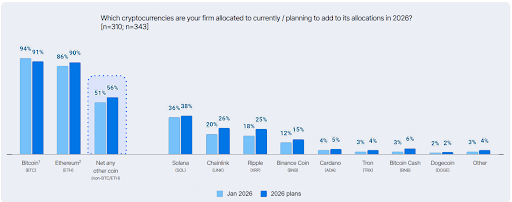
A recent survey by Coinbase and EY-Parthenon reveals that institutional investors are more heavily allocated to Solana (SOL) than to XRP and Dogecoin (DOGE). As of January 2026, 36% of surveyed institutions held SOL, with 38% planning to increase their allocation. In contrast, only 18% held XRP and a mere 2% held DOGE. This preference for Solana places it just behind Bitcoin and Ethereum in institutional portfolios. However, this trend contrasts with the current ETF market data, which shows XRP ETFs leading in net assets at $949.15 million, compared to $849.65 million for Solana ETFs and $9.12 million for Dogecoin ETFs. The survey also indicates a growing institutional preference for gaining crypto exposure through ETFs rather than holding spot crypto directly, with 66% using ETFs as of January 2026, up from 64% a year earlier.

A recent survey by Coinbase and EY-Parthenon shows that institutional investors are more allocated to Solana over XRP and Dogecoin. This contrasts with the current trend in spot crypto ETFs, where XRP ETFs boast more net assets than SOL and DOGE ETFs.

Institutions Are More Invested In Solana Than XRP And Dogecoin

The survey shows that more institutions are investing in Solana than XRP and Dogecoin. 36% of these participants had allocations to SOL as of January 2026, while 38% plan to add to their allocations. Meanwhile, 18% allocated to XRP as of January, while 25% plans to add the token to their allocations this year.

Dogecoin is far behind Solana and XRP, with 2% of these institutions investing in DOGE as of January 2026, while 2% plan to add the meme coin to their allocations. It is worth noting that SOL is only behind Bitcoin and Ethereum and is well ahead of Chainlink, Binance Coin, Cardano, Tron, and Bitcoin Cash.
Source: Chart from Cftassets

This survey contrasts with the current trend among crypto ETFs, showing that investors allocate more to XRP ETFs than to Solana and Dogecoin ETFs. SoSoValue data shows that the XRP ETFs currently boast net assets of $949.15 million, representing 1.14% of the XRP’s market cap. Meanwhile, the Solana and Dogecoin ETFs boast net assets of $849.65 million and $9.12 million, respectively.

Furthermore, the XRP ETFs have seen more inflows since they launched than the Solana and Dogecoin ETFs. The XRP ETFs currently boast total net inflows of $1.21 billion, while the SOL and DOGE ETFs have seen inflows of $993.38 million and $7.64 million, respectively.

Institutions Holding Spot ETFs Over Spot Crypto

The survey also showed that most of these institutions are gaining crypto exposure through the crypto ETFs rather than holding spot crypto. As of January 2025, 64% of these institutions held spot crypto ETFs to gain exposure to Solana, XRP, Dogecoin, and other digital assets. This figure has climbed to 66% as of January 2026, signaling that more institutions are investing in crypto amid regulatory clarity.

Furthermore, 39% of these institutions held spot crypto as of January 2025. However, this figure has decreased to 36% as of January 2026, suggesting that institutions prefer to gain crypto exposure through an ETF wrapper rather than holding crypto directly. These institutions have also been seeking crypto exposure through the digital asset treasury companies (DATs). As of January 2025, 51% of these institutions invested in these DATs, and that figure increased to 53% as of January 2026.

At the time of writing, the XRP price is trading at around $1.36, down over 2% in the last 24 hours, according to data from CoinMarketCap.

SOL trading at $85 on the 1D chart | Source: SOLUSDT on Tradingview.com

Trending Cryptos

Related Reads

Prime Minister Backing, SBI's "Shopping Spree," Lawson's Pilot: Japan Seizing the Compliance Dividend in Crypto

Japan is moving decisively to establish itself as a leader in the compliant crypto ecosystem through a coordinated national strategy. This commitment is underscored by consistent high-level political support, with successive prime ministers addressing the WebX conference to promote regulatory reform and position Web3 as a core industry. The financial giant SBI Holdings is executing a strategic, multi-billion dollar investment spree to build a comprehensive infrastructure stack. Key moves include acquiring the major exchange Bitbank, investing in core infrastructure firms like Gauntlet and EDX Markets, and forming "SBI Solana Global" to develop a yen-denominated stablecoin (JPYSC) and tokenized assets on the Solana network. Concurrently, a pilot by convenience store chain Lawson will test stablecoin payments in a real-world retail setting. The Japanese approach combines high regulatory barriers, which limit competition, with strategic capital from established financial conglomerates (zaibatsu) rather than standalone crypto firms. Upcoming tax reforms, planning to slash crypto capital gains tax from 55% to 20%, are designed to attract domestic savings. This integrated model—strict licensing, deep-pocketed traditional finance, real-world use cases, and favorable taxation—creates a formidable, closed-loop system for early entrants like SBI. It offers a potential blueprint for other jurisdictions seeking to formalize their crypto industries, signaling a shift from regulatory arbitrage to a race for compliance and legitimacy.

marsbit26m ago

Prime Minister Backing, SBI's "Shopping Spree," Lawson's Pilot: Japan Seizing the Compliance Dividend in Crypto

marsbit26m ago

An AI Uncovers a 15-Year-Old Linux Vulnerability in 5 Seconds, While Another AI Turns an Innocent Journalist into a Car Thief Suspect

AI Discovered a 15-Year-Old Linux Bug but Also Wrongly Targeted a Journalist An AI security tool, VEGA, identified "GhostLock" (CVE-2026-43499), a severe Linux kernel vulnerability hidden for 15 years since 2011, affecting nearly all distributions. Exploiting a flaw in the kernel's lock management, an attacker could gain root privileges in about 5 seconds from a standard user account. This demonstrates AI's growing ability to find complex bugs humans missed. In a stark contrast, another AI system caused a dangerous police confrontation. Automotive journalist Joel Feder was surrounded by four police cars after Flock Safety's automated license plate recognition (ALPR) cameras mistakenly flagged his vehicle. The error originated from a typo in a national stolen vehicle database ("34 03 DTM" was entered as "34 DTM"). Feder's manufacturer plate, "34 10 DTM," was misread due to its small font, triggering a nationwide alert. Police, with hands on holsters, detained Feder for an hour before resolving the mistake. The two cases highlight the dual nature of AI in security. On one hand, it can efficiently uncover critical software vulnerabilities, enhancing safety. On the other, it can exponentially amplify human errors—like a simple data entry mistake—when deployed in automated, large-scale surveillance systems without adequate human oversight. The incident underscores the critical need for robust review mechanisms in AI-driven decision systems, especially in high-stakes areas like law enforcement. The greatest vulnerability in the AI era may not be in code, but in the unchecked delegation of final judgment to automated processes.

marsbit51m ago

An AI Uncovers a 15-Year-Old Linux Vulnerability in 5 Seconds, While Another AI Turns an Innocent Journalist into a Car Thief Suspect

marsbit51m ago

Is Ethereum Truly a "World Computer"?

Ethereum has long been branded as a "world computer," yet its current infrastructure reveals significant geographic concentration, challenging this claim. An analysis of validator node distribution shows the network heavily leans toward Western nations. The U.S. alone hosts 38.19% of all validators, while Germany accounts for 13.04%, meaning these two countries comprise over half the network. Notably, a substantial portion of U.S. validators are residential nodes run from home connections, reflecting grassroots participation. In contrast, representation from Asia, South America, the Middle East, and Africa is minimal. Examining only professionally-operated institutional validators shows a more balanced picture, with countries like Singapore, Hong Kong, Japan, and South Korea collectively reaching nearly 25%. This shift indicates strategic institutional deployment to meet local regulatory requirements and reduce latency for regional users. A core problem is Ethereum's peer-to-peer gossip protocol, which systematically disadvantages regions with low node density. Late message arrival reduces a node's "peer score," pushing it to the network's periphery, further delaying future messages. This can impact validator rewards and network performance in these areas, posing a challenge to decentralization. However, this geographic imbalance also presents a significant opportunity. For Ethereum to truly become a global settlement layer, localized infrastructure is essential. Pioneering reliable validator operations in underserved regions like the Middle East, South America, or Africa could establish a crucial first-mover advantage, meeting growing demand for compliant, low-latency staking services in these markets.

marsbit1h ago

Is Ethereum Truly a "World Computer"?

marsbit1h ago

Trading

Spot

Hot Articles

What is XRP 2.0

XRP 2.0: A New Frontier in the Cryptocurrency Landscape Introduction to XRP 2.0 In the ever-evolving realm of cryptocurrency, new projects continuously emerge, vying for attention and adoption. One such promising initiative is XRP 2.0, a novel cryptocurrency project designed to leverage advanced blockchain technology and robust encryption methodologies. While the name draws parallels with Ripple’s XRP, it’s crucial to note that XRP 2.0 operates independently, focusing on enhancing transaction security, privacy, and scalability. As the digital financial landscape increasingly embraces decentralized solutions, XRP 2.0 aims to contribute meaningfully to web3 and the overall expansion of crypto projects. What is XRP 2.0? At its core, XRP 2.0 is a cryptocurrency project that aims to create a secure and decentralized digital currency ecosystem. Its foundational technology integrates sophisticated blockchain principles with cutting-edge encryption techniques. The overarching goal of XRP 2.0 is to establish itself as a reliable and efficient platform enabling swift transaction execution while prioritizing enhanced privacy protections for its users. The project is promoted as a solution to many limitations faced by existing cryptocurrencies, proposing a system that can handle a higher volume of transactions with improved speed and privacy. This versatility positions XRP 2.0 as a significant contender in a marketplace riddled with various digital currencies. Who is the Creator of XRP 2.0? The identity of the creator behind XRP 2.0 has been flagged as ‘Wilbur.’ However, comprehensive details regarding Wilbur or their associated entity remain elusive. The anonymity of many cryptocurrency creators is not an uncommon phenomenon in the industry, often designed to maintain a degree of privacy and security. Who are the Investors of XRP 2.0? As of now, specific information related to the investment foundations or organizations supporting XRP 2.0 is not publicly available. In the cryptocurrency sector, the backing by reputed investors can significantly influence a project's credibility and success, yet the transparency regarding the financial supporters of XRP 2.0 has not been established. How Does XRP 2.0 Work? XRP 2.0 stands out by employing a combination of blockchain technology and advanced encryption algorithms that ensures secure and decentralized transactions. Its innovative structure includes unique features designed to foster user engagement and broaden functionalities beyond conventional cryptocurrency transactions. Among these features, XRP 2.0 incorporates AI-powered capabilities, such as text-to-image and text-to-speech functionalities. These additions are designed to enhance the interactive experience for users, promoting broader applicability across various sectors. By bridging technological advancements with user-centered design, XRP 2.0 aims to capture the attention of a diverse range of individuals and enterprises looking to integrate cryptocurrency solutions into their operational frameworks. Timeline of XRP 2.0 Understanding XRP 2.0 requires examining the milestones that have defined its journey thus far: July 23, 2023: XRP 2.0 is introduced as a novel cryptocurrency project, aiming to revolutionize secure and decentralized transaction capabilities in the blockchain domain. September 8, 2023: The launching of another project, XRP20, occurs, marking the emergence of an ERC-20 token on the Ethereum blockchain that remains unrelated to XRP 2.0. November 13, 2023: The XRP Ledger undergoes a significant update with the release of rippled server software version 2.0.0. It is essential to note that this development is disconnected from the XRP 2.0 cryptocurrency project. Key Points About XRP 2.0 To distill the essence of XRP 2.0, several critical factors emerge: Unique Features: The inclusion of features like AI-powered text-to-image and text-to-speech further diversifies the potential applications of XRP 2.0. Blockchain Technology: The framework utilizes advanced blockchain mechanisms and encryption protocols, ensuring a secure and decentralized environment for transactions. Scalability and Privacy: XRP 2.0 prioritizes enhanced privacy protections in transaction processes and the scalability necessary to accommodate a growing user base. No Affiliation with Ripple: Importantly, despite its name, XRP 2.0 does not have any allegiance or collaboration with Ripple’s XRP, distinguishing its operational framework and objectives within the cryptocurrency ecosystem. Conclusion XRP 2.0 represents an ambitious venture into the cryptocurrency sphere, aiming to offer a combination of security, privacy, and efficiency in digital transactions. By integrating sophisticated technologies and user-friendly features, the project sets out to broaden the horizons of what cryptocurrency can achieve in today's digital economy. While the anonymity of its creator and lack of disclosed investors might raise questions for some, XRP 2.0's focus on advanced functionalities and decentralisation enhances its appeal amidst an increasingly crowded crypto market. As the cryptocurrency landscape continues to evolve, XRP 2.0 may yet emerge as a pivotal player in the expansion of secure and scalable blockchain solutions.

1.1k Total ViewsPublished 2024.04.01Updated 2024.12.03

What is XRP 2.0

Discussions

Welcome to the HTX Community. Here, you can stay informed about the latest platform developments and gain access to professional market insights. Users' opinions on the price of XRP (XRP) are presented below.

活动图片