Study Shows Cryptocurrency Usage in Switzerland Twice as High as in Germany

cryptonews.ruPublished on 2026-08-03Last updated on 2026-08-03

Abstract

A study by Bearingpoint reveals Switzerland's cryptocurrency adoption rate is double that of Germany, with 28% of Swiss adults using crypto compared to 14% in Germany. The survey of over 4,000 adults also shows Switzerland leads in viewing crypto as a worthwhile investment (37%) and being open to CBDCs (44%). Experts attribute Switzerland's lead to its early regulatory clarity, notably the DLT Act of 2021, which fostered a mature ecosystem like "Crypto Valley," home to 1,749 blockchain firms. While crypto remains most popular among youth, it complements, rather than replaces, traditional finance. Germany, lagging in retail adoption, is now leveraging its massive banking network—serving tens of millions—to integrate crypto services and potentially close the gap. The future will show if Germany's scale can match Switzerland's head start.

In a Bearingpoint survey, the results of which were published on July 30, more than 4,000 adults in Germany, Austria, and Switzerland were interviewed. Austria was in the middle: 18% of respondents reported using cryptocurrency at least occasionally, confirming that the gap is not just about interest in digital assets, but also how each market has evolved over time.

YouGov conducted an online poll between June 18 and 29, which involved 2,031 people in Germany, 1,003 in Austria, and 1,001 in Switzerland. The sample was weighted by age, gender, and region, providing a representative picture of the adult population in each country.
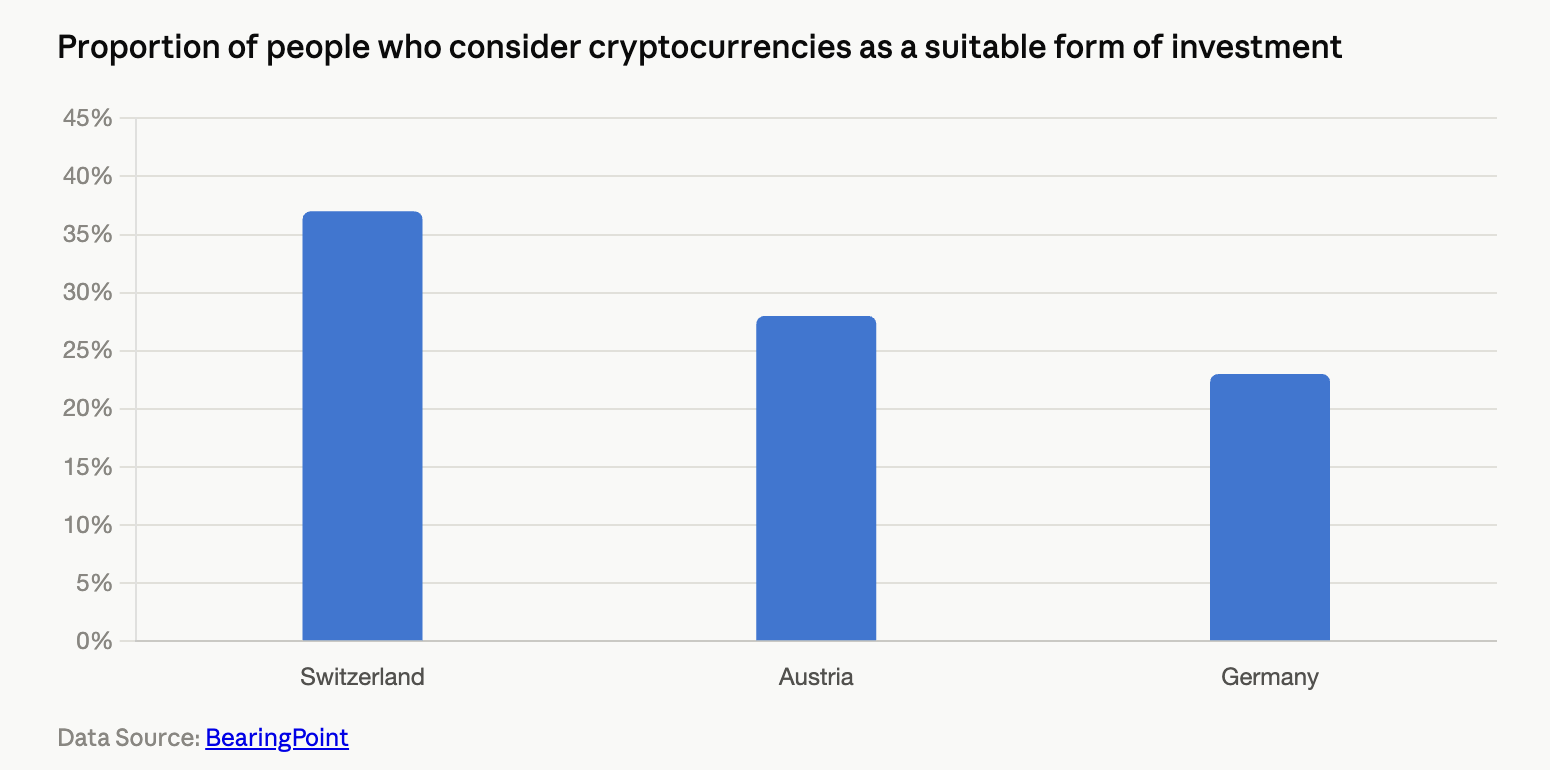
The differences go beyond simple cryptocurrency ownership. In Switzerland, 37% of respondents consider cryptocurrency a profitable investment, compared to 28% in Austria and 23% in Germany. Swiss respondents were also more likely to consider using digital assets as currencies for international trade or reserve currencies: 45% of those surveyed expressed this view compared to 36% in Austria and 32% in Germany. Such metrics typically only appear after people master the technology, not just know of its existence.

Switzerland also led in openness to state-issued digital money. 44% of respondents said they would consider using a central bank digital currency (CBDC), such as a digital franc, in everyday life, compared to 38% in Austria and 29% in Germany. A central bank digital currency is simply a digital version of state-issued money, not a privately issued cryptocurrency.

Dr. Robert Bosch, Global Head of Financial Services at Bearingpoint, stated that the survey results show Switzerland is not just more favorable towards cryptocurrencies, but also more generally ready to adopt digital money. Bosch noted:

"In Germany, they discuss the risks, while neighbors are already actively using digital money and investing more in it."

Early Regulations Laid the Groundwork for Switzerland

Switzerland's leadership reflects decisions made years before today's adoption data. In September 2020, parliament approved the Distributed Ledger Technology (DLT) Act, and this regulatory framework came into full force on August 1, 2021. Distributed ledger technology (DLT) is a shared record-keeping system that allows blockchain networks to securely record and verify transactions.

Instead of developing a completely new crypto law, Switzerland updated existing financial and civil legislation. The amendments clarified how tokenized assets fit into established legal frameworks, settled issues related to bankruptcy proceedings, and introduced licensing for specialized DLT-based trading venues. Such legal clarity tends to attract companies long before it is reflected in consumer surveys.

The timing was crucial. While most of Europe was still figuring out its regulatory framework, Swiss companies were already operating under clear rules. This gave founders, investors, and financial institutions time to build businesses, refine products, and gain practical experience before broader European regulations came into effect.
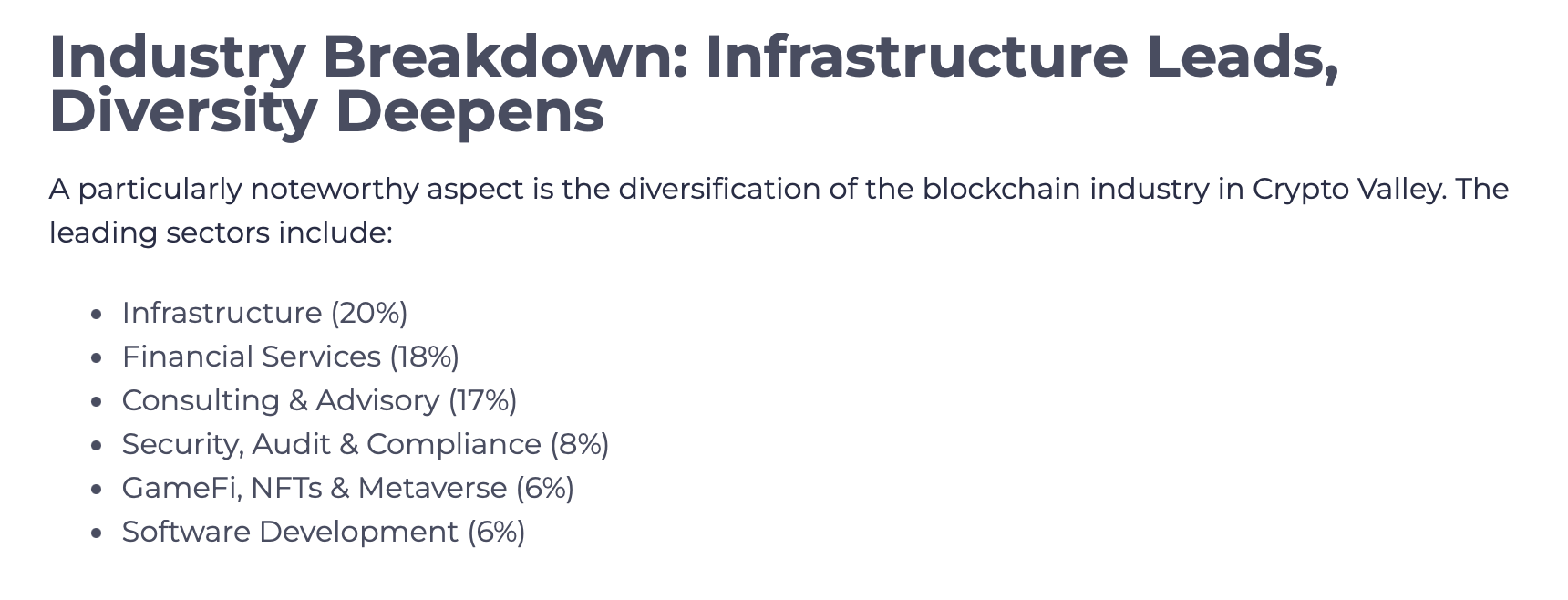
Screenshot from CV VC's "Crypto Valley Company & Industry Report" published in May 2025.

These early decisions also fostered the growth of "Crypto Valley," which spans Switzerland and Liechtenstein. According to a 2024 industry report, the ecosystem comprised 1,749 active blockchain and DLT companies, representing annual growth of 14% and an increase of 132% since 2020.

"Crypto Valley" Creates Its Own Momentum

Zug remains the center of "Crypto Valley," home to approximately 719 companies, or 41% of the ecosystem, while Zurich accounts for about 15%. Additional clusters have expanded in Geneva, Ticino, Lucerne, Neuchâtel, and Liechtenstein, giving blockchain companies access to lawyers, banks, developers, venture funds, and technical specialists without leaving the region.

This concentration creates an advantage that is hard to replicate. As more companies set up offices here, specialized financial services, compliance expertise, and investment capital tend to follow. Switzerland has become home to organizations linked to Ethereum, Cardano, Solana, Polkadot, Tezos, Sygnum Bank, Amina Bank, and Bitcoin Suisse, reinforcing this cycle.
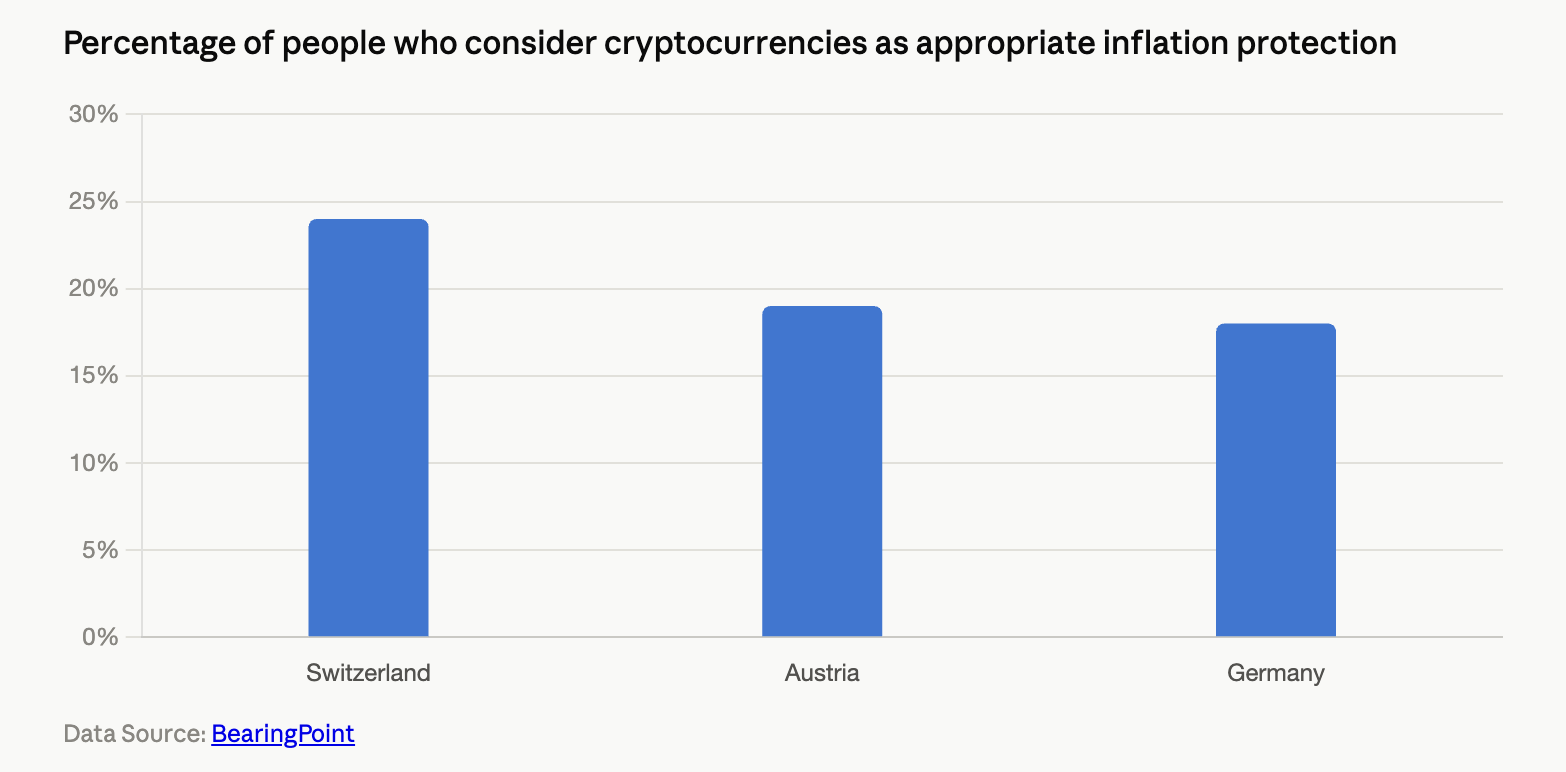
The survey also showed that cryptocurrencies remain most popular among young people, and their usage continues to vary by gender, education level, and income. In Switzerland, 36% of respondents aged 18-24 reported using cryptocurrency, while Austria and Germany showed similar patterns but with lower participation rates. These demographic trends help explain who adopts cryptocurrency first, but they do not explain Switzerland's broader national-level leadership.

Cryptocurrencies Evolve Alongside Traditional Finance

The survey results indicate that digital assets complement traditional financial system (TradFi) habits rather than replace them. From 80% to 87% of respondents in the three countries still consider state-issued currencies effective payment tools, while about 64% of Swiss respondents continue to prefer gold as a hedge against inflation.

This combination is becoming more common. People often view cryptocurrency as just another financial instrument, not an alternative to traditional money, allowing banks and policymakers to expand digital offerings without displacing established financial products.

Germany Counts on Banks to Close the Gap

Germany still lags behind Switzerland in retail cryptocurrency adoption, but its banking sector could change that picture. Cooperative banks linked to DZ Bank and savings banks linked to Dekabank collectively serve around 80 million clients, giving them reach that few crypto platforms can match.

At the end of December 2025, DZ Bank received approval to launch its "meinkrypto" platform, which integrates into the VR Banking app. The service launched with support for Bitcoin, Ether, Litecoin, and Cardano, with asset custody provided by Börse Stuttgart Digital. Individual cooperative banks still have to decide whether to activate this feature.

Dekabank is developing a similar platform for the German Sparkassen network, which serves about 50 million clients. Rollout is expected to continue into 2026, with initial support for Bitcoin and Ether. Integrating cryptocurrencies into familiar banking apps removes one of the biggest hurdles for newcomers, eliminating the need to open accounts on separate digital asset platforms.

Scale of Germany's Banking System Matches Switzerland's Early Lead

Switzerland gained its advantage through regulatory certainty and years of ecosystem development. Germany is pursuing a different strategy, leveraging established banks and existing client relationships to expand access within the European regulatory framework.

This approach gives Germany enormous distribution potential, yet Switzerland still benefits from years of experience, infrastructure, and business concentration. Future Bearingpoint surveys, as well as data on client numbers using German banking platforms, should give a clearer picture of whether the gap will begin to close or Switzerland will continue to solidify its leadership.

end-content

Trending Cryptos

Related Questions

QAccording to the article, what are the two main reasons for Switzerland's significantly higher cryptocurrency adoption rate compared to Germany?

AThe article cites two main reasons: 1) Early and clear regulatory actions, such as the 2020 DLT Act, providing legal certainty years before other European nations. 2) The development of the 'Crypto Valley' ecosystem, which created a self-reinforcing hub for blockchain companies, talent, and capital.

QHow does Germany plan to potentially close the gap in cryptocurrency adoption with Switzerland?

AGermany is relying on its established banking sector. Major cooperative banks like DZ Bank and savings banks via Dekabank are integrating cryptocurrency buying/selling services directly into their existing banking apps used by tens of millions of customers, making access easier for the average person.

QBeyond simple ownership, what other key differences in perception does the survey reveal between Swiss, Austrian, and German respondents?

AThe survey shows Swiss respondents are more likely to view cryptocurrency as a profitable investment (37% vs 23% in Germany) and to consider using digital assets for international trade or as reserve currencies (45% vs 32% in Germany). They also show more openness to central bank digital currencies (CBDCs).

QWhat is the article's assessment of how digital assets relate to traditional finance based on the survey results?

AThe article concludes that digital assets are largely complementing traditional finance (TradFi) rather than replacing it. Most respondents still see state-issued currencies as effective payment tools and value gold for inflation hedging. Cryptocurrency is often seen as another financial instrument to be used alongside traditional ones.

QWhat demographic group shows the highest rate of cryptocurrency use across all three countries surveyed, and what does this suggest?

AYoung adults aged 18-24 show the highest cryptocurrency use (e.g., 36% in Switzerland). This suggests that younger demographics are the earliest adopters, but the article notes this alone does not explain Switzerland's broader national-level leadership in adoption.

Related Reads

Insurance Agent in Hong Kong Loses Over $3.3 Million Due to 'Romantic' Crypto Scam

An experienced Hong Kong insurance agent fell victim to a "romance scam" involving fake crypto investments, losing over HK$26 million (approximately US$3.3 million), according to local police. Authorities reported 25 similar cases of online romance-linked investment fraud in just one week in late July, with total losses nearing HK$70 million. The scam began when an acquaintance introduced the victim to a woman seeking insurance advice. The woman later connected him via WhatsApp to a man nicknamed "Uncle," who claimed to sell cars. Over time, "Uncle" built trust and an online romantic relationship with the victim. He then claimed to have successful investment experience and persuaded the victim to invest in cryptocurrencies, directing him to install a fake crypto investment platform app and introducing a person posing as the platform's owner to "help" manage a crypto wallet. Over roughly six months, the victim personally handed over more than HK$4 million in cash across various Hong Kong locations and transferred nearly HK$22 million to bank accounts provided by the scammers. Suspicion only arose when the fake app showed returns exceeding 800% and withdrawal attempts were blocked. Subsequently, both the "romantic partner" and the supposed expert cut off all contact. Police emphasized that even financially experienced individuals can be defrauded when scammers use emotional pressure and gradually build trust.

cryptonews.ru3m ago

Insurance Agent in Hong Kong Loses Over $3.3 Million Due to 'Romantic' Crypto Scam

cryptonews.ru3m ago

Trading

Spot

Hot Articles

How to Buy T

Welcome to HTX.com! We've made purchasing Threshold Network Token (T) simple and convenient. Follow our step-by-step guide to embark on your crypto journey.Step 1: Create Your HTX AccountUse your email or phone number to sign up for a free account on HTX. Experience a hassle-free registration journey and unlock all features.Get My AccountStep 2: Go to Buy Crypto and Choose Your Payment MethodCredit/Debit Card: Use your Visa or Mastercard to buy Threshold Network Token (T) instantly.Balance: Use funds from your HTX account balance to trade seamlessly.Third Parties: We've added popular payment methods such as Google Pay and Apple Pay to enhance convenience.P2P: Trade directly with other users on HTX.Over-the-Counter (OTC): We offer tailor-made services and competitive exchange rates for traders.Step 3: Store Your Threshold Network Token (T)After purchasing your Threshold Network Token (T), store it in your HTX account. Alternatively, you can send it elsewhere via blockchain transfer or use it to trade other cryptocurrencies.Step 4: Trade Threshold Network Token (T)Easily trade Threshold Network Token (T) on HTX's spot market. Simply access your account, select your trading pair, execute your trades, and monitor in real-time. We offer a user-friendly experience for both beginners and seasoned traders.

12.7k Total ViewsPublished 2024.03.29Updated 2026.06.02

How to Buy T

Discussions

Welcome to the HTX Community. Here, you can stay informed about the latest platform developments and gain access to professional market insights. Users' opinions on the price of T (T) are presented below.

活动图片