AGIBot Removes Chief Scientist Luo Jianlan from Its Leadership Page

marsbitPublished on 2026-08-03Last updated on 2026-08-03

Abstract

Zhiyuan Robot's executive team has seen a change. The name of former Chief Scientist **Jianlan Luo** is no longer on the official website's latest list of partners. Previously listed as a Partner, Senior Vice President, and Chief Scientist, his personal profiles now only mention his role as an assistant professor, omitting any reference to Zhiyuan. This follows earlier social media speculation about his potential departure. If confirmed, Luo's tenure lasted approximately 1 year and 4 months, from April 2025 to August 2026. The timing is notable as it comes shortly after Zhiyuan confirmed its initiation of a Hong Kong IPO process in late July 2026. Neither the company nor Luo has officially announced this change. Luo, a UC Berkeley PhD and former Google X researcher, joined Zhiyuan in April 2025, leading its Embodied AI Research Center and contributing significantly to its research in real-world robot reinforcement learning.

Leadership changes at AGIBot!

Just now, QbitAI discovered that the name of former Chief Scientist Luo Jianlan is no longer present on the latest list of the partner team on the AGIBot official website.
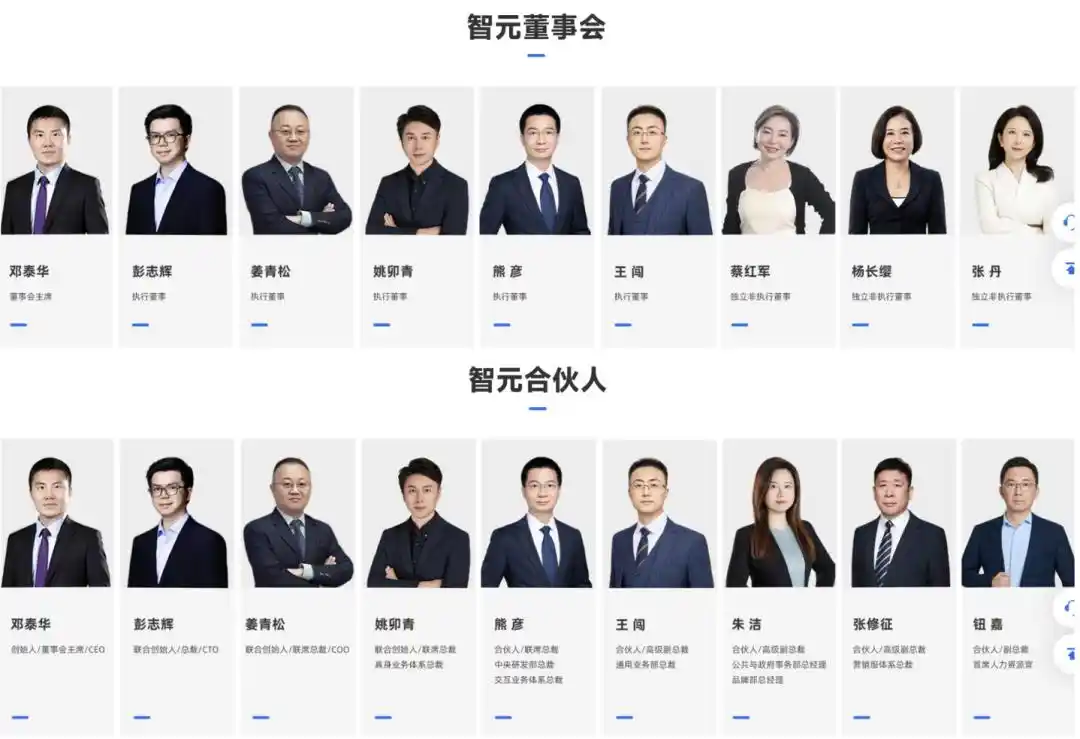
In the previous official website list, Luo Jianlan's title was:

AGIBot Partner, Senior Vice President, and Chief Scientist.

When AGIBot first publicly disclosed its partner team in September 2025, Luo Jianlan appeared on the official website alongside Deng Taihua, Peng Zhihui, Yao Maoqing, and others, holding the title of Partner, Senior Vice President, and Chief Scientist.
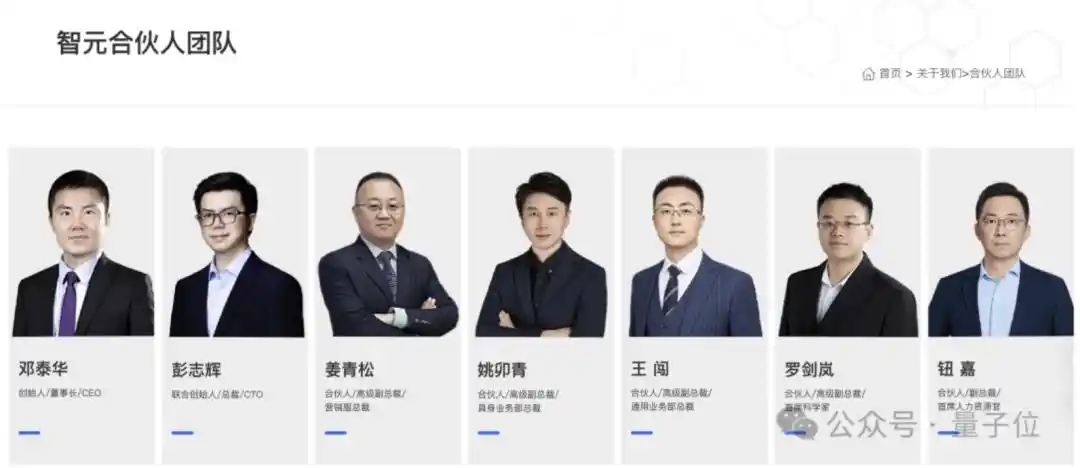
In fact, even before this change to the official website list, there were many rumors on social media about Luo Jianlan's potential departure.

Now, with his name formally disappearing from the AGIBot website, this rumor seems to have gained another layer of corroboration.

Additionally, two other changes are worth noting.

Currently, Luo Jianlan's personal homepage only retains his affiliation as an Assistant Professor at Shanghai Chuangzhi College, with no mention of AGIBot in his personal bio.
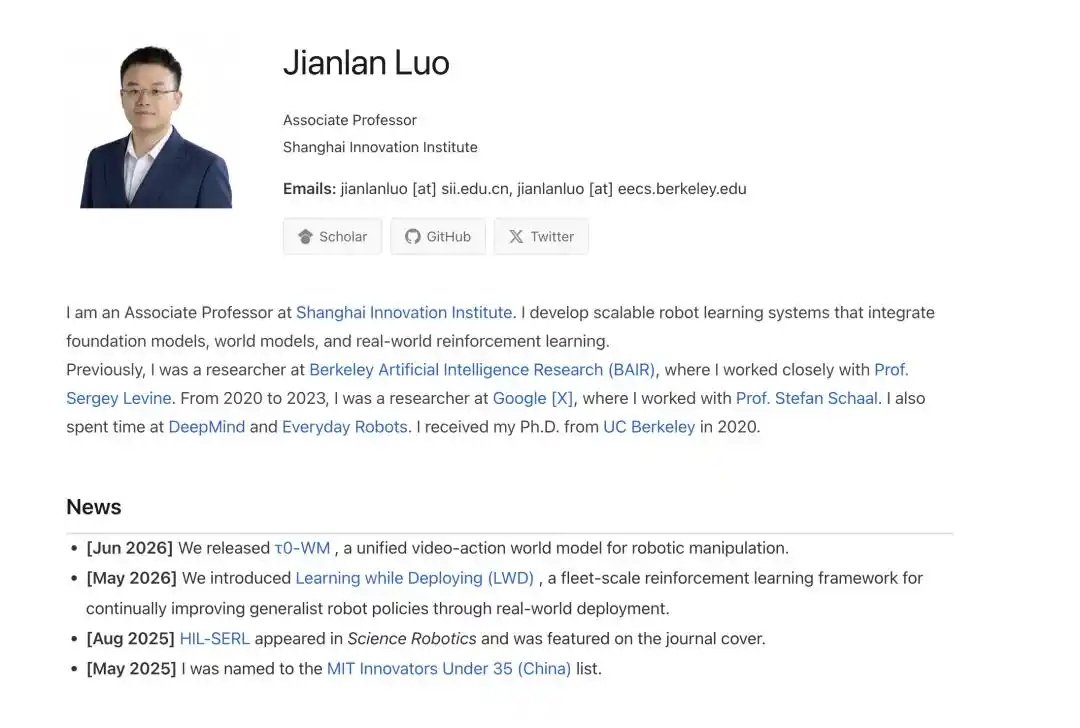
Similarly, his X profile bio does not retain any positions related to AGIBot.
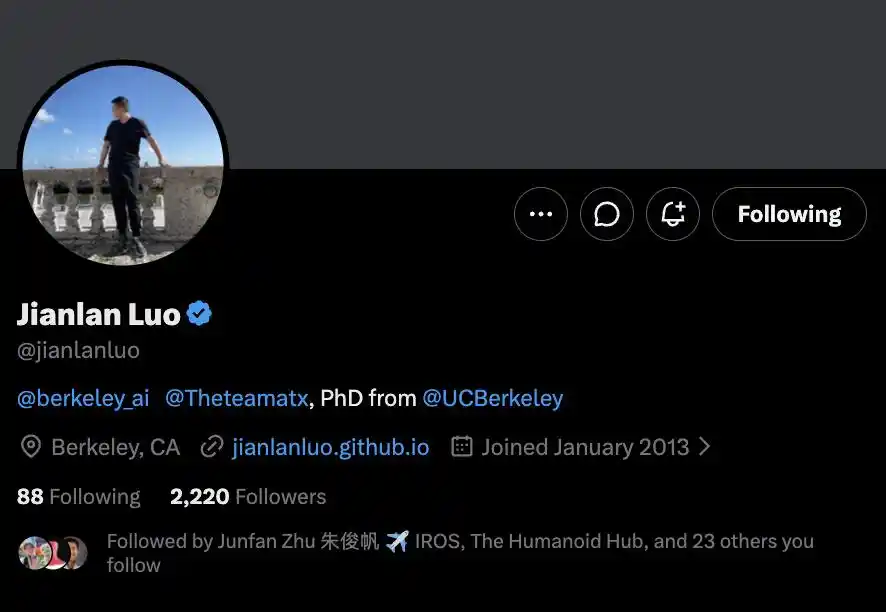
If these changes indeed correspond to an adjustment in his position, then it is highly likely that Luo Jianlan has already left AGIBot.

It is also noteworthy that the timing of this suspected personnel change is rather delicate.

Just recently, on July 24, 2026, AGIBot Innovation publicly confirmed that the company had initiated the process for a Hong Kong IPO.

However, as of the time of writing, neither AGIBot nor Luo Jianlan himself has publicly announced this personnel change. The specific details still await official confirmation.

Tenure of Approximately 1 Year and 4 Months

In April 2025, AGIBot officially announced Luo Jianlan's joining as Chief Scientist.

Simultaneously, the "AGIBot Embodied AI Research Center" he led in establishing was also formally founded, primarily responsible for cutting-edge embodied AI algorithm research and the engineering implementation of related technologies.

Subsequently, Luo Jianlan's position was further elevated to AGIBot Partner, Senior Vice President, and Chief Scientist, joining the company's core management and technical team.

If this departure news is true, from joining in April 2025 to leaving in August 2026, Luo Jianlan's formal tenure at AGIBot lasted approximately 1 year and 4 months.

Notably, just last week, Luo Jianlan was still promoting his work on VLA at AGIBot on X.
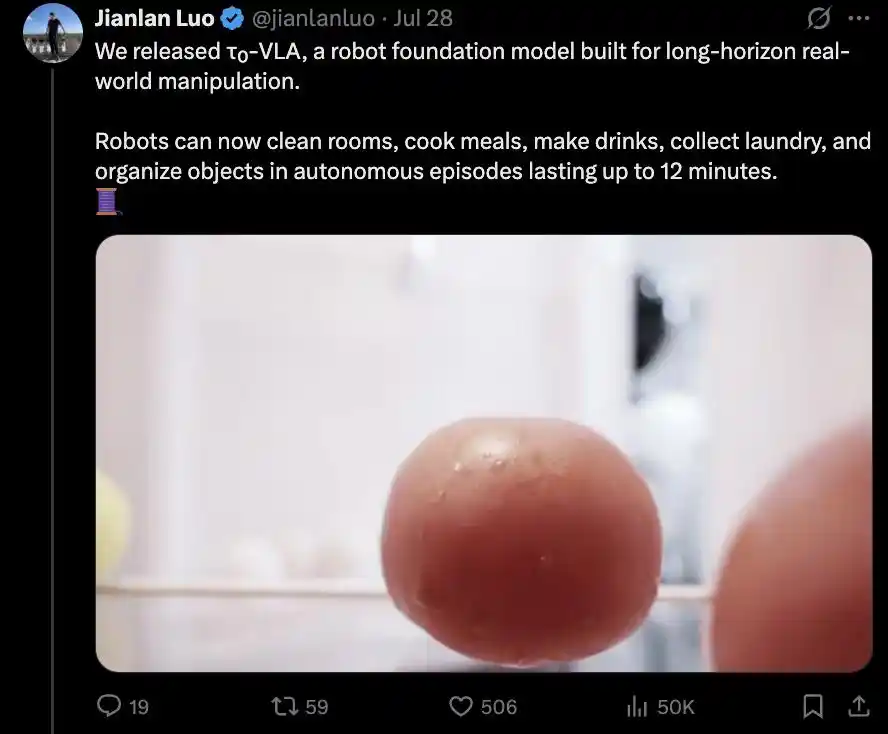
Overall, Luo Jianlan's research directions mainly revolve around robot learning, real-world reinforcement learning, and embodied intelligence. To date, his Google Scholar citation count has reached 8,449.
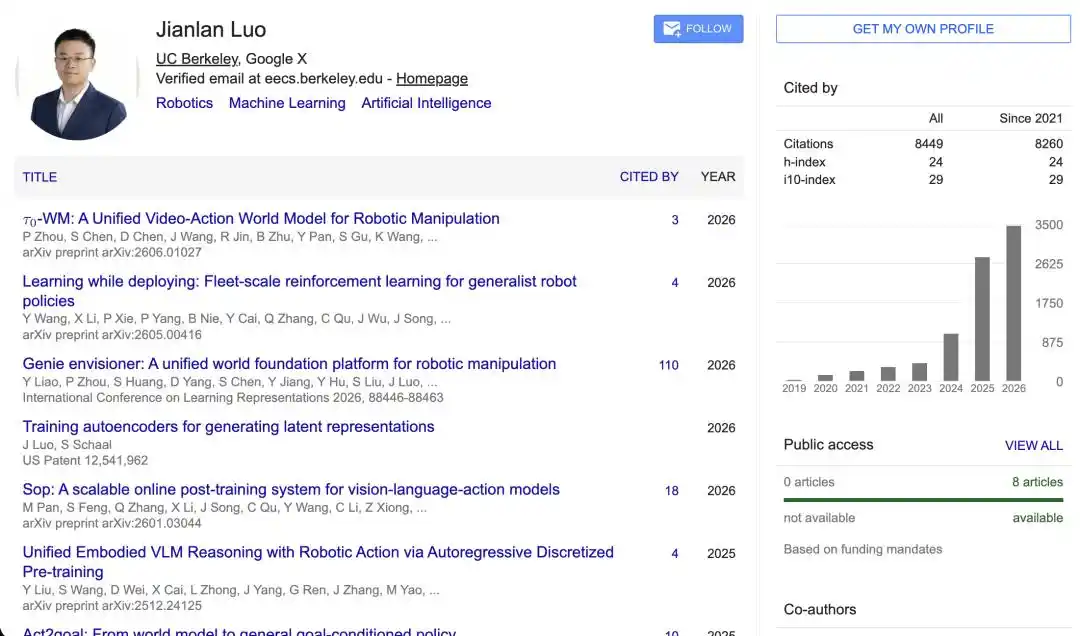
Looking back at Luo Jianlan's academic and research career is also quite impressive.

Luo Jianlan was born in 1993 and received his bachelor's degree from Wuhan University of Technology.

In 2015, he went to UC Berkeley for further studies and obtained his Ph.D. in 2020. During his time at Berkeley, he was advised by robotics luminaries Pieter Abbeel and Alice Agogino.

After his Ph.D., Luo Jianlan joined Google X as a researcher, collaborating with roboticist Stefan Schaal, and also participated in related research at DeepMind and Everyday Robots during his time there.

After leaving Google, he returned to the Berkeley Artificial Intelligence Research Laboratory (BAIR), working as a postdoctoral researcher in Sergey Levine's team, continuing research on real-world robot reinforcement learning.

There, he led the development of SERL and HIL-SERL.

Among these, SERL organized the algorithms, data collection, reward design, and robot control tools required for real-world reinforcement learning into a reusable system.

HIL-SERL further incorporated human intervention: robots explore autonomously most of the time, and only when they are about to fail or encounter difficulty do humans briefly take over. The system then uses these few but crucial corrective data points to continue learning, thereby reducing the reliance on a large amount of human demonstration in real-world reinforcement learning.

In April 2025, when Luo Jianlan officially joined AGIBot, he also brought this accumulated years of real-world reinforcement learning methodology into the company.

During his tenure of over a year at AGIBot, he was almost involved in building the entire research mainline for the company in real-world reinforcement learning, online post-training, and world models.

From promoting real-world reinforcement learning into industrial assembly scenarios, to using systems like SOP and LWD to connect robot deployment, data feedback, and model updates, and to incorporating future prediction and pre-execution evaluation into robot control through projects like τ0-WM, the representative works during Luo Jianlan's tenure, seemingly scattered, actually point towards the same goal:

Making the robot deployment process itself the starting point for the next round of learning.

Reference Links

[1]https://www.agibot.com.cn/company/leadership

[2]https://scholar.google.com/citations?hl=en&user=SJoRNbYAAAAJ&view_op=list_works&sortby=pubdate

This article is from the WeChat public account "QbitAI" (ID: QbitAI), author: Henry.

Related Questions

QAccording to the article, what significant change occurred on the company's official website regarding Luo Jianlan?

AThe latest partner team list on Agibot's official website no longer includes the name of the former Chief Scientist, Luo Jianlan.

QWhat was Luo Jianlan's full title at Agibot Robot before his apparent departure?

AHe held the titles of Partner, Senior Vice President, and Chief Scientist at Agibot Robot.

QFor approximately how long did Luo Jianlan officially work at Agibot Robot, according to the article?

AHe worked at Agibot Robot for about 1 year and 4 months, from his joining in April 2025 to his apparent departure in August 2026.

QWhat is one of the core research directions Luo Jianlan focused on and brought to Agibot Robot?

AHe focused on real-world robot reinforcement learning and brought this research direction to the company.

QWhat major company development was happening around the time of Luo Jianlan's apparent departure, as mentioned in the article?

AAgibot Innovation confirmed in late July 2026 that the company had initiated the process for a Hong Kong IPO.

Related Reads

Once-Popular Web3 Enters Wave of Layoffs

The once-hot Web3 industry is experiencing a severe wave of layoffs. While many companies attribute job cuts to AI-driven restructuring, the primary reason is often financial pressure. The Web3 sector, at the intersection of tech and finance, has been hit particularly hard. Employees at major cryptocurrency exchanges report sudden, impersonal layoffs—often with system access revoked overnight—and minimal or no severance. Common tactics include setting impossible performance targets or terminating employees for minor policy violations. The working atmosphere has become toxic, marked by intense monitoring, excessive meetings, and management obsessed with control and internal politics rather than product innovation. The industry's core business model is collapsing. Exchange revenue from trading fees and listing charges has plummeted due to a decline in quality projects and retail investor exodus. Events like the massive forced liquidation on October 10th further shattered confidence. Competition from on-chain derivatives platforms and prediction markets is intensifying the downturn. As layoffs continue, displaced workers struggle to find new opportunities. Many transition to the AI sector, but face significant bias from traditional finance and even some AI firms, which view crypto industry experience with suspicion. The current downturn appears more structural than cyclical, driven by unsustainable practices, internal strife, and a failure to innovate, raising questions about the industry's future trajectory.

marsbit6m ago

Once-Popular Web3 Enters Wave of Layoffs

marsbit6m ago

Sales Drop 26% But Prices Rise? Xiaomi's Dilemma

Xiaomi, facing a significant 26.3% year-on-year decline in global smartphone shipments in Q2 2026, has implemented its third price hike of the year. On August 2nd, prices were raised for nine models, including the flagship Mi 17 series (up 400-500 yuan) and Redmi K90/Turbo 5 series (up 300 yuan). This move completes a pattern where cost pressure, originating from surging memory chip prices, has climbed from entry-level to mid-range and now flagship products. The primary driver is a severe supply squeeze on consumer-grade DRAM and NAND flash memory, as major manufacturers like Samsung shift advanced capacity to more profitable HBM for AI applications. According to Xiaomi President Lu Weibing, memory prices for the same configuration have skyrocketed nearly fourfold since Q1 2025, adding roughly 1500 yuan to the cost of a mainstream 12GB+512GB phone. IDC estimates consumer memory costs have risen nearly 300% year-on-year. While the price increases hurt demand and contributed to the sales slump, Xiaomi's strategy of reducing entry-level models and upgrading its product mix also played a role. Domestically, its market share in China fell to 12% (5th place), while leaders Huawei and Apple saw shipments grow over 24%. To mitigate future risks, Xiaomi is accelerating its in-house "Surge" chip development and optimizing memory configurations across its lineup. Xiaomi is not alone; major brands like OPPO, vivo, and Apple have already raised prices in 2026, with industry insiders predicting another round of increases (200-800 yuan) in the second half. A full-scale industry-wide涨价 cycle is underway, forcing both manufacturers and consumers to recalibrate their strategies and purchasing decisions amid sustained cost pressures.

marsbit17m ago

Sales Drop 26% But Prices Rise? Xiaomi's Dilemma

marsbit17m ago

Three Consecutive Quarters of Decline: The Crypto Market is Experiencing Its Longest Ebb Since 2022

The cryptocurrency market experienced its third consecutive quarterly decline in Q2 2026, marking its longest downturn since 2022, according to a CoinGecko report. The total market capitalization fell 12.6% to $2.1 trillion, a retreat of roughly 52% from its October 2025 peak. Multiple indicators signal an orderly capital exit from the sector. For the first time since Q3 2023, the total stablecoin market cap shrank (-1.6% to $305.1B), indicating funds are leaving the ecosystem entirely, not just rotating to safer crypto assets. Trading volumes on centralized exchanges dropped 27.9%, while DeFi's Total Value Locked (TVL) plummeted 23.4%. Both Bitcoin (-14.2%) and Ethereum (-25.4%) underperformed traditional risk assets like equities in Q2, breaking from previous correlative narratives. Ethereum saw its first-ever three-quarter losing streak, with its market share falling to around 10%. A few areas saw growth. Prediction market volumes surged 48.7%, largely driven by sports betting. Hyperliquid's HYPE token entered the top 10 by market cap, and tokenized collectibles platforms grew, though primarily via gamified mechanics. Despite a ~9.8% Bitcoin rebound in July, historical trends suggest caution for August. The market, now ~49% below its 2025 high, is undergoing a measured retreat. Its recovery hinges on future Federal Reserve policy and the industry's ability to develop sustainable revenue streams beyond speculation.

marsbit31m ago

Three Consecutive Quarters of Decline: The Crypto Market is Experiencing Its Longest Ebb Since 2022

marsbit31m ago

Trading

Spot
活动图片