Strategy's Preferred Stock STRC Unpegs by 11%, Can Its Perpetual Motion Machine Keep Spinning?

marsbitPublished on 2026-06-20Last updated on 2026-06-20

Abstract

The preferred stock STRC issued by Strategy (MicroStrategy) has depegged over 11% from its $100 target par value, raising questions about the sustainability of the company's capital flywheel strategy. STRC, a perpetual preferred stock designed to trade around $100, serves as a key engine for Strategy's expansion, allowing it to raise fiat currency via at-the-market offerings to buy Bitcoin without diluting common shareholder equity. Its depegging, despite dividend rate hikes, suggests market concerns extend beyond yield to the core stability of Strategy's model. Analysts point to potential leveraged unwinding and, more critically, worries about Strategy's liquidity. While the company cites its massive Bitcoin holdings as covering decades of dividends, a recent small BTC sale—a first—has shaken confidence in its "never sell" narrative. If STRC remains discounted, impairing Strategy's fundraising ability, fears may grow that the company could be forced to sell Bitcoin to meet obligations, potentially turning a major market buyer into a seller and exerting significant downward pressure on Bitcoin's price.

Author | Azuma, Odaily Planet Daily

Strategy's preferred stock, STRC, is experiencing sustained "unpegging."

U.S. stock market data shows that since May 15th, STRC has gradually deviated from its target par value of $100. Recently, the discount has intensified significantly, hitting a low of $83.26 during Thursday's session and closing at $88.59, representing an unpegging of over 11% from the target par value.

For an ordinary stock, an 11% decline might not be a big deal. But for STRC, its persistent deviation from the $100 target par value signals a severe challenge to the product's core design objective.

This is because, in Strategy's original design, STRC was created as an income-oriented security intended to trade around a $100 par value, not a highly volatile speculative asset. The widening gap between market price and target par value is leading more investors to re-examine the logic behind this product.

More importantly, as Strategy continues to expand its Bitcoin reserves, STRC has gradually grown into the company's most crucial financing channel. In a sense, the market pricing of STRC reflects not only investor sentiment towards a preferred stock but also market confidence in Strategy's entire capital operation model.

STRC: The Engine of Strategy's Capital Flywheel

To understand the severity of this unpegging, we must first clarify STRC's product structure and its unique anchoring mechanism.

STRC is an innovative financial derivative instrument launched by Strategy in 2025. Unlike Strategy's common stock, MSTR, STRC is positioned as a perpetual preferred stock with a fixed target par value ($100) and relatively stable dividend income, resembling a fixed-income security.

  • Odaily Note: Strategy founder Michael Saylor recently revealed that STRC was designed with the assistance of AI.

Within Strategy's balance sheet expansion cycle, STRC is not just an ordinary financing tool but the most powerful engine of its current capital flywheel.

Before STRC, Strategy primarily relied on issuing convertible notes and direct common stock offerings to raise funds for Bitcoin purchases. However, both models had limitations—convertible notes were constrained by maturity dates and debt leverage caps, while frequent common stock offerings diluted existing shareholders' equity.

STRC's emergence perfectly addressed this pain point. Its core utility in Strategy's strategy is primarily manifested in two dimensions:

  • Unlimited "At-the-Market" (ATM) Offering Program: As long as STRC's market price remains at or above $100, Strategy can continuously issue new STRC shares in the secondary market through the ATM mechanism, raising fiat currency.
  • Purchasing Power with Zero Equity Dilution: As a perpetual preferred stock, STRC has no legal maturity or principal repayment pressure and lacks the voting rights and residual asset claims of common stock. This means Strategy can create billions in fiat purchasing power out of thin air, channeling it entirely into Bitcoin accumulation, without diluting MSTR shareholder equity or increasing rigid debt interest expenses.

Through the "issue more STRC ➡️ raise fiat ➡️ buy BTC ➡️ increase company net assets ➡️ boost STRC trust" loop, Strategy successfully constructed what seemed like an infinitely cycleable capital flywheel.

However, a key prerequisite for this flywheel's smooth operation is that STRC must trade near its $100 par value. Once the market price falls significantly below $100, based on ATM fundraising terms and market arbitrage logic, Strategy will effectively be unable to absorb funds from the market through the discounted preferred shares, and its entire capital magic trick will factually grind to a halt.

At the design stage, to ensure STRC's secondary market price would consistently adhere to the $100 target par value, Strategy introduced a "monthly dynamic dividend rate adjustment" mechanism. Simply put, when STRC's market price is below $100, Strategy can increase the dividend rate to enhance the product's attractiveness; when the price is above $100, it can lower the dividend rate — in theory, through continuous dividend rate adjustments, STRC should be able to trade long-term around $100.

But now, even though Strategy has raised the dividend to a high of 11.5% and switched the payout frequency from monthly to bi-weekly, STRC's "unpegged" state hasn't been effectively corrected... Why is that?

Unpegging Reasons: Confidence, Confidence, and Still Confidence

The ineffectiveness of dividend corrections means the market is pricing in risks that go beyond STRC's yield itself. From current market discussions, risk concerns are primarily focused on two levels.

First, surface-level technical factors. Some market participants believe the recent decline largely stems from concentrated stampeding due to arbitrage capital deleveraging.

Over the past year, STRC traded consistently around $100, attracting significant yield-seeking arbitrage capital. Such funds often use leverage to amplify returns, capturing both dividend income and price convergence arbitrage. However, as STRC broke below $100 and continued to weaken, some leveraged accounts hit risk control limits, forcing them to sell holdings; price declines then triggered more leveraged capital to unwind, creating a chain reaction. In this process, selling pressure intensified, causing STRC's decline to far exceed what normal supply-demand changes would warrant.

Yet, explaining the current market performance solely through leverage-driven stampeding seems insufficient. For many investors, a deeper concern lies in Strategy's liquidity reserve situation.

Earlier this month, J.P. Morgan released a research report pointing out that Strategy has an annual dividend obligation of approximately $1.7 billion. Based on current cash reserve levels, its cash on hand is only sufficient to cover about 6.3 months of preferred stock dividend payments. This sparked market worries about Strategy's promised future liquidity coverage capability.

In response, Strategy offered a starkly different explanation. The company officially posted on X, emphasizing that if its massive Bitcoin reserves are taken into account, they are sufficient to cover 32 years of dividend payments.
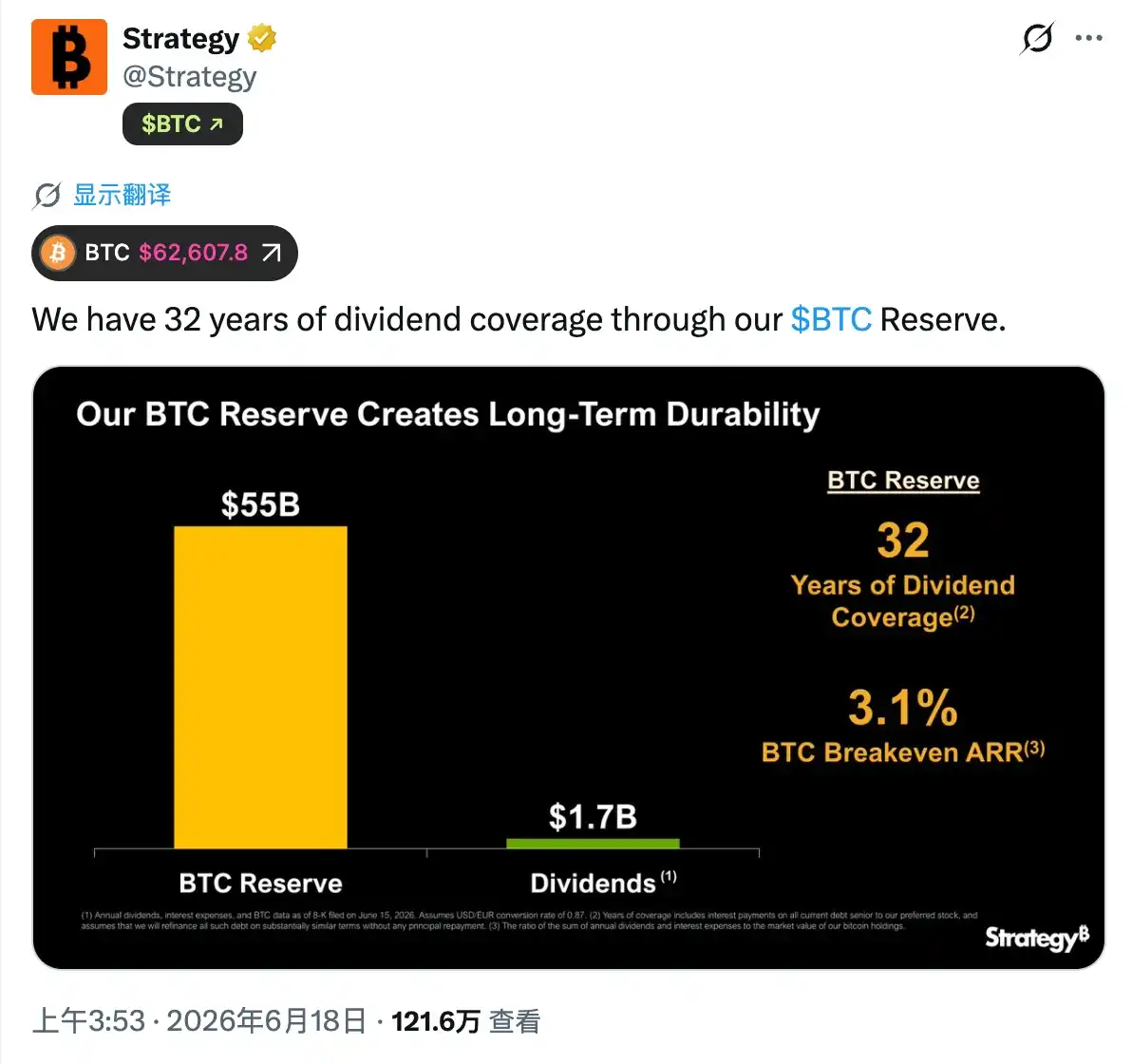
The issue, however, is that these two statements are based on different premises. J.P. Morgan focuses on Strategy's cash position, while Strategy's calculation implies a crucial assumption—if necessary, the company can obtain funds by selling Bitcoin.

This touches on the market's most sensitive nerve. Early this month, Strategy sold a portion of its Bitcoin holdings for the first time. Although the sale involved only 32 Bitcoins and was packaged by the company as "active market desensitization testing," with mention of "buying back more later," it still caused significant market shock. The reason is that over the past few years, Strategy and its founder Michael Saylor have consistently promoted a core narrative to the market—Bitcoin is a long-term strategic reserve asset, and the company will source operational funds through capital market financing, not by selling Bitcoin.

Therefore, when the market witnessed Strategy selling Bitcoin for the first time, it inevitably raised greater concerns—if financing conditions tighten in the future, will Strategy need to rely further on selling Bitcoin to meet dividend obligations? If the answer is not an absolute no, then investors must reassess the risk profile of related securities.

From this perspective, the persistent "unpegging" of STRC reflects the market re-evaluating the robustness of Strategy's entire capital structure.

Strategy's Buying Power Could Turn into Selling Pressure

For Strategy, the biggest impact of STRC's sustained unpegging is the weakening of its financing function.

Over the past few years, Strategy's ability to continuously expand its Bitcoin reserves hinged on a core logic: raising funds from capital markets by issuing stocks, convertible notes, and preferred shares, then using those funds to increase Bitcoin holdings. STRC is precisely Strategy's most important financing tool. When it trades persistently below its $100 target par value, it means the market is demanding higher risk compensation, and Strategy's financing ability consequently faces a temporary shutdown.

Going forward, STRC's re-pegging status may become a crucial indicator for the market to observe Strategy's risk profile. If STRC remains discounted for an extended period, leading to persistently constrained financing ability, while Strategy's cash reserves continue to deplete, market fears about Strategy potentially needing to sell more Bitcoin to meet dividend payments will inevitably intensify.

Once this expectation strengthens, its impact will extend beyond STRC itself. As one of the most significant marginal buyers in the Bitcoin market over recent years, Strategy's financing ability and accumulation pace have profoundly influenced market supply-demand expectations. If Strategy's buying power turns into selling pressure, it could exert unimaginable downward pressure on Bitcoin.


Trending Cryptos

Related Questions

QWhat is the core issue with Strategy's preferred stock STRC, and why is it significant?

AStrategy's preferred stock STRC has experienced a significant 'de-pegging' from its target par value of $100, with its price falling more than 11% below this level. This is significant because STRC is not meant to be a high-volatility speculative asset but a yield-oriented security designed to trade around $100. Its sustained discount threatens the core mechanism of Strategy's capital model, as it undermines the company's primary ability to raise funds through at-the-market (ATM) offerings of STRC, which are only viable when the stock trades at or above $100.

QHow did STRC function as the 'engine' of Strategy's capital flywheel, and what was the critical prerequisite for its operation?

ASTRC functioned as the engine by enabling Strategy to raise fiat currency through continuous at-the-market (ATM) share offerings without diluting the equity of common shareholders (MSTR holders) or incurring fixed debt obligations. The capital flywheel worked as follows: issue more STRC -> raise fiat -> buy Bitcoin -> increase the company's net assets -> boost confidence in STRC. The critical prerequisite for this flywheel to operate smoothly was that STRC's market price had to remain stable around its $100 target par value to facilitate new ATM issuances.

QAccording to the article, what are the two main reasons given for STRC's continued de-pegging despite high dividend adjustments?

AThe two main reasons are: 1) Technical factors involving a deleveraging cascade, where leveraged arbitrage funds were forced to sell their STRC holdings as the price fell below $100, creating a self-reinforcing cycle of selling pressure. 2) A deeper, fundamental loss of market confidence related to concerns about Strategy's liquidity. Investors are worried that if financing becomes tight, Strategy might need to sell its Bitcoin reserves to cover dividend payments, contradicting its long-standing 'hodl' narrative and increasing the perceived risk of STRC.

QWhat was the discrepancy between JPMorgan's analysis and Strategy's own statement regarding the company's ability to cover its dividend obligations?

AJPMorgan's analysis focused on Strategy's cash reserves, concluding they were only sufficient to cover about 6.3 months of preferred stock dividend payments. In contrast, Strategy's official statement argued that if its massive Bitcoin reserves were factored in, the company had enough assets to cover 32 years of dividend payments. The core discrepancy lies in the underlying assumption: JPMorgan considered immediate cash liquidity, while Strategy's calculation assumed the company could and would sell Bitcoin if necessary to generate funds for dividends.

QWhat broader market implication does the article suggest if STRC remains de-pegged and Strategy's financing ability weakens?

AThe article suggests that if STRC remains de-pegged, weakening Strategy's ability to raise new capital, market concerns will intensify that Strategy may be forced to sell portions of its Bitcoin holdings to meet its cash obligations (like dividend payments). As Strategy has been one of the most significant marginal buyers in the Bitcoin market, a shift from being a consistent buyer to a potential seller could create substantial downward pressure on the price of Bitcoin itself, impacting the broader market.

Related Reads

BIT Research: Liquidity is Disappearing, Will Bitcoin Replay the Bottoming Pattern of 2022?

The crypto market is currently in an adjustment phase driven by policy expectations and liquidity shifts. Despite a brief rebound fueled by geopolitical easing and SpaceX's strong IPO performance, unexpectedly hawkish signals from new Fed Chair Kevin Warsh have removed anticipated easing support. Concurrently, stablecoin liquidity is shrinking, with insufficient new capital inflows, pushing the market into a typically quiet summer period. Pricing lacks catalysts for a sustained rally. Daily trading volume has significantly contracted, stablecoin growth has slowed markedly, and the supportive effect of Strategy's (formerly MicroStrategy) STRC preferred stock-financed Bitcoin purchases is fading. Amid policy uncertainty, seasonal weakness, and liquidity contraction, Bitcoin faces near-term downward pressure. Warsh's hawkish pivot and refusal to provide a clear policy outlook have increased risk premiums, historically unfavorable for Bitcoin. Technically, the trend remains bearish below $73,700, with $62,446 as critical support. A break below could accelerate declines, though a prolonged consolidation phase, similar to 2022's bottoming process, is possible. Liquidity is a core constraint. Current daily volume is around $500 billion, roughly 25% of the peak during the July-Oct 2025 rally. The 12-month growth rates for USDT and USDC have fallen to ~20%, with 6-month growth near zero, indicating weak new inflows. Bitcoin ETF and Strategy-driven inflows have also weakened, with a 30-day rolling net outflow. With inflation at 4.2% above the Fed's target, combined hawkish policy, seasonal factors, and liquidity shortages challenge Bitcoin's ability to hold above $60,000. However, this adjustment phase may be forming a cyclical low this summer, potentially setting the stage for the next bull cycle.

marsbit4m ago

BIT Research: Liquidity is Disappearing, Will Bitcoin Replay the Bottoming Pattern of 2022?

marsbit4m ago

Who Makes the Best Use of Claude Code? The Answer Might Not Be Programmers

Claude Code Usage Report Summary (Based on ~400k sessions) Core Finding: In agentic programming with Claude Code, a clear division of labor has emerged: humans primarily decide *what* to build (planning decisions), while Claude decides *how* to build it (execution decisions). Key Insights: 1. **Effectiveness is not limited to programmers.** In code-generation tasks, success rates for users in non-technical fields (law, finance, management, research) are nearing those of software engineers. What matters most is the user's domain expertise and understanding of the problem to be solved. 2. **Domain expertise drives success and efficiency.** Sessions where users exhibited "expert" proficiency in the task's domain saw verified success rates double compared to "novice" sessions. Experts also delegated more work per instruction, with Claude executing more actions and producing more output. 3. **AI is amplifying, not replacing, domain knowledge.** Claude Code lowers the *implementation* barrier, not the *judgment* barrier. The value of knowing the "what" and "why" is increasing relative to just knowing the "how" to code. 4. **Usage is evolving.** Over a 7-month period (Oct '25 - Apr '26), the share of sessions for debugging halved, while use for software operations, data analysis, and non-code writing roughly doubled. The estimated economic value of typical tasks increased by ~25%. Conclusion: The data suggests coding agents are making programming background less critical for completing technical tasks. However, they reward and amplify deep domain understanding. The ability to successfully direct an AI agent stems more from mastery of a specific field than from coding skill itself. The primary gains come from being competent in a domain; deep specialization adds only marginal additional advantage. This may signal a shift where software creation becomes integrated into various professions.

marsbit39m ago

Who Makes the Best Use of Claude Code? The Answer Might Not Be Programmers

marsbit39m ago

Trading

Spot
Futures

Hot Articles

Discussions

Welcome to the HTX Community. Here, you can stay informed about the latest platform developments and gain access to professional market insights. Users' opinions on the price of S (S) are presented below.

活动图片