Strategy’s $76K Cost Basis Emerges As A Key Market Stress Line

bitcoinistPublished on 2026-02-04Last updated on 2026-02-04

Abstract

The key to understanding Bitcoin's current market phase lies in analyzing structural factors rather than short-term price direction. A CryptoQuant report highlights that MicroStrategy's average Bitcoin acquisition price of approximately $76,000 has emerged as a critical structural level for the broader market. This level is significant due to the sheer volume of Bitcoin accumulated at this price point, financed through capital markets via equity issuance and convertible debt. This links Bitcoin's market structure to broader liquidity conditions. The sustainability of this structural demand depends on favorable funding conditions. If Bitcoin's price weakens toward this zone amid tightening liquidity, MicroStrategy's ability to sustain accumulation could be reduced, removing a key source of demand. On-chain data supports a cautious outlook: the Realized Cap has struggled to expand, indicating rotation among existing holders rather than new inflows. The Spent Output Profit Ratio (SOPR) frequently remains below 1, showing short-term holders are realizing losses. Despite this, accumulation continues, with MicroStrategy holding 713,502 BTC at an average cost of $76,052. The market is likely to remain in broad consolidation until spot volume, ETF inflows, and Realized Cap reaccelerate. The $76,000 level is not a guaranteed floor, but a crucial structural test for the market.

The key to understanding Bitcoin’s current market phase is not forecasting short-term price direction, but analyzing structure—where capital is concentrated, how that capital is financed, and whether fresh demand is entering the system. A recent CryptoQuant report shifts the focus away from narratives and toward these underlying mechanics, highlighting Strategy as a central structural reference point.

According to CryptoQuant analyst Maartunn, Strategy’s average Bitcoin acquisition price around $76,000 has emerged as a critical level for the broader market. This price was not intentionally targeted as support, but the sheer volume of Bitcoin accumulated at this level makes it impossible to ignore. As market price gravitates toward this zone, the question is no longer whether Bitcoin is bullish or bearish, but whether the market can absorb supply and hold without exposing deeper stress.

This level also carries significance beyond spot price action. Strategy’s accumulation has been financed through capital markets, including equity issuance and convertible debt, linking Bitcoin’s market structure to broader liquidity conditions. If price weakens toward this area while funding conditions tighten, the sustainability of structural demand comes into focus.

A CryptoQuant analyst notes that leverage in this cycle extends beyond derivatives and into capital markets. Although Strategy is not employing short-term trading leverage, its Bitcoin accumulation has been financed through equity issuance and convertible bonds. This places growing importance on the capital-market window remaining open. If Bitcoin prices and Strategy’s equity weaken simultaneously while funding conditions tighten, the firm’s ability to sustain accumulation diminishes, reducing a key source of structural demand.

On-chain data reinforces this cautious framework. Bitcoin’s Realized Cap has struggled to expand despite large price swings, suggesting rotation among existing holders rather than meaningful new inflows. In this environment, upside moves are more likely to be driven by short covering or temporary liquidity effects than by durable spot demand.

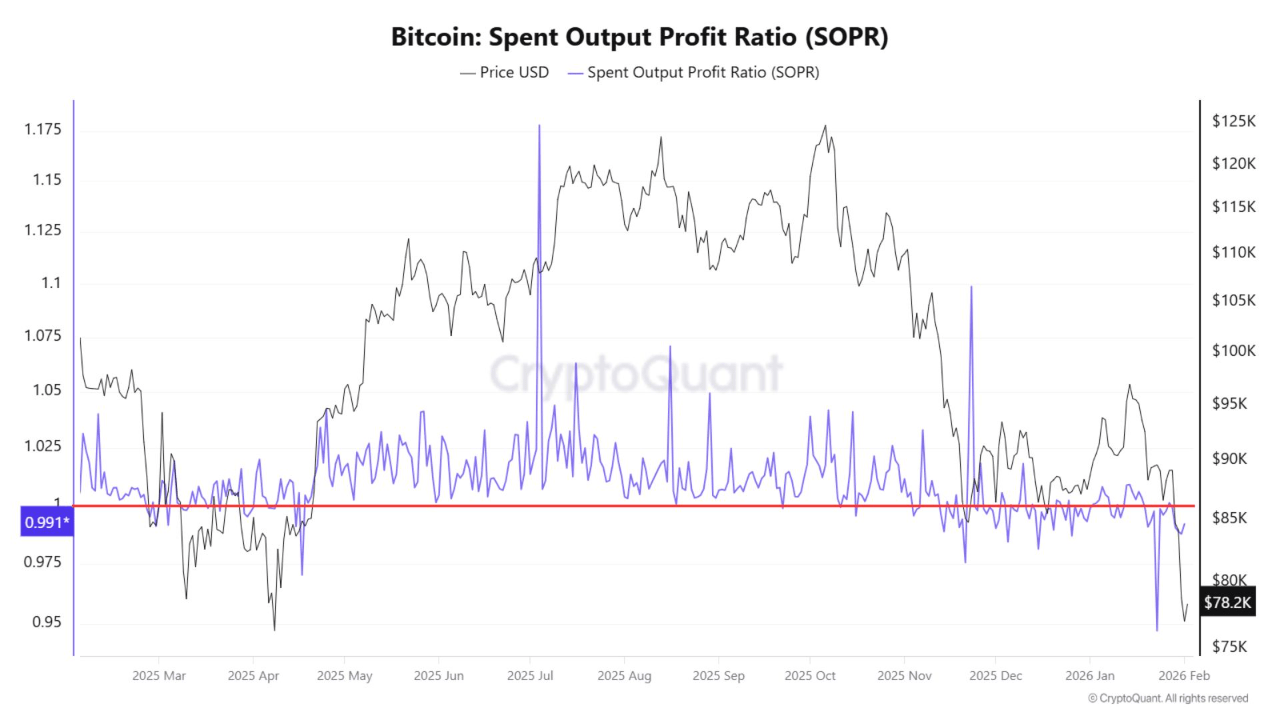
Bitcoin Spent Output Profit Ratio | Source: CryptoQuant

SOPR further supports this view. With SOPR frequently below 1, short-term holders continue to realize losses and exit positions. While this dynamic can fuel relief rallies, historical trend reversals usually require SOPR to reclaim and hold above the 1.0 threshold.

Despite these constraints, accumulation has not stopped entirely. On Monday, Michael Saylor announced that Strategy acquired 855 BTC for approximately $75.3 million at an average price of $87,974. As of February 1, 2026, Strategy holds 713,502 BTC, acquired for roughly $54.26 billion at an average cost of $76,052.

Until spot volume, ETF inflows, and Realized Cap reaccelerate together, the base case remains broad consolidation. The $76,000 level is not a guaranteed floor, but a structural test—this remains a market defined by structure, not price.

Related Questions

QWhat is the significance of the $76,000 price level for Bitcoin's market structure according to the CryptoQuant report?

AThe $76,000 level represents the average acquisition price of Bitcoin by MicroStrategy, and its significance lies in the massive volume of Bitcoin accumulated at this price. It has emerged as a critical structural reference point for the broader market, testing whether the market can absorb supply and hold without exposing deeper stress, rather than being an intentional support level.

QHow has MicroStrategy financed its substantial Bitcoin accumulation, and why is this important?

AMicroStrategy has financed its Bitcoin accumulation through capital markets, including equity issuance and convertible debt. This is important because it links Bitcoin's market structure to broader liquidity conditions. If funding conditions tighten while Bitcoin's price and equity weaken simultaneously, the firm's ability to sustain its accumulation diminishes, reducing a key source of structural demand.

QWhat does the stagnation of Bitcoin's Realized Cap indicate about the current market?

AThe struggle of Bitcoin's Realized Cap to expand, despite large price swings, indicates that market activity is primarily characterized by rotation among existing holders rather than the entry of meaningful new capital or fresh demand into the system.

QWhat is the significance of the Spent Output Profit Ratio (SOPR) frequently being below 1?

AWhen the SOPR is frequently below 1, it indicates that short-term holders are, on average, realizing losses and exiting their positions. While this can sometimes fuel short-term relief rallies, a sustained historical trend reversal typically requires the SOPR to reclaim and hold above the 1.0 threshold.

QAs of the article's date, what are the details of MicroStrategy's Bitcoin holdings?

AAs of February 1, 2026, MicroStrategy holds 713,502 BTC, which were acquired for approximately $54.26 billion, resulting in an average cost basis of $76,052 per Bitcoin.

Related Reads

Behind Musk and Huang Jen-hsun's 'AI Factories', an Unseen Battle for Freshwater Has Begun

Behind the "AI factories" of Elon Musk and Jensen Huang lies a hidden battle for a critical resource: fresh water. As AI models like ChatGPT and Claude process billions of prompts daily, they consume vast amounts of water for cooling. By 2030, global AI infrastructure is projected to use 9.3 trillion liters annually—enough to meet the basic needs of 1.3 billion people. This "water grab" stems from the massive heat generated by high-powered GPUs. Over 70% of data centers use evaporative cooling systems, where water absorbs heat and evaporates into the atmosphere, depleting local groundwater. Training models like GPT-4 can consume over 600 million liters of water. Tech giants like Google and Microsoft report skyrocketing water usage, sparking conflicts with local communities over resources. A flashpoint occurred in Memphis, Tennessee, where Musk's xAI built the Colossus supercomputer. It draws nearly 3.8 million liters of drinking water daily from local aquifers, leading to public outrage and legal action. In response, xAI is building an $80 million water recycling plant to use treated wastewater instead. Facing pressure, companies like Microsoft promote "waterless" closed-loop cooling systems. However, these systems increase electricity consumption by 20-30%, shifting the water burden to power plants, which require immense cooling water themselves—a case of indirect water footprint transfer. For China's AI industry, this crisis offers a strategic warning and opportunity. Instead of replicating the West's resource-intensive model, China can leverage its "East Data, West Computing" policy to locate data centers in cooler, water-rich regions like Guizhou. Furthermore, developing lightweight edge computing for smart homes and embodied AI robots can drastically reduce the need for constant cloud queries, cutting both water and energy consumption at the source. The freshwater war underscores a fundamental question: Will AI be a tool for human advancement or a silicon-based monster competing for our planet's last drops of clean water? The answer is becoming clearer as the water vapor rises.

marsbit22m ago

Behind Musk and Huang Jen-hsun's 'AI Factories', an Unseen Battle for Freshwater Has Begun

marsbit22m ago

AGI is Just One Step Away

The article discusses Anthropic's release of the Fable 5 model, a heavily restricted version of its powerful Mythos model. Initially unveiled in April, Mythos reportedly identified over 10,000 high-risk vulnerabilities for 50 enterprise clients, causing significant concern. Due to its dangerous capabilities in areas like autonomous cyber-attacks and biochemical weapons design guidance (classified as CB-1 level), the unaltered Mythos 5 remains limited to about 200 vetted entities like government agencies. Fable 5, released with a safety classifier, demonstrates extraordinary performance, leading benchmarks in coding (SWE-Bench Pro), software engineering, and research. It exhibits true "long-horizon agency," autonomously planning and executing complex, multi-step tasks like migrating 50 million lines of code in a day, moving beyond simple question-answering. The article positions Fable 5 at OpenAI's Level 3 ("Agent") and progressing toward Level 4 ("Innovator"), suggesting AGI (Artificial General Intelligence) is within reach, potentially 18-24 months away. To mitigate risks, Anthropic implemented a two-layer safety "cage": a silent routing system that redirects dangerous queries to a weaker model, and a mandatory 30-day data retention policy for all Mythos traffic to detect patterns of malicious use. Despite its high cost ($10/$50 per million input/output tokens), the model targets the enterprise market, where its unparalleled productivity and defensive capabilities against AI-powered cyber threats justify the premium. This signals a market maturation where top-tier AI becomes a strategic, high-value tool for businesses, potentially widening the gap with consumer-focused models and accelerating the rise of "one-person companies" while disrupting labor markets.

marsbit34m ago

AGI is Just One Step Away

marsbit34m ago

AI Investors' 2026 Anxiety: When Models Devour Everything, What Moat Is Left for Startups?

In 2026, a wave of investor anxiety questions the defensibility of AI startups as models improve, fearing that most companies are just "thin wrappers" destined to be absorbed by foundation models or chipmakers. The author argues against this despair, positing that true moats lie not in benchmark performance but in areas models cannot easily reach. The logic of despair is that if models excel at all measurable tasks, only compute and cutting-edge model weights hold lasting value. However, the essay contends that the most valuable work is inherently "untrainable." Benchmarks measure what can be measured and thus optimized for, but real-world correctness often resides in private, complex systems. Examples include legacy codebases, intricate legal transactions, or hospital workflows. This kind of correctness is proprietary, costly to establish, and cannot be validated quickly—it requires time and trust within an organization. As models commodify visible, measurable tasks from both above (labs absorbing scaffolding) and below (saturation by cheaper models), value shifts to "untrainable ground." This encompasses work where correctness is a private truth, locked behind integration barriers, licenses, liability frameworks, and entrenched user habits. Trust and adoption are slow, human-centric processes that smarter models cannot accelerate. Successful companies defend their position by embedding deeply into client operations, owning the definition of "good" within a specific domain (e.g., Harvey in law, OpenEvidence in medicine), and pricing on outcomes rather than tokens. While labs compete fiercely, they are incentivized to keep the application layer vibrant. The future belongs not to those competing on generic benchmarks but to those navigating unscoreable terrain, doing the "unsexy work" of translation between models and messy human realities. The most cited benchmark scores are thus maps of territory about to become worthless, signaling who will lose the right to define what counts as good.

marsbit2h ago

AI Investors' 2026 Anxiety: When Models Devour Everything, What Moat Is Left for Startups?

marsbit2h ago

Trading

Spot
Futures

Hot Articles

What is $BITCOIN

DIGITAL GOLD ($BITCOIN): A Comprehensive Analysis Introduction to DIGITAL GOLD ($BITCOIN) DIGITAL GOLD ($BITCOIN) is a blockchain-based project operating on the Solana network, which aims to combine the characteristics of traditional precious metals with the innovation of decentralized technologies. While it shares a name with Bitcoin, often referred to as “digital gold” due to its perception as a store of value, DIGITAL GOLD is a separate token designed to create a unique ecosystem within the Web3 landscape. Its goal is to position itself as a viable alternative digital asset, although specifics regarding its applications and functionalities are still developing. What is DIGITAL GOLD ($BITCOIN)? DIGITAL GOLD ($BITCOIN) is a cryptocurrency token explicitly designed for use on the Solana blockchain. In contrast to Bitcoin, which provides a widely recognized value storage role, this token appears to focus on broader applications and characteristics. Notable aspects include: Blockchain Infrastructure: The token is built on the Solana blockchain, known for its capacity to handle high-speed and low-cost transactions. Supply Dynamics: DIGITAL GOLD has a maximum supply capped at 100 quadrillion tokens (100P $BITCOIN), although details regarding its circulating supply are currently undisclosed. Utility: While precise functionalities are not explicitly outlined, there are indications that the token could be utilized for various applications, potentially involving decentralized applications (dApps) or asset tokenization strategies. Who is the Creator of DIGITAL GOLD ($BITCOIN)? At present, the identity of the creators and development team behind DIGITAL GOLD ($BITCOIN) remains unknown. This situation is typical among many innovative projects within the blockchain space, particularly those aligning with decentralized finance and meme coin phenomena. While such anonymity may foster a community-driven culture, it intensifies concerns about governance and accountability. Who are the Investors of DIGITAL GOLD ($BITCOIN)? The available information indicates that DIGITAL GOLD ($BITCOIN) does not have any known institutional backers or prominent venture capital investments. The project seems to operate on a peer-to-peer model focused on community support and adoption rather than traditional funding routes. Its activity and liquidity are primarily situated on decentralized exchanges (DEXs), such as PumpSwap, rather than established centralized trading platforms, further highlighting its grassroots approach. How DIGITAL GOLD ($BITCOIN) Works The operational mechanics of DIGITAL GOLD ($BITCOIN) can be elaborated on based on its blockchain design and network attributes: Consensus Mechanism: By leveraging Solana’s unique proof-of-history (PoH) combined with a proof-of-stake (PoS) model, the project ensures efficient transaction validation contributing to the network's high performance. Tokenomics: While specific deflationary mechanisms have not been extensively detailed, the vast maximum token supply implies that it may cater to microtransactions or niche use cases that are still to be defined. Interoperability: There exists the potential for integration with Solana’s broader ecosystem, including various decentralized finance (DeFi) platforms. However, the details regarding specific integrations remain unspecified. Timeline of Key Events Here is a timeline that highlights significant milestones concerning DIGITAL GOLD ($BITCOIN): 2023: The initial deployment of the token occurs on the Solana blockchain, marked by its contract address. 2024: DIGITAL GOLD gains visibility as it becomes available for trading on decentralized exchanges like PumpSwap, allowing users to trade it against SOL. 2025: The project witnesses sporadic trading activity and potential interest in community-led engagements, although no noteworthy partnerships or technical advancements have been documented as of yet. Critical Analysis Strengths Scalability: The underlying Solana infrastructure supports high transaction volumes, which could enhance the utility of $BITCOIN in various transaction scenarios. Accessibility: The potential low trading price per token could attract retail investors, facilitating wider participation due to fractional ownership opportunities. Risks Lack of Transparency: The absence of publicly known backers, developers, or an audit process may yield skepticism regarding the project's sustainability and trustworthiness. Market Volatility: The trading activity is heavily reliant on speculative behavior, which can result in significant price volatility and uncertainty for investors. Conclusion DIGITAL GOLD ($BITCOIN) emerges as an intriguing yet ambiguous project within the rapidly evolving Solana ecosystem. While it attempts to leverage the “digital gold” narrative, its departure from Bitcoin's established role as a store of value underscores the need for a clearer differentiation of its intended utility and governance structure. Future acceptance and adoption will likely depend on addressing the current opacity and defining its operational and economic strategies more explicitly. Note: This report encompasses synthesised information available as of October 2023, and developments may have transpired beyond the research period.

363 Total ViewsPublished 2025.05.13Updated 2025.05.13

What is $BITCOIN

Discussions

Welcome to the HTX Community. Here, you can stay informed about the latest platform developments and gain access to professional market insights. Users' opinions on the price of BTC (BTC) are presented below.

活动图片