Strategy Drops $1.25 Billion On Bitcoin Above $91,000

bitcoinistPublished on 2026-01-13Last updated on 2026-01-13

Abstract

Strategy, a prominent Bitcoin treasury company, has made its largest single purchase since July of last year, acquiring 13,627 BTC for approximately $1.25 billion. This significant investment, announced by co-founder Michael Saylor, was executed at an average price of $91,519 per Bitcoin. The purchase, funded through stock offerings, brings the company's total holdings to 687,410 BTC. The firm's total investment now stands at $51.80 billion, which has appreciated to a value of $63.28 billion, representing an unrealized profit of over 22%. Saylor also shared a comparison of top-performing assets since 2020, noting that Nvidia, MicroStrategy, and Bitcoin have been the leaders in annualized returns. Despite a strong start to the year, Bitcoin's price has recently stabilized around $91,400.

Bitcoin treasury company Strategy has continued its accumulation of the cryptocurrency, taking its holdings to 687,410 BTC with the latest purchase.

Strategy Has Acquired Another 13,627 Bitcoin

As announced in an X post by Strategy co-founder and chairman Michael Saylor, the company has completed a new Bitcoin acquisition involving 13,627 BTC, spending an average of $91,519 per token or a total of about $1.25 billion.

This purchase is rather large; in fact, it’s the biggest buy that the firm has made since July of last year. In his usual Sunday foreshadowing post, Saylor hinted that the acquisition would be significant, using the caption: “₿ig Orange.”

In a reply to the post, the Strategy chairman reflected on the company’s accumulation journey, saying, “Ironic that our $60.25 billion Bitcoin position started with a $0.25 billion purchase in August 2020.”

Following the purchase announcement, Strategy’s stack has officially grown to 687,410 BTC and total investment to $51.80 billion. At present, these holdings are valued at $63.28 billion, meaning that the treasury company is in a profit of more than 22%.

According to the filing with the US Securities and Exchange Commission, the new acquisition took place in the week between January 5th and 11th, funded using proceeds from the company’s MSTR and STRC at-the-market (ATM) stock offerings.

Last Monday, Strategy announced expansions for both its Bitcoin treasury and US Dollar reserve, but the focus this week appears to have been on the cryptocurrency alone. The USD reserve, which was created by the company at the start of December, has seen two additions so far, and the latest one took its value to $2.25 billion.

In another X post, Saylor has also shared a chart that compares annualized returns for the best-performing assets in the “Bitcoin Standard Era,” referring to the period since August 2020 when the firm made its first purchase of the cryptocurrency.
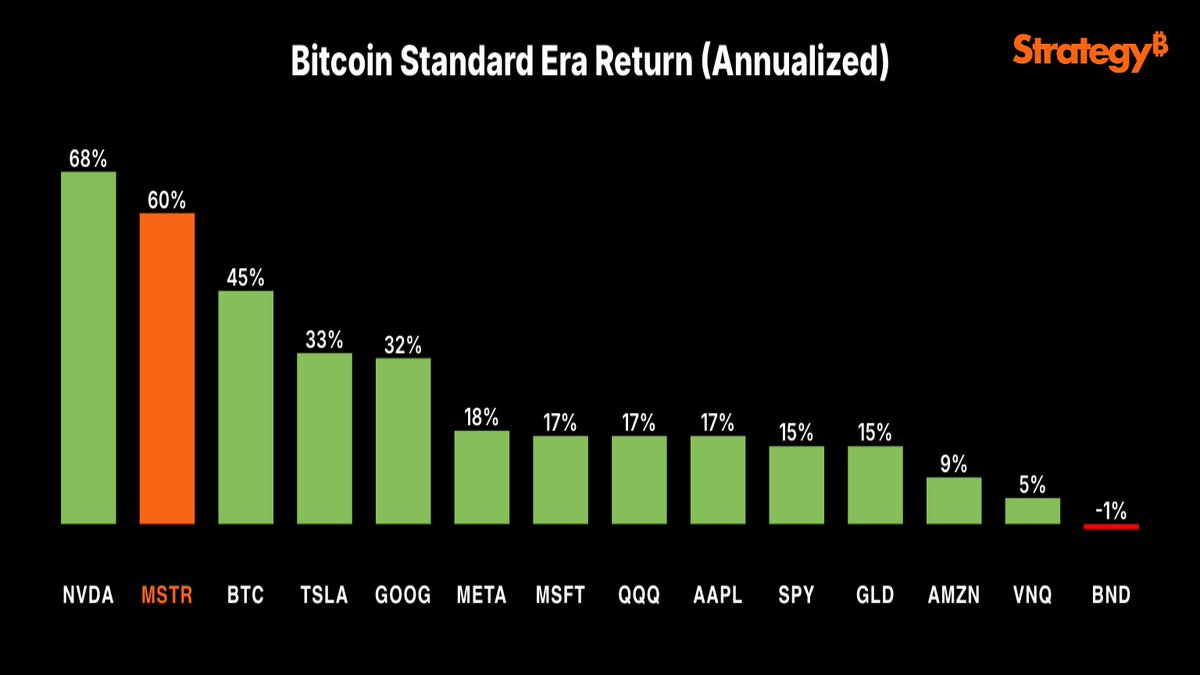
Looks like Nvidia has seen the best returns in this period | Source: @saylor on X

As displayed in the graph, MSTR has produced the second-most annualized returns in this timespan, with its profits of 60% surpassing even BTC’s, which has managed a return of 45%.

The number one performing asset in the period has been Nvidia (NVDA), posting annual returns of 68%. The strength behind the company’s stock was initially driven by the Ethereum mining boom and more recently, by the rise of AI datacenters.

“The best-performing assets of this decade are Digital Intelligence $NVDA, Digital Credit $MSTR, and Digital Capital $BTC,” Saylor wrote, framing each asset under a distinct role.

BTC Price

Bitcoin kicked off 2026 with a recovery surge, but bullish momentum has faded for the asset as its price is still trading around $91,400.

The price of the coin seems to have taken to sideways movement in recent days | Source: BTCUSDT on TradingView


Related Questions

QHow many Bitcoins did Strategy purchase in its latest acquisition and at what average price?

AStrategy purchased 13,627 Bitcoin at an average price of $91,519 per token.

QWhat is the total value of Strategy's Bitcoin holdings after this purchase and what is their current profit percentage?

AStrategy's total Bitcoin holdings are valued at $63.28 billion, representing a profit of more than 22%.

QAccording to the article, which asset has seen the best annualized returns since August 2020?

ANvidia (NVDA) has seen the best annualized returns since August 2020, posting annual returns of 68%.

QHow was Strategy's latest Bitcoin purchase funded?

AThe purchase was funded using proceeds from the company's MSTR and STRC at-the-market (ATM) stock offerings.

QWhat was the initial value of Strategy's first Bitcoin purchase in August 2020, as mentioned by Michael Saylor?

AThe initial purchase in August 2020 was valued at $0.25 billion.

Related Reads

Not Speculation but a Necessity: The 4 Unique Values of Prediction Markets

Polymarket's recent $4 billion funding round and soaring valuation of $15 billion highlight the explosive growth of prediction markets, with trading volume reaching $25.7 billion in March 2026—a 10.6% monthly increase. This analysis argues that prediction markets serve critical non-speculative functions, positioning them as essential tools rather than mere gambling platforms. Prediction markets offer four unique values: entertainment consumption, insurance-like protection, risk hedging, and truth discovery. Firstly, they stimulate economic activity by engaging users in event-based betting, similar to the broader sports industry. Secondly, they act as a form of decentralized insurance, allowing users to hedge against specific, well-defined risks (e.g., weather events) transparently and without traditional overhead costs. Thirdly, institutions and individuals use these markets to hedge against geopolitical and commodity price risks, as demonstrated during the U.S.-Iran conflict and the launch of 24/7 commodity markets on platforms like Kalshi. Finally, prediction markets counter media bias by aggregating crowd-sourced information, often achieving 30% higher accuracy than surveys due to users' vested interests. Experts like Bitwise’s Jeff Park and SIG’s Jeff Yass emphasize the markets' role in risk transfer and financial innovation. As these platforms evolve, they are poised to become trillion-dollar markets, offering more reliable, decentralized mechanisms for information pricing and risk management.

marsbit2h ago

Not Speculation but a Necessity: The 4 Unique Values of Prediction Markets

marsbit2h ago

Trading

Spot
Futures

Hot Articles

What is $BITCOIN

DIGITAL GOLD ($BITCOIN): A Comprehensive Analysis Introduction to DIGITAL GOLD ($BITCOIN) DIGITAL GOLD ($BITCOIN) is a blockchain-based project operating on the Solana network, which aims to combine the characteristics of traditional precious metals with the innovation of decentralized technologies. While it shares a name with Bitcoin, often referred to as “digital gold” due to its perception as a store of value, DIGITAL GOLD is a separate token designed to create a unique ecosystem within the Web3 landscape. Its goal is to position itself as a viable alternative digital asset, although specifics regarding its applications and functionalities are still developing. What is DIGITAL GOLD ($BITCOIN)? DIGITAL GOLD ($BITCOIN) is a cryptocurrency token explicitly designed for use on the Solana blockchain. In contrast to Bitcoin, which provides a widely recognized value storage role, this token appears to focus on broader applications and characteristics. Notable aspects include: Blockchain Infrastructure: The token is built on the Solana blockchain, known for its capacity to handle high-speed and low-cost transactions. Supply Dynamics: DIGITAL GOLD has a maximum supply capped at 100 quadrillion tokens (100P $BITCOIN), although details regarding its circulating supply are currently undisclosed. Utility: While precise functionalities are not explicitly outlined, there are indications that the token could be utilized for various applications, potentially involving decentralized applications (dApps) or asset tokenization strategies. Who is the Creator of DIGITAL GOLD ($BITCOIN)? At present, the identity of the creators and development team behind DIGITAL GOLD ($BITCOIN) remains unknown. This situation is typical among many innovative projects within the blockchain space, particularly those aligning with decentralized finance and meme coin phenomena. While such anonymity may foster a community-driven culture, it intensifies concerns about governance and accountability. Who are the Investors of DIGITAL GOLD ($BITCOIN)? The available information indicates that DIGITAL GOLD ($BITCOIN) does not have any known institutional backers or prominent venture capital investments. The project seems to operate on a peer-to-peer model focused on community support and adoption rather than traditional funding routes. Its activity and liquidity are primarily situated on decentralized exchanges (DEXs), such as PumpSwap, rather than established centralized trading platforms, further highlighting its grassroots approach. How DIGITAL GOLD ($BITCOIN) Works The operational mechanics of DIGITAL GOLD ($BITCOIN) can be elaborated on based on its blockchain design and network attributes: Consensus Mechanism: By leveraging Solana’s unique proof-of-history (PoH) combined with a proof-of-stake (PoS) model, the project ensures efficient transaction validation contributing to the network's high performance. Tokenomics: While specific deflationary mechanisms have not been extensively detailed, the vast maximum token supply implies that it may cater to microtransactions or niche use cases that are still to be defined. Interoperability: There exists the potential for integration with Solana’s broader ecosystem, including various decentralized finance (DeFi) platforms. However, the details regarding specific integrations remain unspecified. Timeline of Key Events Here is a timeline that highlights significant milestones concerning DIGITAL GOLD ($BITCOIN): 2023: The initial deployment of the token occurs on the Solana blockchain, marked by its contract address. 2024: DIGITAL GOLD gains visibility as it becomes available for trading on decentralized exchanges like PumpSwap, allowing users to trade it against SOL. 2025: The project witnesses sporadic trading activity and potential interest in community-led engagements, although no noteworthy partnerships or technical advancements have been documented as of yet. Critical Analysis Strengths Scalability: The underlying Solana infrastructure supports high transaction volumes, which could enhance the utility of $BITCOIN in various transaction scenarios. Accessibility: The potential low trading price per token could attract retail investors, facilitating wider participation due to fractional ownership opportunities. Risks Lack of Transparency: The absence of publicly known backers, developers, or an audit process may yield skepticism regarding the project's sustainability and trustworthiness. Market Volatility: The trading activity is heavily reliant on speculative behavior, which can result in significant price volatility and uncertainty for investors. Conclusion DIGITAL GOLD ($BITCOIN) emerges as an intriguing yet ambiguous project within the rapidly evolving Solana ecosystem. While it attempts to leverage the “digital gold” narrative, its departure from Bitcoin's established role as a store of value underscores the need for a clearer differentiation of its intended utility and governance structure. Future acceptance and adoption will likely depend on addressing the current opacity and defining its operational and economic strategies more explicitly. Note: This report encompasses synthesised information available as of October 2023, and developments may have transpired beyond the research period.

363 Total ViewsPublished 2025.05.13Updated 2025.05.13

What is $BITCOIN

Discussions

Welcome to the HTX Community. Here, you can stay informed about the latest platform developments and gain access to professional market insights. Users' opinions on the price of BTC (BTC) are presented below.

活动图片