Stop Focusing Only on Bitcoin—We Are Already in a Bear Market

marsbitPublished on 2025-12-18Last updated on 2025-12-18

Abstract

The author argues that the crypto market has been in a bear market for about a year, despite many investors' reluctance to accept it. The peak of market euphoria occurred around November 2024, with the launch of $TRUMP marking the final exuberance. Two key misconceptions are highlighted: First, the meme coin frenzy was not a precursor to an "altseason"—it *was* the altseason itself. Unlike previous cycles with distinct new narratives and liquidity splits between "dumb money" and "hot money," this cycle lacked differentiation, keeping both groups in the same arena. Second, Bitcoin is no longer driven primarily by crypto-native cycles but by institutional and macro factors, meaning its price resilience doesn’t indicate an ongoing bull market. The bear market began after the $TRUMP peak, and the market has since gone through phases of anxiety, denial, panic, and now anger and depression. The author writes to encourage debate, correct flawed mental models, and signal a intention to begin accumulating near what they believe is the bottom.

Author: XY

Compiled by: Tim, PANews

One Year into the Bear Market

It took me some time to convince myself: we are in a bear market, and it has been going on for about a year.

November 2024 was a period of market excitement, and the launch of $TRUMP pushed the market into extreme euphoria—it was the final frenzy that no one wanted to believe was the end.

Below, I will explain my perspective.

It all starts with that old cliché: "History doesn't repeat itself, but it often rhymes."

This foolish saying has been hugely misleading for market analysis—it's downright harmful.

It has made us overly reliant on historical patterns and, at the same time, eroded our ability to question.

Yes, this reliance on historical patterns for prediction is like viewing the world through a prism carved with old designs. It inevitably misinterprets new realities and ultimately causes us to overlook the latest driving factors in the market. This is precisely where the danger lies.

More specifically, we misread two fundamental changes.

Change One

We thought Meme mania was the spark that would ignite altseason, but in reality, Meme mania was altseason itself.

When Meme coins surged one after another, we thought it was just the beginning.

Some talked about altseason, and a few bold ones even mentioned a raging bull market.

We were all wrong.

Keep in mind that previous cycles always featured bubble叠加-bubble phenomena, typically driven by new narratives. These new narratives gave rise to new markets, which often led to differentiation.

This differentiation was important because it split liquidity into two distinct groups.

The first group is dumb money.

This type of capital prefers simple operations, market depth, and low barriers to entry, staying within highly liquid tokens.

The second group is hot money.

This capital actively pursues returns and is willing to overcome complexity to find opportunities.

The subsequent short-term rotation of hot money fueled bullish trends, which eventually evolved into what people called altseason.

This cycle never produced that trend. There was no new narrative to explore this time.

From start to finish, both groups remained in the same arena.

Dumb money could participate effortlessly, and hot money could still profit by getting in early.

Our mistake was expecting an "altseason" to occur.

But it never happened.

The only path the market had was: from Bitcoin to a new narrative, then to altseason.

That used to be the script you wanted.

But the reality is that Meme mania became the altseason people anticipated.

November 2024 marked the peak profitability for most traders, and TRUMP was the climax of the market狂欢.

Change Two

Bitcoin is no longer driven internally by the crypto market but is instead dominated by institutions and macro markets.

And the macro environment follows a different timeline and reacts differently to changes.

After the TRUMP surge, many interpreted Bitcoin's resilience as the market still being in a consolidation or bull market correction phase.

This interpretation stemmed from an anchoring bias based on past experiences: people are accustomed to the idea that Bitcoin must crash sharply to confirm a bear market, applying this to a market structure now dominated by institutions.

This cognitive framework is outdated.

Bitcoin has actually decoupled from the native cryptocurrency market cycle.

Once you recognize this, the subsequent developments make perfect sense.

The bear market began after the MEME coin TRUMP, regardless of Bitcoin's price performance.

So, stop focusing only on Bitcoin.

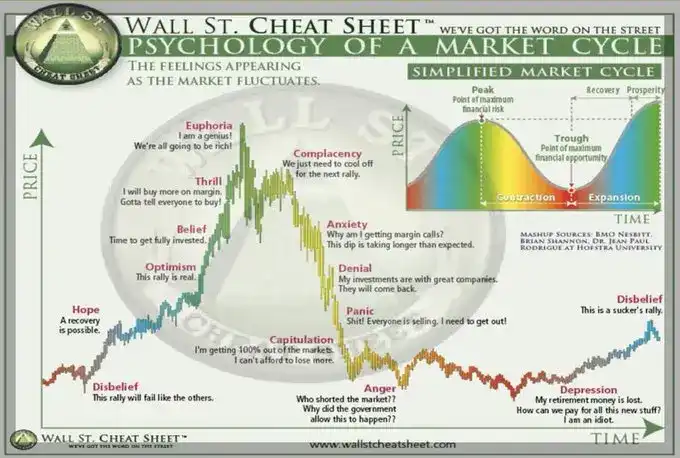
From January 2025 to the present, the market has fully gone through the three stages of anxiety, denial, and panic. If you've made profits, you can clearly see these stages in the people around you; if you've suffered losses, you've experienced these emotions firsthand.

We are now in the stage of anger and depression.

So, why am I writing this post?

Two reasons.

First, one of the reasons the crypto market has been profitable for me is the ability to buy near the bottom. If you misjudge the market phase, this advantage disappears.

If you think the bear market isn't over yet, you'll keep waiting for the bottom to arrive, unaware that you're already in it.

Second, I hope this perspective sparks fierce debate or helps people become alert and break free from the wrong cognitive framework.

I have extremely high confidence in this judgment.

That's why I will soon start acting to prove my judgment.
Related Questions

QAccording to the author, when did the bear market in cryptocurrency actually begin?

AThe author states that the bear market began around the time of the $TRUMP meme coin frenzy, which was in November 2024, and has been going on for about a year.

QWhat were the two fundamental changes that the author believes most people misread about the market cycle?

AThe two changes were: 1) Meme frenzy was the altcoin season itself, not a precursor to it, and 2) Bitcoin is now dominated by institutional and macro markets, not the internal crypto market cycle.

QWhy does the author argue that there was no traditional 'altcoin season' in this cycle?

AThe author argues there was no traditional altcoin season because no new narrative emerged to create a differentiation between 'dumb money' and 'hot money.' Both groups operated in the same arena of meme coins, so the expected rotation of hot money into other altcoins never occurred.

QWhat is the danger of relying on the saying 'history doesn't repeat itself, but it often rhymes' for market analysis?

AThe author calls this saying misleading and pernicious because it creates a path dependency and reduces our ability to question new realities, causing us to misread new market factors and ignore the latest driving forces.

QWhat is the author's main purpose for writing this article?

AThe author's main purposes are: 1) To help people recognize they are already in a bear market so they can take advantage of buying near the bottom, and 2) To spark debate and help people break free from incorrect cognitive frameworks about the market.

Related Reads

Bankless Co-founder: Why I Sold All My ETH

Author David Hoffman, founder of Bankless, explains his decision to sell all his ETH, despite being a prominent figure in the Ethereum ecosystem. He clarifies that his move is not a bearish take on Ethereum itself, which he remains highly optimistic about as a network. His core argument is that the "ETH is money" thesis, which he helped popularize, has largely played out. Hoffman argues that ETH has achieved the market valuation it deserves based on Ethereum's current success and competitive position. He details several reasons for this view. First, the path for ETH to become global money required nearly flawless execution and sustained dominance across Ethereum's entire technical and social stack—a coordination challenge he now believes had a narrower window for success than anticipated. Second, market data shows a strong correlation between L1 chain activity/fees and the price of its native asset; Ethereum's fee dominance has been challenged by competitors like Solana. Third, the "strong version" of crypto (decentralized, native crypto economies) that ETH's monetary thesis relied upon has struggled to maintain a positive mainstream narrative and stable adoption beyond a brief period. Finally, Ethereum's architecture as a "giver"—providing secure block space and tokenization capabilities at cost to L2s and applications—means it doesn't capture premium value directly. Its rollup-centric roadmap further directs most profits to L2s and applications ("fat app theory"). In conclusion, Hoffman believes the opportunity for ETH to be revalued significantly upward as money has diminished. He sold not because ETH will fail, but because its monetary thesis has matured, and he seeks to allocate capital to other opportunities he finds more compelling.

链捕手1h ago

Bankless Co-founder: Why I Sold All My ETH

链捕手1h ago

From Issuer to Infrastructure Owner: Circle's Arc Strategy and the Fatal Gap in the GENIUS Act

Circle raised $222 million for its proprietary Layer-1 blockchain, Arc, positioning itself not just as a stablecoin issuer but as the owner of the settlement infrastructure USDC relies on. This move, backed by investors like BlackRock and Apollo, highlights a significant structural conflict unaddressed by the GENIUS Act of 2025. While the act focuses on stablecoin reserves and issuer oversight, it remains silent on the market structure implications of an issuer controlling the underlying network—a scenario akin to a currency issuer also owning the payment rails. Traditionally, financial regulations separate issuers from settlement infrastructure to ensure neutrality. With Arc, Circle gains control over transaction ordering, fees, and network rules, potentially favoring USDC over competitors. The article argues that this creates a permanent structural temptation, even if no abuse occurs. The solution lies in applying established market infrastructure principles: mandating neutral transaction ordering, transparent fee schedules, and governance separated from Circle’s commercial interests. The current pre-mainnet phase offers a critical window for regulators to establish these rules before Arc becomes entrenched. Once operational, enforcing changes would be costly and disruptive. The core question remains: should a regulated stablecoin issuer be allowed to own the settlement network its competitors must use? The GENIUS Act doesn’t answer this, but Circle’s Arc strategy makes it urgent.

marsbit1h ago

From Issuer to Infrastructure Owner: Circle's Arc Strategy and the Fatal Gap in the GENIUS Act

marsbit1h ago

What Are the Key Variables Determining the AI Bull Market?

Title: What Determines the AI Bull Market? Key Variables Revealed Despite rising oil prices above $100/barrel, persistent inflation, and fragile Fed rate cut expectations—a traditionally hostile environment for high-valuation tech stocks—the AI sector continues to drive the market to new highs. According to analysts, the current AI boom is in a phase of "rational fervor": while bubbles exist, they are not yet out of control. The crucial shift is the emergence of Agentic AI, which is evolving from an assisting tool (Copilot) to an autonomous execution tool (Autopilot), creating a clearer commercial path from investment to revenue. This shift accelerates Token consumption and inference computing demand while boosting revenue forecasts for leading firms. The market is now rewarding capital expenditure as it transforms from a burden into a competitive moat, supporting hardware chains like GPUs, optical modules, and storage. However, valuations have already priced in growth expectations for 2027-2028. The forward P/E ratio for the "Magnificent Seven" tech giants is about 35x, compared to 25x for the rest of the S&P 500. This premium implies AI adoption must occur 5 to 8 times faster than past technological revolutions—a scenario with little room for error. The sustainability of the AI bull market hinges on three key variables: 1. **Short-term liquidity shocks**: Risks include sustained high oil prices, resurgent inflation, rising interest rates, and potential unwinding of the yen carry trade. The critical question is whether the upward revision speed of Annual Recurring Revenue (ARR) can outpace the rise in interest rates. 2. **Mid-term industry realization**: Can the actual pace of AI adoption and commercialization match the current lofty valuations? Historically, general-purpose technology revolutions follow a non-linear path with periods of acceleration and deceleration. 3. **Long-term structural constraints**: These include energy and power grid limitations, employment displacement and consumer purchasing power, social acceptance and potential backlash, and potential hardware technology breakthroughs that could disrupt current supply chains. While the long-term prospects for AI remain optimistic with potential for significant productivity gains, the stock market's pricing depends not just on the vision but on the actual speed of realization amid these growing constraints. The direction is clear, but the pace of execution will determine whether the bubble remains controlled or spirals out of control.

marsbit1h ago

What Are the Key Variables Determining the AI Bull Market?

marsbit1h ago

Trading

Spot
Futures

Hot Articles

How to Buy ZEST

Welcome to HTX.com! We've made purchasing Zest Protocol (ZEST) simple and convenient. Follow our step-by-step guide to embark on your crypto journey.Step 1: Create Your HTX AccountUse your email or phone number to sign up for a free account on HTX. Experience a hassle-free registration journey and unlock all features.Get My AccountStep 2: Go to Buy Crypto and Choose Your Payment MethodCredit/Debit Card: Use your Visa or Mastercard to buy Zest Protocol (ZEST) instantly.Balance: Use funds from your HTX account balance to trade seamlessly.Third Parties: We've added popular payment methods such as Google Pay and Apple Pay to enhance convenience.P2P: Trade directly with other users on HTX.Over-the-Counter (OTC): We offer tailor-made services and competitive exchange rates for traders.Step 3: Store Your Zest Protocol (ZEST)After purchasing your Zest Protocol (ZEST), store it in your HTX account. Alternatively, you can send it elsewhere via blockchain transfer or use it to trade other cryptocurrencies.Step 4: Trade Zest Protocol (ZEST)Easily trade Zest Protocol (ZEST) on HTX's spot market. Simply access your account, select your trading pair, execute your trades, and monitor in real-time. We offer a user-friendly experience for both beginners and seasoned traders.

391 Total ViewsPublished 2026.05.19Updated 2026.05.19

How to Buy ZEST

HTX Learn: Learn Hot Tokens to Share 1000 USDT​

To enhance your understanding of this week's featured cryptos, we are rolling out various rewarding events. Join them now and bring home generous rewards through learning and trading.

18.9k Total ViewsPublished 2026.05.21Updated 2026.05.21

HTX Learn: Learn Hot Tokens to Share 1000 USDT​

Discussions

Welcome to the HTX Community. Here, you can stay informed about the latest platform developments and gain access to professional market insights. Users' opinions on the price of A (A) are presented below.

活动图片