Stock Price Falls Below IPO Price, First Launch After IPO Hits a Snag, Where Will SpaceX Go From Here?

Odaily星球日报Published on 2026-07-17Last updated on 2026-07-17

Abstract

SpaceX Faces Post-IPO Pressure as Starship Launch Aborted, Stock Slumps SpaceX's highly anticipated 13th test flight of its Starship rocket was aborted during the final ignition sequence on July 17th due to issues with some Raptor engines failing to start as expected. CEO Elon Musk stated the company will replace two engines and aims for another launch attempt early next week. This setback comes at a critical time for SpaceX. Following its historic IPO last month, the company's stock (SPCX) has recently fallen below its offering price, down nearly 40% from its peak. The market had hoped a successful test would bolster the declining share price, but the abort triggered further after-hours selling. The article highlights a shift in investor perspective post-IPO. While previous Starship test failures were often viewed within SpaceX's "fail fast, iterate" Silicon Valley engineering culture as valuable data points, public market investors are now more focused on timelines, commercialization prospects, and their impact on valuation and future cash flows. Each delay or issue is now quickly factored into the stock price. While public listing provides crucial capital for ambitious projects like Starlink and Starship, it also brings increased scrutiny and pressure for predictable progress. The upcoming launch attempt is now seen as more than a technical milestone; its success or failure is likely to significantly influence market sentiment and the stock's near-term trajectory as Sp...

Original | Odaily Planet Daily (@OdailyChina)

Author|Azuma(@azuma_eth)
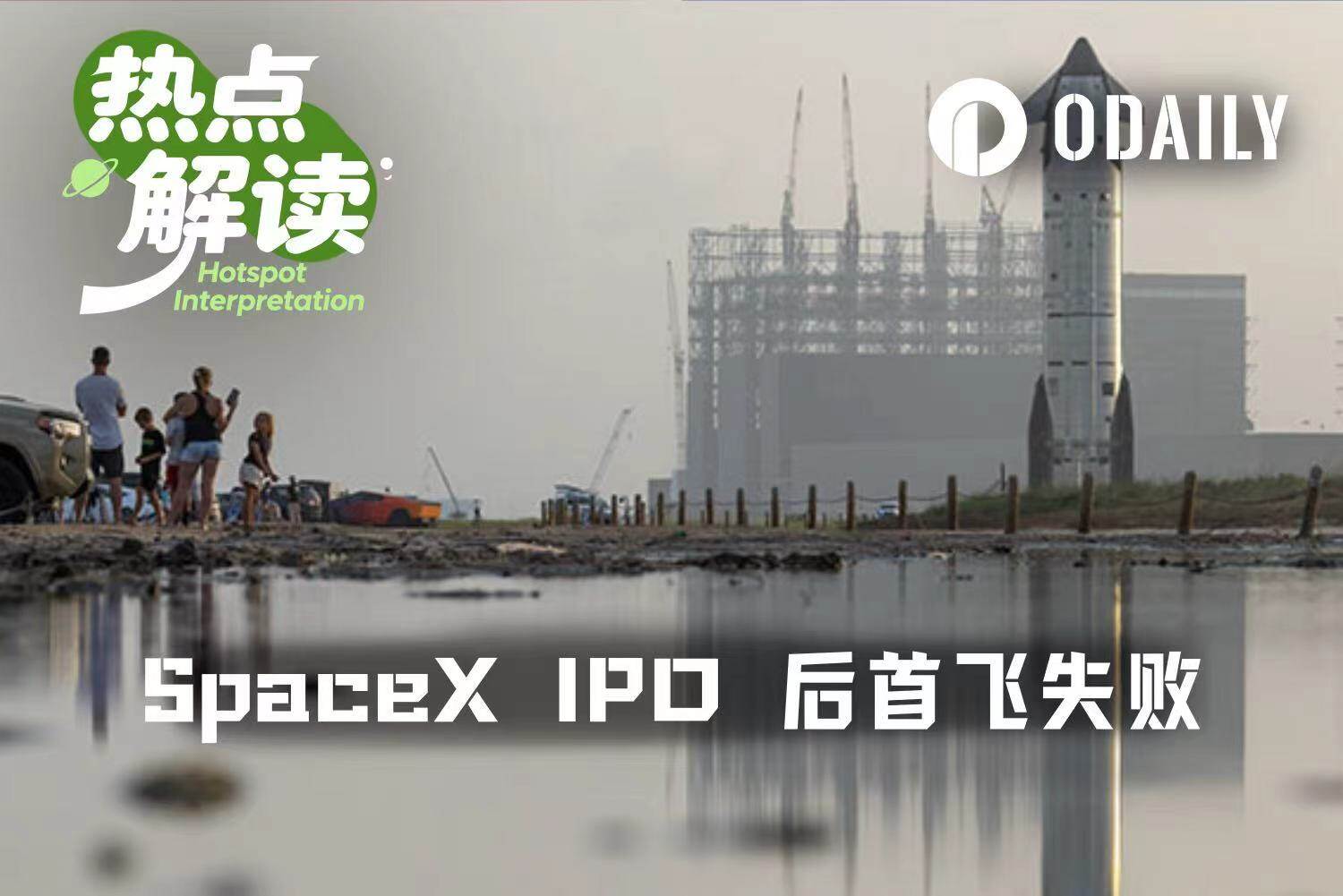
At 17 a.m. Beijing time on July 17th, SpaceX originally planned to conduct the 13th test flight of Starship. However, just as the launch countdown entered the final ignition phase, the automatic launch abort sequence was triggered because some Raptor engines failed to start as expected, forcing the cancellation of this test flight.

Elon Musk stated that to ensure a smooth flight, SpaceX will remove and replace two Raptor engines, hoping to make another launch attempt in a few days, with the most likely launch time being early next week.

Prior to this test flight, SpaceX's stock price had just fallen below its IPO price, with the maximum decline since listing approaching 40%. As the first Starship test flight after SpaceX's IPO, the market had originally hoped to use it to verify the latest progress of Starship and inject a shot in the arm into the persistently sluggish stock price in recent times. However, the outcome of the launch failure dealt another blow to SpaceX's stock price — SPCX briefly plummeted in after-hours trading, currently reported at $127.07.
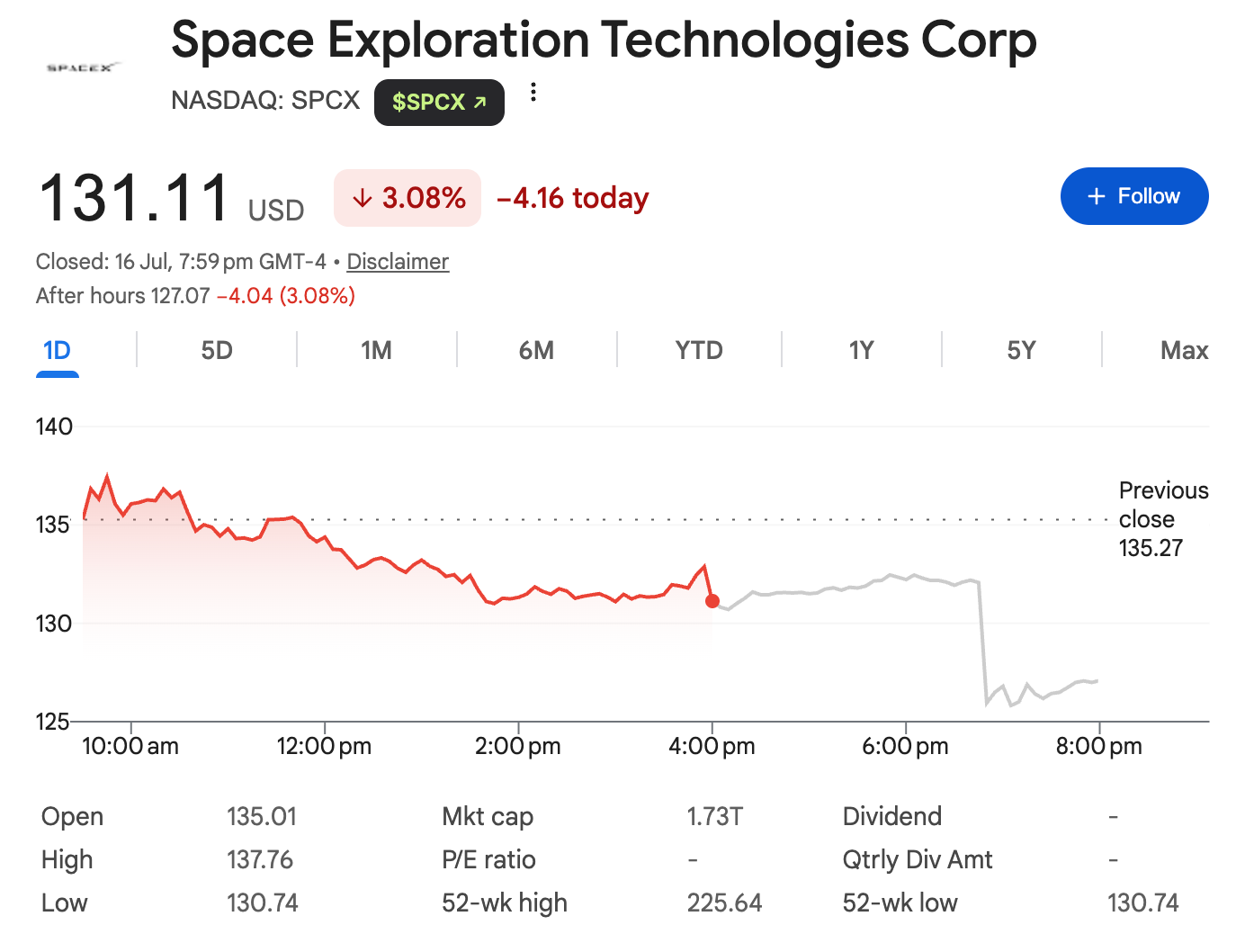
A test flight failure is nothing new for SpaceX, but judging from the secondary market's reaction this time, investors are clearly reevaluating a question: After going public, can SpaceX still afford the luxury of "unlimited trial and error"?

Test Flight Failures Are Not New, But Times Have Changed

If we turn the clock back a few years, almost every Starship test flight failure was seen as part of the engineering progress. While discussions in the community about Elon Musk "blowing up rockets" were mainly in a teasing tone, there was also a degree of respect within them.

For SpaceX, the company has always adhered to the Silicon Valley-style R&D philosophy — build fast, test fast, fail fast, and iterate fast. Compared to completing all verification on the ground, SpaceX prefers to send rockets into the sky as soon as possible, obtain data through real flights, and continuously optimize the design. Because of this, in over ten previous Starship test flights, various unexpected events, from in-flight disintegration, booster recovery failures to orbital verification setbacks, have almost run through the entire development history. However, these setbacks have not hindered Starship's continuous forward evolution.

In the era of the primary market, this R&D model also received general recognition from investors. Whether institutional shareholders or employee shareholders, they valued more whether the R&D pace was continuously advancing and whether technological barriers were accumulating, rather than whether a particular test flight succeeded or failed. For them, a failure meant acquiring a new batch of flight data, meant getting one step closer to final commercialization, and essentially still belonged to part of the R&D cost.

But after the IPO, the way the capital market views Starship has begun to change. For secondary market investors, Starship is no longer just an R&D project; it has become an important variable affecting the company's valuation. A test flight setback not only means needing to replace engines and rearrange the launch window but may also imply a delay in commercial deployment timelines, a slowdown in revenue realization, and a readjustment of future cash flow forecasts. In the past, engineers saw data accumulated from a test; now, Wall Street sees whether growth expectations can be met on schedule.

This change does not mean the capital market demands SpaceX "must succeed, must not fail," but rather that every failure will be incorporated into the valuation system for recalculation. Especially against the backdrop of the company already being public and the market assigning a high growth premium, any event potentially affecting the Starship commercialization timeline is more likely to trigger stock price volatility than before.

The IPO: Both Motivation and Constraint

A month ago, SpaceX just completed the largest IPO in human history.

For any capital-intensive, high-investment technology company, the greatest significance of entering the capital market is precisely to obtain more stable and lower-cost financing capabilities. For SpaceX, which is still in a phase of rapid expansion, whether it's continuously building the Starlink constellation, advancing Starship R&D, or laying out a larger commercial space network in the future, it all implies massive capital expenditures. The financing channels brought by the IPO can undoubtedly provide more ample "fuel" for these long-term plans.

But the capital market never provides anything for free. As more and more public investors become shareholders, what SpaceX needs to face is no longer just pure engineering problems, but the capital market's ongoing scrutiny of growth, profit, and the pace of realization.

In the past, Musk could tell investors: "Failure is also part of R&D."

Now, every delay, every launch abort, every test flight incident may quickly be reflected in the stock price, and further affect the company's financing capability, market sentiment, and may even indirectly squeeze management's decision-making space. The capital market inherently pursues certainty, while the greatest characteristic of aerospace R&D is precisely uncertainty. There always exists a difficult-to-eliminate tension between the two.

For SpaceX, going public means both gaining more abundant funds and bearing heavier pressure on its shoulders.

Next Week's Relaunch Is Crucial

Fortunately, this test flight was not a failure after the rocket lifted off (at least it didn't explode), but an active termination of the launch during the ignition phase, making problem localization relatively clear. According to Musk's latest statement, SpaceX will attempt another launch early next week.

For SpaceX's engineers, this might just be another ordinary launch postponement; but for the newly public SpaceX, this relaunch carries significance far beyond mere technical verification.

If the relaunch goes smoothly, market concerns about the Starship R&D pace are expected to ease, and the recently pressured stock price may experience an emotional recovery; conversely, if another unexpected event occurs, SPCX may test even deeper lows.


Related Questions

QWhat happened during SpaceX's planned Starship test flight on July 17?

AThe test flight was aborted during the final ignition countdown due to some Raptor engines failing to start as expected, triggering the automatic launch abort sequence.

QWhat was the market reaction to the failed Starship test flight, according to the article?

AThe stock price (SPCX) dipped after hours, trading at $127.07. This added pressure as the stock had already fallen nearly 40% from its IPO price.

QHow does the article suggest the IPO has changed how investors view SpaceX's Starship development?

AThe IPO has shifted the perspective. While pre-IPO investors saw test failures as part of the R&D process, public market investors now see them as events that could delay commercialization, impacting growth forecasts, cash flow, and ultimately the stock valuation.

QWhat are the dual implications of SpaceX going public, as described in the article?

AGoing public provides SpaceX with more stable and lower-cost financing for its ambitious projects. However, it also brings increased pressure, as every delay or setback can quickly affect the stock price, market sentiment, financing capabilities, and potentially constrain management's decision-making freedom.

QWhy is the next Starship launch attempt, planned for early next week, considered crucial?

AA successful relaunch could alleviate market concerns about Starship's development timeline and potentially lead to a recovery in the recently pressured stock price. Conversely, another failure could cause the stock to fall further.

Related Reads

Li Shanyou: The World Is Getting More Competitive, But We Can Choose to Be Slower, Go Deeper, and Turn Inward

**Title:** Li Shanyou: The World Is Moving Faster and More Chaotically; We Can Choose to Be Slower, Deeper, and More Inward **Summary:** In an era where AI evolves weekly and past experiences often fail, the article argues for returning to First Principles. It shifts focus from "cognition" (knowledge/content), which AI has disrupted, to "consciousness" or "the capacity to know"—the foundational ability that enables cognition and determines its scope and depth. The piece uses Zhang Yiming (founder of ByteDance) as a case study for the "second-order consciousness" of the mobile internet era: success through rational logic, modeling, and deduction, which allowed him to surpass earlier "first-order" entrepreneurs reliant on copying experiences. However, the author suggests that the AI era demands a further leap to "third-order consciousness"—operating from a place of inner inspiration, vision, or "ideas," beyond pure rationality. Figures like Elon Musk and Steve Jobs are cited as examples, with DeepSeek's Liang Wenfeng presented as a potential representative of this new, AI-native wave of entrepreneurs driven by curiosity and innovation rather than just commercial logic. For the majority who may not become such visionary leaders, the author proposes an alternative path: the "Path of Quality" or "Work as Art." This involves turning inward, focusing on the immediate task at hand, and imbuing one's work with care and dedication—creating a "quality" product not as a means to an end, but as an end in itself. This process refines both the work and the individual's own consciousness. In a hyper-competitive, fast-paced world, this path offers a counterpoint: to be slower, go deeper, and focus inward, finding meaning by creating quality in everyday endeavors, regardless of scale.

marsbit30m ago

Li Shanyou: The World Is Getting More Competitive, But We Can Choose to Be Slower, Go Deeper, and Turn Inward

marsbit30m ago

1inch Co-founder Anton Bukov Leaves, Launches New Project Second Tier

Anton Bukov, co-founder of the decentralized exchange aggregator protocol 1inch, has announced his departure from the company's daily operations. Bukov, who was instrumental in designing core 1inch architectures like the Router, Fusion, and cross-chain Swap, ceased involvement in November 2025 due to strategic and leadership disagreements, though he retains his co-founder title and 50% equity stake. Concurrently, Bukov unveiled his new venture, Second Tier (tier.xyz), describing it as infrastructure to "shorten the distance between economic intent and on-chain execution." He explicitly stated it is not a DEX or aggregator. The project's public-facing material is currently a manifesto criticizing systemic financial friction and advocating for building new architectural categories rather than competing within existing ones. No product details, team, or funding have been disclosed. The split highlights a strategic divergence within 1inch. While CEO Sergej Kunz has steered the company toward traditional finance integration—evidenced by a 2025 brand refresh and a major Coinbase partnership—Bukov emphasized a commitment to decentralized, permissionless DeFi principles. Bukov's exit coincides with a challenging period for 1inch. Q1 2026 data shows a 60.3% quarterly drop in its daily average trading volume to $97.1 million, underperforming the broader DEX aggregator market decline. Its market share fell from 25.2% to 17.0%, dropping it to fourth place among competitors. Key questions remain regarding Bukov's future role as a major 1inch shareholder, the timeline for Second Tier's product development, and whether 1inch's institutional-focused strategy can reverse its declining trading metrics.

Foresight News44m ago

1inch Co-founder Anton Bukov Leaves, Launches New Project Second Tier

Foresight News44m ago

Meituan Leads Investment, New Unicorn in Dexterous Hands Born

Xynova, a full-stack provider of dexterous hand solutions for embodied intelligence, has officially become a unicorn after securing a 500 million yuan Series A+ round led by Meituan. This marks the company's third major funding in 2024, bringing the total raised in four months to approximately 1.5 billion yuan. The investment lineup features a prominent group of industrial and internet giants, including repeat investors like Xiaomi and new backers such as NIO Capital and China Merchants Capital. With total market capitalization of its industrial shareholders exceeding 5 trillion yuan, the backing represents a strategic positioning across the new energy manufacturing, smart logistics, and last-mile delivery sectors. Founded in 2024 by CEO Xia Yuxuan, Xynova focuses on the critical "last centimeter" of robot interaction—the dexterous hand. Moving beyond traditional technical debates, the company adopts a full-stack, self-developed approach, integrating hardware and algorithms. Its flagship product, the Flex 2, is a hybrid tendon-and-direct-drive hand with 23 degrees of freedom, weighing under 400 grams and boasting a key component lifespan of over 1.5 million cycles. The industry narrative is shifting from robot mobility to practical utility, making reliable, mass-producible components crucial. Xynova has established a 5,400-square-meter factory in Hangzhou, with annual capacity expected to reach 10,000 units by year-end. The company believes embodied robots will see large-scale real-world adoption within three years, potentially as soon as 18 months.

marsbit53m ago

Meituan Leads Investment, New Unicorn in Dexterous Hands Born

marsbit53m ago

Trading

Spot
活动图片