Bitcoin price prediction: $55.5K or $70K for its next impulse move?

ambcryptoPublished on 2026-07-17Last updated on 2026-07-17

Abstract

After a brief recovery above $65K, Bitcoin's price retreated slightly, with recent liquidations remaining modest compared to earlier large-scale sell-offs. Analysts note fragile market conditions, citing negative ETF flows and lack of specific Bitcoin demand. However, the Bitcoin Regime Score, which combines several market metrics, indicates a modestly bullish short-term outlook for the second consecutive week. From a technical perspective, Bitcoin's price action is at a critical juncture. The higher timeframe trend remains bearish, with $65,260 acting as a key resistance level. The analysis suggests a potential continuation of the downtrend toward $55,560 or even $51,934 in the coming weeks, unless the price closes above $67,292 on a 4-hour chart. An alternative scenario could see a rally up to $77,489 before the larger bearish trend resumes.

After falling to $62.2K on Monday, 13th July, Bitcoin [BTC] gained by 4.45% a day later as the price poked its head above the $65K-level. In the 48 hours since then, Bitcoin has fallen by 1.37% again. The liquidations caused by the rejection of $65K were not much.

Compared to the liquidation cascade caused by the slide from $74K to $60K, the liquidation figures in recent days were modest. The past 24 hours only saw $52 million in BTC trader liquidations, compared to nearly $980 million in liquidations on 23rd June, when BTC fell from $64.2K to $62K.

AMBCrypto reported that fragile market conditions could stall a recovery. According to a Bitfinex analyst, there was no Bitcoin-specific demand in sight, ETF flows were negative, and so was the Coinbase Premium Index.

Bitcoin bounce is not over yet!
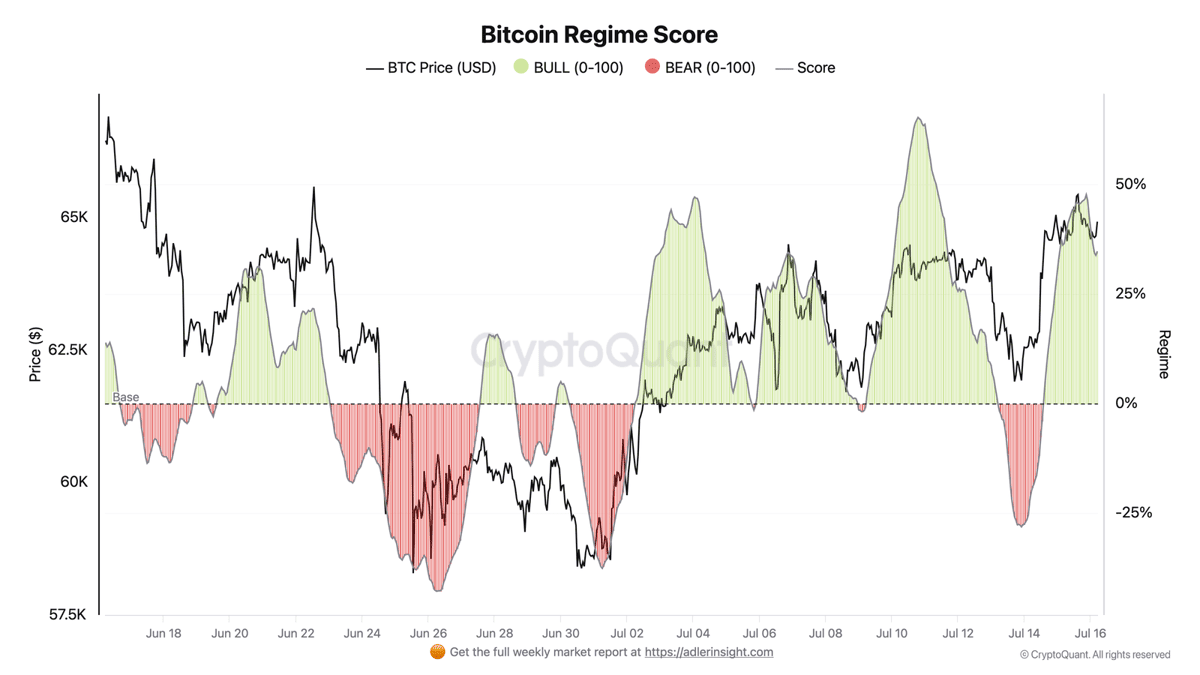
Source: Axel Adler Jr.

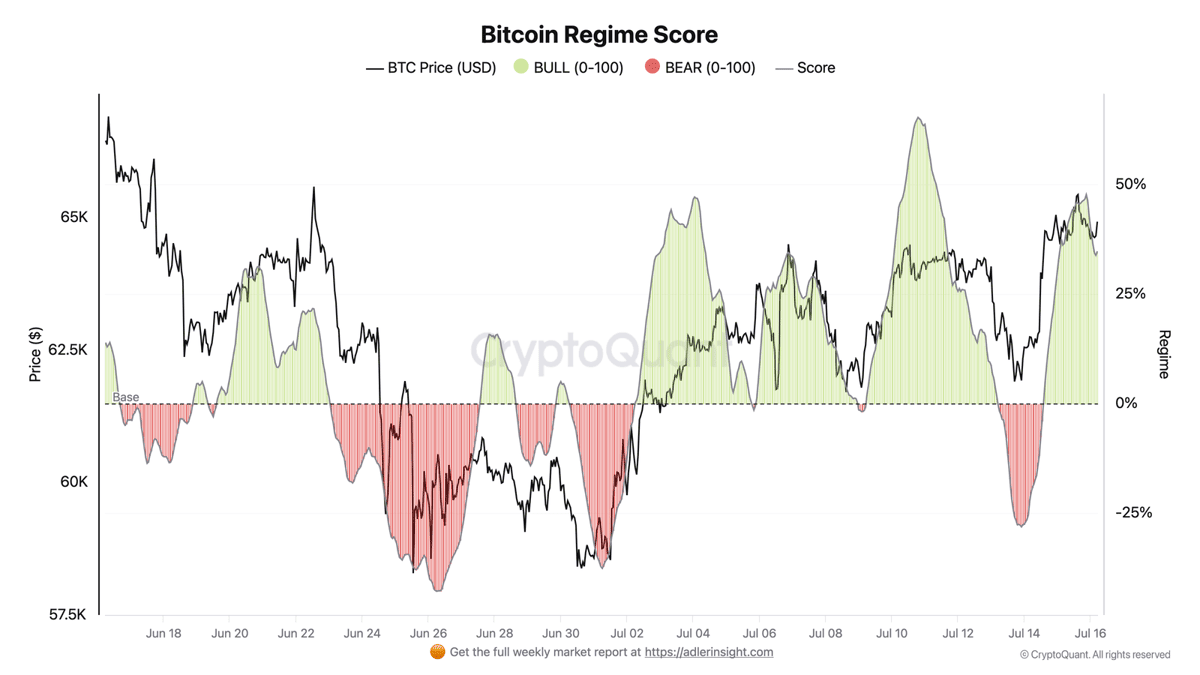
The Bitcoin Regime Score combines taker flow, funding rates, Open Interest, exchange flows, ETF flows, and price trends. Using this metric, crypto analyst Axel Adler Jr. demonstrated that the press time reading of +34.6 put the regime score in modestly bullish territory.

The pullback below zero on 14th July has been reversed since, due to the buying pressure that followed.

Main market components have been pointing in the bullish direction in the short-term, the analyst concluded. In fact, the regime remained bullish for the second consecutive week.

Bitcoin price prediction and the case for an imminent bearish reaction
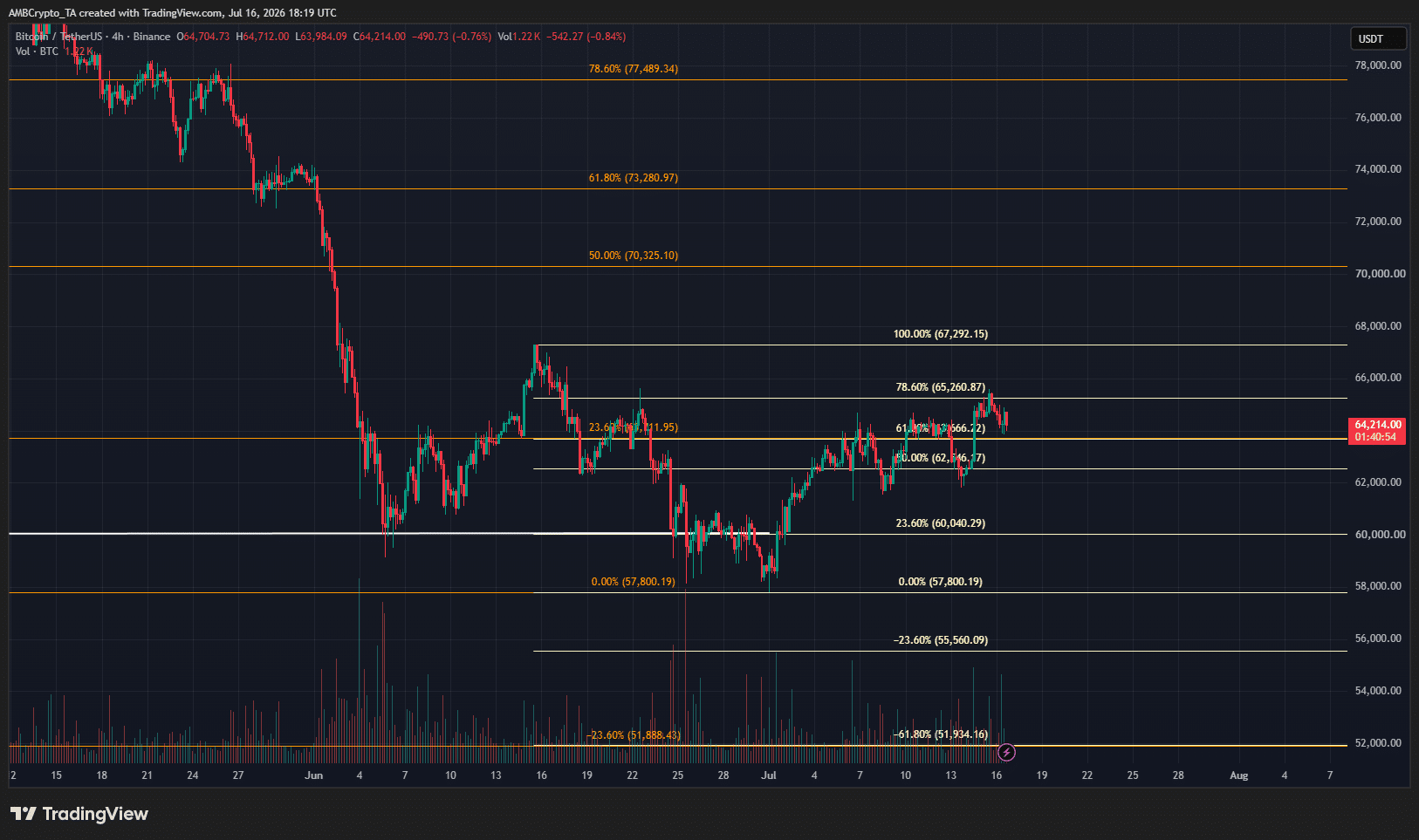
Source: BTC/USDT on TradingView

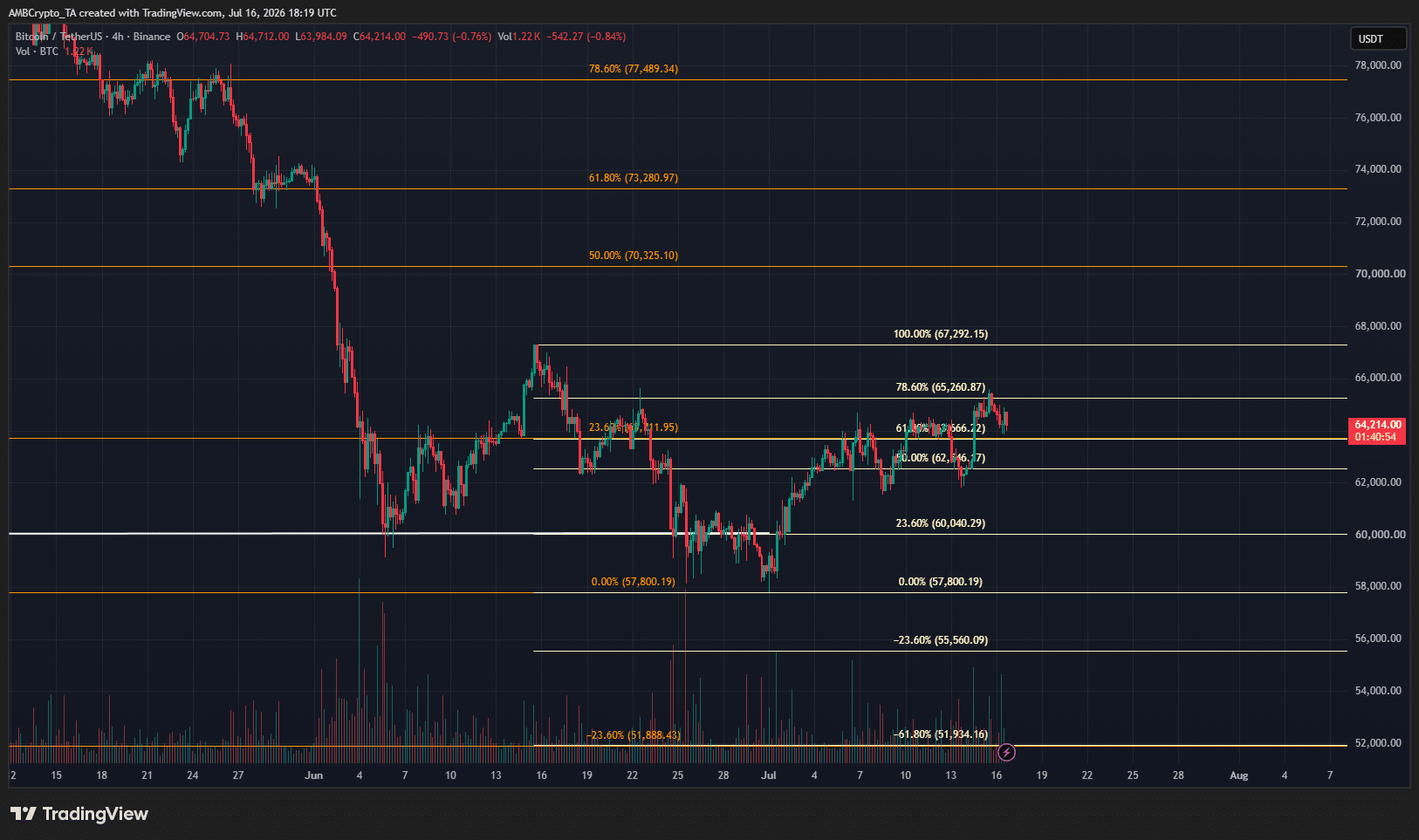
At the time of writing, the price action was at a precarious location. The higher timeframe price trend was bearish. Using the higher timeframe impulse price move from $82,850 to $51,888, Fibonacci retracement levels (orange) were plotted.

Another set of retracement levels was plotted using the 4-hour timeframe’s swing structure. The $65,260-level was the 78.6% retracement level, a key resistance. In recent hours of trading, a bearish reaction ensued too.

It is expected that Bitcoin will continue its downtrend and fall to $55,560 and $51,934 in the coming weeks. This bearish idea would be invalidated upon an H4 session close above $67,292.

In the second scenario, a rally up to $77,489 might materialize before the higher timeframe downtrend takes control.


Final Summary

  • The Bitcoin Regime Score metric showed short-term bullish market components for Bitcoin.
  • Price action showed there was a good chance of rejection from $65.3K and a bearish trend continuation.


Trending Cryptos

Related Questions

QWhat does the Bitcoin Regime Score metric indicate about the current market conditions?

AThe Bitcoin Regime Score, which combines factors like taker flow, funding rates, and ETF flows, had a reading of +34.6 at press time, putting it in 'modestly bullish' territory. The analyst noted that main market components have been pointing in a bullish direction in the short-term, and the regime remained bullish for the second consecutive week.

QWhat are the two potential price targets mentioned if Bitcoin continues its bearish trend?

AIf Bitcoin continues its downtrend, the article suggests it could fall to $55,560 and $51,934 in the coming weeks.

QAccording to the price action analysis, what level would invalidate the bearish idea of a downtrend continuation?

AThe bearish idea of a downtrend continuation would be invalidated upon a 4-hour (H4) candlestick session closing above the $67,292 level.

QHow did recent liquidations compare to the large liquidation event on June 23rd?

ARecent liquidations were modest compared to the event on June 23rd. The past 24 hours saw only $52 million in BTC trader liquidations, whereas the June 23rd event involved nearly $980 million in liquidations when BTC fell from $64.2K to $62K.

QWhat was the reason given for the fragile market conditions potentially stalling a Bitcoin recovery?

AAccording to a Bitfinex analyst cited in the article, the fragile conditions were due to a lack of Bitcoin-specific demand, negative ETF flows, and a negative Coinbase Premium Index.

Related Reads

Prices From the Future Fool the Oracle, Ostium Drained of $24 Million in Five Minutes

Ostium, a perpetual trading platform, suffered a security incident on July 15, resulting in significant losses from its public liquidity vault. Initial analyses from Blockaid, Cyvers, and PeckShield estimate losses of up to $24 million. The exploit occurred over a five-minute window. According to security firms, the core issue was not a missing signature, but a data integrity failure: a registered price oracle (PriceUpKeep) submitted authorized price reports with manipulated future timestamps, creating false trading profits. The protocol’s verification process confirmed the signatures as authorized but did not enforce price sanity checks or timestamp boundaries, allowing the manipulated data to be accepted for settlement. This caused the liquidity vault to pay out on these fraudulent profits. Ostium’s co-founder confirmed the team paused trading within an hour and is collaborating with law enforcement and security experts. The extracted funds were reportedly swapped for ETH, with a portion moved to Tornado Cash. The incident highlights risks in DeFi oracle designs where cryptographic signature verification is insufficient without additional safeguards for data validity, timestamp freshness, and price reasonableness. Ostium's response and planned fixes—including stricter timestamp validation, independent price checks, and circuit breakers—will be critical to preventing similar exploits.

marsbit4m ago

Prices From the Future Fool the Oracle, Ostium Drained of $24 Million in Five Minutes

marsbit4m ago

Li Shanyou: The World Is Getting More Competitive, But We Can Choose to Be Slower, Go Deeper, and Turn Inward

**Title:** Li Shanyou: The World Is Moving Faster and More Chaotically; We Can Choose to Be Slower, Deeper, and More Inward **Summary:** In an era where AI evolves weekly and past experiences often fail, the article argues for returning to First Principles. It shifts focus from "cognition" (knowledge/content), which AI has disrupted, to "consciousness" or "the capacity to know"—the foundational ability that enables cognition and determines its scope and depth. The piece uses Zhang Yiming (founder of ByteDance) as a case study for the "second-order consciousness" of the mobile internet era: success through rational logic, modeling, and deduction, which allowed him to surpass earlier "first-order" entrepreneurs reliant on copying experiences. However, the author suggests that the AI era demands a further leap to "third-order consciousness"—operating from a place of inner inspiration, vision, or "ideas," beyond pure rationality. Figures like Elon Musk and Steve Jobs are cited as examples, with DeepSeek's Liang Wenfeng presented as a potential representative of this new, AI-native wave of entrepreneurs driven by curiosity and innovation rather than just commercial logic. For the majority who may not become such visionary leaders, the author proposes an alternative path: the "Path of Quality" or "Work as Art." This involves turning inward, focusing on the immediate task at hand, and imbuing one's work with care and dedication—creating a "quality" product not as a means to an end, but as an end in itself. This process refines both the work and the individual's own consciousness. In a hyper-competitive, fast-paced world, this path offers a counterpoint: to be slower, go deeper, and focus inward, finding meaning by creating quality in everyday endeavors, regardless of scale.

marsbit1h ago

Li Shanyou: The World Is Getting More Competitive, But We Can Choose to Be Slower, Go Deeper, and Turn Inward

marsbit1h ago

1inch Co-founder Anton Bukov Leaves, Launches New Project Second Tier

Anton Bukov, co-founder of the decentralized exchange aggregator protocol 1inch, has announced his departure from the company's daily operations. Bukov, who was instrumental in designing core 1inch architectures like the Router, Fusion, and cross-chain Swap, ceased involvement in November 2025 due to strategic and leadership disagreements, though he retains his co-founder title and 50% equity stake. Concurrently, Bukov unveiled his new venture, Second Tier (tier.xyz), describing it as infrastructure to "shorten the distance between economic intent and on-chain execution." He explicitly stated it is not a DEX or aggregator. The project's public-facing material is currently a manifesto criticizing systemic financial friction and advocating for building new architectural categories rather than competing within existing ones. No product details, team, or funding have been disclosed. The split highlights a strategic divergence within 1inch. While CEO Sergej Kunz has steered the company toward traditional finance integration—evidenced by a 2025 brand refresh and a major Coinbase partnership—Bukov emphasized a commitment to decentralized, permissionless DeFi principles. Bukov's exit coincides with a challenging period for 1inch. Q1 2026 data shows a 60.3% quarterly drop in its daily average trading volume to $97.1 million, underperforming the broader DEX aggregator market decline. Its market share fell from 25.2% to 17.0%, dropping it to fourth place among competitors. Key questions remain regarding Bukov's future role as a major 1inch shareholder, the timeline for Second Tier's product development, and whether 1inch's institutional-focused strategy can reverse its declining trading metrics.

Foresight News1h ago

1inch Co-founder Anton Bukov Leaves, Launches New Project Second Tier

Foresight News1h ago

Trading

Spot

Hot Articles

How to Buy MOVE

Welcome to HTX.com! We've made purchasing Movement (MOVE) simple and convenient. Follow our step-by-step guide to embark on your crypto journey.Step 1: Create Your HTX AccountUse your email or phone number to sign up for a free account on HTX. Experience a hassle-free registration journey and unlock all features.Get My AccountStep 2: Go to Buy Crypto and Choose Your Payment MethodCredit/Debit Card: Use your Visa or Mastercard to buy Movement (MOVE) instantly.Balance: Use funds from your HTX account balance to trade seamlessly.Third Parties: We've added popular payment methods such as Google Pay and Apple Pay to enhance convenience.P2P: Trade directly with other users on HTX.Over-the-Counter (OTC): We offer tailor-made services and competitive exchange rates for traders.Step 3: Store Your Movement (MOVE)After purchasing your Movement (MOVE), store it in your HTX account. Alternatively, you can send it elsewhere via blockchain transfer or use it to trade other cryptocurrencies.Step 4: Trade Movement (MOVE)Easily trade Movement (MOVE) on HTX's spot market. Simply access your account, select your trading pair, execute your trades, and monitor in real-time. We offer a user-friendly experience for both beginners and seasoned traders.

5.0k Total ViewsPublished 2024.12.10Updated 2026.06.02

How to Buy MOVE

Discussions

Welcome to the HTX Community. Here, you can stay informed about the latest platform developments and gain access to professional market insights. Users' opinions on the price of MOVE (MOVE) are presented below.

活动图片