State Street, Galaxy and Ondo join tokenized cash race with 24/7 sweep fund

cointelegraphPublished on 2025-12-11Last updated on 2025-12-11

Abstract

State Street Investment Management, Galaxy Asset Management, and Ondo Finance are launching a tokenized liquidity fund called the State Street Galaxy Onchain Liquidity Sweep Fund (SWEEP). The fund will use PayPal’s PYUSD stablecoin to allow accredited investors to move cash "sweep" balances onto public blockchains, enabling 24/7 onchain liquidity. Ondo will seed the fund with $200 million. State Street will serve as custodian, while Galaxy provides digital asset infrastructure. The fund is set to launch on Solana in early 2026, with plans to expand to Stellar and Ethereum using Chainlink’s CCIP. This move places SWEEP in a growing race among institutions like BlackRock and Franklin Templeton to define onchain cash and tokenized real-world assets (RWA). The partnership highlights the convergence of traditional finance and crypto, with each firm contributing regulatory oversight, infrastructure, and distribution networks. Solana was chosen for its low fees and fast settlement, appealing to large institutions adopting blockchain for digital assets.

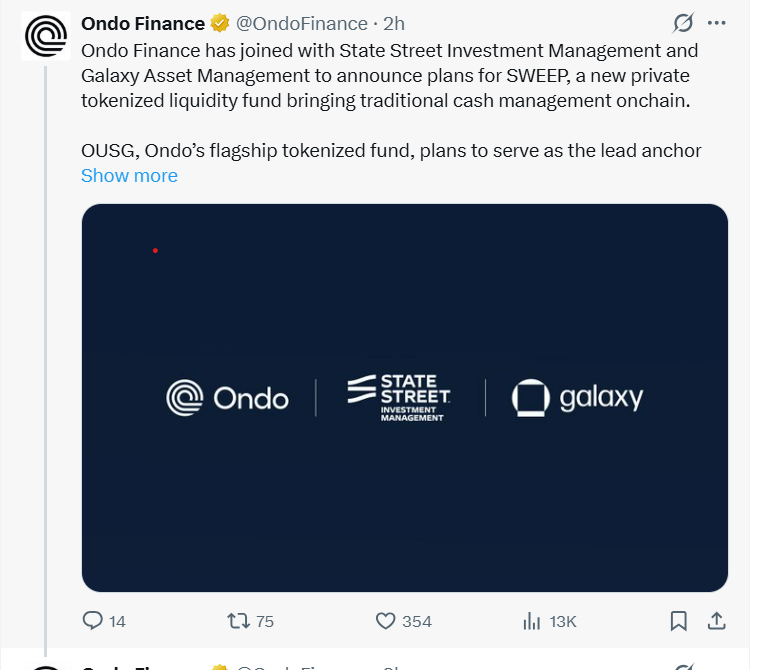
State Street Investment Management and Galaxy Asset Management are joining forces with Ondo Finance on a tokenized liquidity fund that pushes cash “sweep” balances directly onto public blockchains, opening up a source of potential 24/7 onchain liquidity.

The planned State Street Galaxy Onchain Liquidity Sweep Fund, or SWEEP, is designed to take in and pay out PayPal’s (PYUSD) stablecoin for accredited investors, the companies said Tuesday.

Ondo is expected to seed the fund with $200 million, tying a major tokenized real-world asset (RWA) issuer directly into State Street’s tokenization stack. The fund will be powered by Galaxy Digital infrastructure, and State Street Bank and Trust Company, an affiliate of State Street Investment Management, will act as custodian.

SWEEP is set to launch on Solana in early 2026, with rollouts on other networks, including Stellar and Ethereum, to follow, using Chainlink’s Cross-Chain Interoperability Protocol (CCIP).

Related: Solana and Coinbase’s Base connect together using Chainlink

Race to define onchain cash

The move drops another heavyweight into an increasingly crowded race to define what “onchain cash” looks like for institutions. BlackRock and Franklin Templeton already run tokenized cash‐management vehicles, including money‐market and other short‐term fixed‐income funds, on public blockchains. For its part, Ondo has built a business around wrapping Treasurys and other credit exposures into onchain vehicles that can plug into crypto markets.

“By partnering with Galaxy, we will push the envelope together and drive the evolution of the TradFi landscape onchain,” said Kim Hochfeld, global head of cash and digital assets for State Street Investment Management.

“Tokenization is rapidly becoming the connective tissue between traditional finance and the onchain economy,” said Ian De Bode, president of Ondo Finance. “Our planned investment would not only anchor this innovative fund – but also supports the continued growth of Ondo’s fund that offers institutional investors exposure to short-term US Treasuries with 24/7 instant mints and redemptions.”
Source: Ondo Finance

Related: Blockchain trial on Canton Network tests collateral reuse with tokenized US Treasurys

Building an onchain capital markets stack

The launch comes as tokenized funds and tokenized equities are starting to resemble components of an emerging onchain capital markets stack more than isolated pilots.

Superstate opened up onchain capital raising for US Securities and Exchange Commission‐registered public companies via its Direct Issuance Programs on Ethereum and Solana Wednesday, targeting the equity side of that stack by letting issuers sell new stock directly for stablecoins and settle immediately to investor wallets.

State Street’s partnership with Galaxy and Ondo also highlights how the roles are shaping up as traditional finance and crypto firms share the same products. State Street brings Big Four regulatory cover and custody, Galaxy contributes digital‐asset infrastructure and tokenization expertise, and Ondo provides both capital and an existing RWA distribution network.

Related: Galaxy expands into UAE as part of Middle East push

Solana’s role in the tokenization race

Solana’s role as the initial venue highlights a second competitive race unfolding beneath the product arms race. The chain has become a favored home for tokenized assets and high‐throughput trading, from tokenized public shares to experiments in onchain liquidity funds, as issuers look for lower fees and fast settlement.
Source: Solana

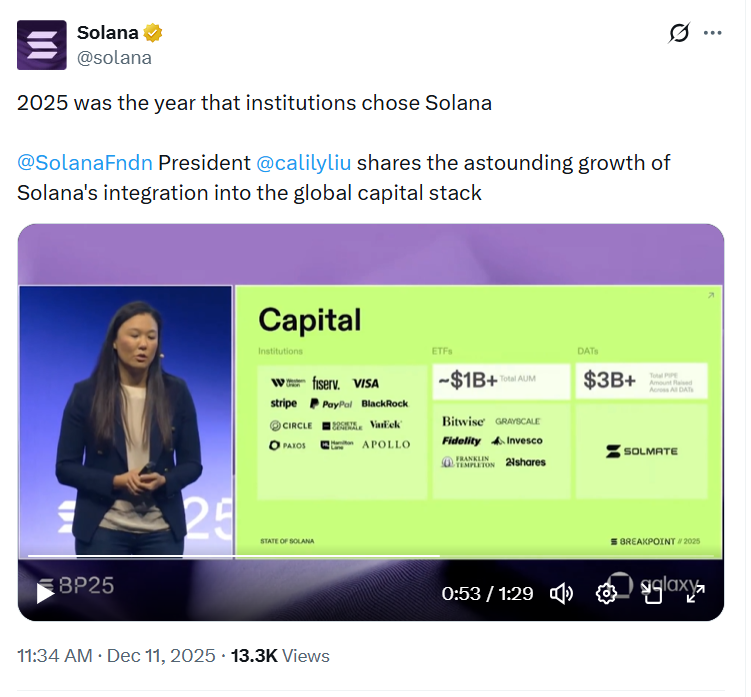
Some of the largest institutions in the world have chosen the Solana blockchain for their digital assets play, including Western Union, which processes over $100 billion in remittance volume every year, and Pfizer, which processes $2 trillion of merchant payment volume annually. Physical staked exchange-traded funds (ETFs) on Solana have also almost reached $1 billion in assets under management.

Launching on Solana first, with plans to expand to Stellar and Ethereum, allows SWEEP to tap into multiple ecosystems where stablecoins and RWA tokens are already part of the infrastructure.


Trending Cryptos

Related Reads

Two Funding Rounds in Three Months: The Chinese Version of Palantir is on Fire

Investment Community AI has learned that Beijing Zhongshu Ruizhi Technology Co., Ltd., a domestic industrial-grade causal intelligence and high-reliability decision-making AI company, has recently completed a strategic financing round worth hundreds of millions of RMB. This round saw participation from China Internet Investment Fund, Suzhou Chuangtou National Social Security Fund, Financial Street Capital, ICBC Capital, Kunlun Capital, among others, with existing shareholders also increasing their investment. This follows a Series B funding round in the hundreds of millions completed just three months prior. The rapid succession of two major funding rounds signifies strong market recognition of the company's underlying original technology and scaled commercial implementation. Often referred to as the "Chinese version of Palantir," Zhongshu Ruizhi is entering a new phase of accelerated technological iteration, widespread scenario replication, and scaled performance release, mirroring the explosive growth of China's AI market. Founded in April 2020 by Dr. Han Han, a Tsinghua University Ph.D. and former core drafter of national AI policies, the company is mission-driven to "move AI from the digital world to the physical world." It focuses on the high-reliability, strong-decision industrial AI track and enterprise-grade AI Agent full-stack infrastructure. The team tackles the challenge of applying AI to China's vast and complex industrial and energy systems by developing a new intelligent operating system from scratch. Its core technological breakthrough lies in three proprietary底层 technologies: meta-causal cognitive theory, causal models, and a dynamic ontology engine. These address critical pain points of generative large models in industrial settings—such as AI hallucinations, insufficient reasoning, lack of temporal logic, unverifiable decisions, and multi-source rule conflicts—thereby providing trustworthy, explainable, and executable智能决策 capabilities. Commercially, Zhongshu Ruizhi has achieved scaled deployment, serving over 50 central state-owned enterprises and industrial groups in sectors like power, petroleum, and aerospace, with implementations in more than 800 highly complex production scenarios. The company reported doubled revenue in 2025, demonstrating strong self-sufficiency and a viable business model—a rarity among new-generation AI firms. The latest funds will be allocated towards advancing foundational theoretical research, replicating successful application models to expand market presence (including overseas), and attracting top-tier talent. Lead investor China Internet Investment Fund highlighted that in the current shift from general AI capability contests to deep industrial empowerment, industrial-grade causal intelligence is crucial for building China's modern digital foundation and fostering new quality productive forces. They expressed support for the company's efforts to define decision-making paradigms and trustworthy standards for industrial intelligence, aiming to secure a rule-making voice in the global physical AI arena.

marsbit8m ago

Two Funding Rounds in Three Months: The Chinese Version of Palantir is on Fire

marsbit8m ago

The Biggest Political Economy Question in the AI Era: As Robots Become More Capable, How Do Humans Share the Value?

In the AI era, the most pressing political economy question is: as machines become increasingly capable, how can humanity share in the value they create? An article originally critiquing China's tech focus has sparked a deeper debate on this global challenge. Historically, industrial progress improved efficiency but still relied on human labor for wealth creation and distribution. AI is fundamentally different—it is now replacing cognitive and knowledge work. As AI and robots take over more tasks, economic growth may continue while direct human participation in value creation shrinks, creating a core tension between productivity gains and widespread income generation. The issue is not unique to China. While leading tech companies amass enormous wealth, labor's share of income is declining globally. The core problem is a broken link: technological innovation and corporate profits are not translating into sufficient consumer income and demand. Three potential paths forward are outlined: a traditional capitalist model where profits primarily go to capital owners; a state-capitalist approach with public investment in AI; and more innovative models like digital sovereign wealth funds, universal shareholding, or AI-era basic income schemes to directly distribute AI-generated value. The future competitive advantage may lie not just in technological supremacy, but in which society can build a new, inclusive distribution system for the intelligent economy. The ultimate challenge is ensuring that as AI creates value, humans have a means to obtain income and share in the resulting widespread social benefits.

marsbit19m ago

The Biggest Political Economy Question in the AI Era: As Robots Become More Capable, How Do Humans Share the Value?

marsbit19m ago

Generating Profits for Seven Consecutive Quarters, Emerging Markets Carry Trade Outperforms Everything

For the seventh consecutive quarter, dollar-funded emerging market carry trades have delivered positive returns, marking the longest winning streak since 2008. According to Bloomberg's index, this strategy has gained approximately 22% since late 2024, outperforming U.S. Treasuries, emerging market sovereign, and corporate dollar debt. The core of the trade involves borrowing low-interest currencies like the U.S. dollar, euro, or yen to invest in high-yielding emerging market assets, such as Turkish lira bonds offering over 40% returns. Returns were amplified by favorable currency moves, with the dollar weakening against most emerging market currencies and other traditional funding currencies. For instance, the trade gained 48% on the Colombian peso in the past year. A key test came in August 2024 with a historic joint U.S.-Japan currency intervention, which caused only a modest 1% dip in the carry trade risk premium as investors shifted funding from the yen to the euro and Swiss franc. Looking ahead, the primary risk is the timing of Federal Reserve policy changes. While persistent inflation allows the Fed to hold rates, a rapid rise in long-term U.S. yields could threaten the trade. Another concern is crowding, as massive inflows increase vulnerability to a sudden reversal. High interest rates in regions like Latin America and Eastern Europe, supported by external factors like Middle East tensions and energy prices, continue to sustain the opportunity. Major investors remain engaged, favoring currencies like the Mexican peso, South African rand, and Turkish lira.

marsbit34m ago

Generating Profits for Seven Consecutive Quarters, Emerging Markets Carry Trade Outperforms Everything

marsbit34m ago

Trading

Spot

Hot Articles

How to Buy ONDO

Welcome to HTX.com! We've made purchasing OndoFinance (ONDO) simple and convenient. Follow our step-by-step guide to embark on your crypto journey.Step 1: Create Your HTX AccountUse your email or phone number to sign up for a free account on HTX. Experience a hassle-free registration journey and unlock all features.Get My AccountStep 2: Go to Buy Crypto and Choose Your Payment MethodCredit/Debit Card: Use your Visa or Mastercard to buy OndoFinance (ONDO) instantly.Balance: Use funds from your HTX account balance to trade seamlessly.Third Parties: We've added popular payment methods such as Google Pay and Apple Pay to enhance convenience.P2P: Trade directly with other users on HTX.Over-the-Counter (OTC): We offer tailor-made services and competitive exchange rates for traders.Step 3: Store Your OndoFinance (ONDO)After purchasing your OndoFinance (ONDO), store it in your HTX account. Alternatively, you can send it elsewhere via blockchain transfer or use it to trade other cryptocurrencies.Step 4: Trade OndoFinance (ONDO)Easily trade OndoFinance (ONDO) on HTX's spot market. Simply access your account, select your trading pair, execute your trades, and monitor in real-time. We offer a user-friendly experience for both beginners and seasoned traders.

6.6k Total ViewsPublished 2024.03.29Updated 2026.06.02

How to Buy ONDO

Discussions

Welcome to the HTX Community. Here, you can stay informed about the latest platform developments and gain access to professional market insights. Users' opinions on the price of ONDO (ONDO) are presented below.

活动图片