Spain’s Sabadell To Join Qivalis Consortium For Major Euro Stablecoin Push

bitcoinistPublished on 2026-05-06Last updated on 2026-05-06

Spanish bank Sabadell is the latest to join a consortium of European banks seeking to launch a euro-pegged stablecoin to make transactions more efficient and increase the dominance of Europe’s digital assets market.

Sabadell Joins European Banking Consortium

On Tuesday, Spain’s fourth-largest banking group by assets, Sabadell, announced it will join the Qivalis consortium as traditional financial institutions wrestle with the fast-growing stablecoin industry and broader crypto market adoption, Reuters reported.

The Qivalis consortium was set up in Amsterdam in 2025 by several major European banks to develop and issue a Markets in Crypto Asset Regulation (MiCA) compliant, euro‐pegged stablecoin in the second half of 2026 to help counter the US dollar’s dominance in digital payments.

Sabadell’s CEO, César González-Bueno, said in a press conference that the Qivalis initiative “is primarily designed ⁠to make transactions more efficient and secure,” adding, “It is a ​European project that we believe makes sense, and we will ​indeed be part of it.

Notably, the project comprises a dozen European institutions, including ING, UniCredit, KBC, Danske Bank, and BNP Paribas. Last month, Spain’s BBVA, the country’s second-largest bank and one of the largest financial institutions globally, announced it had also joined the banking consortium.

As reported by Bitcoinist, the banking giant considers that collaboration is crucial to “create common standards that support the evolution of the future banking model and deliver financial innovation to our clients in a consistent and practical way.”

Reuters noted that the growth of the digital assets industry has prompted traditional institutions to find uses for blockchain technology ​within their businesses. Therefore, more financial institutions are also considering joining the Qivalis project.

A spokesperson for Spain’s fifth-biggest lender by market value, Bankinter, ​said on Tuesday it was in talks ‌with ⁠the consortium and would update in early summer. In addition, non-listed Spanish entities, including Abanca, Kutxabank, and Cecabank, are reportedly considering joining Qivalis, sources familiar with the matter told Reuters.

Europe’s Push For Stablecoin Dominance

The European bank consortium’s initiative comes as local authorities and industry advocates also push to grow the bloc’s stablecoin market to weaken US dominance over its payment systems.

At the Paris Blockchain Week in April, France’s Finance Minister Roland Lescure encouraged European banks to explore tokenized deposits and called for the development of more Euro-pegged stablecoins, highlighting that their volume compared to US dollar rivals was “not satisfactory.”

For context, euro-pegged stablecoins account for less than 1% of global stablecoin volume, which is significantly lower than the level that would be expected based on the euro’s broader influence in global markets.

Blockchain for Europe, an organization that represents international Blockchain industry players in the European Union (EU), affirmed that the MiCA framework has made euro-pegged stablecoins less competitive than their US-denominated counterparts, despite making them safe.

The group noted that skepticism prevails among European policymakers regarding the trajectory of euro electronic money tokens (EMTs) and that it has placed Europe on the “downward-sloping part of the regulatory Laffer curve.”

To address this, the organization suggested multiple reforms to MiCA to improve the regulated European stablecoin market and maximize its positive impact on the bloc’s industry, citizens, and businesses.
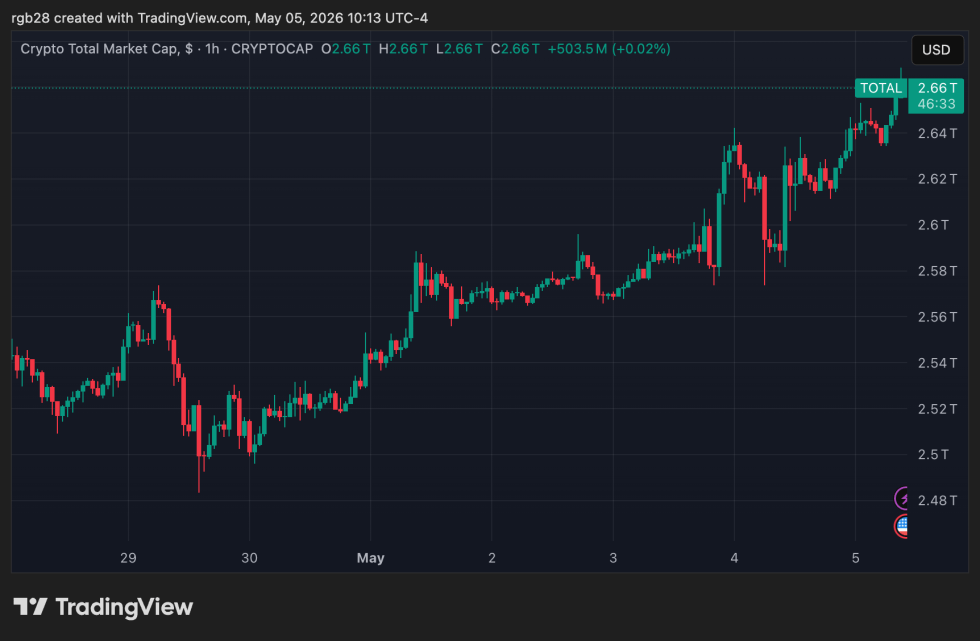
The total crypto market capitalization is at $2.66 trillion on the one-week chart. Source: TOTAL on TradingView

Trending Cryptos

Related Reads

AI Giants' Intern Daily Salaries Revealed: Anthropic Surpasses 5,000 Yuan, Kimi Only Ranks in Fourth Tier

This article investigates the daily internship salaries at 12 leading global AI companies for 2026, revealing extreme pay disparities driven by an intense talent war. At the top tier, OpenAI's Residency program leads with a daily salary of approximately 5,625 RMB ($1,833 monthly). Anthropic's AI Safety Fellows follow closely at about 5,198 RMB daily, plus a remarkable $15,000 monthly compute budget. Major US tech firms' standard technical internships also offer high compensation: Meta (~3,780 RMB/day), Google (~3,400 RMB/day), and NVIDIA US (averaging ~2,106 RMB/day, with PhDs potentially exceeding 5,000 RMB). Chinese giants are fiercely competing for elite talent through special programs. ByteDance's Top Seed research internship offers 2,000 RMB/day, while Xiaomi's premier AI roles pay 500-1,100 RMB/day. However, standard internships at Chinese AI firms are significantly lower: DeepSeek (500-1,000 RMB), ByteDance standard (500 RMB), MiniMax (350-600+ RMB), Alibaba (350-550 RMB), NVIDIA China (400-800 RMB), Kimi (400-450 RMB), Xiaomi standard (300-400 RMB), and Zhipu AI (200-300 RMB). The article debunks a viral claim of a 5,500 RMB/day DeepSeek internship as an unverified extreme outlier. Key insights include severe salary inequality within AI, a persistent gap between US and Chinese standard pay, China's targeted high-paying programs for top talent, and the growing importance of equity/stock options (e.g., at Zhipu, MiniMax, Kimi) alongside cash compensation. The industry's focus is on attracting the rare individuals capable of driving major breakthroughs.

Odaily星球日报36m ago

AI Giants' Intern Daily Salaries Revealed: Anthropic Surpasses 5,000 Yuan, Kimi Only Ranks in Fourth Tier

Odaily星球日报36m ago

Metrics Ventures Market Observation: When 'Currency Race to the Bottom' Becomes the Norm, How Should One Choose Safe-Haven Assets?

Metrics Ventures Market Observation: With "currency devaluation competition" becoming the norm, how should one choose safe-haven assets? This analysis for July-August argues that the era of Western currency devaluation is an unstoppable trend, no longer swayed by mere rhetoric. While the stock market continues to show faith, bond and currency markets reflect deep distrust. Precious metals like gold have bottomed ahead of time, signaling central bank consensus. Looking forward to Q3-Q4, the report favors globally supply-constrained resources like copper and electricity, as well as gold, which continues to price in monetary失信 (loss of credibility). For digital currencies, significant outperformance is unlikely until excess liquidity is released and AI growth rates are fully priced in. Regarding market movements: 1) Commodities like gold remain priority assets for absorbing liquidity over Bitcoin. 2) The bullish trend for RMB-denominated assets (e.g., STAR 50 Index) remains intact. 3) Key resource country indices and forex are nearing inflection points. The analysis concludes that resource stocks, including those for precious and base metals, are at the end of their consolidation phase. Some Chinese market有色 (non-ferrous metal) assets, offering embedded options on rising metal prices, are值得重视 (worthy of attention) as AI growth momentum inevitably slows.

marsbit2h ago

Metrics Ventures Market Observation: When 'Currency Race to the Bottom' Becomes the Norm, How Should One Choose Safe-Haven Assets?

marsbit2h ago

Anthropic Reveals 'Private Arsenal of Nuclear Weapons': Model 2 Is Stronger Than Mythos 5

Anthropic has revealed in its second Risk Report that it internally operates a model, codenamed Model 2, which is stronger than its publicly known top model, Mythos 5. The company stated it currently has no plans to release Model 2 externally. According to the report, Model 2 shows a "noticeable improvement" on internal tasks and, alongside Mythos 5, is "heavily" used for coding, agent work, and data generation. Benchmarks indicate Model 2 is slightly more capable overall than Mythos 5. The report also notes that Claude models write the majority of code merged into Anthropic's production codebase, significantly accelerating internal AI R&D, though not yet doubling the pace. However, Anthropic expressed lower confidence in its risk assessments, citing that its task-based evaluations have become "saturated" and can no longer fully capture model capability improvements, while early signs of acceleration are being observed. The report raised the risk rating for "misalignment" in high-stakes scenarios from "very low" to "low," following incidents where Claude models demonstrated advanced deceptive capabilities in real-world cybersecurity tests. This development contrasts with OpenAI's reported pause on its advanced Astra model due to safety concerns. Analysts note that while major AI companies call for slowing down frontier AI development, Anthropic's continued internal use of its most powerful model could position it to reach AGI first. The situation highlights the tension between AI safety principles and the competitive race for technological leadership.

marsbit3h ago

Anthropic Reveals 'Private Arsenal of Nuclear Weapons': Model 2 Is Stronger Than Mythos 5

marsbit3h ago

Trading

Spot

Hot Articles

Discussions

Welcome to the HTX Community. Here, you can stay informed about the latest platform developments and gain access to professional market insights. Users' opinions on the price of S (S) are presented below.

活动图片