SpaceX's IPO Gives Birth to a Trillionaire, Musk's Wealth Equals Half of the Crypto Market

marsbitPublished on 2026-06-15Last updated on 2026-06-15

Abstract

Elon Musk becomes the first person in modern history to surpass a net worth of $1 trillion, driven by SpaceX's record-breaking IPO, which valued the company at $2.2 trillion. Musk's wealth, estimated at $1.11 trillion, now exceeds the combined market capitalization of all cryptocurrencies excluding Bitcoin, highlighting extreme wealth concentration and a decline in altcoin valuations. The IPO saw unprecedented trading volume, setting a new single-day record. Despite this milestone, Musk remains deeply involved in the crypto space; he personally holds Bitcoin, Ethereum, and Dogecoin, while SpaceX and Tesla hold significant Bitcoin reserves collectively ranking among the top corporate holders. His acquisition of X (formerly Twitter) further integrates financial data into social media. However, his vast fortune remains largely tied to volatile stock prices rather than liquid assets.

Author: Oluwapelumi Adejumo

Compiled by: Saoirse, Foresight News

Key Highlights

  • Following SpaceX's public listing, Elon Musk has become the first person in modern history with a personal net worth exceeding $1 trillion.
  • His total wealth of $1.11 trillion surpasses the combined market capitalization of all cryptocurrencies excluding Bitcoin, highlighting extreme wealth concentration and the continued valuation erosion of altcoins.
  • This wealth milestone remains highly dependent on stock price fluctuations; meanwhile, multiple companies under Musk hold Bitcoin, and he remains an active, public participant in the digital asset space.

Elon Musk has now become the first individual in modern history to surpass the $1 trillion mark in personal net worth. SpaceX's record-breaking public listing last week propelled him past this historic wealth threshold.

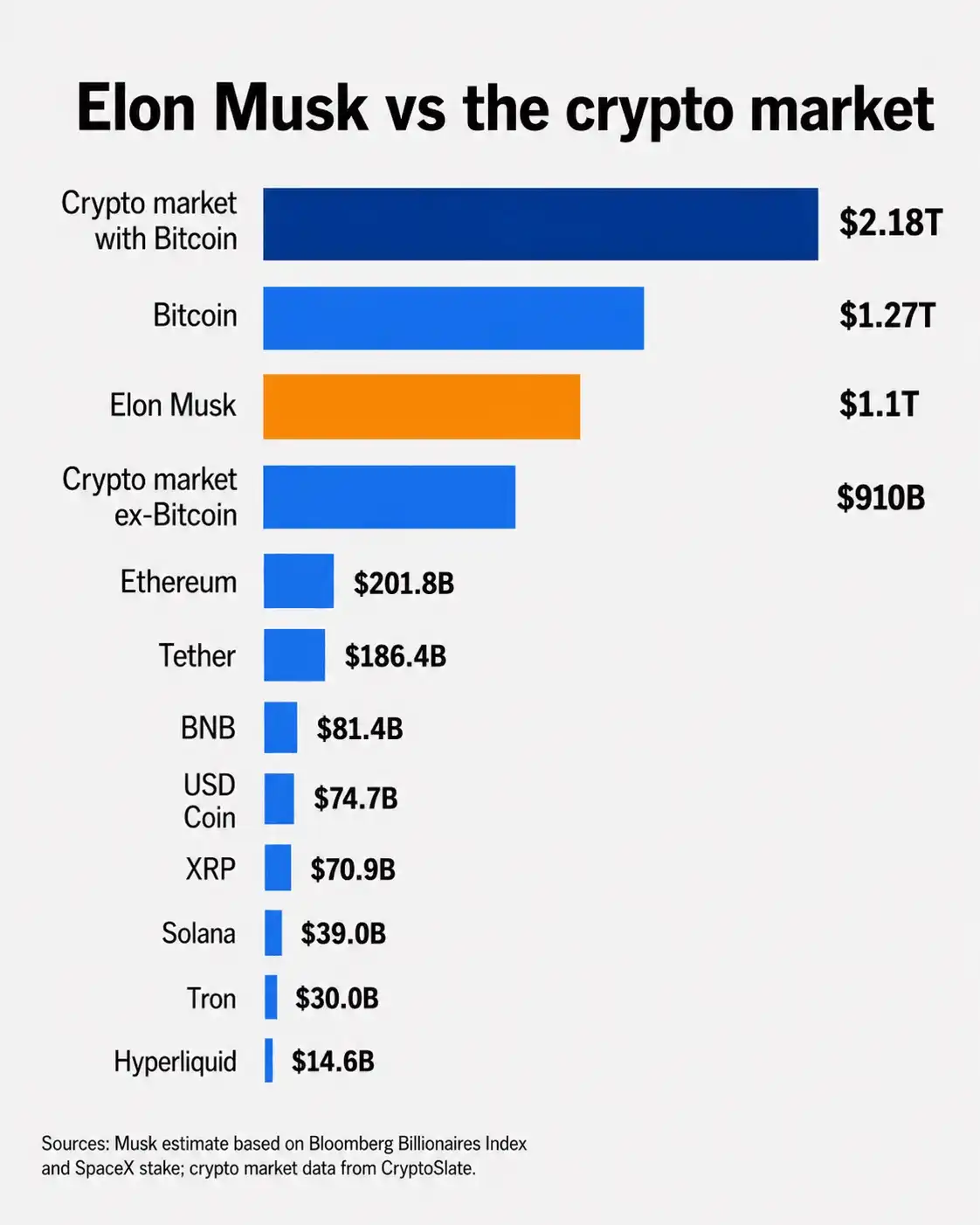
According to the Bloomberg Billionaires Index, the tech entrepreneur's total wealth currently stands at $1.11 trillion.

To put the unprecedented scale of this capital into perspective: Musk's personal net worth is higher than the total market capitalization of the global cryptocurrency market excluding Bitcoin. If the world's largest digital asset, Bitcoin, is included in the calculation, his wealth is exactly equal to half of the entire crypto industry's total market cap.
This wealth milestone quickly sparked global discussions about wealth concentration, as the scale of Musk's fortune even exceeds the Gross Domestic Product of several developed countries.

SpaceX's IPO Breaks Multiple Records

The direct trigger for Musk's wealth surge was SpaceX's highly anticipated listing on the Nasdaq.

The company, which focuses on rocket development, communication services, and artificial intelligence, reached a staggering valuation of $2.2 trillion post-listing.

Underwriters initially set the offering price at $135 per share, raising $75 billion before trading even began.

However, unprecedented investor enthusiasm for the commercial space sector and Musk-affiliated companies drove the stock to open at $150, surge to an intraday high of $176.50, and ultimately close at $161 last Friday.

Market observers noted that the stock listing brought unprecedented market liquidity.

Bloomberg ETF analyst Eric Balchunas pointed out that the stock's trading volume on its first day reached $85 billion. This figure set a new global record for single-day IPO trading volume and ranked among the top ten single-day trading volumes for any individual stock in history, surpassing the highest single-day trading volume of Apple Inc. in any of the past 40 years.
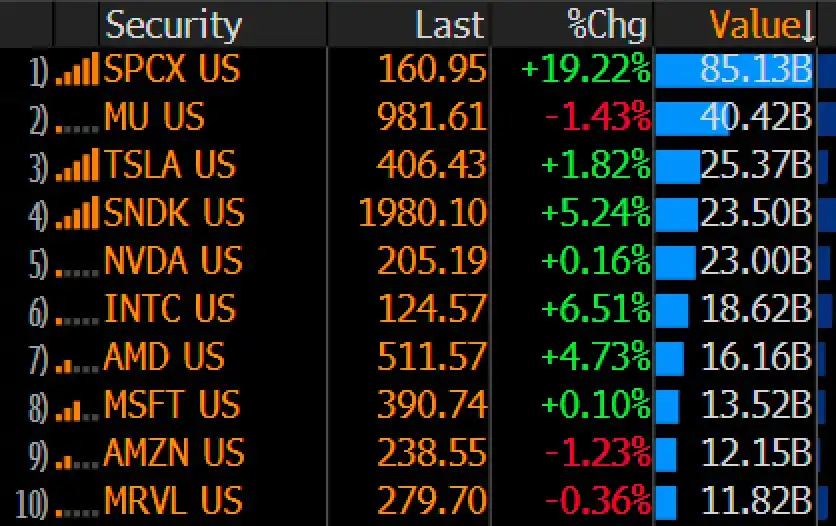
SpaceX Initial Public Offering Trading Volume (Source: Eric Balchunas)

Musk holds a 42% stake in the Hawthorne, California-based company, granting him near unilateral voting control over its operations and strategic decisions.

Musk's Ties to Cryptocurrency

Comparing Musk's wealth scale with the digital asset market clearly shows the significant shift in global capital allocation over the past year.

Data from the TradingView TOTAL2 index shows that the total market capitalization of all altcoins (excluding stablecoins) is approximately $880 billion, a figure easily surpassed by Musk's $1.11 trillion in paper wealth.

Even using the broader statistical approach of data platform CoinGecko—which puts the total global crypto market cap at about $2.27 trillion, with Bitcoin's market cap at $1.28 trillion—the combined value of all remaining altcoins after excluding Bitcoin still falls short of the personal net worth of the SpaceX CEO.

This market cap gap intuitively reflects the significant valuation contraction of the mainstream altcoin market compared to previous cycles. TradingView data shows that in October 2025, the total market cap of crypto assets excluding Bitcoin exceeded $1.7 trillion.
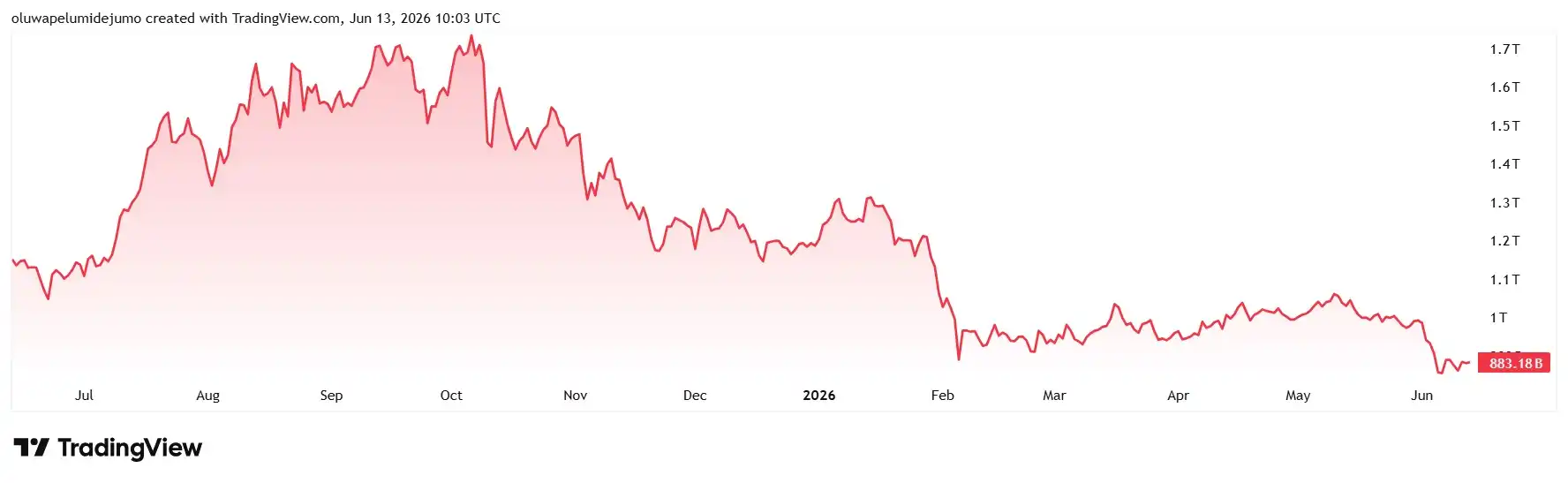
Total Cryptocurrency Market Cap Excluding Bitcoin (Source: TradingView)

This value has nearly halved since then, due to sustained liquidity contraction in the digital asset market and an overall withdrawal of institutional capital from the crypto sector, which has flowed instead into large-cap tech stocks and AI-related equities.

Despite his personal wealth now dwarfing the entire altcoin market, Musk remains deeply intertwined with the digital asset ecosystem, both through personal holdings and corporate balance sheets.

Musk has publicly confirmed that he owns Bitcoin, Ethereum, and Dogecoin. Apart from mentioning a gift of 0.25 Bitcoin in 2018, he has never disclosed his complete personal portfolio, but several of his companies hold institutional-scale positions in the crypto market.

Post-listing regulatory filings reveal that SpaceX's corporate treasury holds 18,712 Bitcoin, corresponding to a value exceeding $1.3 billion. His electric vehicle company Tesla follows a similar strategy, maintaining a long-term holding of 11,509 Bitcoin as part of its corporate liquidity reserve.

If the holdings of both companies were combined, their total Bitcoin holdings would rank fifth globally among publicly traded companies.
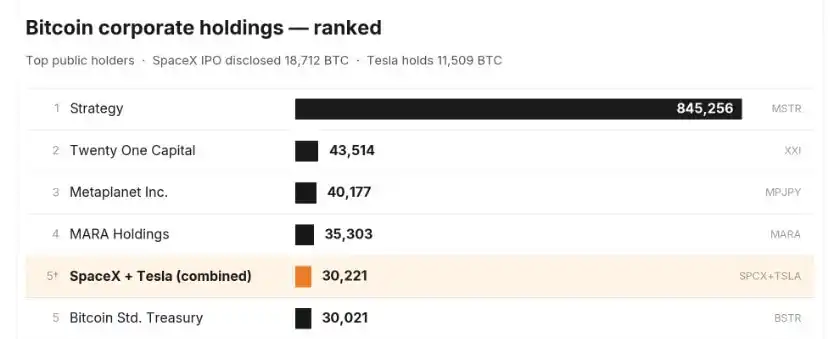
SpaceX and Tesla's Bitcoin Holdings (Source: Bitcoin Treasuries)

Furthermore, Musk's $44 billion acquisition of the social platform X (formerly Twitter) and the integration of financial data tools within the platform have embedded financial market information directly into the mainstream information flow. The platform's built-in cash tag feature displays real-time prices for traditional stocks and various digital assets.

X's official statement clarifies that the platform serves only as a market data tool and does not act directly as a securities broker or cryptocurrency exchange. However, this feature further intertwines Musk's media and commercial ecosystem with the day-to-day functioning of financial markets.

Ultimately, Musk's staggering wealth scale reveals the severe concentration of private wealth in founder-controlled tech giants; it is also important to note that this trillion-dollar fortune is inherently tied to stock market prices and is not a pool of freely spendable cash assets.


Related Questions

QWhat historic milestone did Elon Musk achieve following SpaceX's IPO, according to the article?

AElon Musk became the first person in modern history with a personal net worth exceeding $1 trillion.

QHow does Elon Musk's personal net worth compare to the total cryptocurrency market capitalization, excluding Bitcoin?

AHis personal net worth of $1.11 trillion exceeds the total market capitalization of all cryptocurrencies other than Bitcoin.

QWhat was the approximate valuation of SpaceX following its public listing, as stated in the article?

ASpaceX was valued at an astonishing $2.2 trillion following its public listing.

QWhich two of Elon Musk's companies hold significant amounts of Bitcoin on their corporate balance sheets?

ASpaceX holds 18,712 BTC and Tesla holds 11,509 BTC on their corporate balance sheets.

QWhat key factor does the article highlight as a reason for the shrinking total market cap of altcoins?

AThe article highlights that institutional capital has largely moved away from the crypto sector to flow into large-cap tech and AI-related stocks.

Related Reads

pump.fun's New Feature Brings 'Black Mirror' Into Reality

The article begins by recounting a dark fictional story from *Black Mirror* (Season 7, Episode 1 "Common People"), where a man is forced to perform humiliating tasks online to pay for his wife's life-sustaining medical subscription. It then draws a parallel to a new real-world feature on the crypto platform pump.fun called "Pump.fun Go," which allows users to post and complete paid bounty tasks. This feature gained mainstream attention, often negatively, through extreme examples. A prominent case involved a bounty of 40 SOL (~$2,600) offered to permanently tattoo "$bountywork" on one's forehead. An Indian man completed the task, stating the money "changed his life," and later earned significantly more from a related meme coin. Another bounty paid 200 SOL (~$14,000) for a "bounty.fun" forehead tattoo, with the participant simply stating, "We need the money." The article highlights how this system can amplify darkness, citing the dev behind $Bountywork who spent thousands on bounties for attention-grabbing stunts like eating bugs or drinking hot sauce for small sums. It compares this to past tragic live-streaming incidents where people harmed themselves for money, noting regulation cannot stop those in desperate need. However, it also points to positive, altruistic bounties that have emerged, such as organizing anti-work rallies in New York, performing random acts of kindness for strangers, organizing community food drives, or even helping an elderly person cross the street. The piece concludes by acknowledging the platform reflects both the dark and light sides of human nature when actions are given a price, hoping for more of the latter.

marsbit4m ago

pump.fun's New Feature Brings 'Black Mirror' Into Reality

marsbit4m ago

As the US and Japan Hike Interest Rates, Which Asset Class is Most at Risk?

This week, global markets face two major events: the Bank of Japan's likely interest rate hike and the US Federal Reserve's FOMC meeting. For risk assets, it is a pivotal and volatile week. In the US, expectations for rate cuts have faded dramatically. May's higher-than-expected CPI and resilient jobs data have shifted the Fed's focus from potential cuts to the possibility of future hikes. New Fed Chair Wash is unlikely to raise rates at this meeting, but any hawkish shift in communication, the dot plot, or the policy statement could lead markets to price in tighter policy, pushing up short-term Treasury yields and strengthening the dollar. High-valuation growth stocks, AI-related assets, and small-cap stocks reliant on cheap funding are most vulnerable to rising rates. In Japan, a 25 basis point hike is almost fully priced in (98.3% probability), which would bring the policy rate to 1%, its highest since 1995. The concern is not the hike itself, but its potential to unwind the massive "carry trade," where investors borrowed low-yielding yen to invest globally. Historically, Japan's rate hikes have coincided with global market stress (2000, 2007, 2024). While this well-telegraphed hike may be digested smoothly, two key factors increase uncertainty: 1) Governor Ueda's absence due to illness, putting communication in the hands of less-familiar deputies, and 2) the Fed meeting occurring just days later, creating potential for a compounded market reaction if both central banks sound hawkish. Asset implications: * **Bonds:** US short-term yields sensitive to Fed signals. Japan's rate hike could pressure its massive US Treasury holdings. * **Currencies:** Dollar likely supported by Fed; Yen's reaction hinges on BoJ's forward guidance. * **Equities:** US growth stocks, small-caps most at risk. Japanese stocks face pressure from a stronger yen. * **Crypto:** Assets like Bitcoin face headwinds from higher rates and tighter liquidity; high-beta altcoins are even more vulnerable. The convergence of these two central bank meetings amplifies market volatility risks, with potential spillovers across asset classes globally.

marsbit9m ago

As the US and Japan Hike Interest Rates, Which Asset Class is Most at Risk?

marsbit9m ago

Data Decrypts the BTC Cycle: Three Major Bottom Signals Illuminate Simultaneously, Q4 Could Be a Crucial Turning Point Window?

"Decoding the Bitcoin Cycle: Three Bottom Signals Flash Simultaneously, Is Q4 the Key Turning Point?" The article analyzes Bitcoin's current market position, comparing it to historical cycles. BTC has corrected over 52% from its October 2025 peak of $126,198 to around $59,100 in June 2026. While significant, this drawdown is milder than the 77-86% declines seen in past bear markets. The analysis is framed within Bitcoin's four-year halving cycle. Past cycles show a pattern: prices peak 12-18 months post-halving, bottom 12-14 months after the peak, with lows typically occurring roughly 17 months before the next halving. Following the April 2024 halving and the October 2025 peak, this pattern suggests a potential bottoming window around Q4 2026, ahead of the expected 2028 halving. Three key on-chain metrics are signaling undervaluation: The MVRV Z-Score has dropped near 0.27, approaching historic bottom zones. The market price is only about 9% above the network's average realized price of ~$53,600, a rare low premium. Bitcoin's price recently touched its 200-week moving average (~$62,200), a level that aligned with bottoms in 2015, 2018, and 2020. While US spot Bitcoin ETFs saw record outflows in May/June 2026, indicating retail panic, whale addresses (holding 100+ BTC) reached a yearly high. Entities like MicroStrategy resumed buying, and long-term holders control a near-record 78% of the supply, suggesting accumulation. A major macro overhang was partially removed with a US-Iran ceasefire agreement in mid-June 2026, which eased oil prices and triggered a sharp BTC rally. However, persistent inflation means high-interest rates remain a constraint. The conclusion notes that genuine investment opportunities often arise when confidence is lowest, amidst narratives that "this time is different." While not guaranteeing an immediate bottom, the confluence of cycle timing, undervaluation signals, and shifting macro risks suggests late 2026 may be a critical period for reassessing risk/reward and patient accumulation for long-term believers.

marsbit9m ago

Data Decrypts the BTC Cycle: Three Major Bottom Signals Illuminate Simultaneously, Q4 Could Be a Crucial Turning Point Window?

marsbit9m ago

Trading

Spot
Futures

Hot Articles

Discussions

Welcome to the HTX Community. Here, you can stay informed about the latest platform developments and gain access to professional market insights. Users' opinions on the price of S (S) are presented below.

活动图片