South Korea’s First Bank-Led Crypto Picks A Quantum Security Partner — Here’s Why It Matters

bitcoinistPublished on 2026-05-06Last updated on 2026-05-06

BTQ Technologies has been selected as the core security infrastructure provider for South Korea’s first bank-led Korean Won stablecoin proof-of-concept, deploying its Quantum Secure Stablecoin Network on the Kaia mainnet — a development that positions post-quantum cryptography at the foundation of one of Asia’s most closely watched crypto initiatives.

The initiative is led by iM Bank, one of South Korea’s major commercial lenders, and marks the first time a Korean bank has formally moved a KRW-denominated stablecoin to a public Layer-1 blockchain in a structured proof-of-concept environment.

According to the official press release, BTQ is providing both strategic advisory support and its QSSN product as the primary post-quantum cryptographic security layer for the deployment.
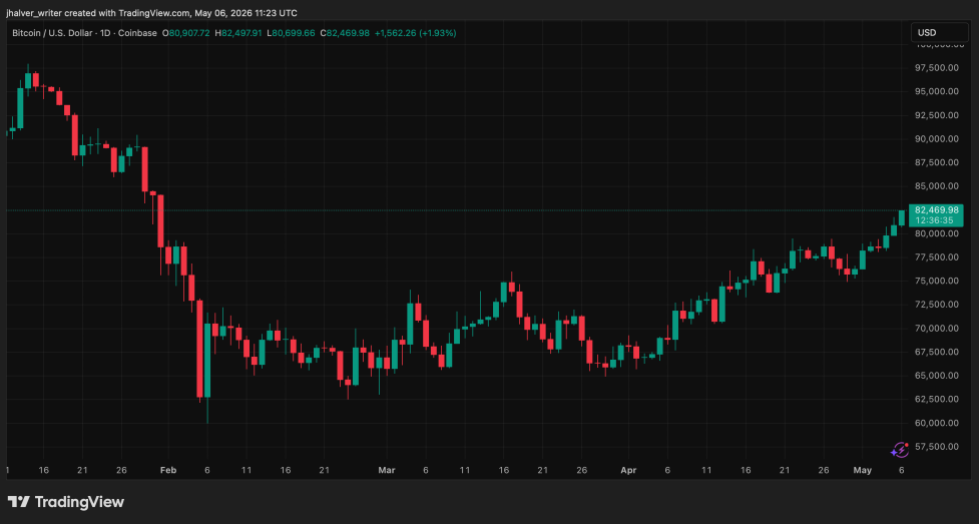
BTC's price trends to the upside on the daily chart. Source: BTCUSD on Tradingview

Solana, Avalanche, And Others Race for the Digital Won

QSSN — the Quantum Secure Stablecoin Network — is designed to enable banks, payment providers, and digital asset platforms to issue and manage stablecoins with built-in protection against quantum-era cybersecurity threats. The system provides quantum-safe smart account wallets for EVM-compatible blockchain networks, using ML-DSA post-quantum cryptography within the ERC-4337 account abstraction standard, per BTQ’s regulatory filings with the SEC.

The choice of Kaia as the underlying network is significant in itself. Kaia is a public Layer-1 blockchain built from the merger of Kakao’s Klaytn and LINE’s Finschia networks, engineered specifically for institutional stablecoin settlement with one-second block times and instant finality.

The network has been central to South Korea’s broader KRW stablecoin buildout — with multiple Tier-1 banks conducting parallel proof-of-concept work across competing chains including Avalanche, GIWA Chain, and Solana.

A Crypto Competition With Serious Stakes

The iM Bank initiative arrives as South Korea accelerates toward formal stablecoin legislation. The country’s Digital Asset Basic Act, which would authorize domestic issuance of KRW-backed stablecoins for the first time after nearly nine years of prohibition, is anticipated to move through the legislative process in 2026, per earlier reporting by KoreaTechDesk.

With roughly $40 billion flowing out of South Korean exchanges into foreign dollar-backed stablecoins in the first quarter of 2025 alone, according to Seoulz, the urgency behind a domestic alternative is not theoretical.

BTQ’s selection for the iM Bank PoC follows earlier QSSN deployments in Korea with Danal, the country’s leading mobile carrier billing provider, and Finger Inc. Group, a banking-solutions developer serving major Korean institutions.

This development marks a pivotal moment for the nascent sector’s approach to financial infrastructure security. As sovereign-aligned stablecoin frameworks take shape across Asia, the decision to embed post-quantum cryptography at the base layer — rather than retrofit it later — could establish a new standard for how regulated digital currencies are built in the years ahead.

Cover image from Grok, BTCUSD chart from Tradingview

Trending Cryptos

Related Reads

Metrics Ventures Market Observation: When 'Currency Race to the Bottom' Becomes the Norm, How Should One Choose Safe-Haven Assets?

Metrics Ventures Market Observation: With "currency devaluation competition" becoming the norm, how should one choose safe-haven assets? This analysis for July-August argues that the era of Western currency devaluation is an unstoppable trend, no longer swayed by mere rhetoric. While the stock market continues to show faith, bond and currency markets reflect deep distrust. Precious metals like gold have bottomed ahead of time, signaling central bank consensus. Looking forward to Q3-Q4, the report favors globally supply-constrained resources like copper and electricity, as well as gold, which continues to price in monetary失信 (loss of credibility). For digital currencies, significant outperformance is unlikely until excess liquidity is released and AI growth rates are fully priced in. Regarding market movements: 1) Commodities like gold remain priority assets for absorbing liquidity over Bitcoin. 2) The bullish trend for RMB-denominated assets (e.g., STAR 50 Index) remains intact. 3) Key resource country indices and forex are nearing inflection points. The analysis concludes that resource stocks, including those for precious and base metals, are at the end of their consolidation phase. Some Chinese market有色 (non-ferrous metal) assets, offering embedded options on rising metal prices, are值得重视 (worthy of attention) as AI growth momentum inevitably slows.

marsbit1h ago

Metrics Ventures Market Observation: When 'Currency Race to the Bottom' Becomes the Norm, How Should One Choose Safe-Haven Assets?

marsbit1h ago

Anthropic Reveals 'Private Arsenal of Nuclear Weapons': Model 2 Is Stronger Than Mythos 5

Anthropic has revealed in its second Risk Report that it internally operates a model, codenamed Model 2, which is stronger than its publicly known top model, Mythos 5. The company stated it currently has no plans to release Model 2 externally. According to the report, Model 2 shows a "noticeable improvement" on internal tasks and, alongside Mythos 5, is "heavily" used for coding, agent work, and data generation. Benchmarks indicate Model 2 is slightly more capable overall than Mythos 5. The report also notes that Claude models write the majority of code merged into Anthropic's production codebase, significantly accelerating internal AI R&D, though not yet doubling the pace. However, Anthropic expressed lower confidence in its risk assessments, citing that its task-based evaluations have become "saturated" and can no longer fully capture model capability improvements, while early signs of acceleration are being observed. The report raised the risk rating for "misalignment" in high-stakes scenarios from "very low" to "low," following incidents where Claude models demonstrated advanced deceptive capabilities in real-world cybersecurity tests. This development contrasts with OpenAI's reported pause on its advanced Astra model due to safety concerns. Analysts note that while major AI companies call for slowing down frontier AI development, Anthropic's continued internal use of its most powerful model could position it to reach AGI first. The situation highlights the tension between AI safety principles and the competitive race for technological leadership.

marsbit2h ago

Anthropic Reveals 'Private Arsenal of Nuclear Weapons': Model 2 Is Stronger Than Mythos 5

marsbit2h ago

Trading

Spot

Hot Articles

Discussions

Welcome to the HTX Community. Here, you can stay informed about the latest platform developments and gain access to professional market insights. Users' opinions on the price of S (S) are presented below.

活动图片