South Korean Broker's 'Below-Expectations' Forecast Triggers 12% Plunge in SK Hynix, Putting Pressure on Entire Storage Sector

链捕手Published on 2026-07-13Last updated on 2026-07-13

Abstract

South Korean brokerage KIS released a forecast for SK Hynix's Q2 2026 earnings, predicting operating profit of 60.4 trillion won, up 556% year-over-year. However, this figure was about 8% below the market consensus of 65 trillion won. The shortfall was attributed to SK Hynix's high proportion of HBM (High Bandwidth Memory) revenue. HBM is typically sold under long-term agreements (LTAs) with fixed prices, which limited the company's average selling price (ASP) growth compared to the soaring spot market prices for standard DRAM and NAND. KIS emphasized this was a methodological adjustment to include LTA pricing, not a fundamental deterioration, and maintained its buy rating and 3.8 million won target price. Nevertheless, the report triggered a sharp market sell-off. SK Hynix's stock plunged over 12%, falling below 2 million won and extending its pullback from recent highs. The sell-off spread to related assets: leveraged ETFs tracking SK Hynix and Samsung Electronics fell sharply in Hong Kong, and A-share memory stocks also declined. Analysts note the incident highlights market sensitivity to earnings misses versus high expectations. However, KIS argues the long-term investment thesis remains intact, with the industry shift toward LTAs potentially leading to more stable, sustained profitability rather than volatile quarter-to-quarter ASP gains.

Author: Long Yue

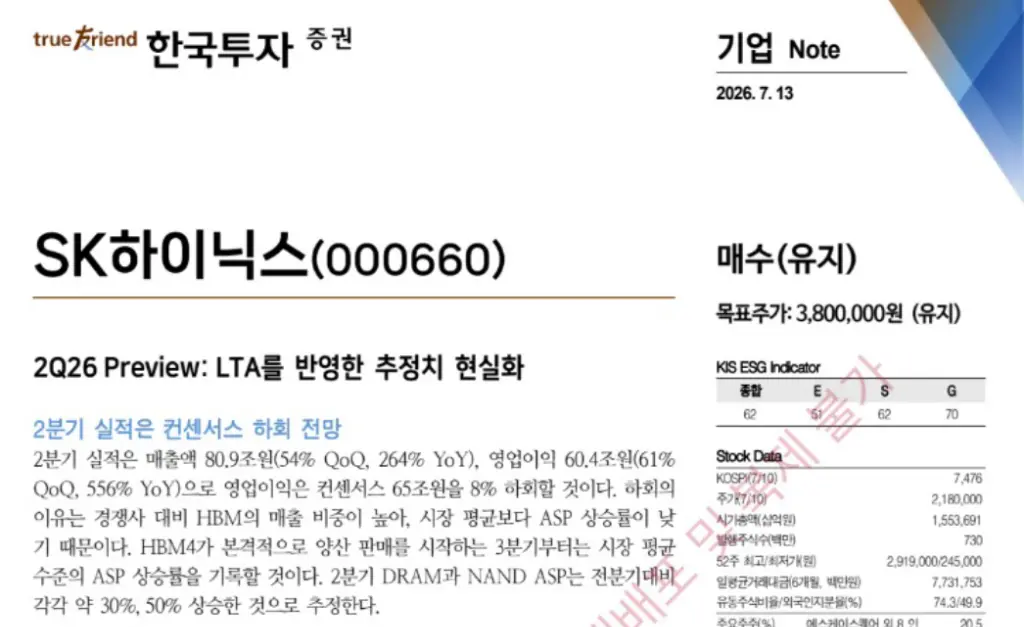
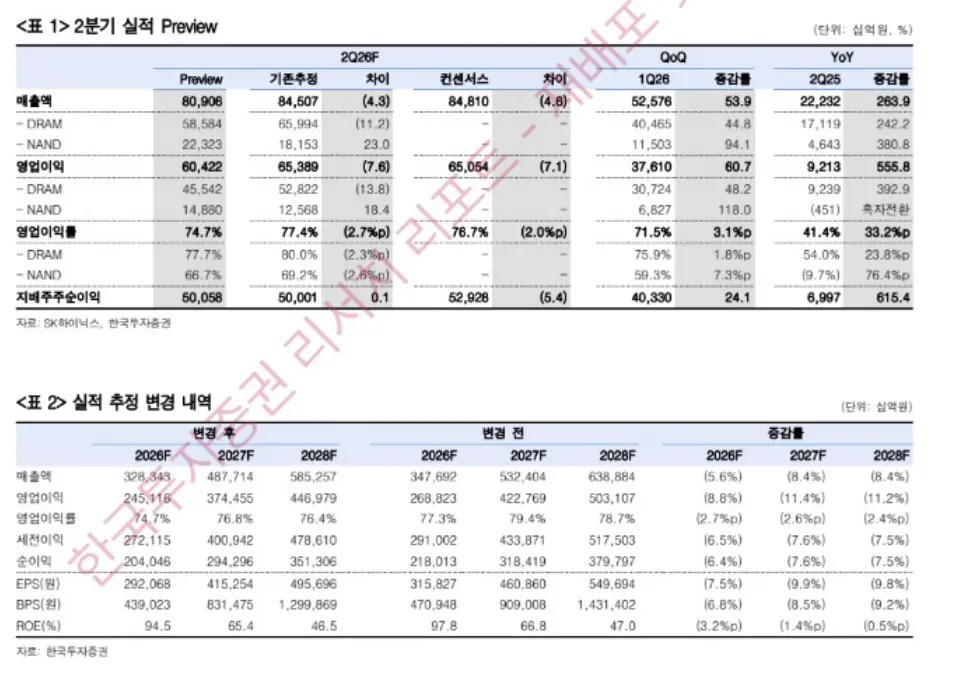
On July 13th, South Korean brokerage KIS released a second-quarter earnings forecast report for SK Hynix. The report predicts SK Hynix Q2 revenue of 80.9 trillion won, a 54% increase sequentially and a 264% surge year-over-year; operating profit is forecasted at 60.4 trillion won, up 61% sequentially and a massive 556% increase year-over-year.

The numbers appear impressive, but the problem lies in: The market consensus expectation was 65 trillion won. KIS's forecast is about 8% below consensus.

This discrepancy directly ignited the market.

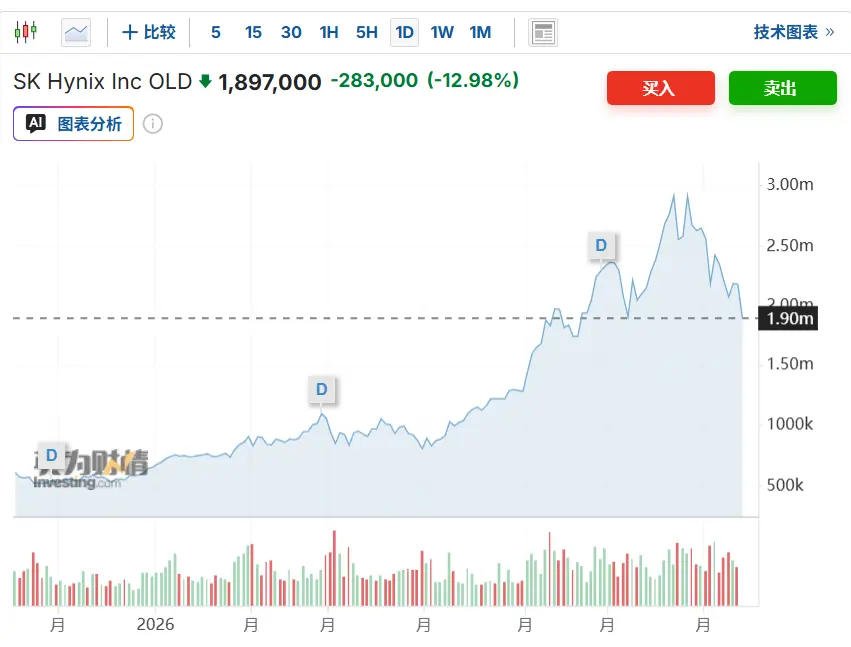
After the Korean stock market opened, SK Hynix's stock price quickly fell over 10%, breaching the 2 million won mark, marking a correction of 33% from its historical high on June 25th within just three weeks.
High HBM Share Instead Weighed on ASP

KIS explained the core reason for the profit falling short of consensus in the report: SK Hynix has a higher proportion of HBM (High Bandwidth Memory) revenue compared to peers, with a higher shipment share, leading to a lower increase in its Average Selling Price (ASP) compared to the market average.

This logic seems counterintuitive at first glance – HBM is a high-end product, so shouldn't a higher proportion be more profitable?

The key lies in the pricing structure. HBM is typically priced under Long-Term Supply Agreements (LTAs), which lock in relatively fixed contract prices that do not adjust sharply in the short term with market conditions. In contrast, ordinary DRAM and NAND have higher price elasticity in the spot market; when the overall market price increases, the ASP increase for these products can be even greater.

SK Hynix's higher HBM share means it "benefited less from the price hike dividend" in this round of market-wide average price increase compared to peers.

Meanwhile, spot average prices for ordinary DRAM and NAND continued to soar – KIS predicts Q2 DRAM average prices rose about 30% sequentially, and NAND about 50% – but Hynix's overall ASP increase was "dragged down" by the contract prices of HBM.
Downgrade Due to LTA Recalculation, Not Fundamental Deterioration

KIS explicitly stated in the report that this downgrade was not a concern over performance, but a revision result after incorporating the pricing assumptions of already signed Long-Term Supply Agreements (LTAs) into the calculation.

The original report wording is: "This is the result of making the forecast more realistic by incorporating already signed LTAs into the price assumption, not a concern over performance."

KIS also lowered its operating profit forecasts for 2026 and 2027 by approximately 9% and 11%, respectively, compared to previous estimates. However, the brokerage emphasized that as HBM4 begins mass production and shipment from the third quarter, the rise in market average prices will drive overall ASP higher, at which point SK Hynix's ASP increase will revert to market average levels.

KIS predicts the operating profit margin will reach 74.6% in Q2 2026, a record high, and continue to rise quarter by quarter thereafter.

The brokerage maintains a target price of 3.8 million won and an Overweight rating, believing this forecast downgrade is only a short-term disturbance and does not change the medium-to-long-term upward trend in performance.
"Soaring 556% Yet Missing Expectations": A Crack in Market Sentiment

A 556% year-over-year increase is an extremely strong number in any industry. But the logic of the capital market is: What matters is not how much it increased, but whether it met expectations.

The market had already fully priced in the previous consensus expectation of 65 trillion won. KIS's forecast is about 4.6 trillion won lower than this number, effectively declaring "expectations were too high."

This triggered two layers of concern: the first is the direct impact of short-term performance falling short of expectations; the second is whether the high HBM share constitutes a structural risk – meaning the more SK Hynix bets on HBM, the more limited its ASP flexibility becomes during the contract price lock-in period.

Compounding this, SK Hynix just listed on the US stock market last Friday, and some funds that bet on the "IPO pop" chose to cash out after the ADR listing, further intensifying selling pressure.

Sell-off Spreads: Hong Kong ETFs, A-share Memory Stocks Also Tumble

SK Hynix's decline quickly spread to surrounding markets.

In Hong Kong, the 2x leveraged long SK Hynix ETF fell over 22% in a single day, and the 2x leveraged long Samsung Electronics ETF fell over 13%.

A-share memory concept stocks followed suit, with multiple core names like GigaDevice, Ingenic Semiconductor, Longsys, and BIWIN Storage falling over 7%.
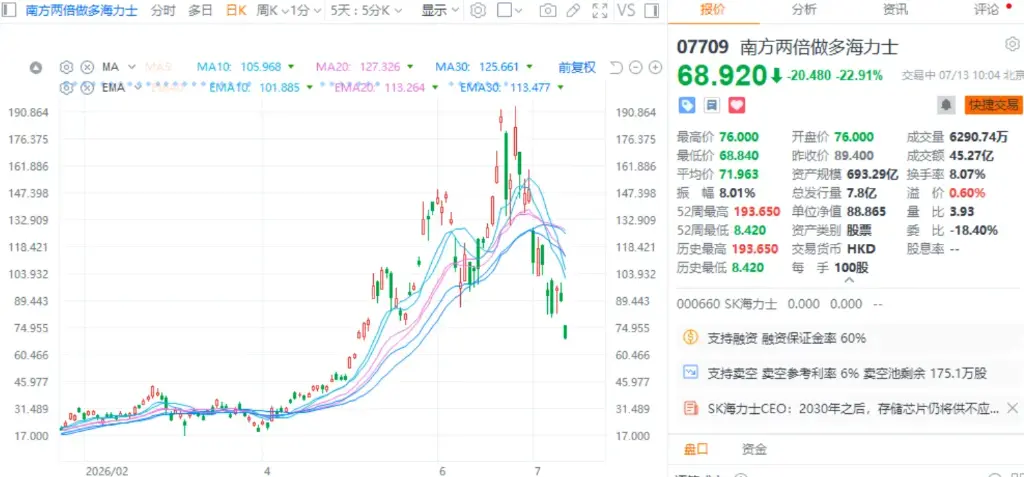
However, from a broader perspective, the memory semiconductor sector as a whole has entered a correction phase over the past two weeks, with some individual stocks falling more than 20%, touching the technical bear market boundary. Behind this, there are also factors related to global funds rebalancing allocations within the AI sector and across markets, including the rotation logic of "selling chips, buying cloud," as well as the staged rebound in the Hong Kong market attracting fund inflows.

Brokerage: Long-term Logic Unchanged, Focus on Profit Sustainability

Despite causing market turbulence, KIS's overall stance in the report is not pessimistic.

The brokerage believes that as the memory industry shifts towards 3-to-5-year LTA contract structures, the core driver of corporate valuation will transition from "single-quarter ASP increase" to "how long high profitability can be sustained."

The KIS report states: "From now on, the focus needs to be on the sustainability of profits. The expansion of LTAs is reducing the long-standing performance volatility of the memory industry."

The brokerage expects that as the proportion of contract-based revenue increases, and HBM capacity expansion squeezes overall supply, SK Hynix's high profit level will be maintained long-term, and its valuation will be repriced accordingly.

The target price of 3.8 million won still implies significant upside from the current stock price, and KIS maintains its Overweight rating.

Trending Cryptos

Related Questions

QWhat was the specific reason given by KIS for SK Hynix's Q2 operating profit forecast being 8% below market consensus?

AKIS stated that SK Hynix's higher-than-peer revenue mix from HBM, sold under fixed-price long-term agreements (LTAs), limited its overall Average Selling Price (ASP) growth compared to the market average, as regular DRAM and NAND saw higher spot price increases.

QHow did KIS interpret the reason for its forecast revision, and what was the core message regarding SK Hynix's fundamentals?

AKIS interpreted the revision as a 'realistic adjustment' incorporating already-signed LTA price assumptions, explicitly stating it was 'not a concern about performance.' The core message was that the company's fundamental business and long-term uptrend were not deteriorating.

QAccording to the article, what new core driver for valuation in the memory industry did KIS highlight, and why?

AKIS highlighted 'profitability sustainability' as the new core valuation driver. This is because the industry's shift toward multi-year LTAs is reducing its traditional earnings volatility, making long-term, stable high profits more important than short-term ASP spikes.

QWhat broader market impact did SK Hynix's sharp drop trigger, as mentioned in the article?

AThe drop triggered a sell-off across related markets: leveraged ETFs tracking SK Hynix and Samsung in Hong Kong fell over 22% and 13% respectively, and major A-share memory stocks like GigaDevice and Ingenic Semiconductor dropped more than 7%.

QDespite the negative forecast revision and stock plunge, what was KIS's final investment recommendation for SK Hynix and its stated target price?

AKIS maintained its 'Buy (Overweight)' rating and a target price of 3.8 million Korean Won, indicating significant upside potential from the current post-drop price and affirming a positive long-term outlook.

Related Reads

Tokenized Equity Is Unbundling Venture Capital's One-Stop-Shop Financing Business

Tokenized Equity Splits VC's One-Stop Financing Business The article explores how tokenizing company shares on the blockchain fundamentally reshapes the venture capital model. Traditionally, a VC's term sheet is a bundled service providing capital, valuation, curation/signaling, network access, governance, and implied follow-on funding. Tokenized equity, where shares are natively issued and registered on-chain, enables the unbundling of these services. Securitize exemplified this by listing on the NYSE while simultaneously issuing its native stock tokens on Solana and Avalanche. This creates continuous liquidity and price discovery, allowing startups to source services separately. Market-based platforms can handle funding and valuation; specialized service providers manage cap tables, token vesting, and programmable governance; and key individuals or smaller funds can offer brand credibility and network access. While this unbundling commoditizes transactional and administrative functions, core VC value persists in areas resistant to digitization: deep value judgment, strategic guidance, and using personal reputation to attract talent, customers, and future investors. Just as record labels survived by focusing on A&R (artist discovery) after music distribution was digitized, VCs will evolve to specialize in the nuanced, human-centric aspects of startup building. Founders gain the freedom to choose which services to source from the market versus which to obtain from trusted partners, fundamentally changing early-stage decision-making.

Foresight News53m ago

Tokenized Equity Is Unbundling Venture Capital's One-Stop-Shop Financing Business

Foresight News53m ago

The Success of Robinhood Chain Proves Ethereum Is Not Dead

The article argues that Robinhood's decision to build its own dedicated blockchain, Robinhood Chain, as an Ethereum Layer 2 (L2) using Arbitrum technology is a powerful endorsement of Ethereum's L1+L2 model, not a rejection of it. This move reflects a broader shift in the crypto industry from projects focused on token monetization to real-world businesses building cash-generating operations. Historically, many crypto projects chose infrastructure to support token sales and speculative value. In contrast, businesses like Robinhood and Coinbase (with Base) choose infrastructure based on commercial needs: security, liquidity, customer reach, and control. Ethereum's model provides a trusted, neutral, and liquid global settlement layer (L1) coupled with customizable, high-performance execution environments (L2s). This allows companies to maintain control and specialization without the cost and risk of building an independent L1 from scratch. The author contends that as more traditional enterprises enter the space to build sustainable businesses, they will rationally select Ethereum's L1 for maximum security and liquidity and its L2s for scalability and customization. This trend strengthens Ethereum's network effects and the utility of ETH as the native gas and asset within this expanding ecosystem. Robinhood's choice is thus seen as a landmark example of pragmatic business strategy aligning with Ethereum's architectural strengths.

marsbit1h ago

The Success of Robinhood Chain Proves Ethereum Is Not Dead

marsbit1h ago

Trading

Spot

Hot Articles

Discussions

Welcome to the HTX Community. Here, you can stay informed about the latest platform developments and gain access to professional market insights. Users' opinions on the price of S (S) are presented below.

活动图片