Solana On-Chain Liquidity Leadership Widens As DEX Volume Stays Robust Across The Network

bitcoinistPublished on 2026-01-09Last updated on 2026-01-09

Abstract

Despite a volatile market with sideways price movements, the Solana network continues to demonstrate robust on-chain activity and performance. It has solidified its leadership in on-chain liquidity, processing a dominant $6.7 billion in DEX volume, which surpasses all other layer 1 and layer 2 solutions. This reflects strong trading environment, deep liquidity pools, and sustained user engagement. Further signaling strength, Solana's derivatives market is expanding, with open interest reaching $3.35 billion, indicating significant new capital inflows and trader activity. The network closed 2025 with record on-chain performance, showing growth in real economic activity, applications, and users. Key developments fueling this growth include a massive $900 million+ spike in stablecoin supply within 24 hours, driven by Jupiter's new stablecoin launch, and Morgan Stanley's filing for a Spot Solana ETF, pointing to a resurgence in institutional crypto flows.

The Solana network is still demonstrating notable activity and performance in a volatile market state, with its price facing sideways movements. With a recent uptick in user participation and demand, the SOL network remains a dominant force in the blockchain sector, ramping up substantial DEX volume over the past few weeks.

Resilient DEX Volume Keeps Solana At The Top

As the cryptocurrency market cools, the Solana network is showing signs of strength. This strength is seen in the network’s on-chain liquidity, which appears to be leading the charge across the dynamic blockchain sector. Solana Daily’s post reveals that Solana’s position at the forefront of on-chain liquidity keeps growing, with Decentralized Exchange (DEX) activity on the network exhibiting notable resilience despite broader market conditions fluctuating.

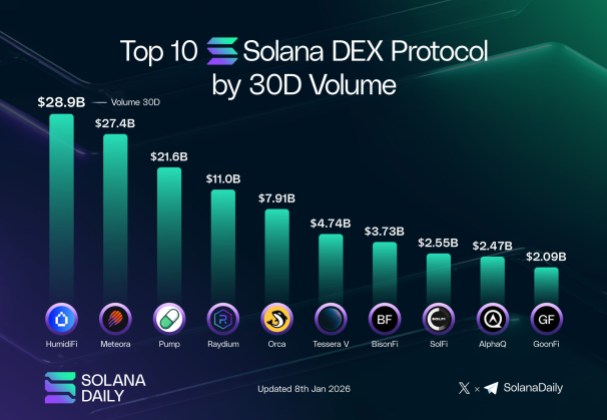
The chart from Solana Daily shows that the network is processing $6.7 billion in DEX volume. Interestingly, this figure surpasses that of all other layer 1 and layer 2 solutions, reflecting SOL’s strong trading volumes, deep liquidity pools, and sustained user engagement.
Source: Chart from Solana Daily on X

As SOL improves in these areas, it expands its lead over competing layer 1 and layer 2 ecosystems. With active market makers, robust DeFi protocols, and high transaction throughput, the network’s liquidity infrastructure seems to be maturing rather than withering after previous spikes in activity.

Another notable development highlighted by Solana Daily is the rise in SOL’s derivatives market as open interest broadens. At the time of the report, the altcoin’s open interest had reached a staggering $3.35 billion, indicating a fresh wave of trader engagement and risk-taking around the asset.

Increasing open interest usually indicates a new capital inflow into futures and perpetual markets, and in SOL’s case, it coincides with growing on-chain activity and a resurgence of speculative activity.

A Milestone In On-Chain Performance Into 2026

In another X post, Solana Daily reported that the SOL network closed 2025 with record on-chain performance, reflecting steady growth in real economic activity across applications, liquidity, and users. Traders, developers, and capital are not just testing Solana. They seem to be committing to the network, cementing its position as one of the most active centers in the cryptocurrency field.

This rise in on-chain performance underscores strong revenue metrics, increasing stablecoin supply, and growing institutional participation, which outline an evolving ecosystem heading into the next cycle. As the network further advances into 2026, narratives about Real World Assets (RWAs), payments, AI-native finance, and privacy infrastructure are beginning to emerge throughout the robust ecosystem.

SOL is slowly becoming an on-chain finance prodigy, which is indicated by the surge in stablecoin supply on the network. The Kobeissi Letter has outlined SOL’s stablecoin growth following a supply spike of over +$900 million in 24 hours.

According to the leading commentary, this is a result of Jupiter, the world’s largest on-chain platform, launching its on-chain focused stablecoin. During the period, Morgan Stanley also filed for a Spot Solana Exchange-Traded Fund (ETF). These moves point to a resurgence in crypto flows.

SOL trading at $139 on the 1D chart | Source: SOLUSDT on Tradingview.com

Related Questions

QWhat is the current DEX volume being processed by the Solana network, and how does it compare to other blockchain solutions?

AThe Solana network is processing $6.7 billion in DEX volume, which surpasses that of all other layer 1 and layer 2 solutions.

QWhat does the significant increase in Solana's open interest indicate about market activity?

ASolana's open interest reaching $3.35 billion indicates a fresh wave of trader engagement, risk-taking, and new capital inflow into futures and perpetual markets.

QWhat two major events contributed to the surge in stablecoin supply on the Solana network?

AThe surge was primarily due to Jupiter, the world's largest on-chain platform, launching its on-chain focused stablecoin, and Morgan Stanley filing for a Spot Solana Exchange-Traded Fund (ETF).

QHow did Solana's on-chain performance fare at the end of 2025, and what does this signify?

ASolana closed 2025 with record on-chain performance, reflecting steady growth in real economic activity and signifying that traders, developers are committing to the network, cementing its position as a highly active center in crypto.

QWhat emerging narratives are beginning to take shape within the Solana ecosystem as it advances into 2026?

ANarratives about Real World Assets (RWAs), payments, AI-native finance, and privacy infrastructure are beginning to emerge throughout the robust Solana ecosystem.

Related Reads

Codex Goal Mode Usage Guide: How to Make AI Continuously Pursue a Specific Objective

"Codex Goal Mode: How to Make AI Work Continuously Toward a Specific Goal" OpenAI's Codex "goal mode" (/goal) transforms the AI from a reactive code assistant into a proactive execution agent capable of working autonomously for hours or even days to achieve a defined objective. To maximize its effectiveness, follow these key principles: 1. **Define Clear, Verifiable Exit Criteria:** The goal prompt should be a concise, measurable success condition, not a lengthy specification. Use quantifiable metrics like "reduce build time by 30%" or "achieve 100% test parity." 2. **Provide Initial Guidance and Tools:** Direct Codex toward likely problem areas and specify available tools (e.g., browsers, testing environments) to prevent it from exploring unproductive paths. 3. **Enable Progress Measurement:** Equip Codex with ways to track advancement, such as creating comparison tools for visual tasks or evaluation sets, ensuring it can gauge its own progress. 4. **Use a Realistic Execution Environment:** For tasks like performance optimization, provide access to environments that closely mimic production (e.g., similar configs, databases) to yield valid results. 5. **Be Cautious with Visual Goals:** Avoid vague "pixel-perfect" instructions. Instead, supplement visual references with functional checklists or design system specifications to prevent Codex from obsessing over minor details. 6. **Implement Progress Tracking:** For long-running tasks, have Codex commit code to draft PRs, update progress documents, or send Slack updates to maintain visibility into its work. 7. **Review and Consolidate Results:** Once the goal is met, instruct Codex to review its work, clean up ineffective experimental code, and reflect on what strategies succeeded or failed. Ultimately, using goal mode shifts the developer's role from writing prompts to managing a persistent engineering agent—defining objectives, establishing metrics, configuring environments, and conducting final reviews.

marsbit52m ago

Codex Goal Mode Usage Guide: How to Make AI Continuously Pursue a Specific Objective

marsbit52m ago

From Ethereum to AI's 'CROPS': What Exactly Is This 'Slow Variable' That Vitalik Has Repeatedly Emphasized?

Recently, Vitalik Buterin has frequently emphasized the concept of "CROPS," first outlined in the Ethereum Foundation's March mandate as core principles guiding its focus: Censorship Resistance, Capture Resistance, Open Source, Privacy, and Security. CROPS represents Ethereum's commitment to providing foundational capabilities for user sovereignty—enabling asset ownership, identity expression, and coordination without reliance on centralized platforms or surrendering ultimate control. This framework is gaining new urgency with the rise of AI, particularly AI agents managing digital assets and automating transactions. While AI offers convenience, it risks centralizing user data, intent, and control if dependent on opaque, centralized services. Vitalik argues for "CROPS AI"—AI that is open, privacy-preserving, secure, and capable of local execution to maintain user agency. He highlights convergence between "CROPS Ethereum access layers" and "CROPS AI," such as using zero-knowledge proofs for private remote LLM calls and Ethereum RPC reads, ensuring users can access services without exposing sensitive information. Ultimately, CROPS is not just an abstract ideal but a practical guide for Ethereum's development and AI integration. It addresses the critical long-term question: as digital systems grow more powerful, how can users retain control over their privacy, assets, and autonomy? In an AI-driven era, these principles may define Ethereum's enduring value—prioritizing verifiable, secure, and user-centric design over short-term optimizations like speed and cost alone.

marsbit57m ago

From Ethereum to AI's 'CROPS': What Exactly Is This 'Slow Variable' That Vitalik Has Repeatedly Emphasized?

marsbit57m ago

Trading

Spot
Futures

Hot Articles

Discussions

Welcome to the HTX Community. Here, you can stay informed about the latest platform developments and gain access to professional market insights. Users' opinions on the price of SOL (SOL) are presented below.

活动图片












