Solana ETFs Just Crossed A New Record Level, But Can Price Reclaim $100?

bitcoinistPublished on 2026-03-13Last updated on 2026-03-13

Abstract

Solana ETFs have reached a record $1.5 billion in net inflows since their July 2025 launch, a period during which SOL's price declined by 57%. This significant institutional demand, with half the assets coming from large firms filing 13F disclosures, presents a stark contrast to the bearish market sentiment and SOL's drop below $100 to a low of $85. Analysts suggest this sustained ETF momentum could create buying pressure that catalyzes a price recovery. One analyst projects that reclaiming the $100 level could trigger a breakout from a long-term descending channel, potentially driving SOL's price toward $250.

Solana ETFs are breaking records even as SOL prices are in a downtrend. While bearish sentiment dominates the crypto market, billions of dollars continue to flow in, painting a contrasting picture between price action and institutional demand. As the cryptocurrency attempts a recovery, analysts are once again eyeing a return to the $100 level. However, the question remains whether the current ETF momentum could be the catalyst that drives a price recovery.

Solana ETFs Hit Record Levels Amidst Price Decline

Solana has been experiencing a rough stretch in the markets lately, with its price falling well below $100 and hitting a low of $85. The drop marks a prolonged bearish trend that has tested the patience of many investors who entered the market at higher levels.

Despite weak price action, Solana Spot ETFs are attracting capital at an unprecedented rate, surprising even seasoned market watchers. This suggests that long-term conviction in the cryptocurrency remains strong even as short-term selling persists.

Notably, Bloomberg ETF analyst Eric Balchunas brought Solana’s ETF numbers into focus in a recent post on X, highlighting that the investment fund has accumulated an impressive $1.5 billion in net inflows since its launch in July 2025. He noted that this remarkable growth occurred despite SOL’s 57% price crash from its ETF launch date, which was one of the toughest debut periods for any ETF product.
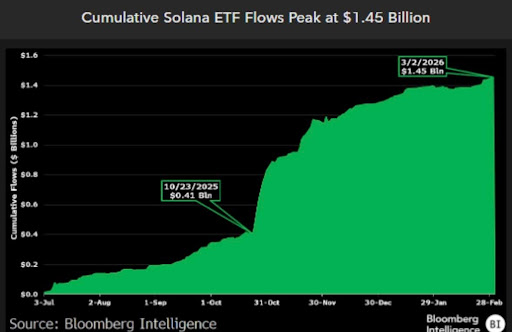
Source: Bloomberg

Balchunas pointed out that when Solana’s market cap is compared to Bitcoin’s, the numbers look even more impressive. On that basis, the inflows into Solana are roughly $54 billion for Spot Bitcoin ETFs, approximately double what BTC itself attracted at the same point in its ETF journey. He noted that the key difference here is that Bitcoin was surging at the time, whereas Solana reached equivalent inflows while in decline.

The Bloomberg analyst also highlighted Solana’s ETF composition, noting that approximately 50% of the fund’s assets came from institutional investors that filed 13F disclosures. He described this as a “serious” investor base, suggesting that large-scale firms are backing Solana and may be positioning for the long term.

SOL Price Roadmap To A $100 Recovery

If Solana’s ETF momentum and institutional demand continue to rise, it would not be surprising if the cryptocurrency attempts another price recovery back toward the $100 region. Usually, demand from ETFs helps create consistent buying pressure, as fund inflows translate into actual purchases of the underlying asset, supporting its price over time. However, whether Solana can turn its current ETF demand into sustained price recovery remains to be seen.
Source: X

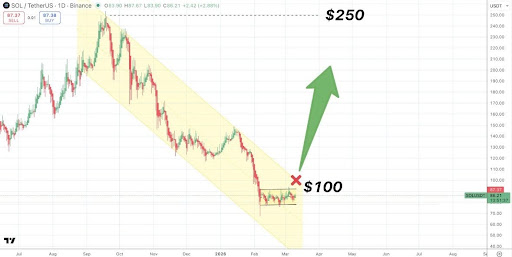
On the more technical side, crypto analyst Satoshi Flipper has issued a forecast suggesting that Solana may be preparing to reclaim the $100 level. He projects that once this happens, the cryptocurrency will automatically break out of a descending channel that has been in place for the past seven months. If the breakout plays out as expected, the analyst projects that the move could carry the SOL price well beyond $100, potentially driving it toward $250.

SOL recovers again | Source: SOLUSDT on Tradingview.com

Related Questions

QWhat is the current trend of Solana ETFs despite the price decline of SOL?

ASolana Spot ETFs are breaking records and attracting capital at an unprecedented rate, with $1.5 billion in net inflows since their launch in July 2025, even as the SOL price has declined significantly.

QAccording to Bloomberg analyst Eric Balchunas, how do Solana ETF inflows compare to Bitcoin ETF inflows on a market cap basis?

AOn a market cap basis, the inflows into Solana ETFs are roughly equivalent to $54 billion for Spot Bitcoin ETFs, which is approximately double what Bitcoin attracted at the same point in its ETF journey.

QWhat percentage of the Solana ETF assets came from institutional investors filing 13F disclosures?

AApproximately 50% of the Solana ETF's assets came from institutional investors that filed 13F disclosures.

QWhat key price level are analysts watching for a potential Solana recovery?

AAnalysts are eyeing a return to the $100 level as a key milestone for Solana's potential price recovery.

QWhat is crypto analyst Satoshi Flipper's price projection for SOL if it breaks out of its descending channel?

ASatoshi Flipper projects that if Solana breaks out of its descending channel, the price could carry well beyond $100, potentially driving it toward $250.

Related Reads

$9.4 Billion: The Largest Robotics Funding This Year Has Emerged

Munich-based humanoid robotics company Neura has completed a $1.4 billion (approximately RMB 94.9 billion) Series C funding round, valuing the company at around $7 billion and positioning it among the global leaders in the sector. The investment round is notable not just for its size—reportedly the largest in robotics this year—but also for its strategic backers, which include tech giants like NVIDIA and Amazon, alongside established industrial players such as German engineering firms Bosch and Schaeffler. This mix of investors signals a significant shift in the industry's focus from technological demonstrations and general-purpose narratives toward practical, industrial deployment and commercialization. Neura's approach centers on developing humanoid robots for defined, high-value industrial tasks rather than pursuing a general-purpose model. Its early validation comes from a partnership with BMW, where its robots are being tested on actual production lines. The involvement of Bosch and Schaeffler, companies deeply embedded in global manufacturing, underscores a growing belief that humanoid robots are transitioning from labs to viable factory-floor solutions. The article highlights two converging trends driving investment: advancements in AI and large language models, which enhance robots' perception and decision-making in unstructured environments, and mounting pressure from labor shortages and rising costs in major manufacturing regions. The funding landscape is now bifurcating between companies like Figure AI, focusing on versatile general-purpose robots, and firms like Neura, targeting specific vertical industrial applications with clearer, shorter paths to ROI. While technical hurdles remain, the core challenges for widespread adoption are increasingly seen as engineering and commercial in nature: managing the high integration and customization costs for different factory environments and establishing robust, localized maintenance and service networks. The record investment in Neura, particularly from industrial capital, indicates the industry's growing confidence in moving from proving feasibility to solving the practical problems of scalability, reliability, and building sustainable business models around humanoid robots in real-world settings like automotive manufacturing and hazardous labor environments.

marsbit7h ago

$9.4 Billion: The Largest Robotics Funding This Year Has Emerged

marsbit7h ago

Trading

Spot
Futures

Hot Articles

Discussions

Welcome to the HTX Community. Here, you can stay informed about the latest platform developments and gain access to professional market insights. Users' opinions on the price of SOL (SOL) are presented below.

活动图片














