Despite continued pressure on the price of Solana (SOL) tokens, its spot ETF has demonstrated strong capital attraction capabilities. According to data from Farside Investors, the Solana ETF has achieved net capital inflows for 7 consecutive days, with cumulative net inflows approaching $700 million. The highest single-day inflow occurred on December 12, reaching $16.6 million. This phenomenon contrasts sharply with SOL's weak performance, which has fallen nearly 55% from its January all-time high, reflecting that institutional investors may be positioning themselves in the Solana ecosystem with a long-term perspective.
I. Inflow Structure: Bitwise as the Dominant Force, Staking Mechanism as Key Attraction
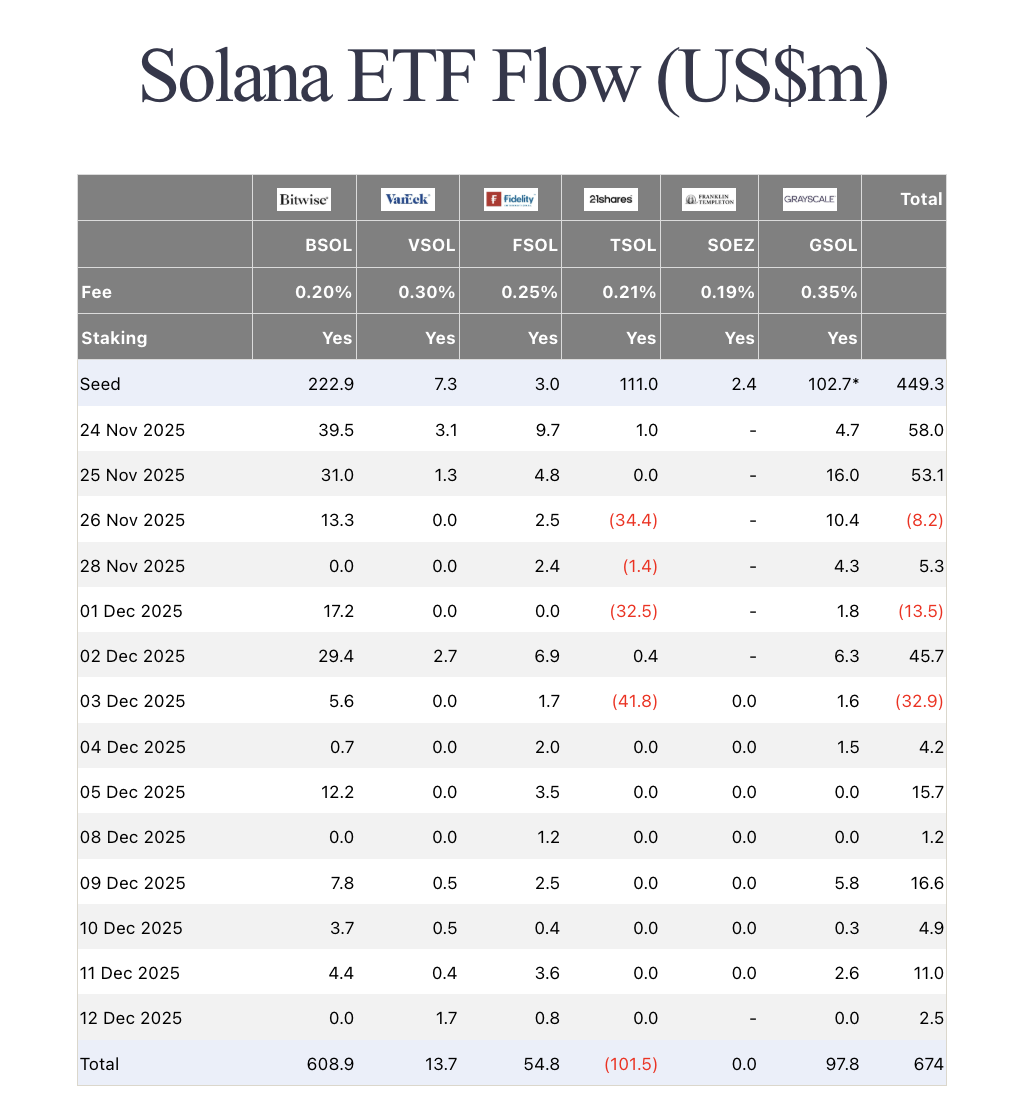
SOL ETF inflow situation. Source: Farside Investors
Solana ETF inflows are highly concentrated, with Bitwise's BSOL ETF being the primary contributor, accounting for over 90% of total inflows, and its assets under management have surpassed $6 billion. This advantage stems from its product design: BSOL utilizes 100% of its custodied assets for on-chain staking, offering an annualized yield of approximately 5%-7%, providing investors with dual returns from "price exposure + staking rewards." In contrast, Grayscale's GSOL stakes only 77% of its assets and has a higher management fee (0.35%), making it less attractive.
Furthermore, the entry of traditional asset management giants like Franklin Templeton has further enriched the product matrix. The staking rewards from these ETFs are directly compounded into the fund's net asset value rather than distributed as cash dividends, better aligning with long-term allocation needs.
II. Price and Flow Decoupling: Short-Term Selling Pressure vs. Long-Term Value Game
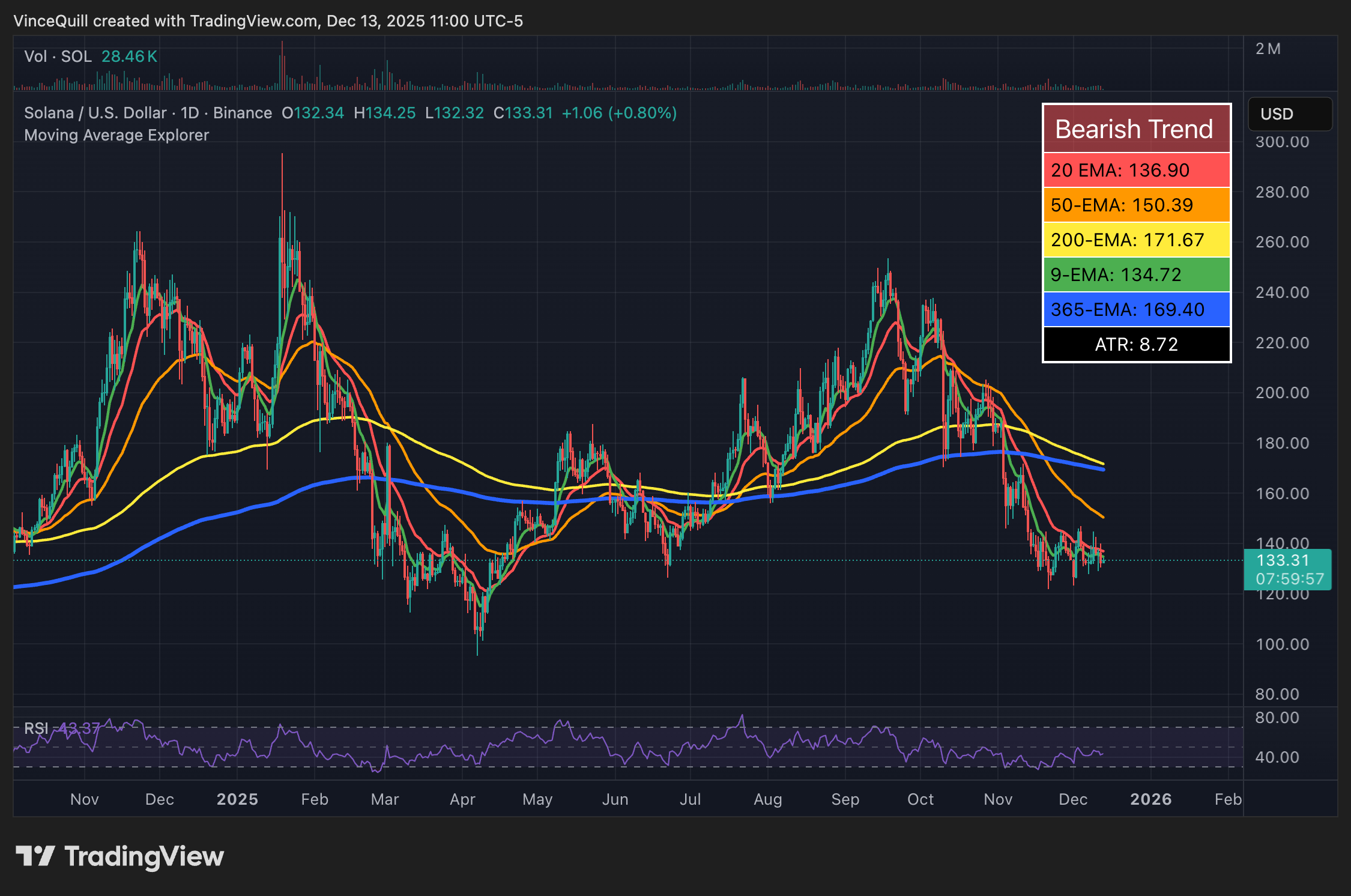
SOL price movement from November 2024 to December 2025. Source: TradingView
Despite continuous ETF inflows, the SOL price remains down roughly 47% from its September local high and has been trading below its 365-day moving average for an extended period. This decoupling is primarily due to three factors:
- Macro Market Pressure: Bitcoin and Ethereum ETFs experienced large-scale net outflows during the same period ($3.48 billion and $1.42 billion respectively), dragging down overall crypto market sentiment.
- Profit-Taking by Speculators: A concentrated outbreak of "buy the rumor, sell the news" behavior after ETF approval, with some early investors choosing to realize profits.
- Whale Selling Impact: For instance, Jump Crypto once sold 1.1 million SOL (approx. $205 million) in a single transaction in late October, creating significant selling pressure in the short term.
However, on-chain data shows that some institutional investors are quietly accumulating during the decline. For example, a mysterious whale cumulatively transferred 1.57 million SOL (approx. $329 million) from platforms like Coinbase to private wallets, hinting at long-term bullish confidence.
III. The Innovative Significance of ETFs: From Price Exposure to Yield Financialization
The core breakthrough of the Solana ETF lies in the compliance of its staking rewards.
By embedding an on-chain staking mechanism into traditional financial products, investors can participate in network governance and earn rewards without directly holding the tokens. This model, referred to as "yield-bearing assets" by Bitwise CIO Matt Hougan, is particularly attractive to traditional financial institutions in a low-interest-rate environment.
Furthermore, the SEC's tacit approval of the staking clauses signals a shift in regulatory attitude. Previously, Ethereum ETFs were forced to remove related clauses due to staking concerns, while the successful listing of Solana ETFs has paved a compliant path for more PoS assets.
IV. Future Outlook: Institutional Divergence and the Battle of Ecosystem Fundamentals
Despite strong inflows, institutional attitudes towards Solana are diverging:
- Bullish Camp: Grayscale's Head of Research, Zach Pandl, predicts that Solana ETFs could absorb 5% of the total supply (approx. $5 billion).
- Cautious Camp: Institutions like BlackRock believe the Solana ecosystem is overly reliant on Meme coin trading, posing speculative risks.
Ecosystem fundamentals remain key to long-term value. Western Union's announcement of issuing a stablecoin on Solana, along with improvements in network throughput and developer activity, is gradually strengthening its positioning as "financial infrastructure." If Solana can continue to optimize network stability and expand enterprise-level use cases, the long-term effects of ETF inflows are expected to gradually materialize in the price.