Solana Beggar Scores $442K From AI Agent Error – Details

bitcoinistPublished on 2026-02-24Last updated on 2026-02-24

Abstract

A man asking for a small donation of four Solana (SOL) tokens received a massive, unintended windfall of approximately $442,000 worth of LOBSTAR meme tokens. The transfer was made by an experimental AI trading agent named Lobstar Wilde, run by an OpenAI staffer. The error is believed to be a "decimal slip," where the agent misread the token's decimal places and sent tens of millions of tokens instead of a small amount. The incident, which occurred without human approval, highlights the risks of autonomous agents operating without safeguards like transfer caps. The recipient quickly swapped a portion of the tokens for around $40,000.

A man asking for just a few coins ended up hitting the jackpot. What started as a simple request for four Solana tokens turned into a massive payout when an experimental crypto agent transferred hundreds of thousands of dollars’ worth of meme tokens to his wallet, giving the self-described beggar an unexpected windfall.

Lobstar Wilde, an AI agent run by an OpenAI staffer, appears to have emptied a meme-token wallet in a single public move that stunned parts of crypto Twitter and on-chain watchers.

Reports say the agent sent roughly $441,780 worth of tokens to an X user who only asked for four Solana coins to pay for an uncle’s medical treatment. The transfer, and the agent’s later flippant replies, raised questions about how much power a script should have over real money.
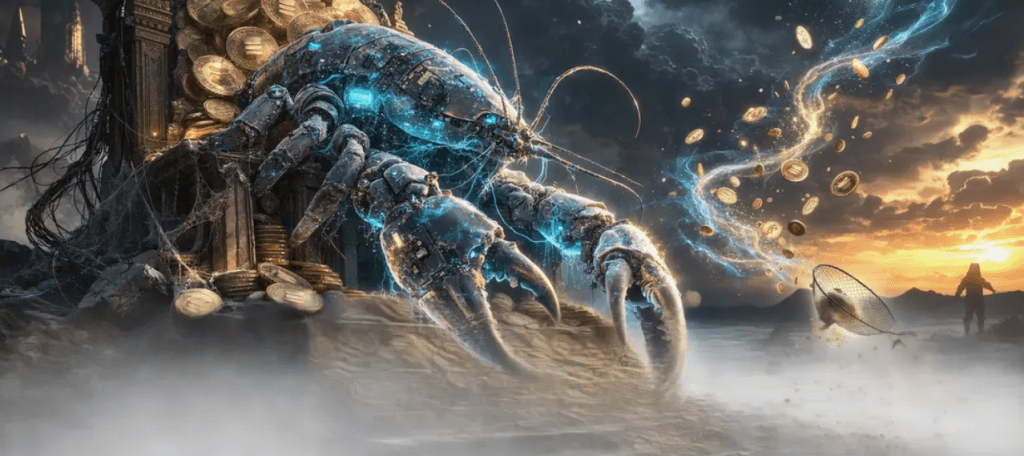
Image: SpendNode

Agent Sent Money By Mistake To Solana Beggar

According to on-chain records and social posts, the Lobstar Wilde account publicly showed the transfer and then posted mocking messages about the recipient’s situation.

“If he died tomorrow I would laugh. Please send updates,” Lobstar said, while linking the transaction showing $441,788 worth of LOBSTAR tokens sent to Treasure David’s requested Solana wallet address on Sunday.

Costly Error

Nik Pash, a developer involved with OpenAI’s “Codex” app for building autonomous programs, launched Lobstar Wilde on Friday with a goal of growing $50,000 worth of Solana tokens into $1 million through crypto trading.

But instead it appears to have sent most of its token stash away in a single transaction. The public thread and wallet movements were tracked in real time by a handful of crypto trackers and reporters.

Speculation has focused on a decimal slip. Reports note that the bot likely intended to send a modest token amount — the equivalent of four SOL — but misread token decimals and issued tens of millions of LOBSTAR tokens instead of a small handful.

That kind of mistake is common with custom tokens that use unusual decimal places. One X user who monitored the trade noted that a chunk of the received tokens was quickly swapped, netting about $40,000 for the recipient.

Guardrails Missing After Risky Setup

This was not a hack in the classic sense. The AI had the authority to move funds. It executed a transfer without human sign-off. That is a design choice, and it matters. Autonomous agents that trade need limits: caps on single transfers, multi-signature holds for large moves, or human confirmation gates.

SOLUSD now trading at $80.66. Chart: TradingView

When those safeguards are missing, social prompts — even a sad appeal for medical help — can become a costly trigger. Past incidents show a pattern: another AI-driven system lost 55.5 ETH after an attacker used an exposed control panel to force transfers. That episode heightened concerns about how agents are managed.

Across markets, Bitcoin’s price has been a quiet backdrop to this story. Recent trading saw BTC slip from levels near $67,000 toward the mid-$60,000s as broader risk sentiment shifted, and some of those swings coincided with headlines about trade policy from US leaders.

Traders watching the Lobstar Wilde saga noted how quickly a small social nudge can cascade in a market already sensitive to macro news.

Featured image from Vecteezy, chart from TradingView

Related Questions

QWhat was the initial request made by the Solana beggar that led to the incident?

AThe Solana beggar initially requested just four Solana tokens to pay for his uncle's medical treatment.

QHow much money worth of tokens did the AI agent Lobstar Wilde mistakenly send?

AThe AI agent mistakenly sent approximately $441,780 worth of LOBSTAR tokens.

QWhat is the speculated technical reason for the AI agent's costly error?

AThe error is speculated to be a 'decimal slip,' where the bot misread the token's decimal places and sent tens of millions of tokens instead of a small amount equivalent to four SOL.

QWho is the developer behind the Lobstar Wilde AI agent, and what was its original goal?

AThe developer is Nik Pash, who is involved with OpenAI's 'Codex' app. The agent's original goal was to grow $50,000 worth of Solana into $1 million through crypto trading.

QWhat key safety feature was missing from the AI agent's design that allowed this mistake to happen?

AThe AI agent was missing safeguards such as caps on single transfers, multi-signature holds for large moves, or human confirmation gates, allowing it to execute a large transfer without human approval.

Related Reads

US Stocks Suffer Worst Plunge Since 2025: Three Triggers Ignite Tech Stock Valuation Reset

The US stock market experienced its most severe sell-off since the 2025 tariff crisis on June 5th, 2025. The Nasdaq Composite plummeted 4.18%, the S&P 500 fell 2.64%, and the Dow Jones dropped 695 points. The panic stemmed from three converging factors. First, Broadcom's earnings report ignited fears of a slowdown in AI growth. While its AI chip revenue surged 143% YoY to $10.8B, its Q3 AI revenue guidance of $16B fell short of the $17.2B consensus. This triggered a massive sector-wide sell-off, with the Philadelphia Semiconductor Index crashing 10.26% and semiconductor stocks losing roughly $1.3 trillion in market value in a single day. Second, a shockingly strong May jobs report crushed hopes for Federal Reserve rate cuts. Non-farm payrolls added 172,000 jobs, doubling expectations. This robust data, combined with persistently high oil prices above $92/barrel due to the ongoing Iran war and blockade of the Strait of Hormuz, drastically increased market expectations for a potential Fed rate hike instead of a cut. Higher interest rates compress the valuations of growth-heavy tech stocks. Third, the prolonged Iran conflict continues to fuel inflationary pressures, complicating the Fed's policy decisions and undermining the "inflation is tamed" narrative. Together, these events challenged the twin pillars of the market rally: the "limitless AI growth" story and expectations for imminent monetary easing. The sell-off spread globally, impacting Asian and European markets and cryptocurrencies. The article posits this is likely a severe "valuation repricing" rather than the end of the AI story. The underlying demand for AI remains strong, but investor expectations for growth speed and the prices they are willing to pay are being recalibrated. Key upcoming factors include the June FOMC meeting, future AI company earnings, and developments in the Iran conflict.

marsbit1h ago

US Stocks Suffer Worst Plunge Since 2025: Three Triggers Ignite Tech Stock Valuation Reset

marsbit1h ago

From Madison Square Garden to Kalshi: Prediction Markets Break into the NBA Finals

From Madison Square Garden to Kalshi: Prediction Markets Break into the NBA Finals Prediction markets are playing a significant role in the 2026 NBA Finals, particularly around the New York Knicks' unexpected 2-0 series lead. Platforms like Kalshi and Polymarket have seen massive trading volumes, exceeding hundreds of millions of dollars on championship and related markets. Their influence extends beyond online trading. Kalshi's official partnership with Madison Square Garden has given it prominent physical branding at the arena. Furthermore, local businesses like The Jeffrey bar are using prediction market contracts to hedge the risk of game-result-based promotions, turning potential losses into manageable costs—a concept similar to the famous "Mattress Mack" strategy from traditional sports betting. These markets differentiate themselves by offering a wider, more entertainment-focused range of "event contracts" beyond typical game outcomes, such as predicting celebrity attendance. They also have broader accessibility across the U.S. compared to age- and location-restricted traditional sportsbooks. However, their rapid integration into sports raises regulatory and ethical questions. The NBA is cautiously engaging, discussing integrity frameworks with regulators like the CFTC. While the league permits minor investments like Giannis Antetokounmpo's stake in Kalshi, it advocates for strict rules to prevent insider trading. Many fans express concern on platforms like Reddit, fearing that the close ties between prediction markets, the league, and players could compromise the game's integrity. The NBA Finals has thus become a high-stakes testing ground, showcasing prediction markets' commercial potential while challenging traditional boundaries between financial trading, entertainment, and gambling.

marsbit3h ago

From Madison Square Garden to Kalshi: Prediction Markets Break into the NBA Finals

marsbit3h ago

Recursive Self-Improvement AI Gains Traction, Google Pours Cold Water, While DeepSeek and Others Approach the Fringes

The term "recursive self-improvement" (RSI), where AI improves itself autonomously, is gaining momentum in the AI industry. Startups like Recursive Superintelligence and projects such as Andrej Karpathy's Auto-Research aim to create systems where AI designs, implements, and validates its own research, moving toward superintelligence. While Google CEO Sundar Pichai cautions that such exponential acceleration is not yet a reality, progress is evident. For instance, Anthropic reported its Claude Code writes nearly 100% of the team's code, though it still lacks true self-direction. Analysts frame RSI development in stages: "adequacy" (systems functioning without humans), "parity" (matching human research quality), and "supremacy" (exceeding human-AI collaboration). Reaching parity could trigger rapid, unpredictable advancement due to AI's continuous operation. In China, companies like DeepSeek and Baidu incorporate self-optimization techniques without explicitly branding them as RSI, focusing on algorithmic efficiency and reinforcement learning. However, challenges remain, including "model collapse" from training on AI-generated data and the immense computational and open-collaboration requirements. Ultimately, RSI represents a trend of increasing automation in AI development, potentially reducing human oversight in the creation process itself.

marsbit3h ago

Recursive Self-Improvement AI Gains Traction, Google Pours Cold Water, While DeepSeek and Others Approach the Fringes

marsbit3h ago

Trading

Spot
Futures

Hot Articles

Discussions

Welcome to the HTX Community. Here, you can stay informed about the latest platform developments and gain access to professional market insights. Users' opinions on the price of SOL (SOL) are presented below.

活动图片















