Solana App Economy Sees Significant Upside Momentum As Cumulative Revenue Surges

bitcoinistPublished on 2026-05-29Last updated on 2026-05-29

Abstract

Despite bearish price pressure, the Solana network is experiencing significant growth in ecosystem activity. Cumulative app revenue has surged to approximately $4 billion, a rise of over $1.17 billion in the past year, signaling strong user engagement and monetization across DeFi, gaming, and trading services. The ecosystem is expanding rapidly, with Solana consistently creating opportunities at scale. It has recently surpassed Ethereum in month-to-date DEX volume ($36.87B vs. $31.59B), demonstrating strength in key areas like usage and speed. Furthermore, active loans on Solana have doubled year-over-year, now representing 10% ($2.1B) of the total on-chain active loans market, positioning it second only to Ethereum and indicating a potential shift towards its perceived security and utility.

Solana’s network growth has not been defined by its price action over the past few months as its ecosystem expands in the face of this unfavorable environment. Activity on the leading network is picking up pace at a significant rate, recording billions of dollars in app revenue in the past year.

Apps Revenue On Solana Network Booms

Regardless of Solana’s price experiencing growing bearish pressure, its network is entering a powerful expansion phase in ecosystem activity. The current network growth is observed in its total app revenue, which has witnessed a massive surge.

Zensei, a DeFi and RWA researcher, shared this development on X, suggesting increasing user engagement and robust monetization among decentralized applications built on the blockchain. This app creation ranges from Decentralized Finance (DeFi) platforms to gaining and trading services, underscoring the massive coverage of Solana in the crypto sector.

According to the researcher’s report, Solana‘s cumulative app revenue has climbed to approximately $4 billion. About a year ago, this figure was sitting at $2.87 billion, representing an over $1.17 billion increase in just 12 months. Such a growth is a sign of expanding real-world utility and sustained demand across the network within a competitive blockchain space.

Zensei stated that there is a rapid growth in how the ecosystem continues to expand across every sector. However, only a few places in the crypto space create opportunities at the scale and speed that Solana does consistently.
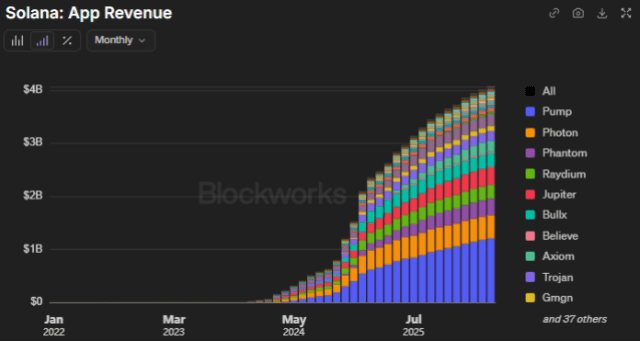
Source: Chart from Zensei on X

Solana’s blockchain dominance is not one to be overlooked. Despite multiple moments of slowdown, the network continues to challenge leading chains such as Ethereum across the sector, even surpassing them in several areas.

In another X post, Zensei reported that Solana has successfully flipped Ethereum in month-to-date Decentralized Exchange (DEX) volume, leading by over $5.27 billion. While Ethereum blockchain recorded about $31.59 billion in MTD DEX volume, SOL scooped up a total of $36.87 billion.

The researcher stated that SOL’s dominance goes beyond just DEX volume. Even though it is valued far lower than the likes of ETH, the network continues to outperform where it matters most, which includes usage, volume, speed, and efficiency.

More Active Loans Carried On The SOL Network

After multiple chains experienced fading active loans due to negative developments such as hacking, particularly the KelpDAO exploit in April 2026, Solana has largely picked up pace in this aspect. This may indicate a shift into SOL as participants search for a more secure blockchain.

As seen in the data posted by David Alexander, a programme and crypto enthusiast, the SOL network currently represents 10% of the total on-chain active loans market. By hitting 10%, SOL has effectively doubled its representation year-over-year (YTD), with over $2.1 billion in outstanding loans. After this notable rise, the leading blockchain is now positioned second to Ethereum.


SOL trading at $81 on the 1D chart | Source: SOLUSDT on Tradingview.com

Related Questions

QAccording to the article, what is the current cumulative app revenue on the Solana network, and how does it compare to a year ago?

AAccording to the article, Solana's cumulative app revenue has climbed to approximately $4 billion. A year ago, this figure was $2.87 billion, representing an increase of over $1.17 billion in 12 months.

QHow has Solana performed against Ethereum in terms of month-to-date Decentralized Exchange (DEX) volume, as reported in the article?

AAccording to researcher Zensei, Solana has flipped Ethereum in month-to-date DEX volume, leading by over $5.27 billion. Solana recorded $36.87 billion compared to Ethereum's $31.59 billion.

QWhat specific metric does the article cite to show Solana's growth in the on-chain loans market?

AThe article states that the SOL network now represents 10% of the total on-chain active loans market. This is a doubling of its year-over-year (YTD) representation, with over $2.1 billion in outstanding loans, positioning it second only to Ethereum.

QWhat reason does the article suggest for Solana's growth in active loans while other chains experienced fading activity?

AThe article suggests that the growth may indicate a shift into SOL as participants search for a more secure blockchain, following negative developments like hacking on other chains, such as the KelpDAO exploit in April 2026.

QWhat key areas does the researcher Zensei state Solana continues to outperform Ethereum, despite having a lower valuation?

AThe researcher states that Solana continues to outperform Ethereum in areas that matter most, which include usage, volume, speed, and efficiency.

Related Reads

From Suppliers to Shareholders: The Big Three Memory Chip Giants Jointly Invest in Anthropic, AI Supply Chain Power Structure Undergoing Reshuffle

For the first time, memory chip giants Micron, Samsung, and SK hynix have jointly invested in the same AI company, Anthropic, as part of its massive $65 billion Series H funding round. This strategic move, positioning the three rival HBM suppliers as "strategic infrastructure partners," highlights a fundamental shift in the AI industry's power dynamics. With HBM (High Bandwidth Memory) being a critically scarce resource essential for AI model training and inference, securing a stable supply has become a key competitive differentiator. By making these chipmakers shareholders, Anthropic aims to lock in this vital component for its rapid expansion, which includes securing major compute commitments from Amazon, Google, and others. For the memory trio, this investment represents a strategic bet on defining the future of AI hardware. Each company gains: SK hynix reinforces its dominant position in the NVIDIA supply chain; Samsung diversifies its client base beyond NVIDIA; and Micron leverages its geopolitical significance as the sole US-based HBM maker. Their collective move signals that competition in AI is evolving beyond model capability to encompass control over the entire compute supply chain—from chips and memory to power and networking. This vertical integration trend, where infrastructure providers become direct stakeholders in AI firms, marks the industry's maturation as AI transforms from a research project into essential global infrastructure, setting the stage for a new era of ecosystem competition.

marsbit1h ago

From Suppliers to Shareholders: The Big Three Memory Chip Giants Jointly Invest in Anthropic, AI Supply Chain Power Structure Undergoing Reshuffle

marsbit1h ago

Investment Philosophy of Gavin Baker, an Early Nvidia Investor: Long AI Infrastructure Bottlenecks, Short Overall Market Risk

Gavin Baker, an early investor in Nvidia and founder of Atreides Management, outlines his investment philosophy: going long on AI infrastructure bottlenecks while hedging against broader market risk. He argues AI is not a bubble but a supercycle driven by constraints in power, wafers (semiconductors), and compute efficiency (tokens per watt). True alpha, he believes, lies not in application-layer companies like OpenAI but in "picks and shovels" providers—companies solving physical bottlenecks in GPU connectivity (e.g., Astera Labs), memory (Micron), inference chips (Cerebras, Positron), advanced manufacturing (TSMC, ASML), and energy supply. His portfolio reflects this barbell strategy: concentrated bets on key infrastructure players alongside a significant put position on the QQQ ETF to hedge overall market downside. Baker contends this cycle differs from the dot-com bubble because demand is fueled by the strong balance sheets of hyperscalers (Google, Meta, Amazon, Microsoft), not debt, and physical supply constraints (e.g., chip manufacturing capacity) prevent runaway overinvestment. He highlights the growing importance of inference (vs. pre-training), vertical/small language models, sovereign infrastructure deployment speed, and the convergence of energy and space (e.g., orbital compute). His long-term view is that performance-per-watt and token cost reduction will dictate winners as AI scaling hits fundamental physical limits.

marsbit2h ago

Investment Philosophy of Gavin Baker, an Early Nvidia Investor: Long AI Infrastructure Bottlenecks, Short Overall Market Risk

marsbit2h ago

Trading

Spot
Futures

Hot Articles

Discussions

Welcome to the HTX Community. Here, you can stay informed about the latest platform developments and gain access to professional market insights. Users' opinions on the price of S (S) are presented below.

活动图片