Solana 2025 Report Card: Annual Revenue of $1.5 Billion, Surpassing the Combined Total of 'Hyperliquid + Ethereum'

marsbitPublished on 2026-01-04Last updated on 2026-01-04

Abstract

Solana's 2025 Performance: $1.5B in Annual Revenue, Outpacing Ethereum and Hyperliquid Combined In 2025, Solana emerged as the top-performing blockchain by key financial and usage metrics. According to Nansen, Solana's on-chain fee revenue reached $603 million, surpassing Tron ($581M) and Ethereum ($514M). The network also recorded over 10.5 billion active addresses and 230.1 billion transactions. Blockworks Research data shows Solana's total annual revenue exceeded $1.5 billion, outperforming Hyperliquid ($780M) and Ethereum ($690M) combined, while maintaining a median transaction cost below $0.01. Solana co-founder Anatoly Yakovenko attributed this success to capacity growth and cost efficiency. Additionally, Solana's spot trading volume hit $1.6 trillion, exceeding all centralized exchanges except Binance. JupiterExchange data indicates Solana's share of total crypto trading volume grew from 1% in 2022 to 12% in 2025. Solana's revenue structure includes base fees (burned for deflation), priority fees (for validators), MEV income, and minor sources like storage fees. Approximately 50% of fees are burned, benefiting all SOL holders through deflation, while the rest rewards validators. The report highlights that public blockchains, perpetual DEXs (like Hyperliquid with $908M revenue), and launchpads (like Pump.fun with $549M revenue) remain among crypto's most profitable sectors, second only to stablecoins.

Original|Odaily Planet Daily(@OdailyChina)

Author|Wenser(@wenser 2010 )
The year 2025, which was significant for cryptocurrency, has passed. This year, in addition to a series of favorable policies, the regulatory layer, the development of on-chain ecosystems was even more rapid.

From the Meme coin issuance wave sparked by Pump.fun, to the on-chain Perp DEX trend led by Hyperliquid, and then to the stablecoin and PayFi financial wave driven by Circle (CRCL)'s listing, the on-chain ecosystems of numerous public chains have also entered a period of explosion. Among them, Solana, with its ecological vitality, underlying infrastructure construction, and its "application-first" internet-style capital network positioning, surpassed Ethereum to become the "New King of Annual On-Chain Networks".

Odaily Planet Daily will梳理 (sort out) the Solana on-chain ecosystem in this article, attempting to explore the "best business model" in the current crypto market (Odaily Note: Data sources vary, statistical calibers differ, for reference only).

Solana On-Chain Revenue Exceeds $600 Million, Outperforms Ethereum and TRON to Become the "Strongest Public Chain"

Solana's "year-end report card" starts with public chain revenue. Although the price of SOL fell all the way after rising to a new high of nearly $300 last year, and the highest rebound did not reach $270, from the perspective of public chain operation, its ability to generate revenue is already "fractured first".

Solana's On-Chain Fee Revenue Surpassed $600 Million in 2025

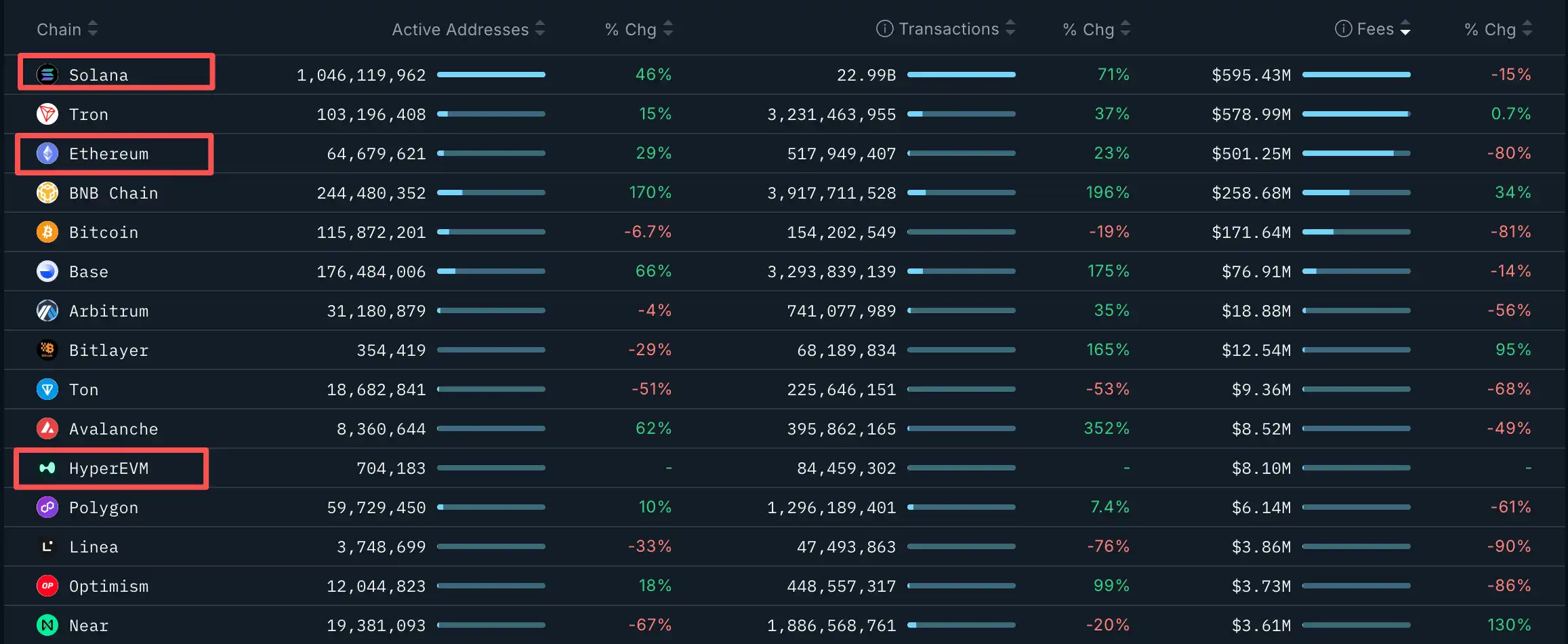
On January 2nd, Nansen data showed that Solana's on-chain fee revenue exceeded $600 million in 2025, surpassing TRON and Ethereum to rank first. The top five blockchains by on-chain fees last year were:

  • Solana ($603 million);
  • TRON ($581 million);
  • Ethereum ($514 million);
  • BNB Chain ($259 million);
  • Bitcoin ($172 million).

In addition, the number of active addresses on the Solana chain exceeded 1.05 billion, and the number of on-chain transactions was about 23.01 billion, both higher than public chains such as Ethereum, Bitcoin, and Tron.

Latest data shows that,as of the time of writing, Solana has maintained its first position in terms of the number of active addresses, number of transactions, and fee revenue over the past year.
Solana's Annual Revenue in 2025 Exceeded $1.5 Billion, Surpassing the Combined Revenue of "Hyperliquid + Ethereum"

According to data from Blockworks Research, Solana's full-year revenue in 2025 exceeded $1.5 billion, leading all public chain networks. Hyperliquid followed closely with revenue of $780 million; Ethereum generated $690 million in the same period, both lagging behind Solana. At the same time, and even more commendable, Solana achieved this revenue while its median transaction fee remained below 1 cent.

In this regard, Solana co-founder Anatoly Yakovenko affirmed this achievement and pointed out that capacity growth and cost-effectiveness are the core driving forces. He believes that network scale, not high fees, supports sustainable revenue expansion.

Solana's On-Chain Spot Trading Volume Reached $1.6 Trillion in 2025, Surpassing All CEXs Except Binance

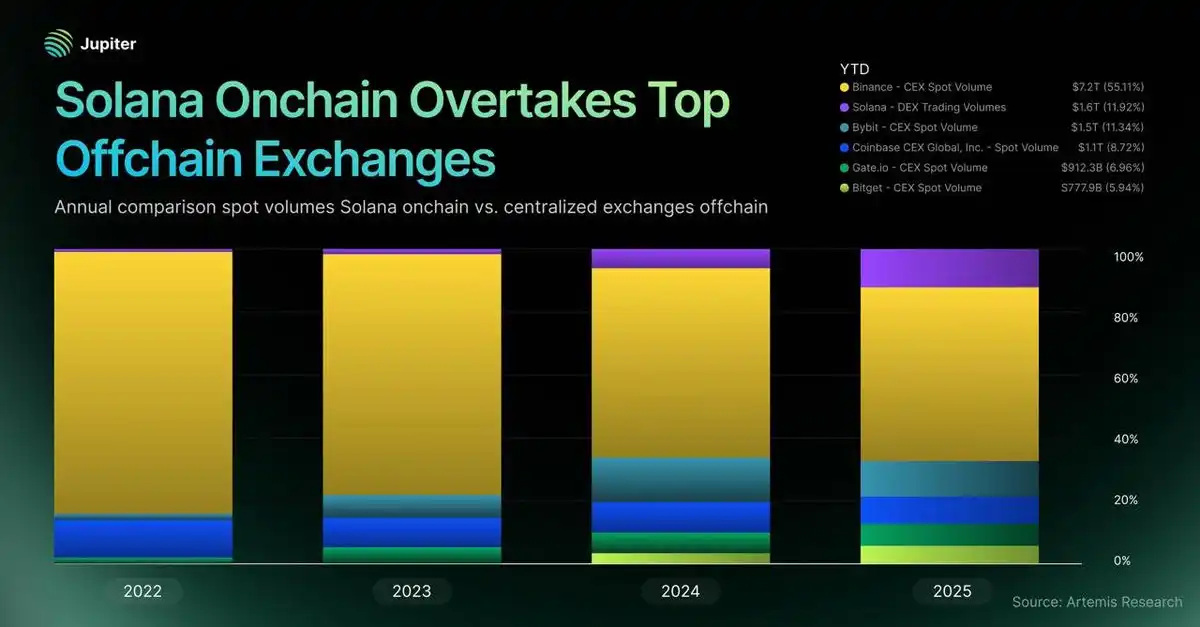
Recently, The Kobeissi Letter stated that Solana's on-chain spot trading volume officially reached $1.6 trillion in 2025, surpassing all centralized exchanges except Binance.

According to data from JupiterExchange, the proportion of Solana's on-chain trading volume to the total trading volume has grown from 1% to 12% since 2022. In 2025, Solana's total trading volume officially exceeded that of Bybit, Coinbase Global, and Bitget, second only to Binance.

At the same time, Binance's market share has dropped from 80% to 55% since 2022. This also means that industry activity in cryptocurrency is rapidly shifting on-chain.
Revealing the Composition of Solana's Ecological On-Chain Revenue: 4 Components Support Over $600 Million

Based on available information, Solana's network revenue mainly comes from on-chain transaction fees. Unlike Ethereum and others, its fee mechanism design focuses more on deflation and validator incentives. The composition of the total fee revenue of $603 million in 2025 is as follows:

First Revenue: Base Fee

  • A very low fixed base fee is charged per transaction (about 5000 lamports).
  • This portion of the fee is entirely burned, not distributed to validators, directly reducing the total supply of SOL, creating deflationary pressure.
  • Accounts for a large proportion of total fee revenue, especially in 2025 with explosive transaction growth, the burning mechanism significantly enhanced SOL's scarcity.

Second Revenue: Priority Fee

  • An additional fee that users can choose to pay to speed up transaction confirmation.
  • During periods of high congestion (such as meme coin booms, large DEX trades), priority fees increase significantly, becoming the main source of revenue increment.
  • This portion of the fee is distributed to block producers (Leaders) and stakers, and is the main reward source for validators.

Third Revenue: MEV (Maximal Extractable Value) Related Revenue

  • Tips paid by searchers through MEV clients like Jito further supplement income.
  • The proportion of MEV revenue increased in 2025, closely related to complex arbitrage opportunities in DEX and meme coin trading.

Fourth Revenue: Other Minor Sources

Such as account rent (storage fees), voting fees, etc., accounting for a small proportion.

In the overall distribution mechanism, about 50% of the fees indirectly benefit all SOL holders through the burning mechanism (deflation); about 50% is directly distributed to validators and stakers, incentivizing network security. Unlike Ethereum, where ecological protocol fee revenue mainly goes to validators, Solana's burning mechanism gives its network revenue greater long-term value capture capability, which is also the key to maintaining low fees under high transaction volume.

Overview of Crypto Money-Making Machine Business Models: Public Chains, Perp DEXs, Launchpads Remain the Most Profitable Tracks, Second Only to Stablecoins

Finally, based on existing market information, public chains (Solana, Ethereum, TRON), on-chain perp DEXs (such as Hyperliquid, Aster, etc.), and on-chain Launchpads (such as Pump.fun) are still the most profitable tracks in the crypto industry, second only to stablecoin projects that collect interest and have stable issuance.

Although we previously analyzed the awkward survival state of current public chain projects in the article "Only 10 Public Chains Have Weekly Revenue Over $100,000: Naked After the Tide Recedes", the existence of public chains like Solana, Ethereum, TRON, and Base tells us: public chains are still the most profitable crypto track, perhaps even without one.

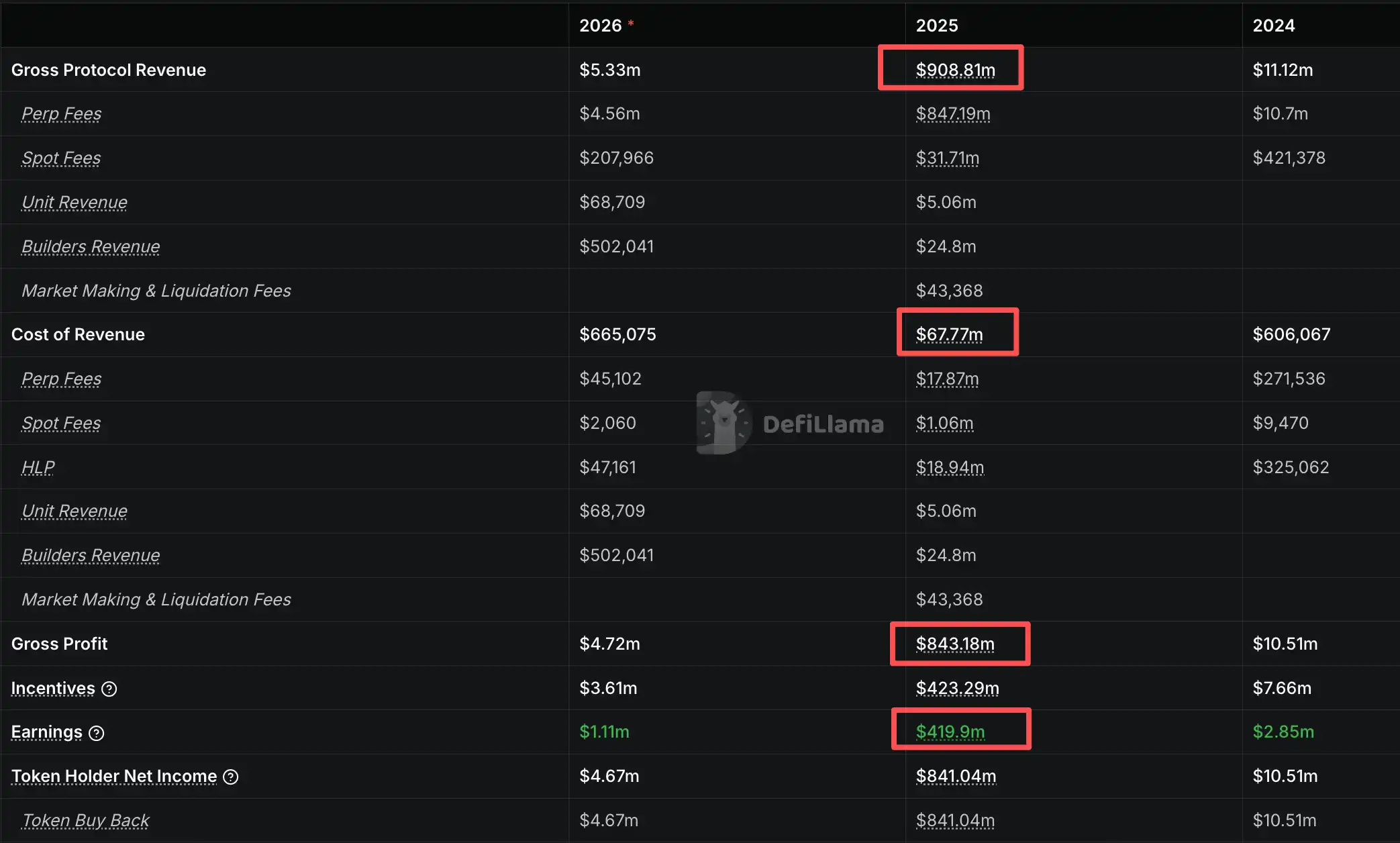
According to DefiLlama data, Hyperliquid's revenue in 2025 was $908 million; its cost of revenue was approximately $67.77 million, and its annual net profit was approximately $843 million. Excluding incentive-based expenses, the net profit attributed to the platform in 2025 was as high as approximately $420 million.
According to DefiLlama data, Pump.fun's annual revenue in 2025 was approximately $550 million. Unlike on-chain perp DEX platforms like Hyperliquid, as a "one-click coin issuance platform", Pump.fun does not need to incur incentive expenses, so its platform's annual net profit is approximately equal to its annual revenue, i.e., $549 million.
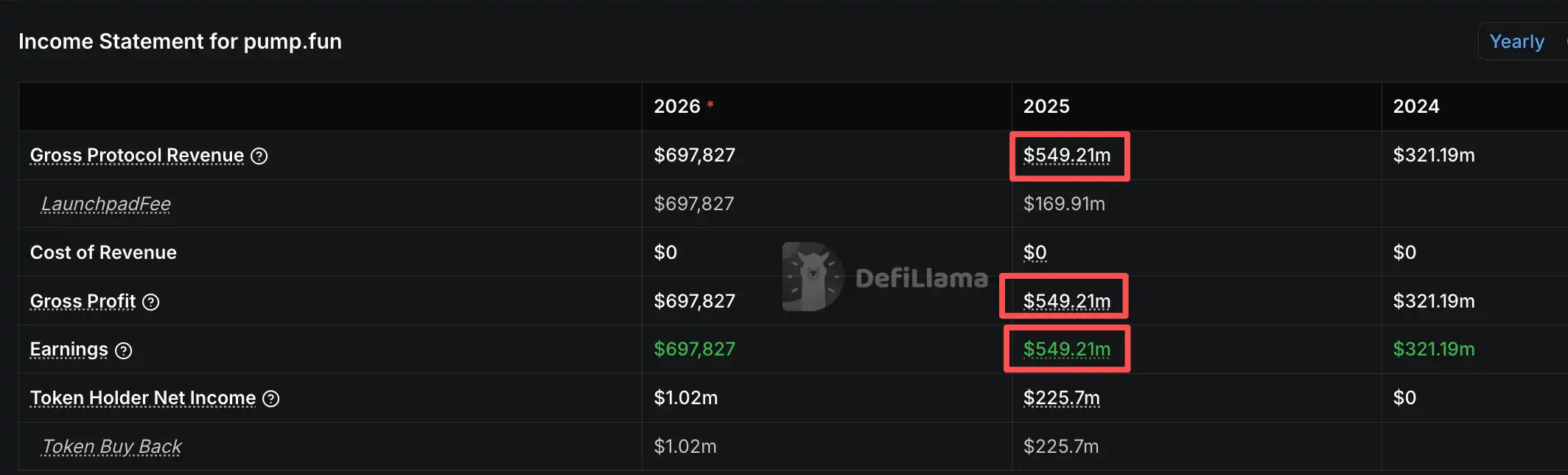
Based on the above information, the industry's mainstream revenue generators are still top applications like public chains, on-chain Perp DEXs, and Launchpad coin issuance platforms, second only to stablecoins (e.g., Tether's net profit related to the stablecoin sector alone was as high as $7.43 billion in 2025).


Trending Cryptos

Related Questions

QAccording to the article, which blockchain had the highest on-chain fee revenue in 2025?

ASolana had the highest on-chain fee revenue in 2025, reaching $603 million.

QWhat was Solana's total annual revenue for 2025, and how did it compare to the combined revenue of Hyperliquid and Ethereum?

ASolana's total annual revenue for 2025 was over $1.5 billion, which was more than the combined revenue of Hyperliquid ($780 million) and Ethereum ($690 million).

QWhat were the four main components that made up Solana's on-chain fee revenue?

AThe four main components were: 1. Base fees (burned), 2. Priority fees (paid to validators and stakers), 3. MEV (Maximal Extractable Value) related income, and 4. Other minor sources like account rent and voting fees.

QHow much on-chain spot trading volume did Solana achieve in 2025, and what did it surpass?

ASolana achieved $1.6 trillion in on-chain spot trading volume in 2025, surpassing all centralized exchanges except for Binance.

QBesides public chains, what other types of crypto projects are mentioned as the most profitable business models, second only to stablecoins?

AThe other most profitable business models mentioned are on-chain Perpetual DEXs (like Hyperliquid) and on-chain Launchpads (like Pump.fun).

Related Reads

Within Strategy's Framework, STRC's Dividend Yield Remains at 12% as Share Price Stays Below Par Value

Michael Saylor, Executive Chairman of Strategy (MSTR), confirmed that the dividend rate for its STRC perpetual preferred shares will remain at 12.00% through August 2026. The rate has increased from 9% at its July 2025 launch to the current high via a "ratchet" mechanism, which permanently raises the rate by 0.5% whenever the share price falls below $95. This mechanism is intended to push the price back toward its $100 par value and support Strategy's "at-the-market" (ATM) program for issuing new shares to fund Bitcoin purchases. However, the mechanism has not worked as intended. STRC shares closed at $89.46 on July 31, remaining about 10-11% below par value despite the record-high dividend. Competition from rival Strive's higher-yielding SATA securities has pressured demand. The persistent discount has forced Strategy to suspend new STRC issuances via its ATM program, limiting this funding channel for Bitcoin acquisitions. STRC's struggles reflect Bitcoin's own volatility, as the preferred shares historically move in tandem. Analysts have warned the ratchet structure carries long-term, one-way risk. A law firm is investigating Strategy's ability to maintain dividend payments if Bitcoin's price stays low. Retail investors own roughly 83% of outstanding STRC shares, a group seen as prone to panic selling during downturns. In response, Strategy has established financial reserves, including a liquidity cushion covering about 26 months of dividend/interest obligations, and a $2 billion share buyback program alongside a Bitcoin monetization framework, though the company emphasized it is not obligated to sell any Bitcoin.

cryptonews.ru1m ago

Within Strategy's Framework, STRC's Dividend Yield Remains at 12% as Share Price Stays Below Par Value

cryptonews.ru1m ago

Analyst: Bitcoin's Price Will Drop to $60k in August, Then Rebound to $70k

Financial analyst Andrey Poroshin has provided a new forecast for Bitcoin's price dynamics in August. Poroshin, an analyst at the Bitbanker exchange, expects the cryptocurrency market to experience a downturn this month, with prices retesting the $60,000 level due to a lack of supportive macroeconomic catalysts. He noted that the recent US Federal Reserve decision to hold interest rates did not significantly impact the market, while inflation remains above the 2% target. Poroshin stated that Bitcoin is ending July under pressure from moderate volatility and a lack of new macroeconomic stimuli, leading to continued market caution. According to his base scenario, Bitcoin will drop to a range of $60,000 to $62,000 before recovering to $70,000. He pointed out that even $70,000 remains below the cost of mining in the US, which has prompted some miners to shift towards AI data center operations. Poroshin cited the winding down of BitMEX's operations as a potential catalyst for a price rebound, suggesting the exit of weaker players often coincides with market reversals and reduced short-term selling pressure. He believes Bitcoin is currently less susceptible to geopolitical shocks, such as the Iran-US conflict, and does not expect significant market changes in August related to the pending CLARITY Act. Looking ahead, Poroshin forecasts that September will bring more active price fluctuations driven by potential Fed rate decisions and possible discussions or approval of the CLARITY Act.

cryptonews.ru1m ago

Analyst: Bitcoin's Price Will Drop to $60k in August, Then Rebound to $70k

cryptonews.ru1m ago

In Jinjiang, Fujian, a Storage Super Unicorn Lies Quiet

In Fujian's Jinjiang, a city known for sportswear, lies a quiet semiconductor giant: Fujian Jinhua Integrated Circuit Co. (JHICC). Once a promising domestic DRAM manufacturer alongside Yangtze Memory and ChangXin Memory Technologies (CXMT), its journey was derailed in 2018 when the U.S. placed it on an Entity List and filed criminal charges for alleged trade secret theft. This halted production for years. A turning point came in February 2024 when a U.S. federal court found JHICC not guilty. However, it had lost crucial time. While CXMT soared to become a top-valued A-share company in 2024, JHICC, with an estimated valuation of 80 billion RMB, was just restarting. Its current output is primarily customized DDR4 chips, not the advanced DDR5/HBM demanded for AI, but it still benefits from the broader memory chip upcycle. JHICC's story is tied to Chen Zhengkun, a veteran engineer who left Micron to lead the venture. Founded in 2016 with state-backed funding, JHICC partnered with Taiwan's UMC to develop DRAM technology. Rapid progress was cut short by the U.S. actions, which Micron initiated, partly due to its heavy reliance on the Chinese market. Post-sanctions, Chen's team worked to rebuild the production line with reduced reliance on U.S. technology. According to its records, JHICC achieved small-scale production and revenue growth under immense pressure. It now focuses on the stable "niche" DRAM market (e.g., TVs, routers) with a monthly capacity of ~40,000 wafers, aiming for 60,000 by 2026. It holds over 1,000 patents but remains on the Entity List. For Jinjiang, investing in JHICC was a bold industrial leap. The local government provided unwavering financial and logistical support during the crisis, helping the company survive. JHICC has become the anchor for a growing local semiconductor cluster. Though its scale lags behind domestic peers, JHICC's persistence symbolizes a hard-won foothold in a global market long dominated by Samsung, SK Hynix, and Micron. Having missed one boom, it seeks a place in the new AI-driven memory supercycle.

marsbit2h ago

In Jinjiang, Fujian, a Storage Super Unicorn Lies Quiet

marsbit2h ago

Trading

Spot

Hot Articles

Discussions

Welcome to the HTX Community. Here, you can stay informed about the latest platform developments and gain access to professional market insights. Users' opinions on the price of ETH (ETH) are presented below.

活动图片














