November 26, 2024, Walkerhill Hotel, Gwangjin-gu, Seoul. The venue for the 50th-anniversary ceremony of the Korea Foundation for Advanced Studies. The lights dim, and an AI-generated image appears on the screen. In the footage is Choi Jong-hyun, the second-generation chairman of the SK Group and founder of this foundation.
He died suddenly in Los Angeles in 1998, 26 years ago. In the AI footage, he opens his mouth to speak again, addressing the young people who received scholarships from the foundation to study abroad all those years ago: "Plant seeds in your hearts, and I hope you have the dream of growing into big trees; we are willing to wait until the seeds you plant grow into trees."
Sitting at the central table in the audience were his son, Chey Tae-won, the current chairman of the SK Group and head of South Korea's second-largest chaebol, and the two children he had brought along to witness this moment: eldest daughter Choi Yun-jung and eldest son Choi In-geun. Chey Tae-won later explained to the media why he brought them: "This is our legacy, so they need to receive training. They need to see what their grandfather did, what their father did." He said he had "obligated them to attend." At the event, he also mentioned "remembering the source when drinking water": when drinking water, think about where it came from; those who benefit should also remember the person who dug the well in the first place.
SK Hynix's stock price has risen 700% over the past year, and its market capitalization has just surpassed 1,000 trillion won, surpassing its old rival Samsung Electronics, making it the most valuable asset in the history of Korean chaebols. As the AI cycle has pushed Hynix into the spotlight of the Korean capital market, when the outside world looked back to find the heirs of this company, they discovered that the SK third generation was not positioned according to the traditional chaebol script. The eldest daughter entered the group's executive narrative earliest; the second daughter is most deeply connected to Hynix, Washington, and American military networks; and the eldest son, who seems the most like the heir, is ironically the quietest one.
After Hynix's Surge, the Old Script for Korean Chaebol Heirs Is Failing
The succession of Korean chaebols has traditionally revolved around four keywords: eldest son, equity, marriage ties, and paternal recognition. Samsung, Hyundai, and Hanwha have all repeated this script.
In October 2022, Samsung Group's third-generation Lee Jae-yong was formally appointed chairman, completing Samsung's generational transition; his eldest son, Lee Ji-ho, recently enrolled in the Korea Naval Academy to prepare for his mandatory military service early—an act itself is already a "succession training move" for the new generation of Korean chaebols. The Hyundai Motor Group followed a bit later, with the third-generation Chung Eui-sun taking over in 2020. Hanwha Group, in 2025, saw Chairman Kim Seung-youn give half the shares of the holding company to his three sons, effectively handing the empire to current Vice Chairman Kim Dong-kwan, 42, whose status as the eldest son has never been in doubt.
The core of this script is "to let the public and the market recognize who the crown prince is in advance." From Lee Jae-yong to Chung Eui-sun to Kim Dong-kwan, regardless of differences in personality, ability, or path, they were all written into the position of "successor" by their fathers, families, and the media, and gradually moved toward that chair through equity, military service, education, and career training.
SK is different. Chey Tae-won and his ex-wife, Roh So-young, have three children: eldest daughter Choi Yun-jung (born 1989), second daughter Choi Min-jung (born 1991), and eldest son Choi In-geun (born 1995). All three children are currently related to the group's future, but none of them fit into the "crown prince" position.
Choi Yun-jung was early on labeled by Korean business media as the "most obvious succession candidate," but her work is not in chips but at SK Biopharmaceuticals; Choi Min-jung once worked in international commerce and policy response at SK Hynix's U.S. subsidiary, but in 2022 she left Hynix for San Francisco to start a healthcare venture; Choi In-geun most resembles the traditional male heir, but in July 2025 he left SK E&S and joined McKinsey & Company's Seoul office. According to the conventions of Korean chaebol third generations, a consulting firm is part of an "external experience" path, not a succession directive.
Chey Tae-won himself put it bluntly in a 2021 interview with BBC Korean: "It hasn't been decided yet. My children must also strive to earn their opportunity. My son is still young, he will live his own life, I won't force him." When asked if board approval is needed for children to participate in management, he answered, "Yes."
This stance turns succession from a family matter into a public test of legitimacy. All three children have to prove themselves, and what they have to prove themselves with is no longer equity, marriage ties, or eldest son status.
Choi Yun-jung: The "Most Obvious Heir," from Lab Bench to Boardroom Table
June 28, 2024, SKMS Research Institute, Icheon, Gyeonggi Province. A meeting of SK Group's business strategy. Attendees include CEOs of major subsidiaries like SK, SK Innovation, SK Telecom, SK Hynix, plus key family members of the group—over 30 people in total. Chey Tae-won was on a business trip in the U.S. at the time, participating via video. The meeting was described by Korean media as an intensive discussion with a sense of crisis, scheduled for one night and two days, with the first day having "no preset end time" until directions were formed.
Choi Yun-jung sat at the conference table. She was the only person attending the meeting in the capacity of Chey Tae-won's child and is the youngest executive within the SK Group. Media interpreted her "sudden appearance" as part of her management training.
To understand why she could sit at that table, one needs to rewind and look at her training. Choi Yun-jung was born in August 1989 at the Korean Armed Forces Capital Hospital in Seoul. At that time, her maternal grandfather, Roh Tae-woo, was the sitting president of South Korea. She spent her childhood and middle school years at an international school in Beijing, then attended the University of Chicago for her undergraduate degree in biology—the same university her parents had attended. During her undergraduate years, she worked as a researcher at the Chicago Brain Science Institute for two years and had research experience at Harvard's Department of Chemistry and Chemical Biology. After graduation, she worked for two years as a consultant at Bain & Company. This is the standard training for Korean chaebol third generations.
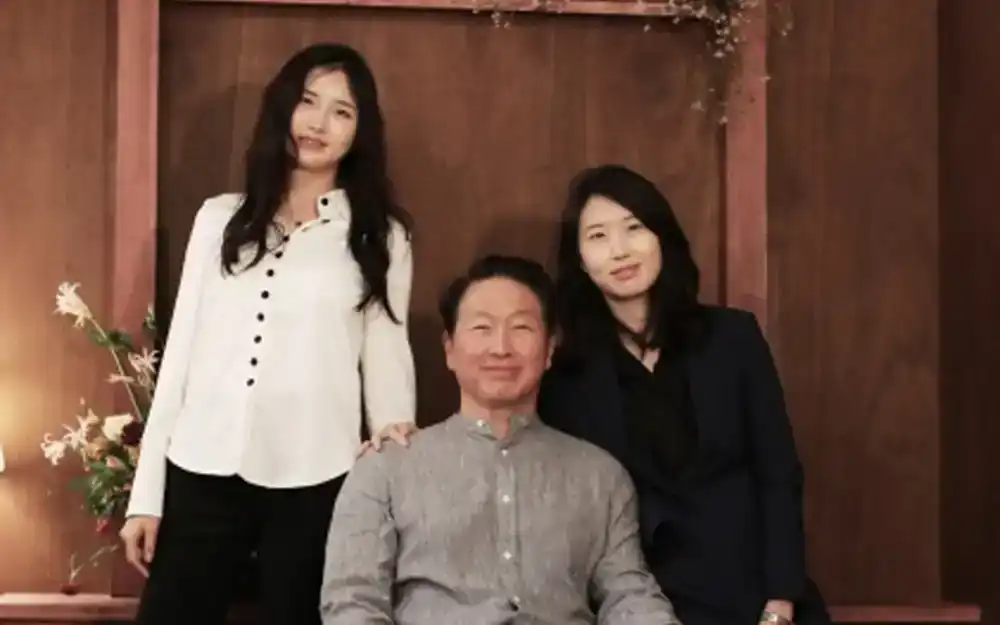
In 2017, she joined SK Biopharmaceuticals as the head of the strategic investment team. But in 2019, she made a decision not typical for an heir: she temporarily left SK to return to Stanford University for a master's degree in biomedical informatics. This is a computational biology track, not ordinary biology. Two years later, she returned to SK to continue in strategy while simultaneously pursuing a Ph.D. in biological sciences at Seoul National University. She is still in her doctoral program, majoring in genetics and developmental biology.
In January 2024, she was promoted to Head of Business Development (Senior Vice President level) at SK Biopharmaceuticals, leading the introduction of radiopharmaceutical therapy (RPT) and radioisotope supply contracts. This is a core pipeline for SK Biopharmaceuticals' transition from traditional neurological drugs to precision medicine in the AI era. By the end of that year, Chey Tae-won established a new "Growth Support Department" within the group's top holding company, SK Inc., responsible for medium-to-long-term planning, portfolio management, global expansion, and new business evaluation, and placed her directly in charge.
Her marriage also does not follow the old chaebol script. In October 2017, she married her Bain colleague, Yoon Do-yeon. Yoon Do-yeon graduated from Seoul National University's Business School and later served as co-CEO of More (모레), a Korean AI infrastructure startup. The company develops an AI model training and computation parallelization software platform. It received strategic investment from KT in 2021 and was valued at around 350 billion won in 2025. This is not a traditional chaebol alliance marriage, but neither is it what Chinese media often calls "marrying an ordinary employee." It is a new type of elite network combination: the chaebol eldest daughter marries a technology entrepreneur of the AI era.
In the narratives of female heirs within chaebols like Samsung and CJ over the past decades, daughters were often seen through art museums, hotels, charitable foundations, luxury retail, or dowries. Choi Yun-jung's position is different. She has taken a seat at the SK Group's table that decides its future direction. Her visibility is not established by marriage, art, or image-building but by scientific training, consulting experience, doctoral research, strategic investments, and group executive positions.
The way chaebol daughters are seen is changing. But Choi Yun-jung herself rarely speaks publicly. She is discussed by Korean media with the label "most like a succession candidate," yet her personal story remains quiet in public reports.
Choi Min-jung: Warships, Washington, and Hynix's Global Heir
October 13, 2024, again at the SK Group's own Walkerhill Hotel, Choi Min-jung, Chey Tae-won's second daughter, held her special wedding with Chinese-American entrepreneur Kevin Hwang.
The wedding had about 500 attendees, including Lee Jae-yong, Koo Kwang-mo, Kim Dong-kwan, and other SK family members. Chey Tae-won and Roh So-young appeared in the same space for the first time since their 1.38 trillion won divorce lawsuit, sitting side by side in the parents' seats on the bride's side. Also present was the dog jointly raised by Choi Min-jung and Kevin Hwang.
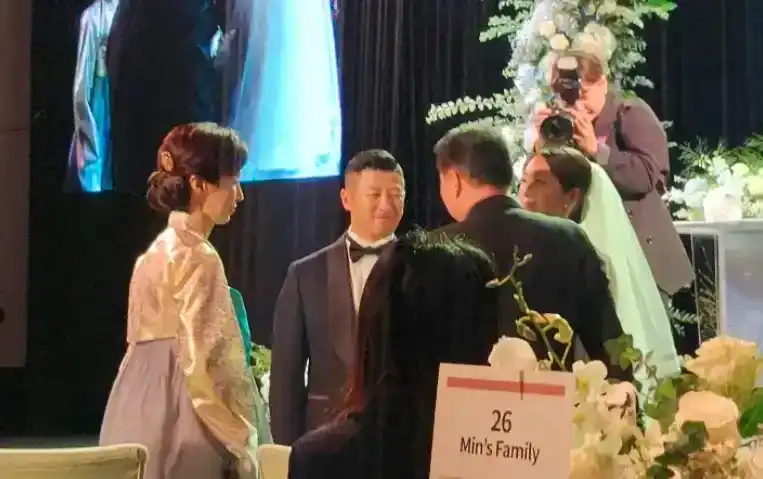
After the groom entered, Choi Min-jung walked into the venue alone, not escorted by her father. The entire ceremony had no official host. Her elder sister Choi Yun-jung gave the congratulatory speech; the groom's brother gave a speech in English. Before the ceremony began, the entire audience observed a moment of silence for Korean and American comrades-in-arms. A side table was set up with medals, dog tags, a rose, and a lemon—an American military tradition to commemorate missing and fallen soldiers, called the Missing Man Table.
Choi Min-jung was born in 1991. She attended middle school at the High School Affiliated to Renmin University of China in Beijing and then entered Peking University's Guanghua School of Management for her undergraduate degree in business administration. Among Korean chaebol third generations, almost none come to China for their undergraduate studies; others either go to Ivy League schools or stay at prestigious Korean universities. During her time in Beijing, she reportedly self-funded her living expenses through scholarships, part-time work at convenience stores, and income from teaching at an exam prep academy, receiving almost no financial support from her parents. This "self-reliant path" is an extremely rare mark among Korean chaebol children.
In 2014, she made a decision that baffled all Korean media: she applied for the 117th class of the Korean Navy Officer Candidate School. Military service is mandatory for Korean men but completely voluntary for women; this was the first time a female member of a Korean chaebol family voluntarily enlisted. In her interview, she said she was inspired by the challenging spirit and leadership of the 1915 Antarctic explorer Ernest Shackleton. During the 11-week training period before commissioning, she often said the same thing to visiting family and friends: "I feel proud to have been born as a daughter of the Republic of Korea. After the training period, I have even greater pride."
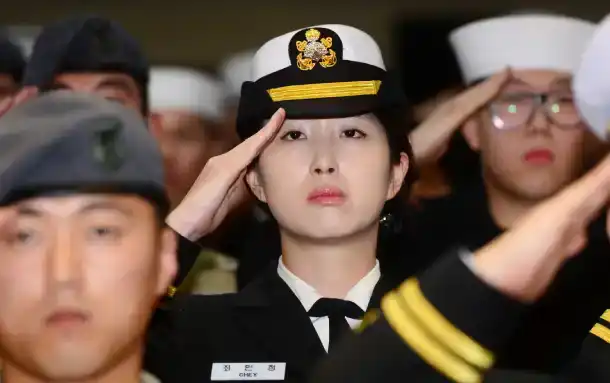
She was assigned to the ROKS Chungmugong Yi Sun-sin destroyer (DDH-975) as an Assistant Operations Information Officer. In December 2015, she was deployed to the Gulf of Aden near Somalia with the 19th contingent of the Cheonghae Unit, performing anti-piracy escort missions. Before discharge, she served as a Situation Officer in the Command and Control Room of the Combat Task Force Headquarters, Second Fleet Command, West Sea. She was discharged on November 30, 2017, with the rank of Navy Lieutenant.
After her discharge, she returned to China and worked in private equity at an investment firm for about a year, then went to the United States to earn a master's degree in International Business and Policy from Georgetown University. In August 2019, she joined SK Hynix's External Cooperation Division (INTRA), working on international commerce and policy response, shuttling between Washington D.C. and Seoul. This is her direct connection point to SK Hynix. But not as an engineer, product manager, or factory operator. She worked on policy, later moving to the strategy department of SK Hynix America, responsible for M&A and investments.
It was during this time that she met her husband, Kevin Hwang. They were neighbors in the Dupont Circle area of Washington, D.C.
Kevin Hwang was born in Indiana, USA. He holds a bachelor's degree from Harvard and an MBA from Stanford. In 2016, he joined the United States Marine Corps as an officer candidate. From October 2020, he worked in South Korea for about nine months as a U.S. Forces Korea logistics plans officer. Both having military backgrounds, they were described by Korean media as having their "relationship deepened by shared military experience."

In February 2022, Choi Min-jung took a leave of absence from SK Hynix and went to San Francisco-based telemedicine startup Done Global as an unpaid advisor; Korean media later revealed she actually served as CFO. A year later, she co-founded Integral Health with scholars from the Department of Psychiatry at Yale School of Medicine, serving as CEO, focusing on AI-driven collaborative care and behavioral health integration.
Her current LinkedIn introduction reads: "Founder of Integral Health | Investor in Healthcare & AI | Veteran | 2x Exits." The "Veteran" tag remains in the most prominent position.
A recurring theme runs through Choi Min-jung's life: the military. From Shackleton to the Gulf of Aden, from SK Hynix INTRA in Washington to marrying a former U.S. Marine Corps captain. She has not entered SK's internal management like her sister, nor has she married into a prominent Korean family according to the traditional chaebol script. But she personifies the new-era position that SK Hynix occupies. Semiconductor companies in the AI cycle are increasingly resembling geopolitical entities, having to navigate U.S. policy, trade controls, supply chain security, and capital mergers and acquisitions. Choi Min-jung's resume is tailor-made for this line.
Choi In-geun: The One Who Seems Most Like the Heir, Why Is He the Quietest?
The story of Choi In-geun begins in a hospital room.
In 2003, the SK Group was rocked by an accounting fraud scandal, and Chey Tae-won was imprisoned. The same year, his and Roh So-young's youngest son, Choi In-geun, was diagnosed with juvenile diabetes, told by doctors he would need insulin injections for life. Choi In-geun was 8 years old at the time.
During that period, Roh So-young, the daughter of a former Korean president, took her child and moved into the pediatric ward of Seoul National University Hospital. At night, with Choi In-geun asleep in bed, she would sit alone watching him. Roh So-young later recalled in an interview that her son was still struggling with diabetes at age 17, but he was a very bright boy, often serving in the choir at a nearby church, even using beatboxing to perform special songs during worship services, and at night copying the Bible with his second sister, Choi Min-jung.
Choi In-geun's educational path differs from his two sisters. He first attended a non-traditional middle school in Korea known for innovative education, later transferring to Hawaii. His mother Roh So-young's educational philosophy was "no need to be anxious about forcing children into the same universities as others," advocating exploring creative and different parenting methods. During Choi In-geun's high school years in Hawaii, Roh So-young lived there for over two years, accompanying him as a study-abroad parent.
He later enrolled at Brown University in the U.S. to study physics, following in his father's footsteps. Chey Tae-won also majored in physics at Korea University, and Chey Tae-won's brother, SK Group Vice Chairman Chey Jae-won, is also a Brown University physics graduate. This is the only clear line of academic continuity in the family. Choi In-geun has a good relationship with his father; they communicate frequently, often play tennis together, and have been photographed talking with arms around each other's shoulders outside a restaurant in suburban Seoul.

After graduation, he interned at the Boston Consulting Group for a period. In September 2020, he joined SK E&S's strategic planning team, working on natural gas market expansion. In 2025, he left SK and joined McKinsey & Company's Seoul office. Korean media interpreted this move as the standard "external experience" path for chaebol third generations, but he himself has made no public statements.
According to the old chaebol script, Choi In-geun should be the default successor. He is the eldest son, carries the family's academic continuity, and his trajectory from SK to McKinsey resembles the training paths of Lee Jae-yong and Chung Eui-sun. But no public statements by him have been reported; the contents of the petition he submitted regarding his parents' divorce case have not been disclosed; and he currently holds no shares in the SK Group. He seems like someone written into a position by the old script but refuses to walk onto that stage.
Choi In-geun is the one among the three children who most resembles an heir and is also the quietest.
The Family in Court
No matter how independent the three children's resumes are, they cannot avoid their parents' marriage. They have not spoken through interviews or social media, but they entered the public narrative of their parents' marriage through legal documents.
Chey Tae-won and Roh So-young held their wedding at the Blue House in 1988, officiated by the then-Prime Minister of South Korea. Roh So-young's father was Roh Tae-woo, who became president the same year. In 2015, Chey Tae-won published a "confession of an illegitimate child" in the Naeil Shinmun, publicly admitting he had a daughter with his live-in partner, Kim Hee-young, and requesting a divorce from Roh So-young, who refused. In 2017, Chey Tae-won again applied for divorce mediation, leading to litigation. In 2019, Roh So-young counter-filed for divorce, demanding consolation money and property division corresponding to SK Inc. shares.
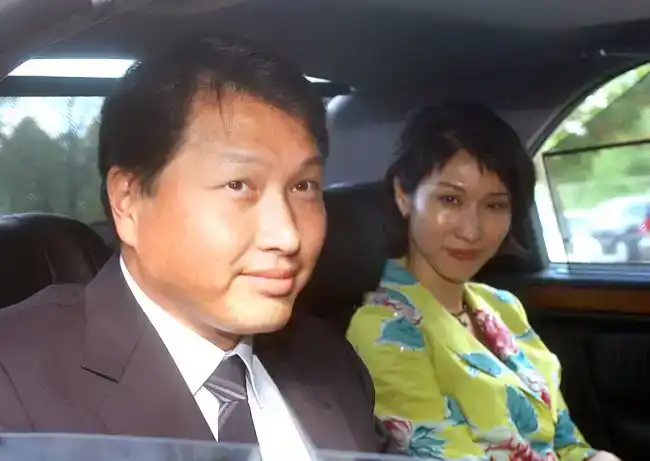
This lawsuit attracted sustained international media attention for three reasons: the division amount could set a historical record in Korean courts, the involvement of funds from the former president's family in the SK Group's early capital structure, and the potential shaking of Chey Tae-won's actual control over SK Inc. due to a massive division.
In 2022, the Seoul Family Court's first instance ruled that Chey Tae-won divide 66.5 billion won in property with Roh So-young and give her approximately 310,000 shares of SK Inc. stock, turning her from a marginal shareholder with 0.01% ownership into the company's fourth-largest shareholder. In May 2024, the second instance ruling changed, jumping the division amount to 1.38 trillion won, the highest single divorce property division in Asian legal history. In October 2025, the Korean Supreme Court overturned the property division part of the second instance ruling and sent it back for retrial.
In May 2023, the three legitimate children submitted petitions to the Seoul High Court Family Division 2, which was hearing the second instance of their parents' divorce case, on three consecutive days. Second daughter Choi Min-jung submitted on the 15th, eldest son Choi In-geun on the 16th, and eldest daughter Choi Yun-jung on the 17th. The three children collectively appeared in their parents' divorce case files through legal documents, but what they wrote and whose side they took has not been disclosed to this day.
At Choi Min-jung's wedding in 2024, Chey Tae-won and Roh So-young appeared in the same space for the first time since the 1.38 trillion won divorce lawsuit, sitting side by side in the parents' seats for the bride. After the ceremony, family members from both sides circled the tables together to greet guests. This brief, ceremonial co-presence was the last family scene the three children could arrange for their parents after the structural failure of this marriage.
Like most chaebol families, what the SK third generation inherits is never just a company or a shareholding table.
When Hynix Becomes a Geopolitical Asset, Succession Is No Longer a Family Matter
Back to that commemorative event in 2024.
Grandfather Choi Jong-hyun returned to the scene via AI footage, speaking to his grandchildren. Father Chey Tae-won told the children this was the family legacy and they needed to receive training. Among the children sitting in the audience, eldest daughter Choi Yun-jung would continue to lead the Growth Support Department at SK Inc. the following year, while eldest son Choi In-geun would leave SK that same summer to join McKinsey. Second daughter Choi Min-jung was not present that day. Nearly a year later, she would return to the same hotel to hold her wedding as the founder of her own AI healthcare company, observing a moment of silence for Korean and American comrades-in-arms before the ceremony began.
The more SK Hynix resembles a global geopolitical asset, the less SK's successors resemble traditional heirs.
Choi Yun-jung's visibility no longer comes from marriage or family portraits but from whether she can deliver SK's next growth story beyond chips; Choi Min-jung's position is not in Hynix's factories or headquarters but between Washington policy circles, Pentagon neighbors, a U.S. Marine Corps husband, and AI healthcare entrepreneurship. She personally embodies the character mirror of this company's revalued industrial attributes in the AI era. Choi In-geun should have been the default successor in this old script, but his silence indicates that relying solely on eldest son status and family academic continuity is no longer sufficient to automatically generate succession legitimacy.
The marriage networks of Korean chaebols have not disappeared; they have merely shifted from the presidential palace and domestic chaebol circles to Silicon Valley AI infrastructure startups and Washington-based former U.S. Marine Corps reserve officers. Choi Yun-jung married More's co-CEO Yoon Do-yeon; Choi Min-jung married Kevin Hwang, who was stationed at the Pentagon. These are still elite unions, but the elites are no longer on the same map.
Chey Tae-won told his children at that 50th-anniversary event to "remember the source when drinking water." For the SK family heirs, inheritance is not a key, not a shareholding table. It is being brought before the "water source" to see how the previous generation dug for water, and then being required to dig their own wells in their own time.
Except their era is no longer the grandfather's era of industrial patriotism, nor the father's era of political-business marriages and group expansion. At the very moment SK Hynix is pushed to the center of the global supply chain by the AI cycle, the three Choi children are also sent to cutting-edge AI labs, Washington social circles, and Wall Street conference tables. What they inherit is the entire set of problems inherent in the global AI industry's great game, not any simple answer.