Silver Soars, Is the Bitcoin 'Bible' Prophecy Failing?

marsbitPublished on 2026-01-28Last updated on 2026-01-28

Abstract

Silver prices have hit a historic high of $117, challenging a core argument from "The Bitcoin Standard," a book that significantly influenced Bitcoin adoption, including MicroStrategy’s $425 million purchase. The book argued that silver could never serve as true "hard money" because its supply is highly elastic—price surges would trigger increased production, causing bubbles to burst, as seen in the 1980s Hunt brothers incident. However, current trends contradict this view. Despite soaring prices, silver production has actually decreased over the past decade. Structural factors are at play: around 75% of silver is mined as a by-product of other metals, so production doesn’t directly respond to silver prices. Moreover, new mining projects take 8-12 years to develop. Supply has fallen short of demand for five consecutive years, with record industrial use—especially in solar panels, EVs, and AI hardware—driving consumption. China’s recent export restrictions on refined silver have further tightened markets. While Bitcoin maximalists use the book’s arguments to dismiss silver’s rally as a speculative bubble, the metal’s fundamental supply-demand dynamics suggest this cycle may be different. The divergence highlights a tension between ideological narratives and evolving market realities.

Original Author: David, Shenchao TechFlow

In 2020, after reading a book, MicroStrategy founder Michael Saylor decided to buy $425 million worth of Bitcoin.

This book is called "The Bitcoin Standard", published in 2018, translated into 39 languages, with over a million copies sold, and revered by Bitcoin enthusiasts as the "bible".
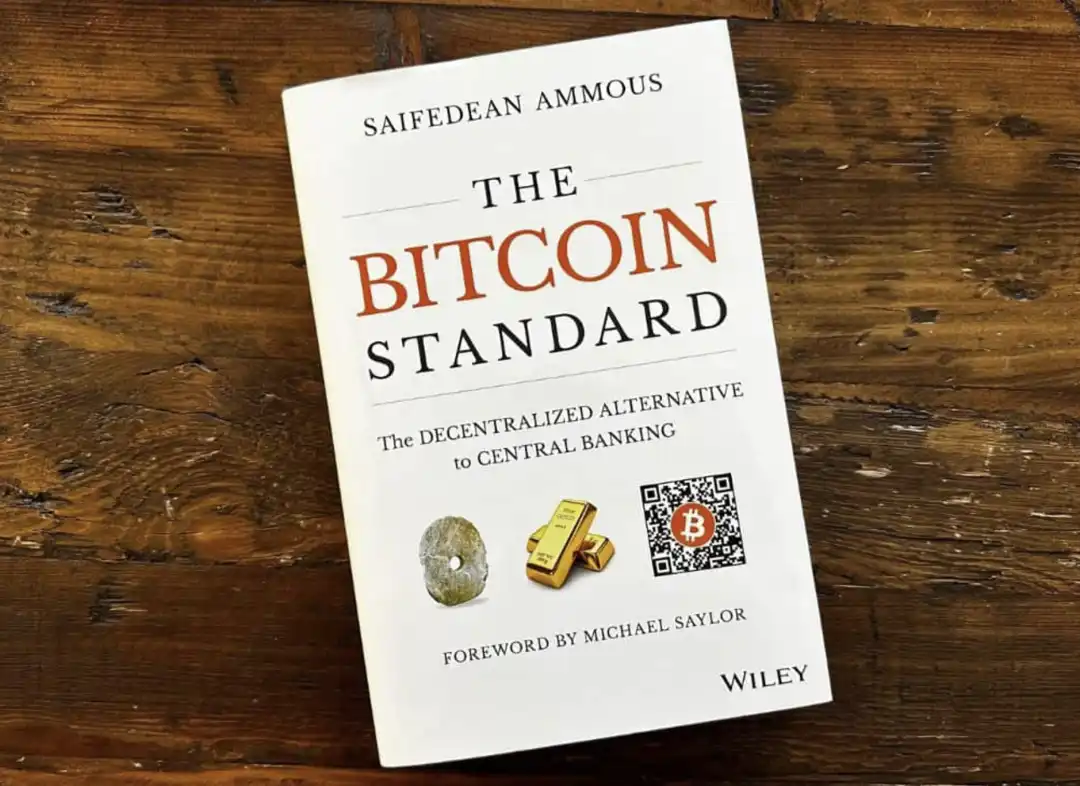
The author, Saifedean Ammous, holds a Ph.D. in Economics from Columbia University, and his core argument is singular:

Bitcoin is a "harder" form of hard currency than gold.

Simultaneously, on the book's promotional page, Michael Saylor's endorsement reads verbatim:

"This book is a work of genius. After reading it, I decided to buy $425 million worth of Bitcoin. It had the greatest impact on MicroStrategy's way of thinking, leading us to shift our balance sheet to a Bitcoin standard."

But there is one chapter in this book that is not about Bitcoin. It explains why silver cannot become hard currency.

Eight years later, today, silver has just surged to a historical high of $117 per ounce, and the investment frenzy in precious metals continues, with even Hyperliquid and a host of CEXs starting to list precious metals contracts in various forms.

Often at times like these, there are always be people acting as whistleblowers or defectors to warn of risks, especially in an environment where everything is rising except Bitcoin.

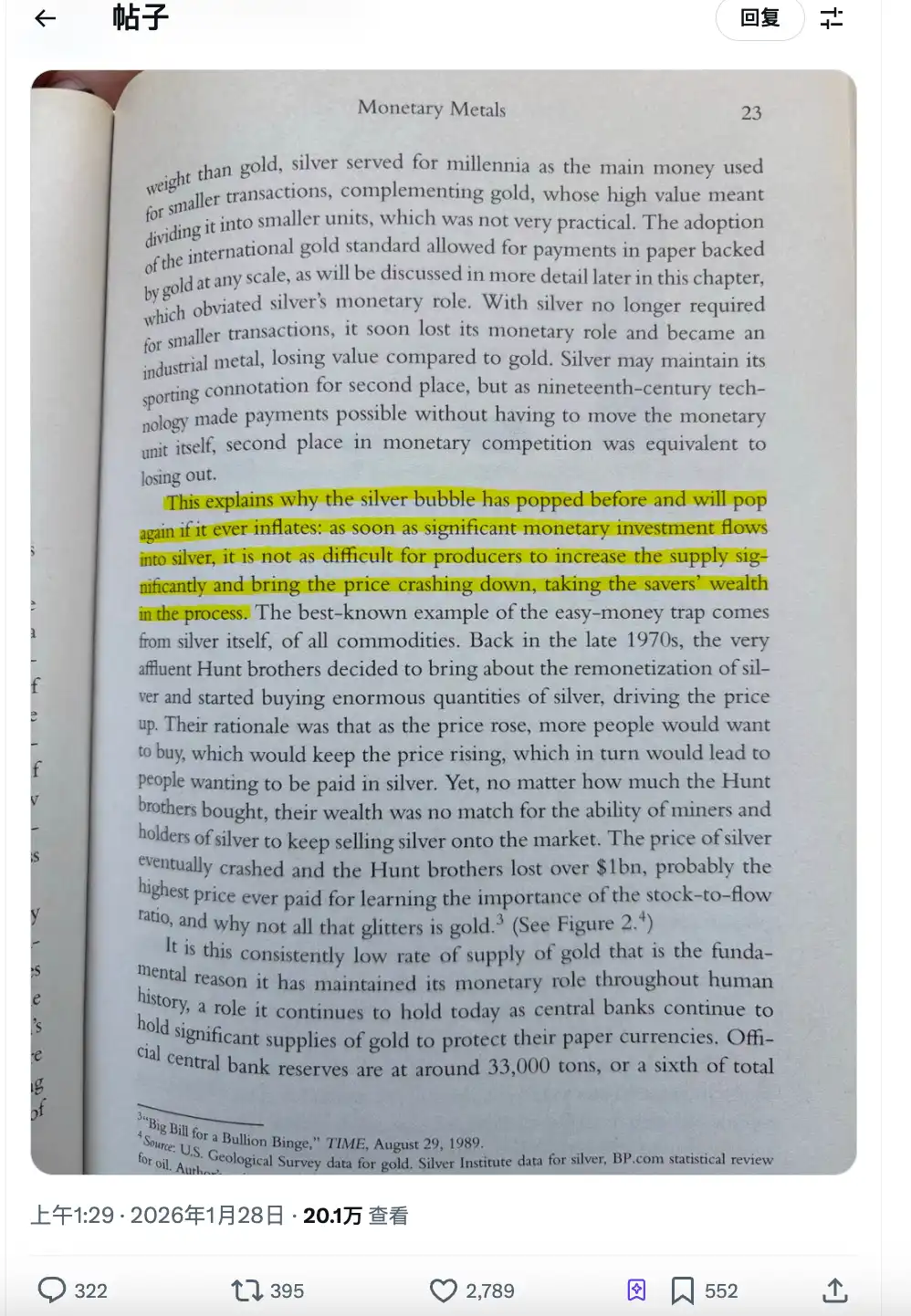
For example, a widely circulated post on Crypto Twitter today cited a screenshot from page 23 of this book, with a highlighted paragraph stating:

Every silver bubble has burst, and the next one will be no exception.
History of Silver Speculation

Before rushing to criticize, let's examine what this core argument actually is.

The core argument in this book is actually called stock-to-flow ratio. BTC OGs have probably heard of this theory.

Translated into plain language: for something to become "hard currency," the key is how difficult it is to increase its production.

Gold is hard to mine. Global above-ground gold stock is about 200,000 tons, with annual new production less than 3,500 tons. Even if the gold price doubles, miners cannot suddenly dig up twice as much gold. This is called "supply rigidity".

Bitcoin is more extreme. The total supply is capped at 21 million coins, halving every four years, and no one can change the code. This is scarcity created by algorithm.

What about silver?

The gist of that highlighted passage is: Silver bubbles have burst before and will burst again. Because once large amounts of money flood into silver, miners can easily increase supply, driving the price down, and evaporating the wealth of savers.

The author also gives an example: the Hunt brothers.

In the late 1970s, Texas oil tycoons the Hunt brothers decided to hoard silver, attempting to corner the market. They bought billions of dollars worth of silver and futures contracts, driving the price from $6 to $50, setting a then-historic high for silver prices.

And then? Miners frantically sold silver, exchanges raised margin requirements, and the silver price crashed. The Hunt brothers lost over $1 billion and eventually went bankrupt.

Therefore, the author's conclusion is:

Silver's supply elasticity is too high,注定 it cannot become a store of value. Every time someone tries to hoard it as "hard currency," the market will teach them a lesson with increased production.

When this logic was written in 2018, silver was $15 per ounce. Nobody cared much.

Is This Silver Rally Different?

For the above logic about silver to hold true, there is a prerequisite: when the silver price rises, supply can keep up.

However, data from the last 25 years tells a different story.

Global silver mine production peaked in 2016 at approximately 900 million ounces. By 2025, this number had dropped to 835 million ounces. The price increased 7-fold, yet production shrank by 7%.

Why did the logic of "price rise leads to production increase" not work?

One structural reason is that about 75% of silver is produced as a by-product of copper, zinc, and lead mining. Miners' production decisions depend on the prices of these base metals, not on silver. Even if the silver price doubles, if the copper price doesn't rise, mines won't open more.

Another reason might be time. The cycle from exploration to production for a new mine project is 8 to 12 years. Even if started immediately, no new supply would be seen before 2030.

The result is a supply deficit for five consecutive years. According to Silver Institute data, from 2021 to 2025, the cumulative global silver deficit is close to 820 million ounces, almost equivalent to a full year's global mine production.
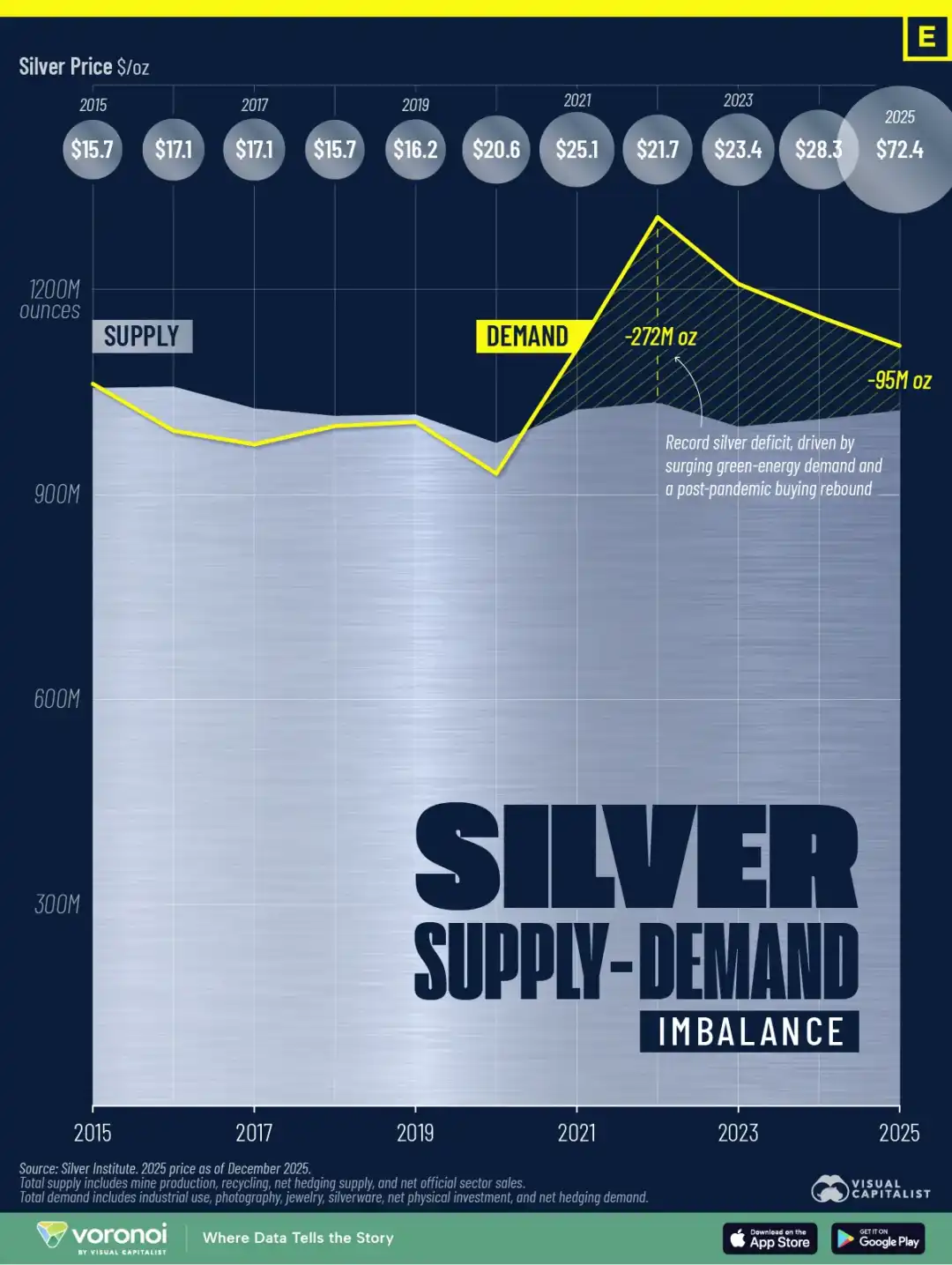
Simultaneously, silver inventories are also bottoming out. The London Bullion Market Association's deliverable silver inventory has dropped to only 155 million ounces. The silver lease rate has surged from the normal 0.3%-0.5% to 8%, meaning someone is willing to pay an 8% annualized cost just to secure physical silver.

There is also a new variable. Starting January 1, 2026, China implemented export restrictions on refined silver, allowing only state-owned large factories with an annual production capacity of over 80 tons to obtain export licenses. Small and medium-sized exporters are directly shut out.

In the era of the Hunt brothers, miners and holders could use increased production and selling to smash the price.

This time, the supply side might be running out of ammunition.

Speculation, but also Hard Demand

When the Hunt brothers hoarded silver, silver was a monetary speculative asset. Buyers thought: the price will rise, hoard it and wait to sell.

The driving force behind the 2025 silver rally is completely different.

First, look at some data. According to the World Silver Survey 2025 report, industrial demand for silver reached 680.5 million ounces in 2024, a historical high. This number accounts for over 60% of total global demand.
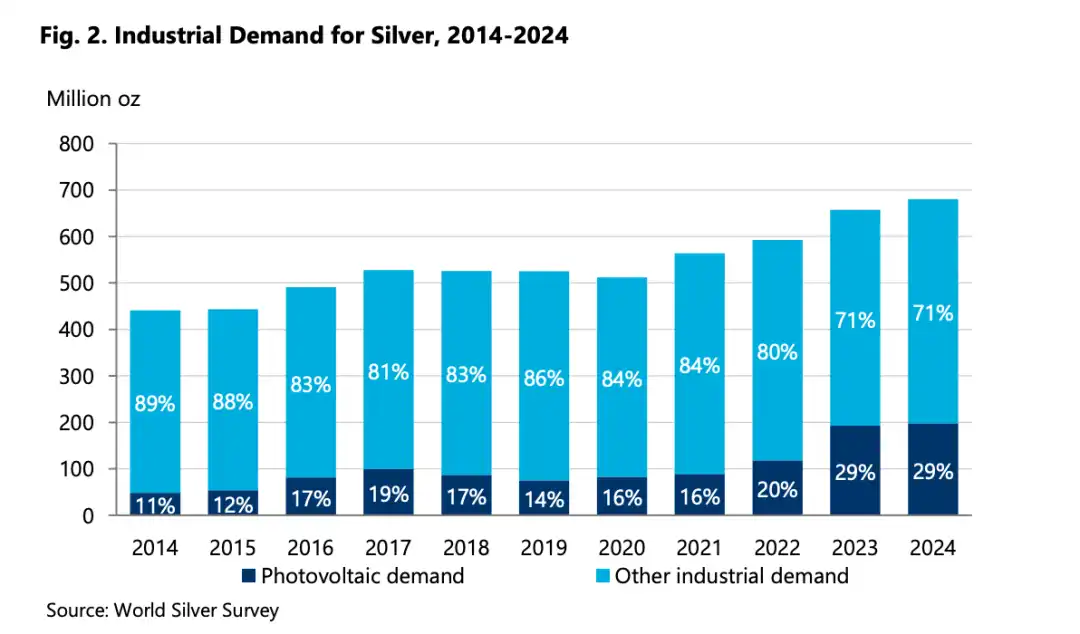
What is industrial demand buying?

Photovoltaics (PV). Every solar panel requires silver paste for its conductive layer. The International Energy Agency predicts global PV installed capacity will quadruple by 2030. The PV industry is already the single largest industrial consumer of silver.

Electric Vehicles (EVs). A traditional internal combustion engine vehicle uses about 15-28 grams of silver. An electric vehicle uses 25-50 grams, with high-end models using even more. Battery management systems, motor controllers, charging interfaces—silver is needed everywhere.

AI and Data Centers. Servers, chip packaging, high-frequency connectors—silver's conductivity and thermal conductivity are irreplaceable. This demand began accelerating in 2024, and the Silver Institute specifically listed "AI-related applications" in its report.

In 2025, the U.S. Department of the Interior listed silver on its "Critical Minerals" list. The last time this list was updated, it added lithium and rare earth elements.

Of course, sustained high silver prices will bring about a "silver thrifting" effect, such as some PV manufacturers already reducing the amount of silver paste per panel. But the Silver Institute's prediction is that even considering thrifting, industrial demand will remain near record levels for the next 1-2 years.

This is essentially rigid demand, a variable that Saifedean might not have foreseen when writing "The Bitcoin Standard".

A Book Can Also Provide Psychological Comfort

The Bitcoin "digital gold" narrative has been largely silent recently in the face of actual gold and silver.

The market has dubbed this year the "Debasement Trade": a weakening dollar, rising inflation expectations, geopolitical tensions, with funds flooding into hard assets for safety. But this wave of safe-haven money chose gold and silver, not Bitcoin.

For Bitcoin maximalists, this requires an explanation.

Hence, the aforementioned book becomes a kind of classical reference for answers and position defense: silver is rising now because of a bubble, wait for it to crash, then you'll know who was right.

This is more like a narrative self-rescue.

When the asset you hold underperforms the market for a whole year, you need a framework to explain "why I am still right."

Short-term price is not important, long-term logic is. The logic for silver is wrong, the logic for Bitcoin is right, so Bitcoin must outperform, it's just a matter of time.

Is this logic self-consistent? Yes. Can it be falsified? Difficult.

Because you can always say "not enough time has passed."

The problem is, the real world doesn't wait. Brothers holding Bitcoin and altcoins, still坚守 in the crypto circle, are really anxious.

Bitcoin theory written 8 years ago cannot automatically cover the reality of not rising 8 years later.

Silver is still soaring, and we sincerely wish Bitcoin good luck.

Related Reads

VCs on 2025 Crypto Investments: 84% of 118 Tokens Break Issue Price, Only One Type of Company is Quietly Making Money

Crypto investor Ching Tseng categorizes the market into four quadrants based on two axes: crypto-native vs. traditional finance (TradFi)-oriented, and having traction vs. no traction. In 2025, 84.7% of 118 tracked token launches fell below their issuance price, with a median fully diluted valuation drop of 71%. Crypto-native projects without traction are experiencing massive capital destruction, often relying on speculative narratives without sustainable revenue or user retention. Crypto-native teams with traction, often built in prior cycles, generate real revenue but face structural challenges with their tokens lacking direct value capture mechanisms. While some have implemented successful buyback programs, the core issue remains finding growth beyond crypto volatility. TradFi-oriented startups without traction face long, costly enterprise sales cycles but benefit from a robust M&A environment, with crypto acquisitions reaching a record $8.6 billion in 2025. The current winners are TradFi-oriented companies with traction, particularly in the Real World Asset (RWA) tokenization space, which grew from $5.5B to $18.6B in 2025. They are winning through enterprise sales, building alliances, and improving unit economics on established compliance stacks. Their main risk is being bypassed by large incumbent institutions building their own infrastructure. The overarching theme is market maturation, where narrative alone is insufficient for long-term success.

marsbit32m ago

VCs on 2025 Crypto Investments: 84% of 118 Tokens Break Issue Price, Only One Type of Company is Quietly Making Money

marsbit32m ago

Trading

Spot
Futures

Hot Articles

What is $BITCOIN

DIGITAL GOLD ($BITCOIN): A Comprehensive Analysis Introduction to DIGITAL GOLD ($BITCOIN) DIGITAL GOLD ($BITCOIN) is a blockchain-based project operating on the Solana network, which aims to combine the characteristics of traditional precious metals with the innovation of decentralized technologies. While it shares a name with Bitcoin, often referred to as “digital gold” due to its perception as a store of value, DIGITAL GOLD is a separate token designed to create a unique ecosystem within the Web3 landscape. Its goal is to position itself as a viable alternative digital asset, although specifics regarding its applications and functionalities are still developing. What is DIGITAL GOLD ($BITCOIN)? DIGITAL GOLD ($BITCOIN) is a cryptocurrency token explicitly designed for use on the Solana blockchain. In contrast to Bitcoin, which provides a widely recognized value storage role, this token appears to focus on broader applications and characteristics. Notable aspects include: Blockchain Infrastructure: The token is built on the Solana blockchain, known for its capacity to handle high-speed and low-cost transactions. Supply Dynamics: DIGITAL GOLD has a maximum supply capped at 100 quadrillion tokens (100P $BITCOIN), although details regarding its circulating supply are currently undisclosed. Utility: While precise functionalities are not explicitly outlined, there are indications that the token could be utilized for various applications, potentially involving decentralized applications (dApps) or asset tokenization strategies. Who is the Creator of DIGITAL GOLD ($BITCOIN)? At present, the identity of the creators and development team behind DIGITAL GOLD ($BITCOIN) remains unknown. This situation is typical among many innovative projects within the blockchain space, particularly those aligning with decentralized finance and meme coin phenomena. While such anonymity may foster a community-driven culture, it intensifies concerns about governance and accountability. Who are the Investors of DIGITAL GOLD ($BITCOIN)? The available information indicates that DIGITAL GOLD ($BITCOIN) does not have any known institutional backers or prominent venture capital investments. The project seems to operate on a peer-to-peer model focused on community support and adoption rather than traditional funding routes. Its activity and liquidity are primarily situated on decentralized exchanges (DEXs), such as PumpSwap, rather than established centralized trading platforms, further highlighting its grassroots approach. How DIGITAL GOLD ($BITCOIN) Works The operational mechanics of DIGITAL GOLD ($BITCOIN) can be elaborated on based on its blockchain design and network attributes: Consensus Mechanism: By leveraging Solana’s unique proof-of-history (PoH) combined with a proof-of-stake (PoS) model, the project ensures efficient transaction validation contributing to the network's high performance. Tokenomics: While specific deflationary mechanisms have not been extensively detailed, the vast maximum token supply implies that it may cater to microtransactions or niche use cases that are still to be defined. Interoperability: There exists the potential for integration with Solana’s broader ecosystem, including various decentralized finance (DeFi) platforms. However, the details regarding specific integrations remain unspecified. Timeline of Key Events Here is a timeline that highlights significant milestones concerning DIGITAL GOLD ($BITCOIN): 2023: The initial deployment of the token occurs on the Solana blockchain, marked by its contract address. 2024: DIGITAL GOLD gains visibility as it becomes available for trading on decentralized exchanges like PumpSwap, allowing users to trade it against SOL. 2025: The project witnesses sporadic trading activity and potential interest in community-led engagements, although no noteworthy partnerships or technical advancements have been documented as of yet. Critical Analysis Strengths Scalability: The underlying Solana infrastructure supports high transaction volumes, which could enhance the utility of $BITCOIN in various transaction scenarios. Accessibility: The potential low trading price per token could attract retail investors, facilitating wider participation due to fractional ownership opportunities. Risks Lack of Transparency: The absence of publicly known backers, developers, or an audit process may yield skepticism regarding the project's sustainability and trustworthiness. Market Volatility: The trading activity is heavily reliant on speculative behavior, which can result in significant price volatility and uncertainty for investors. Conclusion DIGITAL GOLD ($BITCOIN) emerges as an intriguing yet ambiguous project within the rapidly evolving Solana ecosystem. While it attempts to leverage the “digital gold” narrative, its departure from Bitcoin's established role as a store of value underscores the need for a clearer differentiation of its intended utility and governance structure. Future acceptance and adoption will likely depend on addressing the current opacity and defining its operational and economic strategies more explicitly. Note: This report encompasses synthesised information available as of October 2023, and developments may have transpired beyond the research period.

363 Total ViewsPublished 2025.05.13Updated 2025.05.13

What is $BITCOIN

Discussions

Welcome to the HTX Community. Here, you can stay informed about the latest platform developments and gain access to professional market insights. Users' opinions on the price of BTC (BTC) are presented below.

活动图片