Senator Lummis pushes for CLARITY Act, calls it ‘best thing to happen to DeFi community’

ambcryptoPublished on 2026-04-02Last updated on 2026-04-02

Abstract

Senator Cynthia Lummis advocates for the Digital Asset Market Clarity Act of 2025, calling it the "best thing to happen to the DeFi community." She argues the legislation would provide legal certainty and a "safe harbor" for developers, validators, and node operators, ensuring American innovation remains in the U.S. However, this optimism contrasts with Polymarket's prediction market, where the act's odds of passage are only 49%, reflecting broader market uncertainty. This skepticism may stem from ongoing disagreements between the White House and crypto entities like Coinbase. Concurrently, stablecoin infrastructure is evolving. The Better Money Company, backed by A16z crypto, is developing a "stablecoin clearinghouse" to simplify the use of multiple stablecoins across different blockchains. This development follows the passage of the GENIUS Act in 2025, which streamlined stablecoin regulations. Visa's on-chain analytics report a massive $72.3 trillion in stablecoin transaction volume over the past year, with USDC recently outpacing USDT in monthly transaction volume.

The hype around the Digital Asset Market Clarity Act of 2025 is increasing day by day. Senator Cynthia Lummis is the latest to lend some fresh optimism to the ongoing discussion around yield generations, with the Senator claiming that the CLARITY Act is the “best thing that could happen to the DeFi community.”

This is evidence of how even big officials can see the ongoing uncertainty surrounding regulations that are coming up in the way of actual growth of the crypto ecosystem. Hence, by pushing demand for the passage of the CLARITY Act, Lummis believes that this would finally give the crypto community “the legal certainty they deserve”.

Lummis also stressed on the seriousness of the situation as she explained how this proposed law is a one-pot solution to “developers, validators, and node operators.”

Once approved, this Act would provide “a safe harbor” and also “ensure American innovation stays right here on U.S soil.”

Polymarket odds are painting a negative picture

However, this optimism is in contrast to Polymarket odds. At the time of writing, they sat at 49%, even below the neutral level – A sign that the broader market is still unsure about the passage of the Act.
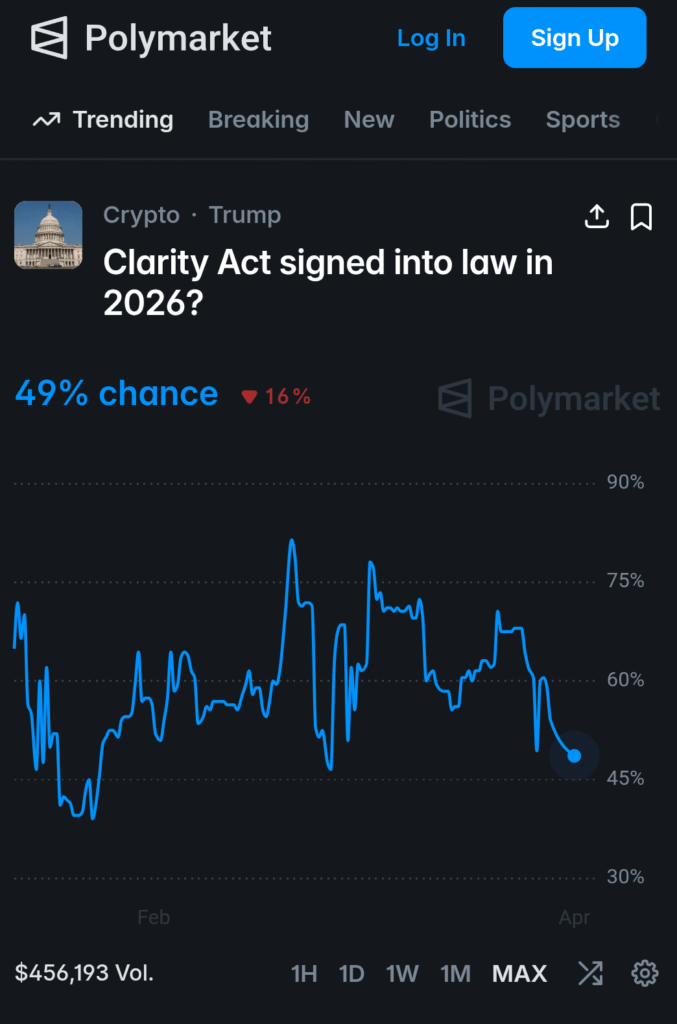
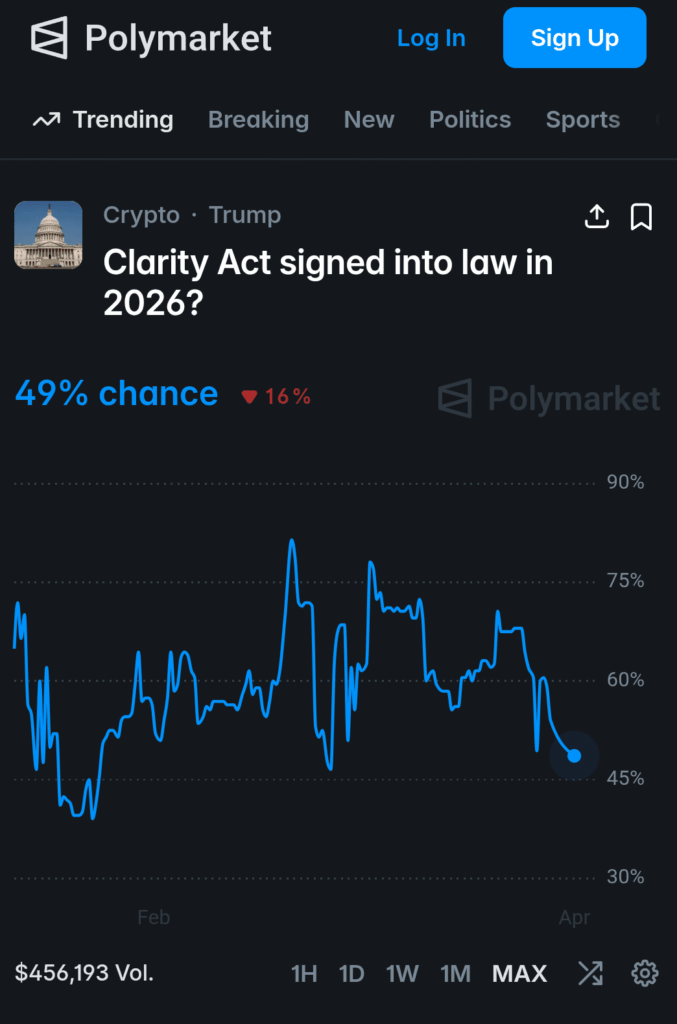
Source: Polymarket

This might be due to the series of disagreements between the White House and Coinbase.

On the contrary, others like the Better Money Company, a stablecoin infrastructure firm, are aiming to build “the next era of money”.

The current situation of the stablecoin market is such that different stablecoins exist across multiple blockchains, issuers, and platforms. And, they often require manual, costly conversions and sometimes even trading at slight value differences.

Finding the missing piece

Hence, to remove this roadblock, The Better Money Company is aiming to build “a stablecoin clearinghouse.” Under this plan, the firm will simplify how developers and businesses integrate stablecoins, enabling them to send, receive, and use multiple stablecoins as if they were one consistent form of money.

With A16z crypto investing in the startup, the plan is simply to develop the “critical missing connectivity layer” required to make the stablecoin ecosystem function effectively.

Other developments in and around stablecoins

All this is happening along the heels of the GENIUS Act that was passed in 2025, making stablecoin regulations seamless.

In the meantime, the total transaction volume of stablecoins hit a count of $72.3 trillion in the last 12 months, as per Visa’s on-chain analytics.
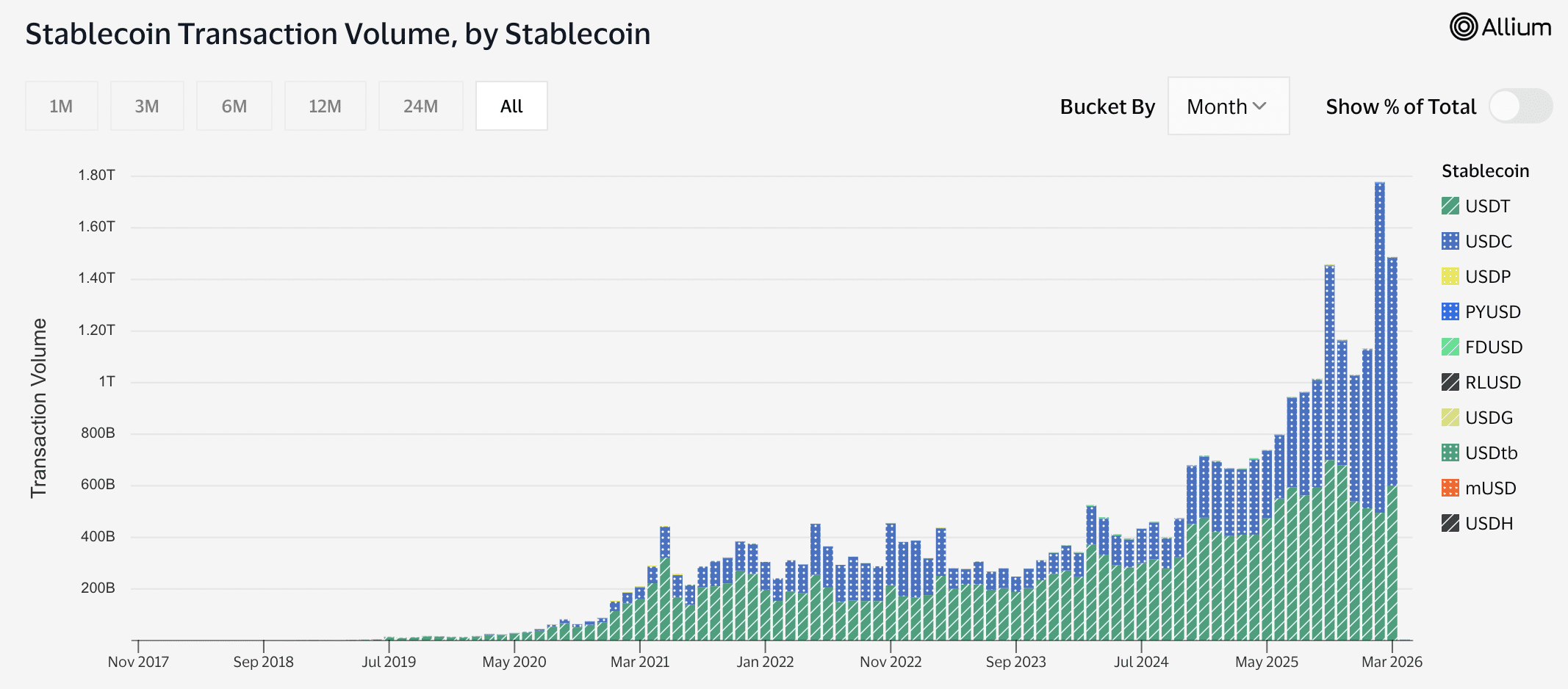
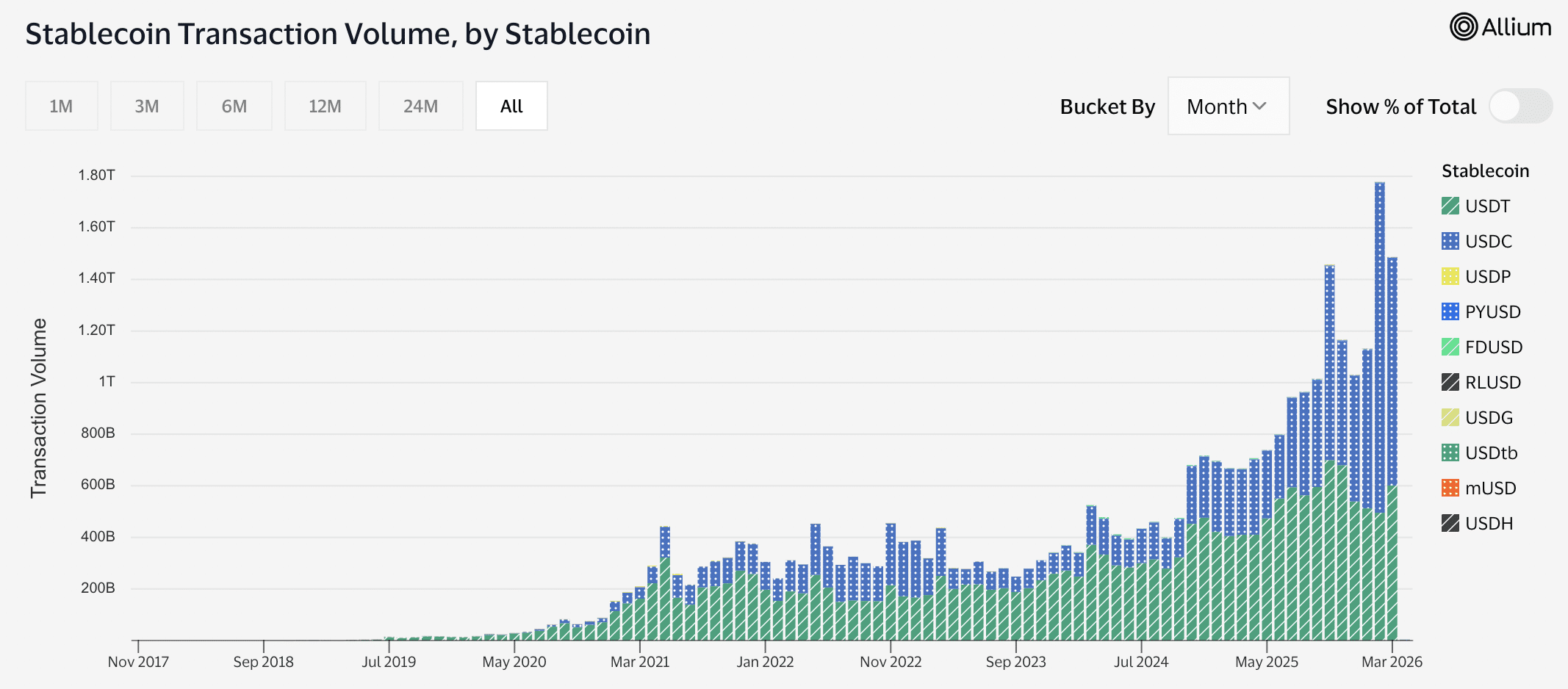
Source: Visa on-chain analytics

That’s not all either as data also revealed that USDC has been outpacing USDT lately. In fact, until last year, most months saw USDT ruling the transaction volume. However, things seem to have changed since 2026.


Final Summary

  • Despite growing optimism from the likes of Senator Cynthia Lummis, Polymarket odds remain below par.
  • Firms like Better Money Company now stepping in with new stablecoin plans.

Related Questions

QWhat is the CLARITY Act and why does Senator Lummis support it?

AThe CLARITY Act refers to the Digital Asset Market Clarity Act of 2025. Senator Lummis supports it because she believes it will provide the DeFi community with 'the legal certainty they deserve,' act as a one-pot solution for developers, validators, and node operators, provide a 'safe harbor,' and ensure American innovation stays in the U.S.

QAccording to the article, what do the current Polymarket odds suggest about the Act's passage?

AThe current Polymarket odds, sitting at 49% (below the neutral level), suggest that the broader market is still unsure about the passage of the CLARITY Act.

QWhat problem is The Better Money Company aiming to solve with its 'stablecoin clearinghouse'?

AThe Better Money Company aims to solve the problem of different stablecoins existing across multiple blockchains, issuers, and platforms, which often require manual, costly conversions and can trade at slight value differences. Their clearinghouse would simplify integration, allowing users to send, receive, and use multiple stablecoins as one consistent form of money.

QWhat significant development in stablecoin regulation preceded the events in this article?

AThe GENIUS Act, which was passed in 2025 and made stablecoin regulations seamless, preceded the events discussed in the article.

QWhat does the data from Visa's on-chain analytics reveal about stablecoin transaction volume and the performance of USDC vs. USDT?

AVisa's on-chain analytics revealed that the total transaction volume of stablecoins was $72.3 trillion in the last 12 months. The data also showed that USDC has been outpacing USDT lately, a change from previous years where USDT typically ruled the transaction volume.

Related Reads

AI Agent Completely Transforms Web3 Gaming: From the Rugpull Bakery Bot Controversy to the New 2026 Agent Paradigm

This article explores how the AI Agent paradigm is fundamentally transforming Web3 gaming, moving from a disruptive force to a core, legitimized element. It begins with the controversy in the competitive baking game Rugpull Bakery, where automated scripts caused fairness issues. Instead of banning them, the developers integrated AI Agents into the official gameplay by providing technical documentation (skill.md, agent.json), marking a shift towards "Agentic Gaming." The piece outlines three primary implementation models for AI Agents in Web3 games by 2026: 1. **Autonomous Competitors & Economic Entities:** AI Agents act as independent players with unique strategies. Examples include TEN Protocol's poker agents, AI Arena's trainable NFT fighters, and Satoshi Strike Force's "Digital Athletes" trained on player data. The Somnia blockchain is highlighted as a dedicated "Agentic L1" infrastructure supporting this model at scale. 2. **Modular Infrastructure & Programmable Environments:** This model, exemplified by EVE Frontier, allows AI Agents to program game world logic itself. Using "Smart Assemblies" (e.g., Smart Turrets, Smart Gates), Agents can modify shared economic and physical rules on-chain, creating dynamic, player/AI-built worlds. The ERC-8183 standard further enables these automated entities to hire other AI services for complex tasks. 3. **Hybrid Companions & Dynamic Adaptation:** Here, AI serves as a collaborative partner. In Parallel Colony, highly autonomous AI Avatars work alongside human players who provide high-level guidance. Illuvium plans to use AI to make NPCs dynamic and responsive, creating personalized, emergent narratives for each player. The conclusion posits that Web3 gaming has reached a "post-human" inflection point. Blockchains' transparency and programmability, combined with new standards and infrastructure like Somnia, make integrating and governing AI Agents not just viable but essential. The future lies in a symbiotic digital order where players transition from manual laborers to commanders and partners of algorithmic intelligence.

marsbit3m ago

AI Agent Completely Transforms Web3 Gaming: From the Rugpull Bakery Bot Controversy to the New 2026 Agent Paradigm

marsbit3m ago

Saylor's Purchase of 1550 Bitcoin Is a Bad Trade

**Title: Saylor's Purchase of 1,550 Bitcoins Was a Bad Trade** The article critically analyzes Strategy's recent move of selling 32 bitcoins followed by a much larger purchase of 1,550 bitcoins. While appearing bullish, the author argues this trade is detrimental to MSTR shareholders. The core argument revolves around the concept of "breakeven modified Net Asset Value (mNAV)," a key metric for Strategy. To increase Bitcoin per share (BPS) for MSTR holders, Strategy must issue new shares at a premium high enough that the funds raised can buy more bitcoin than the bitcoin backing each existing share. Currently, this breakeven mNAV is estimated at 1.30. The recent trade failed on two counts: 1. The shares for the $181 million raise were issued at an mNAV *below* the 1.30 breakeven point. Selling "cheap" shares to buy bitcoin actually *reduces* BPS. 2. Only $101.3 million of the raised funds were used to buy bitcoin; the rest went to boost the company's dollar reserves. The breakeven mNAV calculation assumes *100%* of proceeds are used for bitcoin purchases. Diverting funds, even if mNAV were high, dilutes BPS. The result is an estimated 0.19% decrease in Bitcoin per share for MSTR holders. In exchange, Strategy merely extended its operational runway for its dollar reserves from ~6.3 months to 7 months. The author interprets this as Strategy prioritizing the survival and development of its STRC business over its stated core goal of increasing MSTR's BPS. This constitutes a gamble: if sacrificing MSTR value leads to improved market sentiment and a recovery in STRC's price (and thus mNAV), the whole system could work. If not, Strategy may be forced into a cycle of further diluting MSTR to stay afloat, potentially leading to deferred STRC dividends or corporate decline. The article concludes with a hope for price recovery for Bitcoin, MSTR, and STRC.

Foresight News14m ago

Saylor's Purchase of 1550 Bitcoin Is a Bad Trade

Foresight News14m ago

The AI Bear Market Lasting Two Days Is Over; Why Did Funds Buy Back Storage Stocks First?

After a severe two-day selloff in early June that erased over $1 trillion from U.S. chip stock market value, capital is flowing back first to the memory sector. The correction was not driven by a collapse in AI demand but rather a market reassessment of high expectations. Stocks like Broadcom faced selling pressure despite strong AI revenue guidance, signaling a shift in focus from who has an "AI story" to who can most rapidly translate AI demand into verifiable profits and earnings per share (EPS). Memory companies, such as Micron and SK Hynix, are leading the recovery because their EPS growth is more immediately verifiable. The AI server boom directly increases demand for high-bandwidth memory (HBM) and high-capacity server DRAM, tightening supply and driving up contract prices for conventional DRAM and NAND Flash. This price increase, coupled with a shift to higher-margin products, flows directly into near-term revenue and profitability, as evidenced in recent earnings reports. In contrast, other AI semiconductor segments like GPUs, ASICs, and optical modules, while central to the long-term AI infrastructure story, face longer and less certain paths to EPS validation. Their growth depends more on future product cycles, customer adoption timelines, and capital expenditure plans. The rebound in memory stocks highlights a market preference for assets with shorter, more transparent EPS conversion cycles following the recent de-risking phase. However, this does not negate the potential of other AI hardware segments should they provide clearer near-term order visibility. The episode has raised the validation bar for all AI-related investments.

marsbit14m ago

The AI Bear Market Lasting Two Days Is Over; Why Did Funds Buy Back Storage Stocks First?

marsbit14m ago

Trading

Spot
Futures

Hot Articles

How to Buy HYPE

Welcome to HTX.com! We've made purchasing Hyperliquid (HYPE) simple and convenient. Follow our step-by-step guide to embark on your crypto journey.Step 1: Create Your HTX AccountUse your email or phone number to sign up for a free account on HTX. Experience a hassle-free registration journey and unlock all features.Get My AccountStep 2: Go to Buy Crypto and Choose Your Payment MethodCredit/Debit Card: Use your Visa or Mastercard to buy Hyperliquid (HYPE) instantly.Balance: Use funds from your HTX account balance to trade seamlessly.Third Parties: We've added popular payment methods such as Google Pay and Apple Pay to enhance convenience.P2P: Trade directly with other users on HTX.Over-the-Counter (OTC): We offer tailor-made services and competitive exchange rates for traders.Step 3: Store Your Hyperliquid (HYPE)After purchasing your Hyperliquid (HYPE), store it in your HTX account. Alternatively, you can send it elsewhere via blockchain transfer or use it to trade other cryptocurrencies.Step 4: Trade Hyperliquid (HYPE)Easily trade Hyperliquid (HYPE) on HTX's spot market. Simply access your account, select your trading pair, execute your trades, and monitor in real-time. We offer a user-friendly experience for both beginners and seasoned traders.

3.2k Total ViewsPublished 2024.03.29Updated 2026.06.02

How to Buy HYPE

Discussions

Welcome to the HTX Community. Here, you can stay informed about the latest platform developments and gain access to professional market insights. Users' opinions on the price of HYPE (HYPE) are presented below.

活动图片