SemiAnalysis: Anthropic's Q3 Profits Set to Exceed $1 Billion

链捕手Published on 2026-07-08Last updated on 2026-07-08

Abstract

SemiAnalysis reports that Anthropic is poised to achieve over $10 billion in GAAP EBIT by Q3 2026, driven by a dominant API-centric B2B model. Its Annual Recurring Revenue (ARR) has surged from $9 billion at the end of 2025 to over $60 billion currently, with a projection of reaching $300 billion by late 2027. This growth is primarily fueled by the explosive adoption of Claude Code, which now accounts for over 7% of GitHub commits. Key to Anthropic's profitability is its high-margin API business (constituting 75-85% of ARR), boasting gross margins above 80% and a Net Revenue Retention rate of 500%. This contrasts with OpenAI's greater reliance on consumer subscriptions. Anthropic's efficiency gains have lifted its overall gross margin to the mid-60% range from -94% in 2024. The company faces a primary constraint in compute supply, with future demand vastly outstripping projected new capacity. Its recent confidential IPO filing is seen as strategically urgent to secure capital for locking in compute resources amid a narrowing financing window and before competitors like OpenAI go public. Major risks include potential price competition, regulatory hurdles for model releases, and margin dilution from growing indirect "Token-as-a-Service" sales through cloud platforms.

Author:Xu Chao

The latest analysis from research firm SemiAnalysis reveals that Anthropic is reshaping the AI commercialization landscape with profitability and growth rates far surpassing its competitors. Leveraging a high-margin, API-centric business model, Anthropic has become a frontrunner in the B2B AI market.

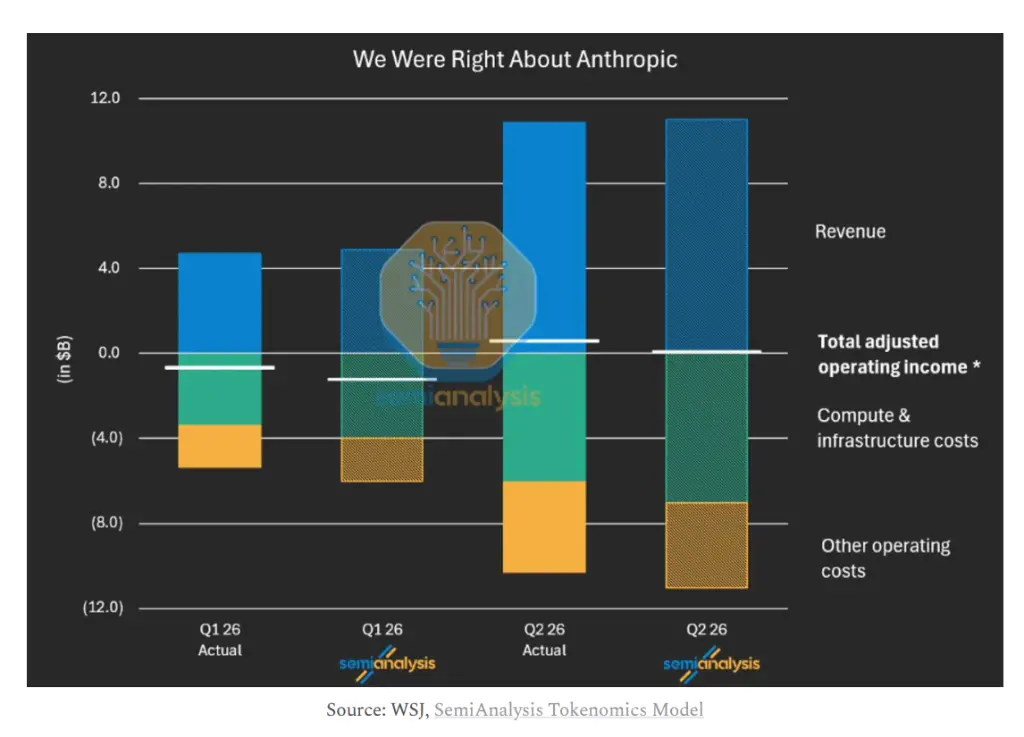
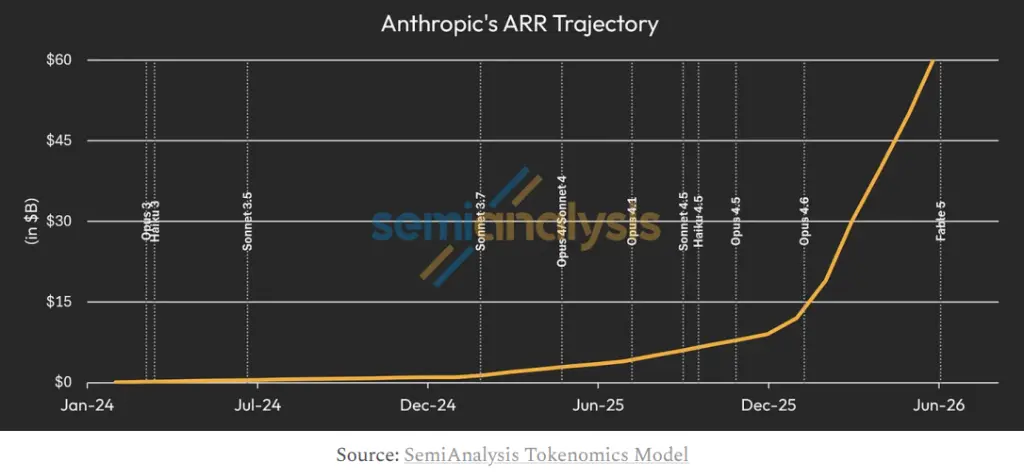
According to a deep-dive report from SemiAnalysis, Anthropic is projected to achieve GAAP EBIT of $1 billion in Q3 2026, representing a profit margin of approximately 6%. Concurrently, its Annual Recurring Revenue (ARR) has surged from $9 billion at the end of 2025 to over $60 billion currently. The agency predicts that if Anthropic maintains its Net New ARR (NNARR) pace of about $15 billion per month, its ARR by the end of 2027 could reach $300 billion, corresponding to a $6 trillion enterprise value, potentially making it the world's highest-valued company.

Anthropic confidentially filed its IPO application on June 1. SemiAnalysis believes there is strategic urgency for listing at this time — Alphabet has completed $84.75 billion in equity financing, and Meta is also rumored to have a multi-billion dollar financing plan, indicating a narrowing capital market window. The report notes that Anthropic's superior financials and business model mean it should go public before OpenAI to seize the initiative in the capital competition.
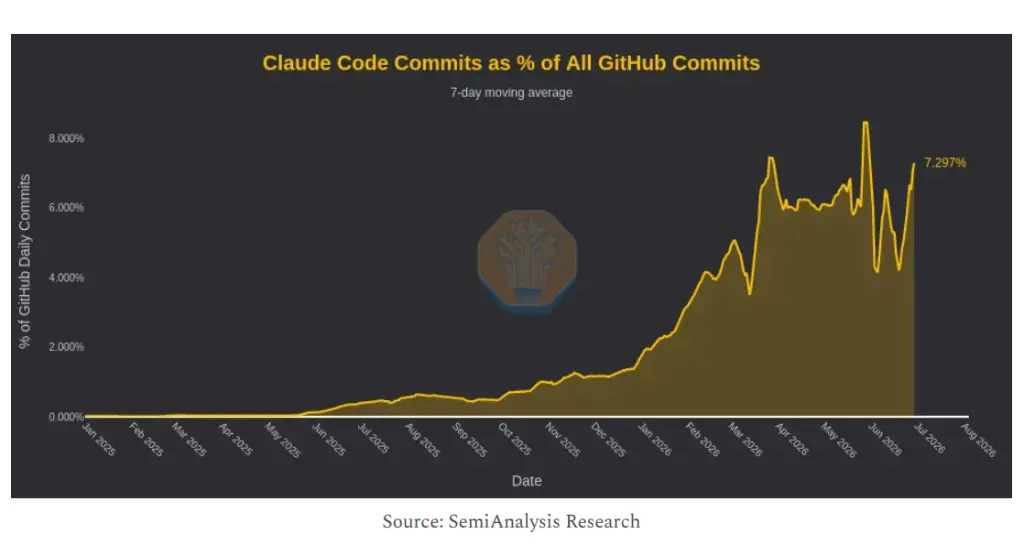
Anthropic's performance inflection point stems from the explosive adoption of Claude Code. SemiAnalysis data shows that Claude Code now accounts for over 7% of all code commits on GitHub, directly driving the company's monthly net ARR additions from $3 billion in January to $11 billion in March.
In terms of revenue structure, Anthropic and OpenAI show a significant divergence. Approximately 75% to 85% of Anthropic's ARR comes from usage-based API billing, with consumer subscriptions comprising only about 5% of total ARR. In contrast, over 65% of OpenAI's revenue in Q1 2026 still came from subscription models, with consumer ARR accounting for about 40%.

SemiAnalysis points out that the core advantage of the API model is the absence of a per-user revenue ceiling — as the same customer adopts more agentic workflows, their token consumption and corresponding revenue will continue to grow, enabling expansion without acquiring new customers. Anthropic's CFO Krishna Rao disclosed in a podcast this May that the company's net revenue retention rate (NRR) is as high as 500%, meaning that the cohort of customers who contributed $30 billion ARR in Q1 contributed only $2 billion a year ago.

The difference in business models is directly reflected in gross margins. SemiAnalysis estimates that Anthropic's current consolidated gross margin has risen to the mid-60% range, compared to negative 94% in 2024. The API business gross margin exceeds 80%.

The core driver of the dramatic gross margin improvement is gains in inference efficiency. Measured by ARR per megawatt of computing power, Anthropic's metric will reach $60 million later this year, up from just $16 million nine months ago. Since inference computing costs are largely fixed, marginal profit margins approach 100% when the number of tokens processed per unit of computing power or token pricing increases.

The report calculates that if both Anthropic and OpenAI reach $100 billion ARR, OpenAI's gross profit would be about $25 billion lower than Anthropic's due to the need to support over 900 million free users (estimated monthly service cost of approximately $0.70/person by SemiAnalysis). This gap will directly impact both parties' reinvestment capacity for next-generation model training.
SemiAnalysis introduces "Earnings Before Training, Interest, and Taxes" (EBTIT) as a core metric for measuring a lab's reinvestment capacity, with Anthropic achieving an EBTIT margin of 36% in Q2 2026. The report forecasts that by 2028, Anthropic's cumulative EBTIT will be $250 billion higher than OpenAI's.

SemiAnalysis estimates that currently over 65% of Anthropic's ARR comes from programming-related use cases, with programming tool startups like Cursor, Cognition, Loveable, and Replit collectively contributing approximately $6 billion ARR. Meta is Anthropic's largest single customer, but its share remains between 3% and 5%.

The report believes that cybersecurity will be the next explosive vertical after programming, and expects that the release of the Fable new model will further increase token pricing and expand application scenarios, driving monthly NNARR in the second half of 2026 beyond the current level of $10 billion per month. Healthcare, finance, biotechnology, and other verticals are also listed as potential major TAM expansion directions.

In terms of distribution channels, the indirect "Tokens-as-a-Service" (TaaS) model sold through hyperscale cloud platforms like AWS Bedrock and Azure Foundry is growing rapidly, now accounting for 15% to 20% of Anthropic's ARR, up from just 5% to 10% a quarter ago. SemiAnalysis believes that paying 20% to 30% of revenue share to hyperscale cloud platforms remains economically justifiable from the perspective of enterprise customer reach efficiency and compliance convenience.

The core constraint facing Anthropic's growth prospects lies in computing power supply.

SemiAnalysis predicts that by 2030, the combined unconstrained computing power demand of Anthropic and OpenAI will exceed 100 gigawatts (GW), while the net new computing power in 2025 and 2026 was only 2.5GW and 5GW respectively. Currently, the combined available computing power of the two companies is just over 6GW.

It is precisely this supply-demand gap that gives the IPO clear strategic significance. The report notes that funds raised from the listing will primarily be used to fill the growing gap between inference operations and new model training demands, and to secure computing power resources in advance at more favorable financing costs. The report also mentions that Meta is considering renting out computing power to external parties (source: market rumors on July 1, 2026) and expects Anthropic to procure incremental computing power from such trusted suppliers.

SemiAnalysis also lists key risk factors, including: rumored price-cutting plans from OpenAI; competitive pressure from Google DeepMind and Meta in programming models; potential regulatory restrictions on frontier model releases by governments; and the dilutive effect on consolidated gross margins from the rising proportion of TaaS revenue. The report clearly states that if regulatory regimes hinder model releases and narrow the capability gap between open-source and frontier proprietary models, it would fundamentally undermine Anthropic's business moat.


Trending Cryptos

Related Questions

QAccording to the article, what is the projected GAAP EBIT for Anthropic in Q3 2026 and the current annual run rate (ARR)?

AThe article projects that Anthropic is expected to achieve a GAAP EBIT of $1 billion in Q3 2026, with a corresponding profit margin of about 6%. Meanwhile, its Annual Recurring Revenue (ARR) has surged to over $60 billion currently, up from $9 billion at the end of 2025.

QWhat key product is credited for triggering Anthropic's revenue inflection point, and what market share does it hold according to the report?

AClaude Code is credited for triggering Anthropic's revenue inflection point. According to SemiAnalysis data, Claude Code currently accounts for over 7% of all code commits on GitHub.

QHow does Anthropic's revenue model primarily differ from OpenAI's, and what is the reported advantage of this model?

AAnthropic's revenue primarily (75% to 85% of ARR) comes from usage-based API billing, with only about 5% from consumer subscriptions. In contrast, over 65% of OpenAI's Q1 2026 revenue was from subscription models, with consumer ARR around 40%. The key advantage of the API model is no per-user revenue cap, as token consumption and corresponding revenue grow with a customer's adoption of more agentic workflows, enabling expansion without needing new customers.

QWhat is identified as the core constraint on Anthropic's growth prospects in the article?

AThe core constraint on Anthropic's growth prospects is the supply of computing power (compute). The article predicts that by 2030, the combined unconstrained compute demand of Anthropic and OpenAI will exceed 100 Gigawatts (GW), while the net new compute added in 2025 and 2026 is only 2.5GW and 5GW respectively.

QWhat is one of the major risk factors mentioned that could fundamentally weaken Anthropic's business moat?

AOne major risk factor is that if regulatory regimes hinder model releases and narrow the capability gap between open-source models and cutting-edge proprietary models, it could fundamentally weaken Anthropic's business moat.

Related Reads

Odaily Editorial Department Tea Party (July 8)

Odaily Editorial Team Casual Chat (July 8) This is an informal column from Odaily's editorial team, sharing immediate thoughts on industry news, data, and hot topics from various angles. It presents investment ideas and opportunity hypotheses still under verification—which may not be direct wealth codes but questions in themselves—alongside observations from industry interactions and materials that genuinely enhance the team's understanding. The content is based on real investment and observation experiences, carries no advertising, and does not constitute investment advice. Its purpose is to broaden perspectives and supplement information sources, not to create consensus. Team Member Shares: * **Wenser (@wenser2010):** Noted a deeper correction (nearly 30%) in US and Korean stocks, including memory stocks, but remains bullish on DRAM due to perceived supply shortages. In prediction markets, personal small bets outperformed blind copying; favors France to win the World Cup. Views crypto-related stocks like STRK as bearish for now, while seeing Circle and Coinbase as potential rebound plays. Observes recent strength in software stocks like Microsoft but is unsure if it's a sustained recovery. * **Bcxiongdi (@bcxiongdi):** Discusses the recent "recovery training" in meme coin markets on Solana and BSC, characterized by small-scale PVP opportunities, admitting to having sold many assets too early. Suggests also watching the Robinhood chain. Found World Cup prediction markets challenging, advising to consider buying during matches rather than only before. * **Azuma (@azuma_eth):** Focuses on the US stock market, particularly the significant semiconductor correction. Believes demand fundamentals remain and considers buying the dip in DRAM stocks. Notes a potential rotation signal as hedge funds have recently concentrated buying in tech stocks. Plans to continue adding to RKLB (Rocket Lab) stock, seeing limited downside and high upside potential at current levels after its founder's share sale window closed.

Odaily星球日报13m ago

Odaily Editorial Department Tea Party (July 8)

Odaily星球日报13m ago

Former Huawei 'Genius Teen' Who Questioned DeepSeek Interview Lands in 'Crossfire' from Web3 Investor

Former Huawei "Genius Youth" Li Bojie recently drew public attention by criticizing his interview experience with DeepSeek. The controversy escalated when Du Jun, co-founder of Web3 investment firm ABCDE Capital, publicly accused Li of being "the founder with the least sense of contractual spirit" he had ever cooperated with, sparking a dispute over Li's startup project, Metagent. Li detailed a frustrating DeepSeek interview where he was accused of potential plagiarism, leading him to end the session. The spotlight then shifted to his venture, Metagent, a Web3+AI project aiming to tokenize AI agents. ABCDE invested $1.5 million, with an initial $500k disbursed. Du Jun claimed the project's progress was severely lacking, with a poor-quality demo and minimal social media activity. He alleged Li stopped communicating, deleted his Telegram, and failed to provide proper financial reporting. In response, Li argued the remaining $1 million was never received, crippling operations and forcing salary cuts. He stated he left Metagent in October 2024 due to family reasons and Web3 compliance concerns, with board approval. He claimed to have fulfilled disclosure duties and that his subsequent projects avoided conflicting fields. Other investors, including ArkStream Capital, shared negative due diligence experiences, citing unprofessional contracts and evasive answers on tokenomics. Metagent's social media went silent in June 2024, effectively stalling. Li has since moved to a new consumer AI agent platform, Pine AI (formerly Logenic AI), which has raised $25 million in Series A funding. He served as its Chief Scientist but recently left, clarifying he was not the founder and departed due to a shift in research interests.

Foresight News43m ago

Former Huawei 'Genius Teen' Who Questioned DeepSeek Interview Lands in 'Crossfire' from Web3 Investor

Foresight News43m ago

SemiAnalysis: Anthropic's Q3 Profit to Exceed $1 Billion

Research firm SemiAnalysis reveals that Anthropic is reshaping the AI commercialization landscape with profitability and growth rates far exceeding competitors. Leveraging a high-margin, API-centric business model, Anthropic has become a leader in the B2B AI market. The report projects that Anthropic will achieve a GAAP EBIT of $1 billion in Q3 2026, with a 6% margin. Its Annual Recurring Revenue (ARR) has surged from $9 billion at the end of 2025 to over $60 billion currently. If it maintains a Net New ARR (NNARR) of approximately $15 billion per month, its ARR could reach $300 billion by the end of 2027, implying a $6 trillion enterprise value and making it the world's most valuable company. Anthropic secretly filed for an IPO on June 1st. SemiAnalysis argues the timing is strategically urgent due to narrowing capital market windows as rivals like Alphabet and Meta secure major funding. The superior financials and business model suggest Anthropic should go public before OpenAI to seize the competitive initiative. The performance inflection stems from the explosive adoption of Claude Code, which now accounts for over 7% of all GitHub commits, driving monthly NNARR from $3 billion in January to $11 billion in March. Anthropic's revenue structure differs significantly from OpenAI's. Approximately 75-85% of Anthropic's ARR comes from usage-based API fees, with consumer subscriptions constituting only about 5%. In contrast, over 65% of OpenAI's Q1 2026 revenue was from subscriptions, with ~40% from consumers. The API model's key advantage is no per-user revenue cap, enabling growth within existing accounts. Anthropic's Net Revenue Retention (NRR) is an extraordinary 500%. This drives superior gross margins, now in the mid-60% range versus -94% in 2024, with API margins exceeding 80%. Core drivers are improved inference efficiency and a largely enterprise-focused model without the cost of serving hundreds of millions of free users. The report introduces "EBTIT" (Earnings Before Training & Interest & Taxes) to measure re-investment capacity, projecting Anthropic's cumulative EBTIT through 2028 will be $250 billion higher than OpenAI's. Over 65% of lab ARR currently comes from programming use cases. Cybersecurity is seen as the next major vertical, with upcoming model releases like Fable expected to further increase token pricing and expand NNARR. Indirect sales via hyperscaler platforms (AWS Bedrock, Azure Foundry) now account for 15-20% of ARR. A core constraint is compute supply. By 2030, combined unconstrained compute demand from Anthropic and OpenAI could exceed 100 GW, far outstripping projected new capacity. IPO proceeds are seen as crucial to lock in future compute resources. Key risks include potential price cuts by OpenAI, competitive pressure from Google DeepMind and Meta in coding models, potential government restrictions on frontier model releases, and margin dilution from growing indirect "Token-as-a-Service" sales. Regulatory actions that narrow the capability gap between open-source and proprietary models are highlighted as a fundamental threat to Anthropic's moat.

marsbit56m ago

SemiAnalysis: Anthropic's Q3 Profit to Exceed $1 Billion

marsbit56m ago

Trading

Spot

Hot Articles

Discussions

Welcome to the HTX Community. Here, you can stay informed about the latest platform developments and gain access to professional market insights. Users' opinions on the price of S (S) are presented below.

活动图片